
HSE-210 · Lesson 8 of 12 · 29 min
Group lockout, shift changes and contractors
Individual lockout is straightforward: one person, one set of locks, one key. Many real jobs are not like that. A plant shutdown may involve dozens of millwrights, electricians, pipefitters and contractors working on the same production line for days, across several shifts, with hundreds of isolation points. The basic principle does not change: every person exposed must have personal control over the energy. But the method must scale. This lesson covers group lockout, transferring lockout at shift changes, and working with contractors.
The principle of group lockout
In a group lockout, one person, often called the person in charge, the primary authorized person or the lockout coordinator, takes responsibility for isolating and locking the energy sources and verifying the zero energy state. Every other worker then places their own personal lock in a way that prevents the isolation from being undone until they remove it. No one relies on someone else's lock to protect them.
OSHA's 1910.147(f)(3) requires group lockout to provide each authorized employee a level of protection equal to a personal lockout device. Primary responsibility is vested in one authorized employee for a set number of employees working under the protection of a group lockout device such as an operations lock; that person must determine the exposure status of each member; where more than one crew or craft is involved, overall coordination is assigned to one authorized employee; and each authorized employee must affix a personal lockout device to the group lockout device, group lockbox or comparable mechanism when they begin work and remove it when they stop.
How a group lock box works
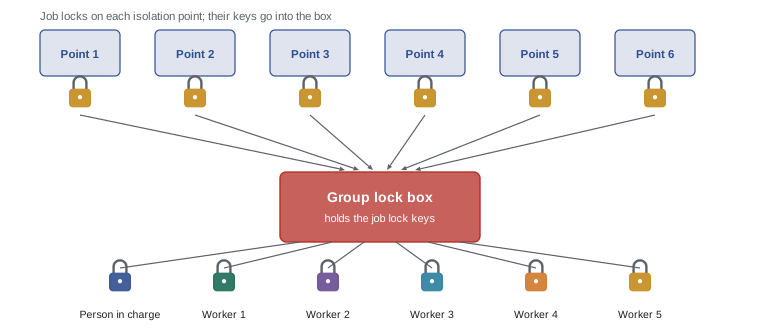
The most common method uses a group lock box:
- the person in charge isolates each energy source and applies a lock from a set of group locks (often called job or system locks) to each isolating device, with a tag;
- the person in charge controls stored energy and verifies the zero energy state, often with a member of the crew witnessing;
- the keys to all the job locks go into the lock box, which is closed;
- the person in charge puts their personal lock on the box;
- each worker who will be exposed checks the lockout and verification record, may verify for themselves where the procedure allows, and puts their personal lock on the box before starting work;
- no one can get the keys to the job locks until every personal lock has been removed from the box.
The box itself is a substantial steel box with many lock positions. Some boxes have a window so the keys can be seen. A list of the isolation points and their locks, the verification record, and a list of the workers who have locked on are usually kept with the box.
Worked problem
Counting locks for a group lockout
A conveyor system has 6 isolation points. A crew of 9 workers plus the person in charge will work on it. How many locks are needed with (a) a group lock box and (b) individual lockout with hasps at every point?
Show solution
- (a) Job locks: 6. Personal locks on the box: \( 9 + 1 = 10 \). Total: \( 6 + 10 = 16 \).
- (b) Each of 10 people locks all 6 points: \( 10 \times 6 = 60 \) locks, plus many hasps.
- The group method uses about a quarter of the locks and is much easier to manage.
Answer: (a) 16 locks; (b) 60 locks plus hasps.
Large and complex jobs
On big shutdowns, several crews may work on different parts of a system at once. Two common arrangements are:
- a single master lock box for the whole job, with each crew leader locking on, and each crew member locking a crew box that holds the crew leader's key (a cascading or daisy-chained arrangement);
- separate group lockouts for separate sections of the system, carefully defined so that the boundaries do not overlap.
In both cases one person coordinates the overall lockout, keeps the master isolation list, and controls any changes. Adding or removing isolation points during the job must be done under that person's control, with the list updated.
Worked problem
A cascading lock box arrangement
A shutdown has 12 isolation points. The coordinator places job locks on all 12 and puts the keys in a master box. Three crew leaders each lock the master box and place their key in their own crew box. The crews have 5, 4 and 6 members, who lock their crew boxes. The coordinator also locks the master box. How many locks are in use?
Show solution
- Job locks on isolation points: 12.
- Locks on the master box: 3 crew leaders + 1 coordinator = 4.
- Locks on crew boxes: \( 5 + 4 + 6 = 15 \).
- Total: \( 12 + 4 + 15 = 31 \).
Answer: 31 locks, managed through four boxes instead of hundreds of locks on hasps.
Verification in a group lockout
A group lockout depends on the person in charge doing the isolation and verification correctly, so good programs build in checks. A second authorized person may witness or repeat the verification. Each worker may be given the opportunity, or required, to verify before locking on, for example by trying the start controls with the person in charge or checking the gauges. Workers who join a job later must be briefed on what is isolated and must see the verification record before they lock on. If a worker is not satisfied, they do not lock on and start work until their concerns are resolved.
Shift changes
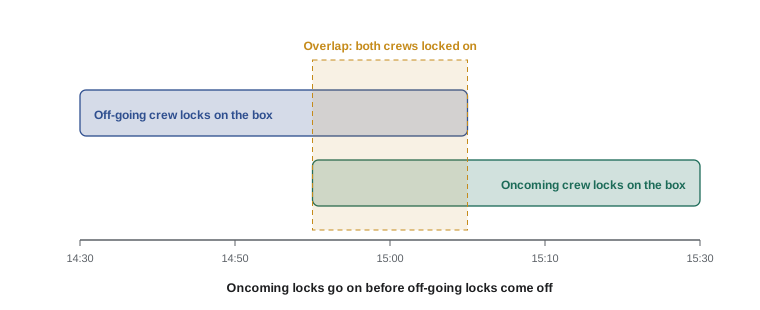
Many jobs last longer than one shift. The lockout must continue without any gap in protection when the off-going crew leaves and the oncoming crew arrives. The basic rule is that the oncoming worker's lock goes on before the off-going worker's lock comes off. A typical procedure:
- the off-going person in charge briefs the oncoming person in charge on the job, the isolation points, the verification and any changes;
- the oncoming person in charge reviews the isolation list and, where the procedure calls for it, re-verifies the zero energy state;
- the oncoming person in charge and crew apply their personal locks to the group box;
- only then do the off-going workers remove their personal locks;
- the transfer is recorded with names and times.
OSHA's 1910.147(f)(4) requires specific procedures during shift or personnel changes to ensure the continuity of lockout or tagout protection, including provision for the orderly transfer of devices between off-going and oncoming employees, to minimize exposure to hazards from unexpected energization or release of stored energy.
Worked problem
Checking continuity at a shift change
The off-going crew of 5 is due to leave at 15:00. The oncoming crew of 4 and their person in charge arrive at 14:50. The briefing and re-verification take 15 minutes. The off-going crew starts removing locks at 15:00. Is there a gap? What should the procedure require?
Show solution
- Briefing and re-verification end at \( 14{:}50 + 15 = 15{:}05 \).
- If the oncoming crew only locks on after re-verification, their locks go on at 15:05.
- The off-going crew removes its locks at 15:00, so the box could have no workers' locks for 5 minutes, with only the person in charge's lock or none.
- The procedure should require oncoming locks before any off-going removal, so the off-going crew waits until 15:05, or the oncoming person in charge locks on at arrival and re-verifies before the crew starts work.
Answer: Yes, a 5-minute gap. The off-going crew must wait until oncoming locks are on.
Contractors and outside workers
Contractors are a frequent source of confusion. The host employer knows the equipment and its procedures; the contractor brings its own workers, locks and possibly its own program. Before work starts, the two must agree how hazardous energy will be controlled. Good practice includes:
- exchanging information about each other's energy control programs and deciding which one applies, or how they fit together;
- making sure contractor workers understand the host's procedures, restrictions and lock removal rules;
- making sure host employees understand the contractor's procedures where those apply;
- identifying contractor locks clearly, for example by a different color or the company name on the tag;
- including contractors in group lockouts by having them lock on to the group box like everyone else;
- agreeing in advance what happens if a contractor's lock is left on.
OSHA's 1910.147(f)(2) requires the on-site employer and the outside employer to inform each other of their respective lockout or tagout procedures, and requires the on-site employer to ensure that its employees understand and comply with the restrictions and prohibitions of the outside employer's program. On multi-employer worksites, OSHA's multi-employer citation policy can hold several employers responsible.
Common failures in group work
Investigations of group lockout incidents point to a few recurring problems:
- someone works under another person's lock without locking on themselves, usually because they were only going to be there a minute;
- a worker removes their personal lock and leaves, and later returns to the job without locking on again;
- an isolation point is added or removed during the job without updating the list;
- the person in charge changes and the new person does not re-verify;
- contractors are not told about the group lock box and use their own locks on some points only.
Each of these is prevented by the simple rule at the center of the system: if you are exposed, your lock is on.
Records for group lockouts
A group lockout generates records that help everyone. A typical record lists the job, the person in charge, each isolation point with its job lock number, the verification performed and by whom, every worker who locked on and off with times, shift transfers, and any changes to the isolation list. On large shutdowns, the coordinator may use an isolation register or electronic system that tracks hundreds of points. These records let anyone joining the job see exactly what is isolated, and they make it possible to confirm at the end that every lock has been removed and every point restored in the right order.
Group lockout also needs clear communication with operations. The control room or production supervisor should know which equipment is under group lockout, who the person in charge is and when the job is expected to finish, so that no one attempts to start connected equipment that could affect the isolated system.
Common mistakes
MistakeWorking under the person in charge's lock without applying your own.
InsteadEvery exposed worker places a personal lock on the group box.
MistakeRemoving off-going locks before oncoming locks are applied.
InsteadOncoming locks go on first, so protection is continuous.
MistakeAdding an isolation point without telling the coordinator.
InsteadAll changes go through the coordinator and the isolation list is updated.
MistakeAssuming contractors know the host's rules.
InsteadExchange program information and brief contractor workers before work.
MistakeLocking on to a group box without seeing the verification record.
InsteadReview the isolation list and verification, and verify yourself where the procedure allows.
Summary and key terms
- In group lockout, one person isolates, locks and verifies, and every exposed worker adds a personal lock.
- Group lock boxes hold the keys to the job locks until every personal lock is removed.
- Large jobs use cascading boxes or separate defined sections, coordinated by one person.
- Workers should see the verification record and may verify themselves before locking on.
- At shift changes, oncoming locks go on before off-going locks come off.
- Host employers and contractors must exchange program information and agree how energy will be controlled.
- The central rule: if you are exposed, your lock is on.
- Group lockout
- Lockout of equipment for several workers using a group device such as a lock box.
- Person in charge
- The authorized person responsible for isolating, locking and verifying in a group lockout.
- Job lock
- A lock applied to an isolating device in a group lockout, whose key goes in the lock box.
- Group lock box
- A box holding the keys to job locks, locked by each worker's personal lock.
- Cascading lock box
- An arrangement in which crew boxes hold keys to locks on a master box.
- Isolation list
- The list of isolation points, locks and verification for a job.
- Shift change transfer
- The orderly handover of lockout between crews without a gap in protection.
- Host employer
- The employer that owns or controls the workplace where contractors work.
- Outside employer
- A contractor whose workers perform work at the host's workplace.
- Continuity of protection
- Keeping at least one exposed worker's lock on at all times.
Practice problems
Work each problem on paper first, then reveal the answer to check.
Who verifies in a group lockout?
Show answer
The person in charge, often witnessed, with workers able to verify before locking on.
Where do the keys to the job locks go?
Show answer
Into the group lock box.
A job has 4 isolation points and 7 workers plus the person in charge. How many locks with a lock box?
Show answer
4 + 8 = 12.
The same job with hasps at every point?
Show answer
8 × 4 = 32 locks.
What is the shift change rule?
Show answer
Oncoming locks go on before off-going locks come off.
What should contractors and hosts exchange before work?
Show answer
Information about their energy control programs and which applies.
Why are contractor locks often a different color?
Show answer
So they are easily identified and the right person can be found.
A worker returns after removing their lock. What must they do?
Show answer
Lock on again before resuming work.
Who controls changes to the isolation list?
Show answer
The coordinator or person in charge.
What is a cascading lock box?
Show answer
Crew boxes holding keys to crew leaders' locks on a master box.
Lesson quiz · 5 questions
Score 60% or more to complete this lesson.
Create a free account to save your progress, take quizzes and earn a certificate.