
HSE-210 · Lesson 3 of 12 · 24 min
Lockout law and standards in Canada
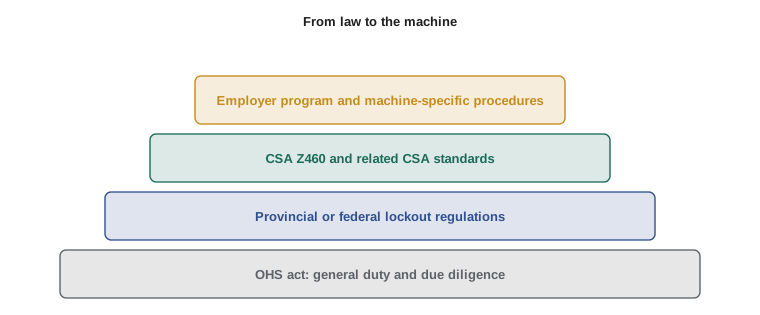
In Canada, workplace health and safety is mostly a provincial and territorial responsibility. Each province and territory has an occupational health and safety act and regulations, and federally regulated workplaces, such as interprovincial transport, banks, telecommunications and federal government operations, fall under the Canada Labour Code. Almost every jurisdiction has specific lockout requirements, and the national consensus standard, CSA Z460, sets out recognized good practice. This lesson gives an overview of both.
The general duty and due diligence
Every Canadian OHS act places a general duty on employers to take every precaution reasonable in the circumstances to protect workers, and places duties on supervisors and workers too. Specific lockout regulations sit on top of that general duty. Employers who are charged with an offence can defend themselves by showing due diligence: that they took all reasonable care to prevent the incident, for example by having a written program, procedures, training, supervision and enforcement. Since 2004, the Criminal Code (section 217.1, from the Westray amendments) has also placed a legal duty on anyone who directs work to take reasonable steps to prevent bodily harm, so a serious lockout failure can in rare cases lead to criminal charges.
CSA Z460: the national standard
CSA Z460, Control of hazardous energy: Lockout and other methods, is the Canadian consensus standard. The current edition at the time of writing is CSA Z460:20, published in 2020; CSA Group has announced work toward a new edition, so check for updates. A standard is not law by itself, but several provinces refer to it, inspectors and courts use it as evidence of good practice, and many employers base their programs on it. Key features of CSA Z460 include:
- lockout as the preferred method, with personal locks applied by each exposed person;
- a hierarchy that considers eliminating the need for exposure, then lockout, then other methods;
- alternative methods of control, permitted only where lockout is not practicable and a documented risk assessment shows the alternative gives effective protection (lesson 10);
- requirements for a written hazardous energy control program, procedures, training, devices, group lockout, shift changes, contractors, lock removal and periodic review;
- guidance on designing equipment so that it can be isolated and locked out easily.
Other CSA standards connect to lockout, including CSA Z432 on safeguarding machinery, CSA Z462 on workplace electrical safety and CSA Z1000 on OHS management systems.
Provincial and federal regulations
The table below lists the main lockout provisions in several jurisdictions. Section numbers change over time, so check the current consolidated regulation.
| Jurisdiction | Main provisions | Notable features |
|---|---|---|
| Federal (Canada Labour Code) | Canada Occupational Health and Safety Regulations, s. 13.16 and related electrical provisions | Lockout under a written procedure before repair or maintenance where a guard is removed; written instructions and authorization if lockout is not feasible |
| Ontario | Reg. 851 (Industrial Establishments) ss. 42, 75 and 76; separate rules for construction projects | Electrical equipment de-energized and locked out with tags; machines stopped, blocked and locked out before maintenance; written procedures required |
| Quebec | Regulation respecting occupational health and safety, ss. 188.1 to 188.13 (in force 2016) | Written energy control procedures for each machine, reviewed periodically; individually keyed locks; logged lock removals |
| British Columbia | OHS Regulation Part 10, including ss. 10.3 to 10.11 | Personal locks marked or tagged; no combination locks; posted group lockout procedures; strict rules for removing another worker's lock |
| Alberta | OHS Code Part 15, ss. 212 to 215.6 | Isolation and verification, personal locks, individual and group procedures, complex group lockout, remote systems and piping isolation |
| Manitoba, Saskatchewan | Manitoba WSH Regulation ss. 16.14 to 16.16; Saskatchewan OHS Regulations s. 139 | Personal locks with a unique identifier; duplicate keys controlled through a logbook |
| Atlantic provinces | Nova Scotia ss. 52 to 54; New Brunswick ss. 239 and 240; Newfoundland and Labrador ss. 129 to 136; PEI s. 30.7 | Written procedures; tags identifying the worker; removal only by the installer except under defined conditions |
Although the wording varies, the regulations share a common core: identify hazardous energy, isolate it, apply a personal lock, release stored energy, verify, keep control of the key, and remove locks only by the person who applied them except under strict conditions. Quebec's 2016 amendments are among the most detailed, requiring a written procedure for each machine that lists the energy sources, the location of isolating devices, the steps for applying and removing locks and the verification method.
Other laws that touch lockout
Other legal requirements often apply alongside lockout rules. Electrical work requires qualified, often licensed, electricians and compliance with provincial electrical safety rules and the Canadian Electrical Code. Confined space entry has its own regulations. Mining, forestry and offshore oil and gas have sector-specific rules. Workers' compensation boards may have their own lockout-related policies or audits, and joint health and safety committees have a role in reviewing programs and investigating incidents.
Enforcement and penalties
Provincial and federal inspectors can issue orders to comply, stop-work orders and, in some provinces, administrative penalties. Prosecutions can lead to large fines. In Ontario, for example, the maximum fine for a corporation convicted under the Occupational Health and Safety Act is $2 million per count, and courts add a 25 per cent victim fine surcharge. Directors and officers can also be fined personally. Lockout failures are among the most common causes of prosecution for machine incidents.
Worked problem
Fine plus victim surcharge
An Ontario employer pleads guilty to one count of failing to lock out a machine and is fined $100,000. The court adds the 25 per cent victim fine surcharge. What is the total amount payable? What would three counts at the same fine cost?
Show solution
- Surcharge: \( 100\,000 \times 0.25 = 25\,000 \).
- Total for one count: \( 100\,000 + 25\,000 = 125\,000 \).
- Three counts: \( 3 \times 125\,000 = 375\,000 \).
Answer: $125,000 for one count; $375,000 for three, before legal costs, lost production and the human cost of the injury.
Who must do what
Canadian law spreads duties across the workplace. Employers must provide the program, procedures, devices, training and supervision. Supervisors must ensure workers follow the procedures and must not direct work that bypasses them. Workers must follow procedures, use their locks, and report hazards. Owners, constructors and contractors have duties when outside workers come on site (lesson 8). Workers also have the right to refuse unsafe work, which applies directly when someone is asked to work on equipment that has not been properly locked out.
Putting it together
For a worker, the legal details matter less than the shared core: every jurisdiction expects energy to be isolated and locked, stored energy to be controlled, the zero energy state to be verified, and locks to stay under the control of the person who applied them. For employers, the details matter a great deal, because procedures must meet the specific requirements of the regulation that applies, and inspectors will ask to see written procedures, training records and evidence of periodic review.
What inspectors look for
When a provincial or federal inspector visits a workplace with machinery, lockout is often one of the first things they check. Typical questions include: Is there a written lockout program and are there procedures for the machines in use? Do the procedures list every energy source, including stored energy? Are isolating devices labelled to match? Do workers have their own personal locks, and do they use them for cleaning and jam clearing as well as for maintenance? How are locks removed when the owner is not available, and is there a record? Have workers been trained, and can they explain the procedure for the machine in front of them? Inspectors may ask a worker to demonstrate a lockout, and they compare what they see with the written procedure.
Equipment design and suppliers
Lockout is easier when equipment is designed for it. Several provinces place duties on suppliers and manufacturers to provide equipment that can be used safely, and CSA Z432, Safeguarding of machinery, together with CSA Z460, describe design features such as lockable isolating devices that isolate all energy at one point, means to dissipate stored energy, and clear labelling. Employers buying equipment should write these requirements into purchase specifications and check them at commissioning, before the equipment enters service. Equipment imported from other jurisdictions may need modifications, such as lockable disconnects or bleed valves, before it meets Canadian expectations.
Joint committees and worker participation
Canadian OHS laws give workers a voice in lockout programs. Joint health and safety committees or health and safety representatives usually have the right to take part in workplace inspections, to review procedures, to receive information about hazards and to participate in incident investigations. Committees are well placed to spot gaps: a worker member who runs the machine every day may know that the procedure misses the second air drop. Involving the committee in writing and reviewing procedures, and in reviewing near misses such as failed verifications, makes the program stronger and supports the employer's due diligence.
For a worker, these laws mean you can expect a written procedure, the right hardware and training, and the right to stop and ask when something does not look right. For a supervisor, they mean you are personally responsible for making sure lockout is done in the work you direct, and you can be prosecuted if you allow it to be skipped.
Keeping up with changes
Regulations and standards change. Provinces amend their OHS regulations, sometimes adding detail on lockout, alternative methods or lock removal, and CSA publishes new editions of its standards. Employers should assign someone to track changes, review the program when the law changes, and update training. Workers moving between provinces should not assume the rules are identical: section numbers, terminology and details such as who may remove an abandoned lock differ.
Finally, remember that compliance with the regulation is the minimum. CSA Z460 and good practice often go further, for example by requiring machine-specific procedures for every machine, periodic observation of authorized persons and documented risk assessments for every alternative method.
Employers that meet the standard as well as the regulation are better protected, and so are their workers.
Common mistakes
MistakeAssuming CSA Z460 is optional because it is a standard, not a regulation.
InsteadRegulators and courts use CSA Z460 as evidence of good practice, and some regulations refer to it.
MistakeThinking the rules only apply to maintenance departments.
InsteadThey apply to any servicing, including cleaning, adjusting and clearing jams, by anyone.
MistakeUsing another province's regulation as your guide.
InsteadCheck the regulation for the jurisdiction where the work takes place, or the Canada Labour Code for federally regulated work.
MistakeBelieving a written program alone shows compliance.
InsteadInspectors check that procedures match the equipment and that training and reviews actually happen.
MistakeTreating electrical lockout as identical to machine lockout.
InsteadElectrical work has additional rules for qualified persons and verification of de-energization.
Summary and key terms
- Canadian lockout rules come from provincial, territorial and federal OHS regulations, supported by the general duty and due diligence.
- CSA Z460:20 is the national consensus standard; a new edition is in development.
- Regulations share a core of isolation, personal locks, stored energy control, verification and controlled lock removal.
- Quebec, British Columbia and Alberta have particularly detailed requirements.
- Ontario fines for corporations can reach $2 million per count plus a 25 per cent victim surcharge.
- Employers, supervisors, workers and contractors all have duties, and workers can refuse unsafe work.
- Procedures must match both the regulation and the actual equipment.
- CSA Z460
- The Canadian standard Control of hazardous energy: Lockout and other methods.
- General duty
- An employer's obligation to take every reasonable precaution to protect workers.
- Due diligence
- Taking all reasonable care to prevent harm; a defence to OHS charges.
- Section 217.1
- The Criminal Code duty on those directing work to prevent bodily harm.
- Victim fine surcharge
- An amount added to a fine, 25 per cent in Ontario OHS prosecutions.
- Joint health and safety committee
- A workplace committee of worker and employer members that reviews safety matters.
- Right to refuse
- A worker's right to refuse work they believe is unsafe.
- Federally regulated workplace
- A workplace under the Canada Labour Code, such as interprovincial transport or banking.
- Alternative method
- A non-lockout control allowed by CSA Z460 when lockout is not practicable and a risk assessment supports it.
- Stop-work order
- An inspector's order to stop work until a hazard is corrected.
Practice problems
Work each problem on paper first, then reveal the answer to check.
Which law applies to lockout at a federally regulated railway yard?
Show answer
The Canada Labour Code Part II and the Canada Occupational Health and Safety Regulations.
What is the current edition of CSA Z460 at the time of writing?
Show answer
CSA Z460:20, with a new edition in development.
What does due diligence mean?
Show answer
Taking all reasonable care to prevent harm, shown through programs, training, supervision and enforcement.
Which Quebec sections cover lockout?
Show answer
Sections 188.1 to 188.13 of the Regulation respecting occupational health and safety.
What does BC prohibit for personal locks?
Show answer
Combination locks.
Which Alberta Code part covers hazardous energy?
Show answer
Part 15.
A $60,000 Ontario fine attracts what victim surcharge?
Show answer
$15,000 (25 per cent), for a total of $75,000.
Name one CSA standard related to lockout besides Z460.
Show answer
CSA Z432 safeguarding of machinery, CSA Z462 electrical safety or CSA Z1000.
What right can a worker use if asked to work on equipment that is not locked out?
Show answer
The right to refuse unsafe work.
What do all Canadian regulations require about lock removal?
Show answer
Generally only the person who applied a lock removes it, except under strict defined conditions.
Lesson quiz · 5 questions
Score 60% or more to complete this lesson.
Create a free account to save your progress, take quizzes and earn a certificate.