
HSE-106 · Lesson 3 of 12 · 26 min
OSHA walking-working surfaces and the law in the US
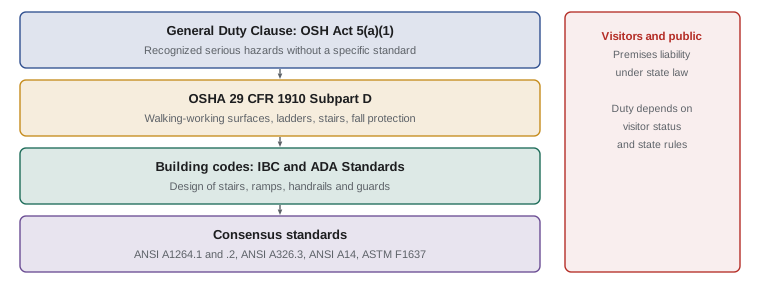
Employers have legal duties to keep floors, stairs, walkways, ladders and outdoor routes safe. These duties come from several layers of law: general duty clauses that require employers to protect workers from hazards, specific regulations on housekeeping, floors, stairs, ladders and guarding, building codes that set how stairs, ramps and guards are built, and standards that fill in technical detail. Property owners and occupiers also owe a duty of care to visitors, customers and members of the public under civil law. This lesson outlines these duties so that you know where requirements come from and where to look for detail. It is an overview: always check the exact wording that applies in your jurisdiction and sector.
Who regulates what in the US
In the United States, the Occupational Safety and Health Act of 1970 created the Occupational Safety and Health Administration (OSHA), which sets and enforces workplace safety standards for most private-sector employers. About half of the states run OSHA-approved state plans, such as Cal/OSHA in California, Washington's Division of Occupational Safety and Health and Oregon OSHA, which must be at least as effective as federal OSHA and may set stricter or additional rules; state plans also cover state and local government workers. Building construction is governed by state and local building codes, most based on the International Building Code (IBC), while the Americans with Disabilities Act (ADA) Standards for Accessible Design set accessibility requirements for ramps, handrails and routes.
The general duty
Section 5(a)(1) of the OSH Act, known as the General Duty Clause, requires each employer to furnish a workplace free from recognized hazards that are causing or are likely to cause death or serious physical harm. OSHA uses this clause when no specific standard applies. Section 5(a)(2) requires employers to comply with OSHA standards, and section 5(b) requires employees to comply with standards and rules that apply to their own actions. For walking and working surfaces, OSHA has detailed specific standards, so the General Duty Clause is used less often than in some other areas.
The 2016 walking-working surfaces rule
OSHA's general industry rules for walking-working surfaces are in 29 CFR 1910 Subpart D. OSHA substantially revised Subpart D, and the related fall protection rules in Subpart I, in a final rule published on November 18, 2016, effective January 17, 2017. The revision updated rules that dated from the 1970s, aligned general industry with construction in many respects, and gave employers more flexibility in choosing fall protection. Construction work is covered separately by 29 CFR 1926, including Subpart M (fall protection) and Subpart X (stairways and ladders).
| Section | Main requirements |
|---|---|
| 1910.21 | Scope and definitions |
| 1910.22 | General requirements: surfaces kept clean, orderly and sanitary; floors kept free of hazards such as sharp or protruding objects, loose boards, corrosion, leaks, spills, snow and ice; load limits; safe access; regular inspection and maintenance |
| 1910.23 | Ladders: rung spacing, width, loading, inspection, use; portable and fixed ladders |
| 1910.24 | Step bolts and manhole steps |
| 1910.25 | Stairways: standard stairs, spiral, ship and alternating tread stairs |
| 1910.26 | Dockboards |
| 1910.27 | Scaffolds and rope descent systems |
| 1910.28 | Duty to have fall protection and falling object protection |
| 1910.29 | Fall protection systems criteria: guardrails, handrails, stair rails, covers, toeboards |
| 1910.30 | Training requirements |
Section 1910.22 is the heart of the slip and trip rules. It requires that all places of employment, passageways, storerooms, service rooms and walking-working surfaces be kept in a clean, orderly and sanitary condition; that floors be maintained free of hazards such as sharp or protruding objects, loose boards, corrosion, leaks, spills, snow and ice; that floors be kept dry where practicable, with drainage, false floors, platforms or mats where wet processes are used; that walking-working surfaces be inspected regularly and as necessary and maintained in a safe condition; and that hazardous conditions be corrected or guarded before employees use the surface again. Repairs that involve the structural integrity of a surface must be done or overseen by a qualified person.
Stairs, ladders and edges
In general industry, section 1910.28 requires fall protection at unprotected sides and edges that are 4 feet or more above a lower level, with specific rules for holes, dockboards, runways, wall openings, fixed ladders and other situations; in construction, the general trigger height is 6 feet (29 CFR 1926.501). Guardrails must have a top rail 42 inches, plus or minus 3 inches, above the walking-working surface, with midrails or equivalent and the ability to withstand 200 pounds (1910.29). Fixed ladders that extend more than 24 feet above a lower level must have a ladder safety or personal fall arrest system on new installations after November 19, 2018, and on all such ladders by November 18, 2036. Lessons 7 and 8 cover stairs and ladders at an awareness level.
Training
Section 1910.30 requires employers to train each employee who uses personal fall protection or who is required to be trained under Subpart D, such as those using ladders, dockboards, rope descent systems or designated areas, in the hazards and the correct procedures. Training must be given by a qualified person and in a language and vocabulary the employee understands, and retraining is required when changes in the workplace or equipment make earlier training obsolete or when an employee's actions show inadequate knowledge.
Building codes and accessibility
Building codes set how permanent stairs, ramps, handrails and guards must be designed when a building is constructed or renovated. The IBC sets limits on stair riser height and tread depth, handrail heights and continuity, guard heights and openings and ramp slopes. The ADA Standards for Accessible Design (2010) set requirements for accessible routes, ramps, handrails and detectable warnings in places of public accommodation and commercial facilities. Existing buildings are usually not required to upgrade to every new code edition, but OSHA's Subpart D still applies to existing workplaces.
Standards that fill in the detail
Several consensus standards help employers meet their duties and are often cited in civil litigation. ANSI/ASSP A1264.1 covers walking-working surfaces, floor and wall openings, stairs and railing systems; ANSI/ASSP A1264.2 covers the provision of slip resistance on walking-working surfaces; ASTM F1637 is the standard practice for safe walking surfaces; ANSI A326.3 sets a method and minimum values for the dynamic coefficient of friction of hard surface flooring; ANSI A14 standards cover ladders; and ASTM F2413 covers protective footwear. OSHA does not set a numeric coefficient of friction requirement.
Duties to visitors and the public
Beyond OSHA, property owners and occupiers owe a duty of care to people who come onto their premises under state premises liability law. The duty usually depends on the visitor's status (invitee, licensee or trespasser), and many states have rules on whether owners are liable for natural accumulations of snow and ice. Slip and fall claims by customers and visitors are one of the most common types of general liability claims for retailers, restaurants and property managers. Good inspection records, cleaning logs and spill response procedures are central to defending these claims.
Worked problem
Which duties apply?
A grocery store has a produce misting system that wets the floor in front of the display, a set of stairs to a mezzanine stockroom, a portable ladder used to stock high shelves and a parking lot that ices over in winter. Identify the main legal duties that apply.
Show solution
- General duty: protect workers from the slip, trip and fall hazards in all four areas.
- Housekeeping and floor rules: control water from the misting system with drainage, mats or other controls and keep the floor free of spills and produce.
- Stairs and ladders: maintain the mezzanine stairs, handrails and any guard at the mezzanine edge; select, inspect and use the ladder correctly and train workers who use it.
- Snow and ice: keep the parking lot and walkways used by workers clear of snow and ice or treated.
- Visitors: the store also owes customers a duty of care on the sales floor and in the parking lot under occupiers' or premises liability law.
Answer: OHS general duty and specific housekeeping, stair, ladder and snow provisions protect workers, and civil liability law protects customers; one set of good controls satisfies both.
Enforcement
OSHA compliance officers can inspect workplaces and issue citations with penalties. Maximum penalties are adjusted for inflation each year; as adjusted in January 2025, the maximum for a serious violation was $16,550 and for a willful or repeated violation $165,514 (check the current figures). Employers can contest citations before the Occupational Safety and Health Review Commission. State plans set their own penalties within federal limits.
Due diligence in practice
Whether a regulator is deciding to prosecute or a court is deciding a case, a central question is whether the employer took every precaution that was reasonable in the circumstances. For slips, trips and falls, due diligence is shown by evidence that the employer identified the hazards, put reasonable controls in place, trained and supervised workers, and checked that the controls were working. In practice, that means documents and records: a hazard assessment that covers floors, stairs, ladders and outdoor areas; written procedures for cleaning, spill response and snow and ice control; inspection checklists that are completed and acted on; maintenance requests with dates of completion; training records; footwear policies; and incident investigations with corrective actions that were followed through.
Records only help if they reflect reality. A floor sweep log that is filled in at the end of a shift for the whole day, or an inspection checklist where every box is ticked without anyone looking, can be worse than no record at all, because it suggests the system is not taken seriously. Supervisors should spot-check that inspections and cleaning actually happened as recorded.
Worker participation
Multi-employer and shared workplaces
Clear written agreements on who inspects, cleans, maintains and clears snow from shared areas prevent hazards from falling between the cracks. Each party should also have a way to report hazards in areas it does not control and confirm that they are fixed.
Inspections and orders in practice
When an inspector visits after a fall or a complaint, they will usually look at the area where the incident happened, ask to see the hazard assessment, cleaning and inspection records, training records and any previous orders, and interview workers, supervisors and committee members. Common orders and citations related to slips, trips and falls include failing to keep floors free of slipping hazards, missing or inadequate handrails and guards, unsafe ladders or ladder use, blocked aisles and exits, inadequate lighting and failure to control snow and ice. Orders usually set a compliance date, and the employer must report back on what was done. Treat an order as an opportunity to fix the underlying system, not only the specific condition the inspector saw, because inspectors often return and look at similar areas.
Employers who disagree with an order or citation can usually appeal or contest it within a short deadline, but the hazard should still be controlled while the appeal is decided. Seeking advice from a qualified health and safety professional or a lawyer is wise where significant penalties or prosecutions are possible.
Keeping up with changes
Laws, codes and standards change. Provinces and states amend their regulations, building codes are updated on regular cycles, and standards such as those for ladders, footwear and slip resistance are revised every few years. Assign someone to watch for changes, subscribe to updates from the regulator and standards bodies, and review procedures when requirements change. Industry associations and safety associations publish guidance that translates legal requirements into practical steps for specific sectors.
Common mistakes
MistakeAssuming there is no rule because no regulation names the specific hazard.
InsteadThe general duty covers recognized hazards without a specific rule.
MistakeThinking only building codes apply to stairs.
InsteadOHS rules also require existing stairs to be maintained and safe.
MistakeIgnoring visitors and customers.
InsteadOccupiers and premises owners owe them a duty of care too.
MistakeKeeping no records of inspections and cleaning.
InsteadRecords show due diligence and support defense of claims.
MistakeUsing another jurisdiction's thresholds.
InsteadFall protection heights and wording differ; check local law.
Summary and key terms
- General duty clauses cover hazards without a specific rule.
- OSHA 1910 Subpart D, revised in 2016, covers walking-working surfaces.
- Rules require clean, orderly, well-maintained surfaces free of slip and trip hazards.
- Fall protection is required at 4 ft in general industry and 6 ft in construction.
- Building codes govern stair, ramp, handrail and guard design.
- Standards fill in technical detail such as slip resistance and ladder ratings.
- Owners and occupiers owe visitors a duty of care under civil law.
- General duty
- Broad legal duty to protect workers from hazards.
- Walking-working surface
- Any surface on which a worker walks or works.
- Housekeeping
- Keeping a workplace clean, orderly and free of hazards.
- Due diligence
- Taking every reasonable precaution to prevent harm.
- Occupier
- Person or organization in control of premises.
- Building code
- Rules for the design and construction of buildings.
- Consensus standard
- Technical standard developed by a standards body.
- Qualified person
- Person with the knowledge and experience to solve problems in a subject.
- Compliance order
- Official order to correct a contravention.
- Trigger height
- Fall height at which fall protection is required.
Practice problems
Work each problem on paper first, then reveal the answer to check.
What legal duty applies where no specific rule exists?
Show answer
The general duty.
Which part of 29 CFR 1910 covers walking-working surfaces?
Show answer
Subpart D.
Name three things floor and housekeeping rules require.
Show answer
Good repair, freedom from slip and trip hazards, control of liquids, waste removal, snow and ice control.
At what height does general industry require fall protection?
Show answer
4 feet.
What governs the design of new stairs?
Show answer
The building code.
Do OHS rules apply to existing stairs?
Show answer
Yes, they must be maintained and safe.
What standard covers portable ladders in your jurisdiction?
Show answer
ANSI A14.
Who owes visitors a duty of care?
Show answer
Owners and occupiers of premises.
Why are inspection records important?
Show answer
They show due diligence and help defend claims.
What is due diligence?
Show answer
Taking every reasonable precaution.
Lesson quiz · 5 questions
Score 60% or more to complete this lesson.
Create a free account to save your progress, take quizzes and earn a certificate.