
HSE-106 · Lesson 1 of 12 · 26 min
Why slips, trips and falls happen
Slips, trips and falls are among the most common causes of injury at work, and they happen in every kind of workplace: offices, hospitals, kitchens, warehouses, farms, construction sites, schools and shops. They are often treated as minor accidents or as the fault of a careless worker, but that view is wrong on both counts. A fall on the same level can break a wrist, hip or ankle, injure the back or cause a head injury, and a significant share of these injuries lead to weeks or months off work. More importantly, almost every slip, trip and fall has causes that can be found and controlled: a floor that becomes slippery when wet, a cable across a walkway, a poorly lit stair, a worn shoe, a rushed task. This course is about finding and controlling those causes.
This first lesson explains what actually happens when a person slips, trips or falls. Understanding the mechanics of walking and losing balance makes it much easier to see why certain conditions are dangerous and why certain controls work. Later lessons cover the scale of the problem, the law, floors, cleaning, footwear, stairs, ladders, weather, lighting, housekeeping, inspections and incident investigation.
This is an awareness-level course. It helps you recognize hazards and understand controls; it does not qualify you to design stairs or guards, select flooring for a specific site or supervise work at height. Falls from height, such as falls from roofs, scaffolds, elevated platforms and through openings, are covered in detail in a separate working-at-heights course. Where this course touches on guardrails, ladders and fall protection, it does so only at an awareness level and points you to that course.
Three different events
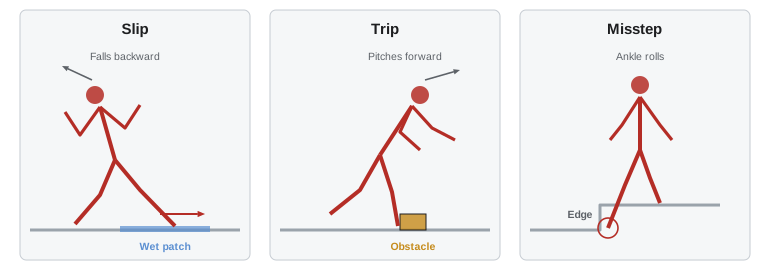
Although people often use the words interchangeably, a slip, a trip and a fall are different events with different causes. Distinguishing them matters because the controls are different.
- A slip happens when there is too little friction between the foot and the walking surface, so the foot slides unexpectedly. Slips usually happen at heel strike, when the front foot lands and slides forward, or at push-off, when the back foot slides backward. The typical result is a backward fall, landing on the buttocks, back, elbows or the back of the head.
- A trip happens when the foot strikes or catches on an object or a change in level, so the foot stops while the body keeps moving forward. The typical result is a forward fall, landing on the hands, wrists, knees, face or shoulders.
- A misstep happens when the foot lands somewhere unexpected: stepping off a curb or stair edge that was not seen, stepping into a hole, or landing on an uneven or unstable surface that rolls or gives way. The result can be a twisted ankle or knee, or a fall in any direction.
- A fall is the loss of balance that brings a person to the ground or to a lower level. A fall can follow a slip, trip or misstep, but it can also follow a faint, a seizure, dizziness, a collision or a push. Falls on the same level are those to the floor or ground on which the person was walking or standing; falls to a lower level are those from a stair, ladder, platform, vehicle, dock edge or other elevation.
How walking works
Walking is a controlled fall. With each step, the body moves its center of mass forward beyond the supporting foot and catches itself by planting the other foot. The gait cycle for each leg has a stance phase, when the foot is on the ground, and a swing phase, when the foot is moving forward through the air. During the stance phase, the foot goes through heel strike, flat foot, mid-stance, heel off and toe off. During the swing phase, the toes clear the ground by only a small margin, typically around one to two centimeters in normal walking. That small clearance is why a lip, ridge or cable just a centimeter or two high can catch the toe and cause a trip.
At heel strike, the leading foot meets the floor at an angle and the body's momentum pushes it forward. To stop the foot sliding, the floor must supply a horizontal friction force. At toe off, the trailing foot pushes backward against the floor to propel the body forward, and again friction must resist sliding. The ratio of the horizontal force needed to the vertical force on the foot is called the required coefficient of friction, or friction demand. Research on level walking has found peak friction demand in the range of roughly 0.17 to 0.30 for normal walking, rising with faster walking, longer strides, turning, pushing or pulling loads, and walking on slopes.
The floor and shoe together supply an available coefficient of friction, which depends on the floor material and finish, the shoe sole material and tread, and anything between them, such as water, oil, grease, dust, food, ice or polish. A slip becomes likely when the friction demand of a step exceeds the available friction. This simple comparison explains most slips: the floor became less grippy because of a contaminant, the shoe was not suited to the surface, or the person moved in a way that demanded more grip than usual.
In this equation, \( \mu \) is the coefficient of friction, \( F_{h} \) is the horizontal (friction) force and \( F_{n} \) is the normal force pressing the surfaces together, which on level ground is roughly the person's weight on that foot. A coefficient of friction is a pure number with no units. Lesson 4 explains how it is measured.
Worked problem
Comparing friction demand and available friction
A worker pushing a loaded cart applies a horizontal force of 230 N through the foot while the vertical force on that foot is 760 N. The floor and shoe combination has an available coefficient of friction of 0.45 when dry and 0.18 when wet with water. Is a slip likely in either condition?
Show solution
- Friction demand: \( \mu_{req} = 230 \div 760 \approx 0.30 \).
- Dry floor: available friction 0.45 is greater than 0.30, so the foot should hold, with some margin.
- Wet floor: available friction 0.18 is less than 0.30, so the foot is likely to slide when pushing.
- The task itself raised friction demand: walking normally might need about 0.2, but pushing a cart needs more grip.
Answer: A slip is unlikely on the dry floor but likely on the wet floor. Controls include keeping the floor dry, choosing a floor and footwear with higher wet friction, and reducing the pushing force with better cart wheels or powered equipment.
Why we lose balance
Balance depends on keeping the body's center of mass over the base of support provided by the feet. When the feet slide or stop unexpectedly, the center of mass moves outside the base of support, and the person must take a quick recovery step, grab something or fall. Recovery depends on reaction time, muscle strength, joint range, vision, the inner ear (vestibular system) and sensation in the feet. People can often recover from small slips and trips, and many near misses happen every day without being noticed. Whether a person recovers or falls depends on how large and sudden the disturbance is and on how much margin they have.
Several things reduce that margin. Carrying a load in front of the body blocks the view of the floor and raises the center of mass. Hands that are full cannot reach for a handrail or wall. Fatigue slows reactions. Hurrying lengthens the stride and increases friction demand. Looking at a phone, tablet or clipboard takes the eyes off the walking surface. Some medications and alcohol affect balance and reaction time. Age, certain medical conditions and vision changes also matter, which is why fall prevention must consider the whole workforce, including older workers and visitors.
The causes: environment, task, person and organization
Slips, trips and falls almost always involve several contributing factors working together. A useful way to think about them is to group them into four categories.
| Category | Examples of contributing factors |
|---|---|
| Environment | Wet, oily or dusty floors; smooth or polished surfaces; changes in level; uneven ground; holes; damaged flooring; poor lighting; glare; ice and snow; clutter; cables |
| Task | Carrying, pushing or pulling loads; hurrying; turning; working on slopes or stairs; climbing on and off vehicles; frequent entry from outdoors |
| Person | Footwear; vision; fatigue; distraction; balance and health; familiarity with the area; behavior such as running or using a phone while walking |
| Organization | Cleaning schedules; maintenance backlogs; layout and storage; staffing; time pressure; reporting culture; purchasing decisions for flooring and footwear |
The organizational factors deserve special attention because they shape all the others. A spill stays on the floor because nobody is assigned to clean it or because there is no spill kit nearby. A cable runs across a corridor because there are not enough outlets. A worker hurries because the production target leaves no slack. A damaged mat stays in place because the maintenance request system is slow. Treating every fall as an individual's carelessness misses these deeper causes and does nothing to prevent the next fall.
Same-level falls and falls from height
Falls on the same level outnumber falls to a lower level in most workplaces, but falls to a lower level are more likely to cause serious injury or death. Even a short drop can be serious: a fall from a stair, a loading dock, a truck bed, a step stool or a ladder can cause fractures and head injuries, and many fatal falls in workplaces involve heights of less than three meters (10 feet). This course covers same-level falls in detail and stairs, ladders and edges at an awareness level. For work where a fall of more than the regulated height is possible, or for roofs, scaffolds, aerial lifts and openings, workers need the specific training provided in the working-at-heights course.
The hierarchy of controls applied to falls
Like other hazards, slips, trips and falls are best controlled using the hierarchy of controls, which ranks controls from most to least effective.
- Elimination: remove the hazard, for example by redesigning a process so water no longer reaches the floor, removing a step by leveling a floor, or relocating equipment so a cable does not cross a walkway.
- Substitution: replace a hazardous condition with a less hazardous one, such as replacing glossy tile with a floor surface with higher slip resistance, or replacing a ladder with a mobile platform with guardrails.
- Engineering controls: physically change the environment, for example with drainage, drip trays, splash guards, entrance matting systems, handrails, better lighting, cord covers, heated walkways and guardrails.
- Administrative controls: change how work is done, with cleaning schedules, spill response procedures, inspections, signs, traffic routes, training and supervision.
- Personal protective equipment: footwear with suitable slip-resistant soles, and ice cleats for winter conditions.
In practice, most sites use a combination. The key point is that footwear, signs and telling people to be careful are the weakest controls; they should support, not replace, better design, maintenance and housekeeping.
A note on blame
Many investigations of slips, trips and falls stop at "worker not paying attention". This conclusion is rarely useful. Everyone loses attention sometimes; a safe workplace is one where a brief lapse does not lead to injury. When a fall happens, the better question is why the floor was slippery, why the obstacle was there, why the person needed to hurry or carry a load that blocked their view, and why the hazard was not found and fixed earlier. Lesson 12 covers investigation in detail.
Common mistakes
MistakeTreating slips, trips and falls as the same event.
InsteadDistinguish slips (low friction), trips (foot caught) and missteps (unexpected footing); each needs different controls.
MistakeAssuming a fall on the same level is always minor.
InsteadSame-level falls can cause fractures, head injuries and long absences.
MistakeBlaming the worker for not paying attention.
InsteadLook for environmental, task and organizational causes that made a lapse dangerous.
MistakeRelying on wet floor signs and footwear alone.
InsteadUse the hierarchy of controls, starting with eliminating contamination and changes in level.
MistakeIgnoring tasks such as pushing and carrying.
InsteadTasks raise friction demand and reduce the ability to recover balance.
Summary and key terms
- A slip is too little friction, a trip is the foot catching and a misstep is unexpected footing.
- Slips usually cause backward falls; trips usually cause forward falls.
- Toe clearance in normal walking is only about one to two centimeters.
- A slip is likely when friction demand exceeds the available friction.
- Contaminants, footwear, task and walking speed all change the friction balance.
- Causes fall into environment, task, person and organization.
- The hierarchy of controls applies; signs and footwear are the weakest controls.
- Slip
- Unexpected sliding of the foot due to insufficient friction.
- Trip
- Foot strikes or catches on an object or change in level.
- Misstep
- Foot lands on an unexpected or unstable surface.
- Same-level fall
- Fall to the surface on which the person was walking or standing.
- Gait cycle
- Repeating sequence of stance and swing phases in walking.
- Heel strike
- Moment the leading foot contacts the floor.
- Toe clearance
- Gap between the toes and the floor during the swing phase.
- Coefficient of friction
- Ratio of friction force to normal force.
- Friction demand
- Coefficient of friction needed to prevent a slip during a movement.
- Base of support
- Area under and between the feet that supports balance.
Practice problems
Work each problem on paper first, then reveal the answer to check.
What usually causes a slip?
Show answer
Too little friction between the foot and the surface.
In which direction do people usually fall after a trip?
Show answer
Forward.
Why can a 1.5 cm lip cause a trip?
Show answer
Toe clearance during walking is only about 1 to 2 cm.
A step needs friction of 0.25 and the floor offers 0.15. What is likely?
Show answer
A slip.
Name two tasks that raise friction demand.
Show answer
Pushing or pulling loads, turning, hurrying, walking on slopes.
Name the four categories of contributing factors.
Show answer
Environment, task, person, organization.
Give one elimination control for a trip hazard.
Show answer
Relocate equipment or outlets so cables do not cross walkways; level a step.
Why is carrying a large box risky on stairs?
Show answer
It blocks the view of the steps and prevents use of the handrail.
Which course covers roofs and scaffolds in detail?
Show answer
The working-at-heights course.
Why is "worker not paying attention" a weak finding?
Show answer
It ignores the conditions that made a normal lapse dangerous.
Lesson quiz · 5 questions
Score 60% or more to complete this lesson.
Create a free account to save your progress, take quizzes and earn a certificate.