
HSE-106 · Lesson 3 of 12 · 27 min
Legal duties for walking surfaces in Canada
Employers have legal duties to keep floors, stairs, walkways, ladders and outdoor routes safe. These duties come from several layers of law: general duty clauses that require employers to protect workers from hazards, specific regulations on housekeeping, floors, stairs, ladders and guarding, building codes that set how stairs, ramps and guards are built, and standards that fill in technical detail. Property owners and occupiers also owe a duty of care to visitors, customers and members of the public under civil law. This lesson outlines these duties so that you know where requirements come from and where to look for detail. It is an overview: always check the exact wording that applies in your jurisdiction and sector.
Who regulates what in Canada
In Canada, occupational health and safety is mainly a provincial and territorial responsibility. Each province and territory has its own act and regulations, enforced by its own regulator, such as the Ontario Ministry of Labour, Immigration, Training and Skills Development, WorkSafeBC, Alberta OHS, CNESST in Quebec and SafeWork Manitoba. Federally regulated workplaces, including banks, airlines, railways, interprovincial trucking, ports, telecommunications and the federal public service, are covered by the Canada Labour Code Part II and the Canada Occupational Health and Safety Regulations (COHSR), enforced by the Labour Program of Employment and Social Development Canada. Building construction is governed separately by provincial building codes, most based on the National Building Code of Canada (NBC).
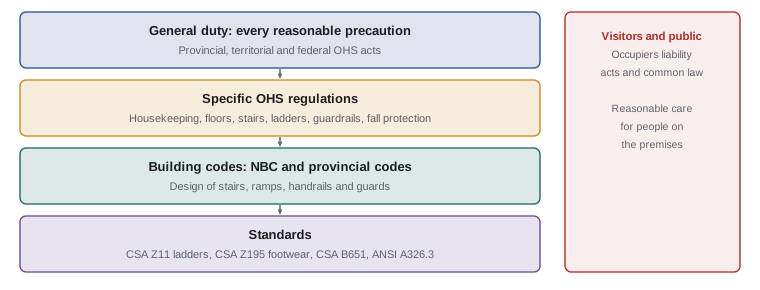
The general duty
Every Canadian OHS statute contains a general duty requiring employers to take every precaution reasonable in the circumstances for the protection of workers, or similar wording. This duty applies even where no specific regulation addresses a hazard. Ontario's Occupational Health and Safety Act, for example, requires employers to take every precaution reasonable in the circumstances for the protection of a worker (section 25(2)(h)), and similar provisions exist in every jurisdiction. Supervisors must ensure workers work safely and must advise them of hazards, and workers must work safely, use required equipment and report hazards and contraventions. Since the Westray amendments to the Criminal Code in 2004, organizations and individuals who direct work can also face criminal negligence charges where they fail to take reasonable steps to prevent bodily harm.
Housekeeping and floor provisions
All Canadian jurisdictions have regulations requiring floors, walkways, stairs and outdoor routes to be kept in good repair and free of slip and trip hazards, and requiring waste and spills to be controlled. The wording varies; the table below shows examples. Most also have specific rules for stairs, ladders, guardrails and fall protection, often in separate parts of the regulations, and sector-specific regulations such as Ontario's construction regulation (O. Reg. 213/91) set further requirements on construction sites.
| Jurisdiction | Example provisions on floors and housekeeping |
|---|---|
| Federal (COHSR) | s. 2.14: keep exterior stairs, walkways and ramps free of ice, snow and slip or trip hazards; remove dust, waste and scrap; keep travelled surfaces slip-resistant and free of holes and loose boards; s. 2.15: false floors or non-slip treatment where floors are normally wet |
| Ontario (Reg. 851, industrial establishments) | s. 11: floors and other surfaces used by workers kept free of obstructions, hazards and accumulations of refuse, snow or ice, and no finish that makes them slippery |
| British Columbia (OHS Regulation) | s. 4.39: floors, platforms, ramps, stairs and walkways maintained in good repair and free of slipping and tripping hazards; s. 4.40: drainage or other controls where liquids collect; s. 4.41: refuse, spills and waste not allowed to accumulate |
| Alberta (OHS Code) | s. 185: worksite kept clean and free of materials or equipment that could cause workers to slip or trip |
| Manitoba (Workplace Safety and Health Regulation) | s. 4.5: floors, platforms, walkways, ramps and stairs kept in good repair and free of slip and trip hazards; s. 2.17: work areas kept clear of snow and ice so far as reasonably practicable |
| Nova Scotia (Occupational Safety General Regulations) | s. 139: floors and stairways designed and maintained to prevent hazards; ice, snow and water removed or sand or salt used when weather makes surfaces slippery |
These provisions share common themes: keep surfaces in good repair, control liquids and contamination, remove waste regularly, deal with snow and ice, and avoid finishes that make floors slippery. Many jurisdictions also require regular workplace inspections by the joint health and safety committee or representative, which should include floors, stairs and housekeeping.
Stairs, ladders and edges
Provincial OHS regulations contain rules on stairs, handrails, ladders, guardrails and fall protection, and building codes set design requirements for permanent stairs and guards. Most provinces require fall protection where a worker could fall 3 metres or more, and at lesser heights where a fall could land on hazardous equipment or substances; the federal COHSR threshold is 2.4 metres. Guardrails are typically required to have a top rail roughly 0.9 to 1.1 metres high, an intermediate rail and often a toe board; Ontario's construction regulation, for example, sets the top rail between 0.9 and 1.1 metres and requires a toe board at least 89 millimetres high where practicable. Ladders must meet CSA Z11 (Portable ladders) or equivalent standards in many jurisdictions. Lessons 7 and 8 cover stairs and ladders at an awareness level.
Training
Canadian OHS laws require employers to provide information, instruction and supervision to protect workers, and many jurisdictions have specific training requirements. Ontario requires workers on construction projects who use certain fall protection methods to complete an approved working at heights training program, and all workers and supervisors in Ontario must complete basic health and safety awareness training. Training on housekeeping, spill response, footwear and reporting is part of the general duty to inform and instruct.
Building codes and accessibility
Building codes set how permanent stairs, ramps, handrails and guards must be designed when a building is constructed or renovated. The NBC and provincial codes set limits on stair rise and run, handrail heights and continuity, guard heights and openings, ramp slopes and landings. Accessibility legislation such as the Accessibility for Ontarians with Disabilities Act (AODA) and its Design of Public Spaces Standards, and the federal Accessible Canada Act, add requirements for exterior paths of travel, ramps and tactile walking surface indicators. Existing buildings are usually not required to upgrade to every new code edition, but OHS law still requires that existing stairs and walkways be safe.
Standards that fill in the detail
Several standards help employers meet their duties. CSA Z11 covers portable ladders. CSA Z195 covers protective footwear. CSA Z259 standards cover fall protection equipment. CSA B651 covers accessible design for the built environment. Many Canadian employers also use US and international standards on slip resistance, such as ANSI A326.3 for measuring the dynamic coefficient of friction of hard surface flooring, ANSI/ASSP A1264.2 on providing slip resistance on walking-working surfaces and ASTM F1637 on safe walking surfaces, because there is no equivalent Canadian standard for slip resistance testing.
Duties to visitors and the public
Beyond OHS law, property owners and occupiers owe a duty of care to people who come onto their premises. Provincial occupiers' liability legislation, such as Ontario's Occupiers' Liability Act and similar statutes in British Columbia, Alberta, Manitoba and Nova Scotia, requires occupiers to take reasonable care to see that people on the premises are reasonably safe; in other provinces the common law of negligence applies. Ontario amended its act in 2020 to require that anyone injured on private property by snow or ice give written notice within 60 days of the injury before suing, with exceptions. Municipalities have their own rules for sidewalks. Slip and fall claims by customers and visitors are one of the most common types of liability claims for retailers, restaurants and property managers.
Worked problem
Which duties apply?
A grocery store has a produce misting system that wets the floor in front of the display, a set of stairs to a mezzanine stockroom, a portable ladder used to stock high shelves and a parking lot that ices over in winter. Identify the main legal duties that apply.
Show solution
- General duty: protect workers from the slip, trip and fall hazards in all four areas.
- Housekeeping and floor rules: control water from the misting system with drainage, mats or other controls and keep the floor free of spills and produce.
- Stairs and ladders: maintain the mezzanine stairs, handrails and any guard at the mezzanine edge; select, inspect and use the ladder correctly and train workers who use it.
- Snow and ice: keep the parking lot and walkways used by workers clear of snow and ice or treated.
- Visitors: the store also owes customers a duty of care on the sales floor and in the parking lot under occupiers' or premises liability law.
Answer: OHS general duty and specific housekeeping, stair, ladder and snow provisions protect workers, and civil liability law protects customers; one set of good controls satisfies both.
Enforcement
OHS inspectors can enter workplaces, inspect, interview workers, issue compliance orders, stop work and, in some provinces, issue tickets or administrative penalties. Serious violations can be prosecuted, and maximum fines are substantial; in Ontario, for example, corporations convicted under the OHSA face fines of up to $2 million per offence, and directors and officers up to $1.5 million. Courts consider whether the employer exercised due diligence, meaning it took every reasonable precaution, which makes documented inspections, procedures and training essential.
Due diligence in practice
Whether a regulator is deciding to prosecute or a court is deciding a case, a central question is whether the employer took every precaution that was reasonable in the circumstances. For slips, trips and falls, due diligence is shown by evidence that the employer identified the hazards, put reasonable controls in place, trained and supervised workers, and checked that the controls were working. In practice, that means documents and records: a hazard assessment that covers floors, stairs, ladders and outdoor areas; written procedures for cleaning, spill response and snow and ice control; inspection checklists that are completed and acted on; maintenance requests with dates of completion; training records; footwear policies; and incident investigations with corrective actions that were followed through.
Records only help if they reflect reality. A floor sweep log that is filled in at the end of a shift for the whole day, or an inspection checklist where every box is ticked without anyone looking, can be worse than no record at all, because it suggests the system is not taken seriously. Supervisors should spot-check that inspections and cleaning actually happened as recorded.
Worker participation
Multi-employer and shared workplaces
Clear written agreements on who inspects, cleans, maintains and clears snow from shared areas prevent hazards from falling between the cracks. Each party should also have a way to report hazards in areas it does not control and confirm that they are fixed.
Inspections and orders in practice
When an inspector visits after a fall or a complaint, they will usually look at the area where the incident happened, ask to see the hazard assessment, cleaning and inspection records, training records and any previous orders, and interview workers, supervisors and committee members. Common orders and citations related to slips, trips and falls include failing to keep floors free of slipping hazards, missing or inadequate handrails and guards, unsafe ladders or ladder use, blocked aisles and exits, inadequate lighting and failure to control snow and ice. Orders usually set a compliance date, and the employer must report back on what was done. Treat an order as an opportunity to fix the underlying system, not only the specific condition the inspector saw, because inspectors often return and look at similar areas.
Employers who disagree with an order or citation can usually appeal or contest it within a short deadline, but the hazard should still be controlled while the appeal is decided. Seeking advice from a qualified health and safety professional or a lawyer is wise where significant penalties or prosecutions are possible.
Keeping up with changes
Laws, codes and standards change. Provinces and states amend their regulations, building codes are updated on regular cycles, and standards such as those for ladders, footwear and slip resistance are revised every few years. Assign someone to watch for changes, subscribe to updates from the regulator and standards bodies, and review procedures when requirements change. Industry associations and safety associations publish guidance that translates legal requirements into practical steps for specific sectors.
Common mistakes
MistakeAssuming there is no rule because no regulation names the specific hazard.
InsteadThe general duty covers recognized hazards without a specific rule.
MistakeThinking only building codes apply to stairs.
InsteadOHS rules also require existing stairs to be maintained and safe.
MistakeIgnoring visitors and customers.
InsteadOccupiers and premises owners owe them a duty of care too.
MistakeKeeping no records of inspections and cleaning.
InsteadRecords show due diligence and support defence of claims.
MistakeUsing another jurisdiction's thresholds.
InsteadFall protection heights and wording differ; check local law.
Summary and key terms
- General duty clauses cover hazards without a specific rule.
- All provinces and the federal COHSR have floor and housekeeping provisions.
- Rules require clean, orderly, well-maintained surfaces free of slip and trip hazards.
- Fall protection is generally required at 3 m (2.4 m federally).
- Building codes govern stair, ramp, handrail and guard design.
- Standards fill in technical detail such as slip resistance and ladder ratings.
- Owners and occupiers owe visitors a duty of care under civil law.
- General duty
- Broad legal duty to protect workers from hazards.
- Walking-working surface
- Any surface on which a worker walks or works.
- Housekeeping
- Keeping a workplace clean, orderly and free of hazards.
- Due diligence
- Taking every reasonable precaution to prevent harm.
- Occupier
- Person or organization in control of premises.
- Building code
- Rules for the design and construction of buildings.
- Consensus standard
- Technical standard developed by a standards body.
- Qualified person
- Person with the knowledge and experience to solve problems in a subject.
- Compliance order
- Official order to correct a contravention.
- Trigger height
- Fall height at which fall protection is required.
Practice problems
Work each problem on paper first, then reveal the answer to check.
What legal duty applies where no specific rule exists?
Show answer
The general duty.
Which federal regulation covers federally regulated workplaces?
Show answer
The Canada Occupational Health and Safety Regulations.
Name three things floor and housekeeping rules require.
Show answer
Good repair, freedom from slip and trip hazards, control of liquids, waste removal, snow and ice control.
At what height do most provinces require fall protection?
Show answer
3 metres.
What governs the design of new stairs?
Show answer
The building code.
Do OHS rules apply to existing stairs?
Show answer
Yes, they must be maintained and safe.
What standard covers portable ladders in your jurisdiction?
Show answer
CSA Z11.
Who owes visitors a duty of care?
Show answer
Owners and occupiers of premises.
Why are inspection records important?
Show answer
They show due diligence and help defend claims.
What is due diligence?
Show answer
Taking every reasonable precaution.
Lesson quiz · 5 questions
Score 60% or more to complete this lesson.
Create a free account to save your progress, take quizzes and earn a certificate.