
HSE-106 · Lesson 9 of 12 · 25 min
Weather, ice, snow and outdoor surfaces
In much of Canada and the northern United States, winter brings a sharp rise in slips and falls. Ice, packed snow, slush and meltwater make parking lots, sidewalks, steps, loading docks and building entrances treacherous for months each year. Outdoor surfaces bring other hazards in every season too: uneven pavement, potholes, curbs, gravel, wet leaves, moss, mud, poorly lit paths and vehicle traffic. Many of these falls happen to workers on their way into or out of work, during deliveries, or when moving between buildings, vehicles and job sites. This lesson covers how to plan and carry out snow and ice control, how to design and maintain outdoor walking routes, how workers can walk and work more safely in winter, and how entrances link outdoor and indoor slip hazards.
Why ice is so slippery
Ice is slippery mainly because a thin layer of liquid or liquid-like water forms on its surface, especially when the temperature is close to the freezing point. That layer acts as a lubricant between the sole and the ice. The slipperiest conditions often occur when temperatures hover around 0 °C (32 °F): freezing rain, wet ice, melting surfaces that refreeze overnight and thin, nearly invisible "black ice" on pavement. Very cold, dry ice can actually offer slightly more grip than wet ice near freezing, although it is still far more slippery than a dry surface. Snow that is compacted by foot or vehicle traffic turns into a smooth, glazed surface. Freeze-thaw cycles, where snow melts by day and refreezes at night, create some of the worst conditions, particularly at the edges of buildings where meltwater drips from roofs and downspouts.
Plan before the first snowfall
Effective snow and ice control starts long before winter. A written winter maintenance plan sets out who does what, when and how. It should cover:
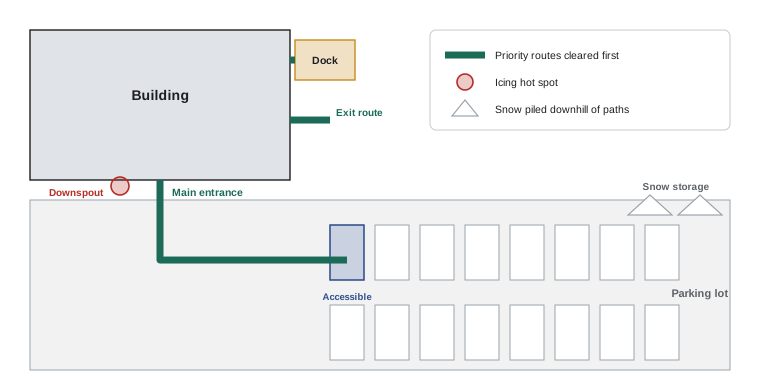
- A site map showing priority routes: main entrances, emergency exits, accessible routes, walkways between parking and doors, loading docks, stairs and ramps, fire hydrants and fire lanes.
- Responsibilities: in-house staff, contractors, tenants and the property owner, with contact details and backups.
- Triggers and timing: when crews start (for example at a forecast or set accumulation), how quickly priority routes must be cleared and treated, and how often they are rechecked during and after storms.
- Methods and materials: plowing, shovelling, snow blowers, de-icers, anti-icing, sand or grit, and where snow will be piled.
- Monitoring and records: logs of when each area was cleared and treated, weather conditions and inspections. These records are essential for managing risk and for defending claims.
- Equipment and supplies: enough salt and sand stored before the season, shovels, spreaders, ice melt buckets at entrances, and traction devices for outdoor workers.
Where snow removal is contracted out, the contract should specify performance standards, response times, materials, recordkeeping and communication. The organization remains responsible for its workers' safety even when a contractor does the work, so it should monitor performance and have a way to deal with gaps, such as icy patches between contractor visits.
De-icing, anti-icing and traction
Three different approaches control ice, and they work best together.
- Anti-icing: applying a de-icing chemical, often as a liquid brine, before a storm, so that snow and ice do not bond to the pavement. This makes removal much easier and uses less chemical overall.
- De-icing: applying chemicals after ice has formed to melt it and break its bond with the surface, followed by removal of the slush.
- Traction: applying sand, grit or similar abrasive materials to provide grip when it is too cold for chemicals to work or as a supplement to them. Sand does not melt ice and can be tracked indoors, so entrance matting and cleaning are important.
Common de-icers work only down to certain temperatures. Rock salt (sodium chloride) becomes much less effective as the pavement temperature falls below about −9 °C (about 15 °F). Calcium chloride and magnesium chloride work at much lower temperatures but cost more. Products marketed as safer for concrete, plants or pets often contain other compounds such as calcium magnesium acetate or potassium acetate. All de-icers should be applied at the rate recommended by the manufacturer: too little does not work, and too much damages concrete, vegetation, waterways and vehicles, and can make floors slippery when tracked indoors. Many municipalities and organizations follow a salt management plan, and in Canada road salts are managed under the Code of Practice for the Environmental Management of Road Salts published under the Canadian Environmental Protection Act.
| Material | Approximate lowest effective pavement temperature | Notes |
|---|---|---|
| Sodium chloride (rock salt) | About −9 °C (15 °F) | Cheap and common; damages concrete, plants and metal; harmful to waterways |
| Calcium chloride | About −29 °C (−20 °F) | Works fast and cold; gives off heat; can leave slippery residue |
| Magnesium chloride | About −23 °C (−10 °F) | Less corrosive than calcium chloride |
| Calcium magnesium acetate | About −7 °C (20 °F) | Less harmful to concrete and plants; more expensive |
| Sand or grit | Any temperature | Provides traction only; does not melt ice; tracked indoors |
Worked problem
How much salt is needed?
A site has 1,800 m² of priority sidewalks and walkways. The salt supplier recommends an application rate of about 15 g/m² for light anti-icing and 40 g/m² for de-icing after freezing rain. The site expects 12 anti-icing applications and 18 de-icing applications in a typical winter. Estimate how much salt to buy before the season.
Show solution
- Anti-icing per application: \( 1\,800 \times 15 = 27\,000 \) g, or 27 kg.
- Anti-icing for the season: \( 12 \times 27 = 324 \) kg.
- De-icing per application: \( 1\,800 \times 40 = 72\,000 \) g, or 72 kg.
- De-icing for the season: \( 18 \times 72 = 1\,296 \) kg.
- Total: \( 324 + 1\,296 = 1\,620 \) kg, about 1.6 metric tons; add a reserve of about 25 percent for a bad winter, giving about 2 metric tons.
Answer: Buy about 2 metric tons of salt, stored dry and covered, and track actual use to refine next year's estimate.
Snow piles, drainage and design
Where snow is piled matters. Piles placed uphill of walkways melt during the day and send water across paths that freeze at night. Piles can block sight lines at intersections, cover fire hydrants and block drains. Plan snow storage areas downhill of walkways and away from drains, entrances and sight lines, and remove snow from the site when space runs out.
Building design and maintenance can prevent many winter slips. Downspouts should discharge away from walkways, or into underground drains, rather than onto sidewalks. Roof overhangs and canopies over entrances keep snow and rain off steps. Heated walkways or snow-melt systems are used at some critical entrances and ramps. Grading and drainage should prevent water from pooling on paths. Icicles and snow sliding from roofs are a separate hazard that may require barricades, snow guards and roof snow removal.
Outdoor walking surfaces in every season
Outdoor surfaces need attention year-round. Common hazards include potholes and cracked or heaved pavement; curbs and wheel stops in parking lots that are hard to see; loose gravel; wet leaves and moss; mud on construction sites; grates and covers that are missing or raised; poorly lit paths and parking lots; and surfaces that become slippery when wet, such as painted lines, metal plates and smooth concrete. Regular outdoor inspections, prompt repairs, contrasting paint on curbs and wheel stops, good lighting and clear separation of pedestrians from vehicles all help.
Parking lots are a particular concern because pedestrians and vehicles share space. Drivers may not see a person who has fallen, and people walking with their heads down against wind and snow may not see vehicles. Designated walkways, crossings, speed limits and lighting reduce these risks.
Vehicles, trailers and loading docks
Getting in and out of vehicles is a common cause of falls, especially for truck drivers, delivery workers and equipment operators. Jumping down from a cab or trailer can injure ankles and knees and can lead to a fall if the ground is icy or uneven. Workers should use the steps and grab handles provided, face the vehicle, maintain three points of contact and never jump. Steps and handholds should be kept clean, free of ice and in good repair. Loading docks combine edges, vehicle movement, dock plates, wet and icy surfaces and debris, and need good lighting, edge marking, dock locks or wheel chocks, and regular cleaning.
Walking on ice
Even with good maintenance, people will sometimes have to walk on slippery surfaces. Safety organizations commonly recommend:
- Plan the route: use cleared and treated walkways, even if they are longer.
- Wear winter footwear with deep, flexible tread, and use ice cleats outdoors when conditions are icy; remove cleats before entering buildings.
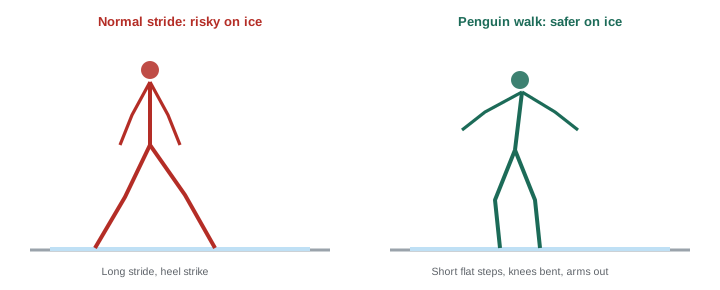
- Walk like a penguin: point your feet slightly outward, bend your knees slightly, take short, flat-footed steps and keep your center of gravity over your front foot.
- Keep your hands free and out of your pockets for balance; use a backpack rather than carrying items in your arms.
- Slow down and allow extra time.
- Use handrails on steps and ramps, and use vehicle grab handles when getting out of cars and trucks.
- Watch for black ice in shaded areas, under downspouts and on bridges and ramps.
- If you start to fall, try to fall to the side and relax, rather than putting out a straight arm to break the fall, and protect your head.
Entrances: where outside meets inside
In winter, the entrance is where outdoor slip hazards come indoors. Snow, slush, water, sand and salt on shoes are carried onto lobby floors, which can become slippery for several meters inside the door. Controls include canopies and vestibules, full entrance matting systems (Lesson 5), extra mats in winter, frequent mopping or floor drying during storms, umbrella bags or stands, and wet floor signs while the floor is wet. Ice melt should not be piled at the door, where it can be tracked inside and leave a slippery residue on hard floors. Lobby floors should have good wet slip resistance.
Weather monitoring and communication
Good winter control depends on knowing what is coming. Assign someone to watch forecasts and pavement temperatures, and agree in advance what conditions trigger action, such as a freezing rain warning or a forecast low below freezing after a wet day. Before a shift change in bad weather, check the routes workers will use when they arrive and leave, which may be in darkness. Communicate conditions to workers through shift briefings, signs, text alerts or the intranet, and encourage people to report icy patches immediately, with a clear contact for the snow crew. For workers who travel between sites, such as home care workers, inspectors and delivery drivers, the employer should consider the routes and destinations they will face, provide traction devices and allow extra time.
Evaluating the winter program
After each winter, review how the program performed. Compare the number of falls on ice and snow with previous years, look at where and when they happened, check whether response times in the plan were met and whether salt and sand supplies lasted, and ask workers and contractors what could be improved. Adjust priority routes, triggers, contracts and equipment for the next season. Small changes, such as moving a downspout, adding a handrail to exterior steps or extending a canopy, often have a large effect on winter falls at a particular site.
Common mistakes
MistakeWaiting until it snows to plan snow removal.
InsteadPrepare a written winter plan with priorities, triggers and records before winter.
MistakeUsing rock salt in extreme cold and assuming it works.
InsteadUse de-icers suited to the temperature, or sand for traction.
MistakePiling snow uphill of walkways.
InsteadStore snow downhill and away from paths, drains and sight lines.
MistakeJumping down from vehicles.
InsteadUse steps and grab handles, face the vehicle and keep three points of contact.
MistakeAssuming a contractor relieves you of responsibility.
InsteadMonitor contractor performance and fill gaps between visits.
Summary and key terms
- Ice is most slippery near 0 °C, especially wet ice and black ice.
- A written winter plan sets priority routes, responsibilities, triggers and records.
- Anti-icing, de-icing and traction work best together.
- Rock salt loses effectiveness below about −9 °C; use other products or sand.
- Pile snow downhill of walkways and route downspouts away from paths.
- Use three points of contact getting into and out of vehicles.
- Walk like a penguin on ice and keep hands free.
- Black ice
- Thin, nearly transparent ice on pavement.
- Freeze-thaw cycle
- Daytime melting followed by overnight refreezing.
- Anti-icing
- Applying chemicals before a storm to prevent bonding.
- De-icing
- Applying chemicals to melt ice that has formed.
- Traction material
- Sand or grit that adds grip without melting ice.
- Priority route
- Walkway cleared and treated first.
- Brine
- Salt solution used for anti-icing.
- Snow storage area
- Planned location for piled snow.
- Ice cleat
- Traction device worn over footwear on ice.
- Vestibule
- Enclosed space between outer and inner entrance doors.
Practice problems
Work each problem on paper first, then reveal the answer to check.
At what temperatures is ice usually most slippery?
Show answer
Near 0 °C (32 °F).
Name four items in a winter maintenance plan.
Show answer
Priority routes, responsibilities, triggers, methods, records, supplies.
What is the difference between anti-icing and de-icing?
Show answer
Anti-icing is before the storm; de-icing is after ice forms.
Below what temperature does rock salt work poorly?
Show answer
About −9 °C (15 °F).
What does sand do?
Show answer
Adds traction without melting ice.
Where should snow be piled?
Show answer
Downhill of walkways, away from drains and sight lines.
How should you get down from a truck cab?
Show answer
Face the cab, use steps and grab handles, three points of contact.
Describe the penguin walk.
Show answer
Feet slightly out, knees bent, short flat steps, center of gravity forward.
How much salt covers 1,000 m² at 20 g/m²?
Show answer
20 kg.
Why are winter records important?
Show answer
To manage performance and defend claims.
Lesson quiz · 5 questions
Score 60% or more to complete this lesson.
Create a free account to save your progress, take quizzes and earn a certificate.