
HSE-106 · Lesson 11 of 12 · 26 min
Housekeeping programs, 5S and inspections
Housekeeping is more than cleaning. It is the ongoing system of keeping a workplace orderly, with a place for everything, walkways clear, waste removed, spills dealt with and equipment in good repair. Good housekeeping prevents slips, trips and falls, but it also reduces fire risk, makes emergency evacuation easier, improves productivity and quality, and shows workers and visitors that the organization cares about its people and premises. Poor housekeeping is often the first visible sign of deeper problems in a workplace. This lesson explains how to build a housekeeping program, how the 5S method can help, how to carry out inspections of walking surfaces and housekeeping, and how to encourage reporting of hazards and near misses.
Elements of a housekeeping program
A housekeeping program turns good intentions into routine practice. It does not need to be complicated, but it should be written down, assigned and checked. Its main elements are:
- Standards: what "good" looks like in each area, ideally with photos, such as clear aisles, marked storage, no items on stairs, spills cleaned within a set time.
- Responsibilities: who keeps each area in order, from individual workstations to shared spaces, and who handles cleaning, waste removal, maintenance and snow control.
- Resources: enough storage, shelving, bins, waste containers, spill kits, cleaning equipment and time in the schedule to use them.
- Routines: clean-as-you-go rules, end-of-shift clean-ups, scheduled deep cleans, and waste collection frequencies matched to the volume generated.
- Inspections: regular checks by supervisors, workers and the health and safety committee or representative, with findings recorded and acted on.
- Reporting: a simple way for anyone to report a hazard, a spill or a near miss, with quick feedback.
- Review: periodic review of incidents, inspection results and worker feedback to improve the program.
The 5S method
5S is a workplace organization method that originated in Japanese manufacturing and is widely used in lean management. Its five steps, translated from Japanese words that each begin with the letter S, provide a structured way to achieve and sustain good housekeeping.
| Step | Japanese term | What it means in practice |
|---|---|---|
| Sort | Seiri | Remove items that are not needed in the area; red-tag doubtful items and decide what to keep, relocate or discard |
| Set in order | Seiton | Give every remaining item a defined place, labeled and close to where it is used; mark walkways and storage locations |
| Shine | Seiso | Clean the area and equipment, and use cleaning as a chance to inspect for leaks, damage and wear |
| Standardize | Seiketsu | Set standards and routines, such as checklists, photos of how the area should look and cleaning schedules |
| Sustain | Shitsuke | Make it a habit through training, audits, leadership involvement and recognition |
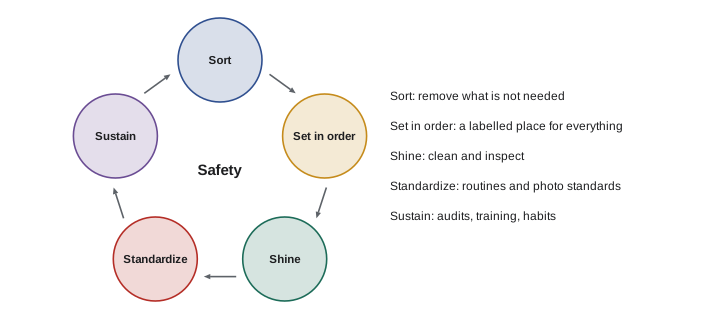
Some organizations add a sixth S for safety, but most practitioners see safety as built into all five steps. Sorting removes clutter that causes trips. Setting in order keeps walkways clear and puts heavy items at safe heights. Shining finds leaks and damage early. Standardizing makes good conditions the norm, and sustaining stops the gradual slide back into disorder. The key insight of 5S is that housekeeping is a continuous process, not a one-time clean-up before an inspection or audit.
Inspections
Regular inspections find hazards before they cause injuries. Most Canadian and US workplaces have some form of inspection requirement: in Canada, joint health and safety committees or representatives are generally required to inspect the workplace regularly, often monthly; in the US, OSHA requires walking-working surfaces to be inspected regularly and as necessary (1910.22(d)), and many state programs require regular inspections as part of an injury and illness prevention program. Beyond legal requirements, inspections are simply good management.
Different types of inspection serve different purposes:
- Pre-use and start-of-shift checks by workers, for example of ladders, work areas and entrances in winter.
- Routine supervisor walk-throughs, often daily or weekly, focusing on housekeeping and obvious hazards.
- Planned inspections by the committee or representative, using a checklist and covering the whole workplace over a set period.
- Specialist inspections, such as slip resistance testing, lighting surveys, structural checks of stairs and platforms, and ladder inspections by a competent person.
- Special inspections after an incident, a change in process or layout, or severe weather.
What to look for
| Area | Inspection points |
|---|---|
| Floors | Spills, contamination, damage, holes, lifted tiles or coverings, slippery finishes, drainage, changes in level |
| Walkways and aisles | Clear width, markings visible, no stored materials, no cords or hoses, good lighting |
| Stairs and ramps | Uniform steps, nosings intact and visible, handrails secure and continuous, guards in place, clear of objects, lighting |
| Entrances | Matting flat and adequate, wet floor signs available, floor dry, canopy and drainage working |
| Ladders and step stools | Correct type and rating, good condition, stored properly, inspection tags |
| Outdoor areas | Pavement condition, curbs marked, snow and ice control, lighting, drainage, downspouts |
| Housekeeping | Storage organized, waste bins emptied, no overflow, spill kits stocked, clean-as-you-go followed |
Checklists help ensure consistency, but inspectors should also look beyond the checklist, talk to workers about problems they see and watch how people actually move through the area. A useful technique is to walk the routes people use at the times they use them, including night shifts, weekends and early mornings in winter, when conditions may be very different from a mid-morning inspection.
Recording and acting on findings
An inspection that does not lead to action is worse than useless, because it shows workers that hazards are noticed but not fixed. Each finding should be recorded with its location, a description and photo if possible, a risk rating, the action required, the person responsible and a target date. Urgent hazards, such as a missing guard, a broken stair tread or a large spill, need immediate action, such as barricading the area, before the inspection continues. Track open items until they are closed and verify that fixes are effective. Share results with workers and the committee, and look for repeat findings, which often point to a root cause such as insufficient storage, a leaking roof or a cleaning schedule that does not match the workload.
Worked problem
Scoring a housekeeping audit
A warehouse uses a monthly 5S audit with 25 checkpoints, each scored 0 (not met), 1 (partly met) or 2 (fully met). This month's results are 15 fully met, 6 partly met and 4 not met. Last month the score was 64 percent. Calculate this month's score and interpret it.
Show solution
- Maximum possible score: \( 25 \times 2 = 50 \).
- Actual score: \( 15 \times 2 + 6 \times 1 + 4 \times 0 = 36 \).
- Percentage: \( 36 \div 50 = 72 \) percent.
- Improvement of 8 percentage points from last month; review the 4 checkpoints not met and assign actions.
Answer: The score is 72 percent, an improvement; focus on the four failed checkpoints and confirm they are fixed before the next audit.
Encouraging reporting
Inspections happen periodically, but workers see the workplace every minute. A reporting system that makes it easy for anyone to report a hazard, spill or near miss multiplies the number of eyes looking for problems. Effective systems are simple, such as a short form, an app, a QR code posted in each area or a phone number; they are non-punitive, so people are not blamed for reporting; they give quick feedback, so the reporter knows what happened; and they lead to visible action. Near-miss reports are particularly valuable for slips and trips, because for every fall that causes injury there are many slips, trips and stumbles that do not, each pointing to the same hazard.
In the US, section 11(c) of the OSH Act protects workers from retaliation for reporting safety concerns and injuries, and OSHA's recordkeeping rule (29 CFR 1904.35) requires employers to have a reasonable procedure for reporting injuries and illnesses that does not deter or discourage reporting.
Contractors, tenants and shared spaces
Housekeeping becomes harder where several employers share a space, such as multi-tenant buildings, construction sites, hospitals with contracted cleaners and retail malls. Each party should know who is responsible for common areas, entrances, stairs, parking lots, snow removal and waste. Contracts and leases should spell this out, and coordination meetings or shared inspection schedules help. On construction sites, the constructor or general contractor typically coordinates site-wide housekeeping, while each subcontractor cleans up after its own work.
Leadership
Workers notice what managers notice. Leaders who walk through the workplace, pick up litter, stop to report a spill, ask about hazards and fix problems quickly send a stronger message than any poster. Including housekeeping in management meetings, in performance reviews and in the planning of new layouts and processes builds it into the way the organization works.
Starting a 5S program
A 5S program usually begins with a pilot area, such as one workshop, stockroom or production line, rather than the whole site at once. The team, including the people who work in the area, takes before photos, then works through the steps. During sorting, items whose need is uncertain are given a red tag and moved to a holding area for a set period, such as two weeks; if nobody needs them, they are relocated or discarded. During set in order, the team decides where each remaining item belongs, using shadow boards for tools, labeled shelves and bins, floor marking for carts and pallets, and visual signals that make it obvious when something is missing or out of place. After shining, the team writes the standard for the area, often a single page with photos, and agrees on daily and weekly routines. After photos and a short presentation to other teams help spread the approach.
5S fails when it is treated as a one-off campaign, when managers impose it without involving workers, or when the extra storage and time it needs are not provided. It succeeds when it becomes part of daily work and when the people in each area own the standard.
Housekeeping in different settings
Housekeeping looks different in different workplaces. In an office, it means cable management, closed drawers, clear aisles, bags stored under desks rather than in walkways, and prompt cleaning of spilled drinks. In a warehouse, it means clear aisles, stretch wrap and banding collected at the point of use, pallets stored flat and away from walkways, and damaged racking reported. In a kitchen, it means continuous cleaning of spills and grease, mats cleaned and lifted for floor cleaning, and waste removed before it overflows. On a construction site, it means daily clean-up of debris, cords and hoses routed overhead or along edges, materials stacked in designated areas and access routes kept clear and lit. In health care, it means clear corridors free of parked equipment and linen carts, prompt spill response and coordination between clinical and environmental services staff.
Using inspection data
Over time, inspection results become a valuable data set. Grouping findings by type and location shows which hazards keep returning and which areas need more attention. Charting the number of open items and the average time to close them shows whether the system is keeping up. Comparing inspection findings with incident and near-miss reports shows whether inspections are finding the hazards that actually cause injuries; if people keep falling in places inspections rate as good, the checklist or the inspection timing needs to change.
Waste management
Overflowing waste bins and piles of cardboard, packaging and scrap are among the most common housekeeping problems and a frequent cause of trips and fires. Plan waste capacity for the volume each area actually produces, place bins where waste is generated, empty them on a schedule that prevents overflow, and provide balers, compactors or recycling cages for cardboard and plastic. Sharp waste, such as broken glass and metal offcuts, needs puncture-resistant containers. Outdoor waste areas need lighting, clear access and snow control, because workers walk to them in all weather and often carry bags that block their view of the ground.
Recognition and feedback
People keep doing what gets noticed. Recognize teams and individuals who maintain high housekeeping standards, report hazards or suggest improvements, for example by sharing before and after photos in team meetings or newsletters, or by inviting a team to explain its approach to others. Recognition should reward participation and improvement rather than low injury counts, which can discourage reporting. Equally, when standards slip, supervisors should address it promptly and constructively, asking what got in the way, such as missing storage, broken equipment or too little time, rather than simply ordering a clean-up.
Common mistakes
MistakeCleaning up only before an audit or visit.
InsteadMake housekeeping a continuous routine with 5S and clean-as-you-go.
MistakeRecording inspection findings without assigning actions.
InsteadAssign each finding a person, a date and follow-up.
MistakeInspecting only at convenient times.
InsteadInspect at night, on weekends and in bad weather too.
MistakePunishing people who report near misses.
InsteadKeep reporting non-punitive and give quick feedback.
MistakeLeaving shared-space responsibilities unclear.
InsteadDefine responsibilities in contracts, leases and site rules.
Summary and key terms
- Housekeeping is an ongoing system, not occasional cleaning.
- A program needs standards, responsibilities, resources, routines, inspections and reporting.
- 5S: sort, set in order, shine, standardize, sustain.
- Inspections range from pre-use checks to planned committee inspections.
- Record findings with actions, owners and dates, and track them to closure.
- Simple, non-punitive reporting multiplies the eyes looking for hazards.
- Leaders set the tone by noticing and fixing housekeeping problems.
- Housekeeping program
- System for keeping a workplace orderly and hazard-free.
- 5S
- Workplace organization method: sort, set in order, shine, standardize, sustain.
- Red tag
- Label marking an item for a decision on whether to keep it.
- Clean-as-you-go
- Rule to tidy up as each task is finished.
- Planned inspection
- Scheduled inspection using a checklist.
- Walk-through
- Informal supervisor inspection of an area.
- Corrective action
- Action taken to fix a hazard found.
- Near miss
- Event that could have caused injury but did not.
- Reprisal
- Punishment for raising a safety concern.
- Audit score
- Percentage of checklist points met.
Practice problems
Work each problem on paper first, then reveal the answer to check.
Name four elements of a housekeeping program.
Show answer
Standards, responsibilities, resources, routines, inspections, reporting, review.
What are the five steps of 5S?
Show answer
Sort, set in order, shine, standardize, sustain.
What happens in the "sort" step?
Show answer
Unneeded items are removed from the area.
How can "shine" help find hazards?
Show answer
Cleaning reveals leaks, damage and wear.
Name three types of inspection.
Show answer
Pre-use, supervisor walk-through, planned committee, specialist, special.
What should each inspection finding include?
Show answer
Location, description, risk, action, person responsible, date.
An audit of 20 points scored 0 to 2 totals 30. What is the percentage?
Show answer
75 percent.
Why are near-miss reports valuable?
Show answer
They reveal hazards before an injury occurs.
What makes a reporting system effective?
Show answer
Simple, non-punitive, quick feedback, visible action.
Who coordinates housekeeping on a construction site?
Show answer
Usually the constructor or general contractor.
Lesson quiz · 5 questions
Score 60% or more to complete this lesson.
Create a free account to save your progress, take quizzes and earn a certificate.