
HSE-101 · Lesson 2 of 12 · 21 min
How safety law works: OSHA and Arizona's state plan
On Jordan's second day, a poster in the staff room caught his eye. It listed phone numbers for ADOSH and for the insurer, and it said every worker had rights under the law. He asked Amara Okafor, a cashier who had worked at Greenway for six years, what the poster was for. 'It's the law that says it has to be there,' she said. 'I'm on the safety committee, so I'll tell you the short version over lunch.'
Most workers never read a health and safety law, and they do not need to read every word. But knowing how the system works helps you understand why your employer does what it does, what you can expect, and where to go if something is wrong. This lesson explains who makes the rules in Arizona, who enforces them, and how the parts fit together.
Who makes the rules in the United States
In the United States, the main workplace safety law is the Occupational Safety and Health Act of 1970, usually called the OSH Act. Congress passed it to make sure every worker has a safe and healthy workplace. The Act created the Occupational Safety and Health Administration, or OSHA, which is part of the U.S. Department of Labor. It also created the National Institute for Occupational Safety and Health (NIOSH), which does research and makes recommendations but does not enforce the law.
The OSH Act lets states run their own safety programs, called state plans, as long as OSHA approves them and they are at least as effective as federal OSHA. About half the states have a state plan. Some cover private-sector and public-sector workers; a few cover only state and local government workers. In states without a plan, federal OSHA covers private-sector workers directly.
Arizona's state plan
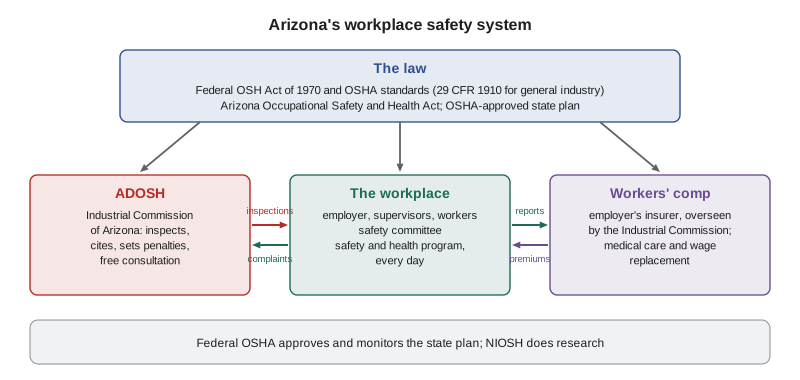
Arizona is a state-plan state. Its program is run by the Arizona Division of Occupational Safety and Health, known as ADOSH, which is part of the Industrial Commission of Arizona. ADOSH covers most private-sector workers in the state, plus state and local government workers. Federal OSHA still covers federal workers in Arizona and a few other groups. Arizona has its own state law, the Arizona Occupational Safety and Health Act, and ADOSH adopts OSHA's standards, sometimes with additions of its own.
For Greenway in Mesa, that means the rules come from the federal OSH Act and OSHA standards, as adopted and enforced in Arizona by ADOSH. When this course says 'OSHA rules,' it means the rules that ADOSH enforces in Arizona. In a state without a plan, the same federal rules would be enforced by federal OSHA.
The Act, standards and the general duty clause
OSHA's rules come in a few forms.
- The OSH Act sets out the big principles: employers must provide a safe workplace and follow OSHA standards, and workers must follow the standards that apply to their own actions.
- Standards are detailed rules with the force of law, published in Title 29 of the Code of Federal Regulations. General industry standards, which cover businesses like Greenway, are in Part 1910. Construction is in Part 1926. A standard might say exactly how forklift operators must be trained, or what a chemical label must show.
- The general duty clause, section 5(a)(1) of the Act, says employers must keep the workplace free of recognized hazards that are causing or likely to cause death or serious harm. It covers serious hazards that no specific standard addresses, such as some heat and violence hazards.
- Guidance from OSHA and NIOSH explains good practice. It is not law in itself, but it shows what a careful employer is expected to know.
When Amara explained this, Jordan asked why there needed to be a general duty clause if there were already standards. 'Because the standards can't list everything,' she said. 'Heat is the big one here. You can't work in a yard in Mesa in July and pretend it isn't dangerous.'
Safety and health programs
Federal OSHA does not have a general rule that every employer must have a written safety program, though many specific standards require written plans, and some states require programs. OSHA does publish Recommended Practices for Safety and Health Programs. They describe a program built on management leadership, worker participation, finding and fixing hazards, training, and checking that the program works. Greenway follows these practices, and its safety committee is a big part of how workers take part.
Inspectors are not the main way a workplace stays safe. ADOSH can visit only a small share of workplaces each year. The people inside the workplace are there every day. A good program means hazards are found and fixed by the people who know the work, long before an inspector arrives. When the program fails, enforcement is the backstop.
Inspections and enforcement
ADOSH compliance officers can inspect workplaces, usually without advance notice. Inspections happen for several reasons. The highest priority is an imminent danger, followed by fatalities and serious injuries reported by employers, worker complaints, referrals from other agencies, follow-up visits and planned inspections of high-hazard industries.
During an inspection, a representative of the employer and a representative of the workers may go along on the walkaround. The officer can talk privately with workers. If the officer finds violations, ADOSH can issue citations with penalties, and the employer must fix the hazard by a set date and post the citation where workers can see it. Penalties can reach thousands of dollars per violation, and much more for willful or repeated violations.
In the most serious cases, criminal law can apply. Under the OSH Act, a willful violation of a standard that causes a worker's death can be prosecuted as a crime. State prosecutors have also used general criminal laws, such as manslaughter, after some workplace deaths.
Workers' compensation
Workers' compensation is separate from ADOSH. Arizona requires employers with employees to carry workers' compensation insurance, and the Industrial Commission of Arizona oversees the system. When a worker is injured or made ill by work, workers' compensation pays for reasonable medical care at no cost to the worker and replaces part of lost wages, regardless of who was at fault. In return, workers generally cannot sue their employer over a work injury.
Workers' compensation insurers also care about prevention, because injuries cost them money. An employer with many claims pays higher premiums. Many insurers offer safety advice and training to the businesses they cover. ADOSH also has a free consultation service that helps employers, especially small ones, find and fix hazards without a citation.
A short history
Before 1970, workplace safety in the United States was mostly left to the states, and protection varied widely. OSHA estimates that about 14,000 workers were killed on the job in 1970. Since then the workforce has more than doubled, yet the yearly number of worker deaths is now around 5,000. Better laws, better equipment, better training and a lot of hard work by employers, unions and workers all played a part. Arizona's own law and its state plan followed in the 1970s, giving the state its own program under OSHA's approval.
Laws tend to change after tragedies. Major chemical disasters led to OSHA's rules on process safety. Deaths in trenches and confined spaces led to stronger standards and enforcement. Rising concern about heat, as summers get hotter in places like Arizona, has pushed regulators toward new rules and special enforcement programs for heat illness. The law keeps growing as people learn where workers are getting hurt.
What the law expects in practice
The details of the law fill thousands of pages, but for a new worker the main expectations of an employer can be summed up in a short list. Whatever the job, the law expects the employer to:
- find the hazards in the work and control them;
- give workers the information, training and supervision they need to work safely;
- provide and maintain safe equipment, tools and protective equipment;
- involve workers in safety, through a committee, a representative or other ways of taking part;
- keep the records the law requires, such as training records and injury reports;
- plan for emergencies and provide first aid;
- report serious incidents to the regulator; and
- never punish a worker for raising a safety concern or using their rights.
Workers have a shorter list. The law expects them to work safely, follow the rules and procedures, use the protective equipment they are given, report hazards and injuries, and not put others in danger. Lesson 4 looks at these duties more closely, including the important role of supervisors.
Amara made one more point. 'The law also cares about people who aren't employees,' she said. 'Customers, delivery drivers, contractors who come to fix the coolers. If we leave a pallet hanging over the aisle and it falls on a customer, that's on us too.'
Jordan asked what happens when a rule does not fit the job. Amara said it happens more than people think. A procedure might have been written for an old machine, or for a quiet day, or by someone who never did the job. 'You don't just ignore it, and you don't just suffer through it,' she said. 'You tell Priya, or you tell the committee, and we fix the procedure or fix the job. That's what the committee is for.' The law expects rules to be followed, but it also expects employers to listen when workers say a rule is not working, and to keep their procedures up to date.
Where to find the rules
You do not need to memorize the law, but you should know where to find help. At Greenway, Jordan found information in four places:
- The staff room board, which had the safety committee members' names, minutes of the last meeting, the required job safety and health poster with ADOSH's phone numbers, the annual injury summary, and the emergency plan.
- The safety binder and the staff tablet, with Greenway's safety program, written procedures and safety data sheets.
- The people: his supervisor, the committee members and the experienced workers.
- Government websites, including ADOSH's pages on the Industrial Commission of Arizona site and OSHA's website, which publish the standards and plain-language guides in English and Spanish.
Where Greenway fits in
After lunch, Amara showed Jordan how the system looked at Greenway. The company had a written safety program in a binder and on the staff tablet. It had a safety committee with members from the store, the greenhouse, the yard and management, which met every month. It had a way to report hazards and near misses, which Jordan had already used. It had trained first aid responders on every shift, written procedures for the forklifts and the chemical room, and a plan for emergencies.
'All of that is partly the law asking for it,' Amara said, 'and partly the insurer, and partly just how you run a decent place. The law sets the floor. Tom wants us above the floor.'
Worked problem
Finding the right rule
Show solution
- Jordan wondered whether Greenway had to give him training before he used the cardboard baler in the warehouse.
- Amara showed him how to look it up. OSHA's general industry standards include rules on machine guarding and on lockout of machines during servicing, and these apply to balers.
- Federal child labor rules also say workers under 18 may not load, operate or unload most power-driven balers.
- Greenway's own procedure, which follows those rules, says nobody uses the baler until they have been trained, signed off by a supervisor, and are 18 or older.
- Jordan, at 19, had his baler training booked for his second week.
Answer: The act sets the general duty, the detailed rules say how, and the workplace procedure turns both into steps workers follow.
Common mistakes
MistakeThinking safety is the government's job.
InsteadRemember that the people in the workplace are responsible every day; inspectors are the backstop.
MistakeAssuming every state follows federal OSHA directly.
InsteadCheck whether your state has a state plan; if it does, that agency enforces the rules.
MistakeConfusing workers' compensation with the safety regulator.
InsteadKnow that workers' compensation pays for injuries and ADOSH enforces the safety law.
MistakeTreating the law as the most a workplace should do.
InsteadSee the law as the minimum; good employers aim higher.
MistakeThinking you need to read every regulation.
InsteadKnow how the system works and where to look, and ask your supervisor or committee.
Summary and key terms
- In the United States, the OSH Act of 1970 created OSHA; states may run approved state plans that are at least as effective as federal OSHA.
- Arizona runs a state plan through ADOSH, part of the Industrial Commission of Arizona, which adopts OSHA standards.
- ADOSH enforces the rules through inspections, citations and penalties; the general duty clause covers serious hazards with no specific standard.
- OSHA's Recommended Practices describe a program built on leadership, worker participation, finding and fixing hazards and training.
- A willful violation that causes a death can be prosecuted as a crime under the OSH Act.
- Workers' compensation is a separate, no-fault insurance system that pays for work injuries and illnesses.
- OSH Act
- The Occupational Safety and Health Act of 1970, the main federal workplace safety law in the United States.
- State plan
- A state workplace safety program approved by OSHA that must be at least as effective as federal OSHA.
- General duty clause
- Section 5(a)(1) of the OSH Act, which requires employers to keep the workplace free of recognized serious hazards.
- Citation
- A written notice from OSHA or a state plan that a workplace has violated a rule, usually with a penalty and a date to fix it.
- Workers' compensation
- A no-fault insurance system that pays for medical care and lost wages after work injuries and illnesses.
Practice problems
Work each problem on paper first, then reveal the answer to check.
Which agency enforces workplace safety rules at Greenway in Mesa?
Show answer
ADOSH, the Arizona Division of Occupational Safety and Health, under Arizona’s OSHA-approved state plan.
What is a state plan?
Show answer
A state workplace safety program approved by OSHA that must be at least as effective as federal OSHA.
When does the general duty clause apply?
Show answer
When there is a recognized hazard likely to cause death or serious harm that no specific standard covers.
Where are OSHA’s general industry standards published?
Show answer
In Title 29 of the Code of Federal Regulations, Part 1910.
What is the difference between workers’ compensation and ADOSH?
Show answer
Workers’ compensation pays for work injuries; ADOSH enforces the safety rules.
Lesson quiz · 5 questions
Score 60% or more to complete this lesson.
Create a free account to save your progress, take quizzes and earn a certificate.