
HSE-101 · Lesson 3 of 12 · 21 min
Your rights under OSHA and ADOSH
In his second week, Jordan was asked to help unload a delivery truck of potting mix. The truck had backed up to the warehouse dock, but the dock plate between the truck and the dock was bent, and it rocked when Jordan stepped on it with a loaded hand truck. He stopped. He did not know whether he was allowed to say no, or whether he would get in trouble for holding up the delivery. The driver was already tapping his watch.
Jordan went to find Priya. She came out, looked at the plate, and stepped on it herself. It rocked. 'Good call,' she said. 'We'll use the portable plate from the other door, and I'll get this one tagged out.' Later that day she sat down with him and went through the rights every worker has. 'You did the right thing,' she said. 'But I want you to know you didn't need my permission. The law gives you those rights.'
This lesson explains those rights. Knowing them protects you, and using them protects the people you work with.
Your rights at a glance
The OSH Act and OSHA's rules, which ADOSH enforces in Arizona, give workers a set of rights. They are often summed up as the rights to a safe workplace, to information and training, to take part, to raise concerns without retaliation, and in some cases to refuse dangerous work.
- The right to a safe workplace, free of recognized serious hazards and in line with OSHA standards.
- The right to know: training in a language and words you understand, information about the chemicals you work with, access to safety data sheets, and copies of test results done to find hazards.
- The right to records: to see the workplace's log of injuries and illnesses, and to get copies of your own medical and exposure records.
- The right to take part, including in safety committees and, through a representative, in the walkaround during an inspection.
- The right to complain to ADOSH or OSHA about hazards, and to have your name kept from your employer if you ask.
- The right to be free from retaliation for using any of these rights.
- The right to refuse work in a narrow set of cases where there is an imminent danger of death or serious injury.
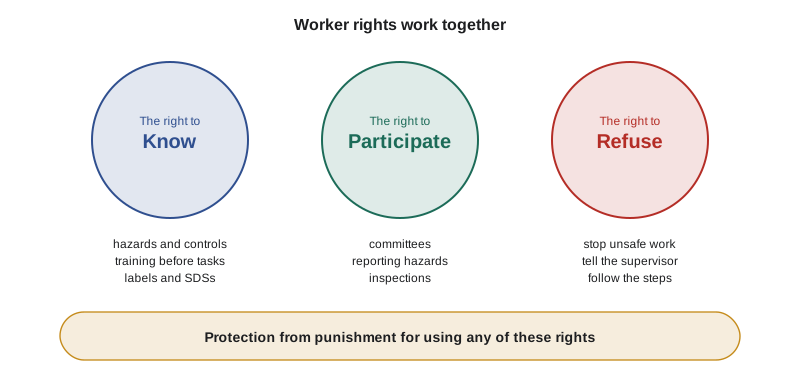
The right to know
You cannot protect yourself from a hazard you do not know about. The right to know means your employer must tell you about the hazards in your job and how they are controlled. It also means you must be trained before you do a task, and supervised by someone who knows the work until you can do it safely.
At Greenway, the right to know showed up in several ways in Jordan's first weeks:
- His first-day orientation covered the main hazards, the emergency plan and how to report problems.
- Before he worked in the chemical room, he was trained on the products stored there, the labels, the safety data sheets and the gloves and goggles to use. Lesson 9 covers this.
- Before he could use the pallet jack, Doug showed him how, watched him do it, and signed off on a training record.
- The hazard assessments for each job were in the binder, and he was told he could read them any time.
OSHA requires training in a language and vocabulary workers understand. If English is not your first language, or you have trouble reading, your employer must give you training you can follow. Several of Greenway's yard staff speak Spanish at home, so the company gives its safety training in English and Spanish.
If you are not sure how to do something safely, the right to know also means you can ask, and keep asking until you understand. A good supervisor would rather explain three times than visit you in hospital.
The right to participate
The people who do the work often know the most about its hazards. The right to participate means you have a voice in how safety is managed. You can report hazards, suggest fixes, take part in inspections and investigations, and join the safety committee.
Federal OSHA does not require safety committees, though some states do. Arizona does not have a general requirement, but many employers, including Greenway, set them up because they work. Greenway's safety committee has worker members from the store, the greenhouse and the yard, plus two managers. It meets monthly, inspects the site, reviews near-miss reports and makes recommendations to Tom.
Amara is a worker member of Greenway's committee. She told Jordan that most of the committee's best ideas came from workers who were not on it. 'The rope barrier in the yard was somebody's idea. So was the anti-fatigue mat at the tills. People tell us things on their break. We take them to the meeting.'
Participating does not have to mean joining a committee. It can be as simple as filling in a near-miss report, saying something at a team huddle, or telling your supervisor that a new procedure does not work in practice.
The right to refuse
The OSH Act does not give a general right to walk off a job. But OSHA's rules protect a worker who refuses to work when all of these conditions are met:
- Where possible, you asked the employer to fix the danger, and they did not.
- You refused in good faith, believing an imminent danger exists.
- A reasonable person would agree there is a real danger of death or serious injury.
- There is not enough time, because of the urgency, to get the hazard fixed through an OSHA or ADOSH inspection.
If you are in that situation, you should stay at the workplace if it is safe to do so, tell your employer you will not do the work until the hazard is fixed, and contact ADOSH or OSHA. Many employers, including Greenway, go further than the law and tell every worker they can stop any job they believe is unsafe without fear of punishment. Greenway calls it 'stop work authority'.
How a refusal works at Greenway
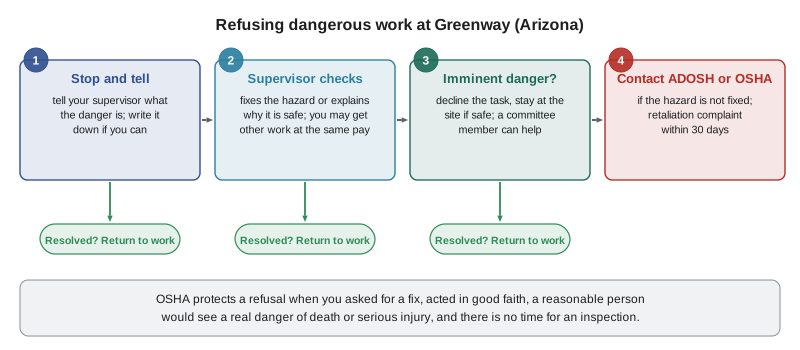
Greenway's procedure combines OSHA's rules with its own stop work policy. It is designed to get the problem fixed quickly, with the people closest to it involved first.
- Stop and tell your supervisor right away what the danger is. Do not just walk away without saying anything.
- The supervisor checks and fixes the problem, or explains why the work is safe. Most concerns end here, with a repair or a change in how the job is done.
- If it is not resolved and you still believe there is an imminent danger, you can decline the task. Stay at the workplace if it is safe, and ask for other work in the meantime. A member of the safety committee can help.
- Contact ADOSH or OSHA if the hazard is still not fixed. If you are punished for raising the concern, you can file a retaliation complaint, which must be made within 30 days.
While the concern is being sorted out, Greenway gives the worker other work at the same pay. Supervisors are told never to hand the refused job to someone else without first explaining the concern and fixing it or checking it is safe.
Jordan's dock plate, again
Looking back, Jordan's situation was handled well, even though he did not know the rules at the time. He stopped. He told his supervisor. The supervisor checked, agreed, and fixed it. It never needed to go further. That is how most safety concerns should go. The formal steps exist for the times when they do not.
Priya told him the one thing she wanted him to remember: 'If you ever stop a job, tell me exactly what the danger is. Write it down if you can. That way there's no confusion about what's happening, and there's a record if you ever need it.'
Protection from retaliation
Rights are worth little if workers are afraid to use them. Section 11(c) of the OSH Act, and a matching section of Arizona's law, protect workers from retaliation. An employer must not fire, demote, discipline, cut the hours or pay of, threaten, or blacklist a worker because the worker reported an injury, raised a safety concern, filed a complaint, took part in an inspection, or refused imminently dangerous work.
A worker who believes they faced retaliation in Arizona must file a complaint with ADOSH within 30 days of the retaliation. The federal OSHA deadline under 11(c) is also 30 days. The deadline is short, so it matters to act quickly. If the complaint is upheld, the employer can be ordered to reinstate the worker and pay lost wages.
Greenway's policy says the same thing in plain words: nobody will ever be punished for raising a safety concern in good faith, even if it turns out there was no problem.
Worked problem
Is this a reasonable refusal?
Show solution
- Situation 1: Lily, a 16-year-old cashier, is asked to climb a 10 ft (3 m) rolling ladder in the store to take down a hanging basket display. She has never used that ladder and has not been trained. She declines and tells her supervisor. Reasonable: under Greenway's stop work policy any worker can stop an unsafe task, and she has not been trained to do it safely.
- Situation 2: Doug stops driving his forklift because the horn and backup alarm have stopped working on a busy Saturday. Reasonable: OSHA requires forklifts with defects that affect safety to be taken out of service until repaired.
- Situation 3: A worker refuses to carry 40 lb (18 kg) soil bags because he would rather work the register. Not a safety refusal: lifting bags is a normal, controlled part of his job, and he has been trained. He can raise concerns about the lifting, but disliking a task is not grounds to refuse.
- Situation 4: On a July afternoon, the yard team is asked to load gravel in full sun at 115 °F (46 °C), and the shade tent and water cooler have not been set up. A worker stops and tells the supervisor. Reasonable: heat at that level with no water, rest or shade is an imminent danger of heat stroke.
Answer: A refusal is reasonable when the danger is not a normal, controlled part of the job, or a normal hazard has become much worse.
Rights belong to every worker
Rights do not depend on how long you have worked somewhere, how many hours you work, or what kind of contract you have. A part-time cashier on her first shift has the same rights as a manager with twenty years' service. Seasonal workers, students on a work placement and workers sent by a temporary agency have them too. Temporary agency workers are a special case worth knowing about: both the agency and the business where they are placed have duties to them, and both must make sure they are trained for the actual work they will do on site.
Every spring, Greenway takes on about a dozen seasonal workers through an agency to help with the rush. Priya gives them the same orientation Jordan had, on their first morning, before they lift a single bag. 'The agency trains them on general stuff,' she said. 'But only we can show them our yard, our forklifts and our chemical room.'
Rights in everyday work
Most of the time, using your rights is not dramatic. It looks like asking how to do something before you start, reading a label, mentioning a problem at the morning huddle, or putting a cone around a spill and telling someone. Rights are used best early, before a hazard becomes an emergency.
Jordan wrote three things on the back of his name tag card that week, so he would not forget: Ask first. Say something. Stop if it's wrong. They are a short version of the right to know, the right to participate and the right to refuse.
Common mistakes
MistakeWaiting for permission to stop an unsafe job.
InsteadStop, tell your supervisor, and follow the refusal steps. You have the right to do this.
MistakeRefusing and walking off the site without telling anyone.
InsteadTell your supervisor what the danger is, stay at the workplace and follow the process.
MistakeThinking you must be certain the job is dangerous.
InsteadYou need an honest belief that a reasonable person in your position could share.
MistakeUsing a safety refusal to avoid a task you dislike.
InsteadRaise concerns about normal, controlled tasks through reporting or the committee instead.
MistakeStaying quiet because you fear getting in trouble.
InsteadRemember the law protects you from retaliation, and complaints must be filed within 30 days.
Summary and key terms
- Workers covered by OSHA and ADOSH have rights to a safe workplace, information and training, records, participation, complaints and protection from retaliation.
- The right to know means being told about hazards and trained and supervised before doing a task, in a way you understand.
- The right to participate includes safety committees, reporting hazards and taking part in inspections.
- Workers are protected when they refuse work that poses an imminent danger and the conditions in OSHA's rules are met.
- Greenway's procedure goes from the supervisor to the committee to ADOSH, and the worker gets other work at the same pay.
- Retaliation is against the law, and a complaint must be filed within 30 days.
- Right to know
- The right to be told about hazards and trained in a way you understand to work safely.
- Imminent danger
- A hazard that could cause death or serious injury before it can be fixed through normal enforcement.
- Stop work authority
- An employer policy that lets any worker stop a job they believe is unsafe without fear of punishment.
- Section 11(c)
- The part of the OSH Act that protects workers from retaliation for using their safety rights.
- Retaliation
- Any action against a worker, such as firing, discipline or loss of hours, because the worker used a safety right.
Practice problems
Work each problem on paper first, then reveal the answer to check.
Name four rights workers have under OSHA.
Show answer
Any four of: a safe workplace, information and training, access to records, taking part, filing complaints, freedom from retaliation and refusing imminently dangerous work.
List the conditions under which OSHA protects a worker who refuses work.
Show answer
The worker asked the employer to fix it, refused in good faith, a reasonable person would see a real danger of death or serious injury, and there is no time to get it fixed through an inspection.
How long does a worker in Arizona have to file a retaliation complaint with ADOSH?
Show answer
30 days.
Is a safety committee required by federal OSHA?
Show answer
No, but many employers set one up and some states require them.
Doug’s forklift has no working horn on a busy day. What should happen?
Show answer
The forklift should be taken out of service until it is repaired.
Lesson quiz · 5 questions
Score 60% or more to complete this lesson.
Create a free account to save your progress, take quizzes and earn a certificate.