
HSE-101 · Lesson 12 of 12 · 25 min
New and young workers: your first days on the job
By the end of the spring rush, Jordan had been at Greenway for three months. He had his forklift ticket, he could read a safety data sheet in under a minute, and he had filed eleven hazard and near-miss reports. When Greenway hired its next group of summer staff, Priya asked him to be a buddy for one of them: Kayla, seventeen, starting her first job ever as a yard and greenhouse helper.
Jordan remembered his own first morning: the binder, the video, the questions he did not know to ask. 'What do I actually tell her?' he asked Priya. 'Everything you wish someone had told you in your first week,' she said. 'And then watch her for a while, because she won't ask.'
This last lesson brings the course together. It explains why new and young workers face higher risk, what special rules protect young workers, what to ask and do in your first days at any job, and how an experienced worker can help a new one. It ends with Kayla's first week.
Why new workers get hurt
Lesson 1 noted that workers in their first month on a job are more than three times as likely to have a lost-time injury as those who have been there more than a year. That is true at every age. Several things combine to make the first weeks risky:
- Not knowing the hazards. A new worker has not yet learned where the forklifts go, which products are dangerous, or which step on the platform is loose.
- Not knowing the safe way. They may not yet have been trained on every task, or may have been trained in a rush.
- Wanting to make a good impression. New workers often say yes to everything, work fast, and avoid asking questions so they do not look slow or ignorant.
- Not knowing their rights. Many new workers do not know they can refuse unsafe work or that they should report every injury.
- Unfamiliar equipment and routines, even for people with experience elsewhere. A forklift driver from another company still needs to learn this yard.
Why young workers face extra risk
Young workers, usually defined as those under 25, have all the risks of new workers, often more strongly. They are more likely to be new, more likely to be in temporary or part-time jobs that get less training, and more likely to work in retail, food service, warehousing and other jobs with hazards that are easy to underestimate. Many have never been told they have rights. And many are less comfortable saying no to an adult in authority.
That is not because young people are careless. Studies of young workers' injuries keep finding the same causes as for everyone else: missing training, missing supervision, unsafe equipment and pressure to work fast. The answer is the same too: training, supervision and a workplace where it is normal to ask questions.
Rules for young workers in Arizona
Young workers in Arizona are protected by the federal Fair Labor Standards Act, enforced by the U.S. Department of Labor, and by Arizona's own child labor law. Where the two differ, the stricter rule applies. The federal rules for non-farm jobs include:
- Workers under 14 generally may not be employed in non-farm jobs, with a few exceptions such as delivering newspapers or working for their parents' business.
- Hours are limited for 14- and 15-year-olds: no more than 3 hours on a school day and 18 hours in a school week, no more than 8 hours on a non-school day and 40 hours in a non-school week, and only between 7 a.m. and 7 p.m., or 9 p.m. from June 1 to Labor Day.
- Workers under 18 may not do jobs the Department of Labor has declared hazardous, through rules called Hazardous Occupations Orders. They include driving forklifts and other power-driven hoisting equipment, operating most power-driven balers and compactors, operating power-driven meat slicers, most driving on public roads, roofing, excavation and work with explosives.
- Arizona's law adds its own limits on hours and types of work for minors, so employers must check both sets of rules.
At Greenway, Kayla, at 17, can work in the yard and greenhouse, but she may not drive the forklift or loader or operate the baler, and company policy also keeps workers under 18 off the wood chipper and away from pesticide mixing. Lily, at 16, can work the registers.
Your first days: what to expect
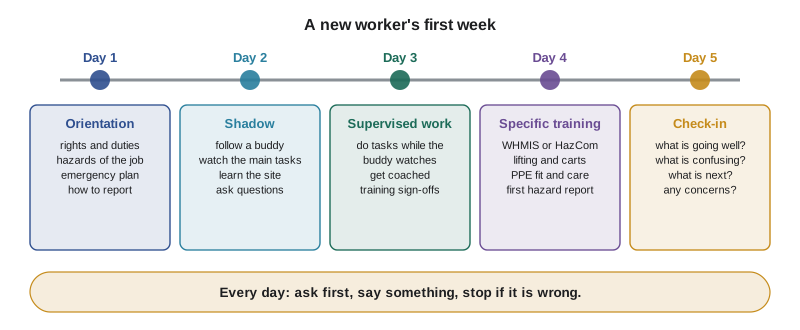
A good employer gives every new worker an orientation before they start work. It should cover, at the very least:
- your rights and duties, and how to raise a concern or refuse unsafe work;
- the main hazards of your job and how they are controlled;
- the PPE you need and how to use and care for it;
- the emergency plan: exits, alarms, the meeting point and first aid;
- how to report hazards, near misses and injuries;
- who your supervisor is, and who the committee members or safety contacts are;
- the rules about violence, harassment and working alone; and
- the training you will get before you do each task.
After orientation, you should be trained on each task before you do it alone, and supervised by someone who knows the work until you can do it safely. Being shown once is not the same as being trained. You should do the task with someone watching who can correct you.
Questions to ask
If your orientation does not cover these, ask. Asking shows you are taking the job seriously, and no reasonable supervisor will hold it against you.
| Question | Why it matters |
|---|---|
| What are the main hazards of my job? | You cannot protect yourself from hazards you do not know about. |
| What training will I get, and when? | You should not do tasks you have not been trained for. |
| What PPE do I need, and where do I get it? | PPE only works if you have the right gear and use it. |
| What do I do if there is a fire or other emergency? | In an emergency there is no time to find out. |
| Who do I go to with a safety concern? | Knowing who to tell makes it easier to speak up. |
| How do I report an injury or a near miss? | Reports fix hazards and protect your rights. |
| Who are the first aid people on my shift? | Seconds count in a medical emergency. |
| Is there anything I should never do here? | Every workplace has a few rules that keep people alive. |
Jordan's answer to the last question, on his own first day, had been three things: never walk in the forklift lane, never reach into a machine that is not locked out, and never go back into a building during an alarm. He passed the same three on to Kayla.
Being a good buddy or mentor
Many workplaces pair new workers with an experienced buddy. A good buddy can make more difference to a new worker's safety than any binder. Doug had been Jordan's buddy. Now Jordan tried to do for Kayla what Doug had done for him:
- Show, then watch, then let go. Show the task, have the new worker do it while you watch and coach, and only then let them do it alone.
- Explain why, not just what. 'Keep the bag close to your body, because it's twice as heavy on your back when it's at arm's length' sticks better than 'lift properly'.
- Point out the hazards that are easy to miss, like the wet ramp in the morning or the blind corner by the warehouse.
- Make questions normal. Ask them often what they are unsure about. New workers rarely volunteer it.
- Model good habits. Wear your PPE, use the walkways and report hazards, because they are watching what you do, not what you say.
- Tell the supervisor if the new worker is being asked to do things they are not ready for.
Capstone: Kayla's first week
Kayla's first week shows the whole course at work.
Worked problem
Day 1 and day 2: orientation and shadowing
Show solution
- Kayla's orientation with Priya covered her rights and duties (Lessons 3 and 4), the emergency plan with a walk to the assembly point (Lesson 10), the main hazards of yard and greenhouse work (Lesson 5), the reporting system (Lesson 6), and the violence and harassment policy (Lesson 11).
- She was issued her PPE and Jordan showed her how to wear each item and when, including the difference between her leather and nitrile gloves (Lesson 8).
- On day 2 she shadowed Jordan, watching and helping with loading orders, watering and moving plant racks. Jordan explained the yard controls: the barrier, the walkways and why customers stay with their cars (Lesson 7).
Answer: Kayla knew her rights, the emergency plan and the main hazards before she did any task on her own.
Worked problem
Day 3 and day 4: supervised work and training
Show solution
- On day 3 Kayla loaded trunks while Jordan watched, using the pallet stand and the cart. Jordan coached her to stand closer to the bumper and to slide heavy bags rather than lift them.
- On day 4 she did her HazCom training with Marisol, then helped in the greenhouse. She found an open bag of perlite next to a fan and asked whether it mattered. Marisol said yes, and showed her how to close and store it (Lesson 9).
- She filed her first hazard report that afternoon: a loose wheel on a plant rack. The rack was tagged out and fixed the next morning, and Priya told her so.
Answer: Supervised practice built safe habits, and her first report showed her that speaking up leads to action.
Worked problem
Day 5: the hard moment
Show solution
- On Friday afternoon, the yard was short-staffed. A busy floor lead asked Kayla to quickly drive the forklift to move one pallet of pots out of the pickup lane.
- Kayla knew she was not trained or allowed to drive the forklift, and that she was not old enough. She also did not want to say no to an adult who was clearly stressed.
- She said, 'I'm not trained on the forklift, and I'm only 17. Can I get Jordan or Doug?' The floor lead stopped, apologized, and radioed Doug.
- At her end-of-week check-in, Kayla told Priya about it. Priya thanked her, and reminded the floor leads at the next huddle who was and was not authorized on each machine.
- Kayla said the hardest part of the week was that moment. Priya said it was also the most important.
Answer: Kayla used her right to refuse work she was not trained or allowed to do, in a calm and clear way, and the workplace learned from it.
Bringing it together
Every lesson in this course comes back to a few ideas:
- Hazards are everywhere, and the job of everyone in the workplace is to find them and control them before they hurt someone.
- The strongest controls change the work, not the worker. Signs, rules and PPE are needed, but they work best as backups.
- Workers have rights, to know, to participate and to refuse, and the law protects them when they use those rights.
- Everyone has duties, and the more control you have, the more you carry.
- Reporting is how workplaces learn. Report hazards, near misses and every injury, and expect to hear back.
- Ask first. Say something. Stop if it's wrong.
Those last three short sentences were the ones Jordan had written on the back of his name tag in his second week. At the end of the summer, he noticed that Kayla had written them on hers.
Where to go next
This course is the starting point of the HSM University safety stream. The next courses in the safety core go deeper into the topics introduced here: HazCom in HSE-102, hazard recognition and risk assessment in HSE-103, protective equipment in HSE-104, fire safety and emergency preparedness in HSE-105, slips, trips and falls in HSE-106, manual handling and ergonomics in HSE-107, violence and harassment in HSE-108, psychological health and safety in HSE-109, and first aid in HSE-110 and HSE-111. Industry-specific courses, such as those for construction, retail, schools and warehouses, build on the same foundation.
Common mistakes
MistakeSaying yes to every task in your first weeks to make a good impression.
InsteadSay when you have not been trained, and ask to be shown first.
MistakeTreating being shown a task once as being trained.
InsteadDo the task with someone watching and correcting you before doing it alone.
MistakeAssuming a new worker will ask if they are unsure.
InsteadAs a buddy or supervisor, ask them often what they are unsure about.
MistakeAsking a young worker to do a task the law bans for their age.
InsteadKnow the age rules and keep a clear list of who may use each machine.
MistakeThinking safety training ends after orientation.
InsteadKeep learning, asking and reporting throughout your time in a job.
Summary and key terms
- Workers in their first month have more than three times the risk of a lost-time injury, at every age.
- Young workers face extra risk because they are often new, in less-trained jobs, unaware of their rights and reluctant to say no.
- In Arizona, federal and state child labor rules limit hours for 14- and 15-year-olds and ban workers under 18 from hazardous jobs such as driving forklifts and operating balers.
- A good orientation covers rights and duties, hazards, PPE, emergencies, reporting, contacts, violence and harassment, and upcoming training.
- New workers should be trained and supervised on each task before doing it alone, and should ask questions every day.
- Good buddies show, watch and then let go, explain why, point out hidden hazards, make questions normal and model good habits.
- New worker
- A worker who is new to a job or workplace, at any age.
- Young worker
- A worker usually defined as under 25.
- Orientation
- The introduction to safety and the workplace that a new worker receives before starting work.
- Hazardous Occupations Orders
- Federal rules that ban workers under 18 from certain dangerous non-farm jobs, such as driving forklifts.
- Buddy
- An experienced worker paired with a new worker to show, coach and watch them.
Practice problems
Work each problem on paper first, then reveal the answer to check.
Give three reasons new workers are at higher risk.
Show answer
Any three: not knowing the hazards, not knowing the safe way, wanting to impress, not knowing their rights, unfamiliar equipment and routines.
How many hours may a 15-year-old work in a school week under federal rules?
Show answer
18 hours, and no more than 3 hours on a school day.
Why could Kayla not drive the forklift, even for one pallet?
Show answer
She was not trained or authorized, and federal rules ban workers under 18 from driving forklifts.
Name four things a good orientation should cover.
Show answer
Any four: rights and duties, hazards, PPE, the emergency plan, reporting, contacts, violence and harassment rules, upcoming training.
What does "show, then watch, then let go" mean for a buddy?
Show answer
Demonstrate the task, coach the new worker while they do it, and only then let them do it alone.
Lesson quiz · 5 questions
Score 60% or more to complete this lesson.
Create a free account to save your progress, take quizzes and earn a certificate.