
HSE-101 · Lesson 8 of 12 · 20 min
Personal protective equipment basics
Jordan's yard kit came in a plastic bin with his name on it: a high-visibility vest, safety glasses, two kinds of gloves, foam earplugs and a hard hat for the days he worked near the loader. He also had a voucher for safety boots. Doug looked at the bin and laughed. 'All that's only any good if you wear it right,' he said. 'Come on, I'll show you.'
Over the next half hour, Doug showed him things the bin did not explain. The leather gloves were for handling paving stones and lumber, not for chemicals; liquid would soak straight through. The nitrile gloves were for the chemical room. The safety glasses had to sit snug against his face, not perched on his forehead. The earplugs had to be rolled thin and pushed well in to work. And the hard hat had a date stamped inside the shell, and an adjustable band that had to be set so it did not fall off when he bent over.
This lesson covers personal protective equipment, or PPE: what it is, when it is used, how to choose and wear it, and how to look after it. HSE-104 Personal Protective Equipment covers the topic in much more depth.
Where PPE fits
Lesson 7 explained that PPE is the last line of defense in the hierarchy of controls. It does not remove the hazard. It reduces harm only if the hazard reaches you, and only if the PPE is right for the hazard, fits, is in good condition and is worn properly. So PPE is used when other controls cannot remove the risk completely, as a backup to them, and sometimes as a short-term measure while better controls are put in place.
That does not make PPE unimportant. Safety boots save toes from dropped paving stones every week in garden centers across the country. Safety glasses save eyes from wood chips, sprays and wire ends. For many tasks, PPE is a required part of doing the job safely, and wearing it is a legal duty for workers.
Who decides what PPE is needed
OSHA's PPE standard, 29 CFR 1910.132, which ADOSH enforces, requires employers to assess the workplace for hazards that need PPE, choose PPE that protects against them, train workers to use it, and certify in writing that the assessment was done. In most cases the employer must pay for the PPE. The main exceptions are ordinary safety-toe boots and prescription safety glasses that the worker is allowed to wear off the job, everyday clothing, and ordinary weather gear. Greenway provides all required PPE and gives each worker a yearly boot allowance.
At Greenway, the PPE needed for each job is listed in the job hazard analysis and on a chart in each work area. When in doubt, the rule is to ask your supervisor before starting.
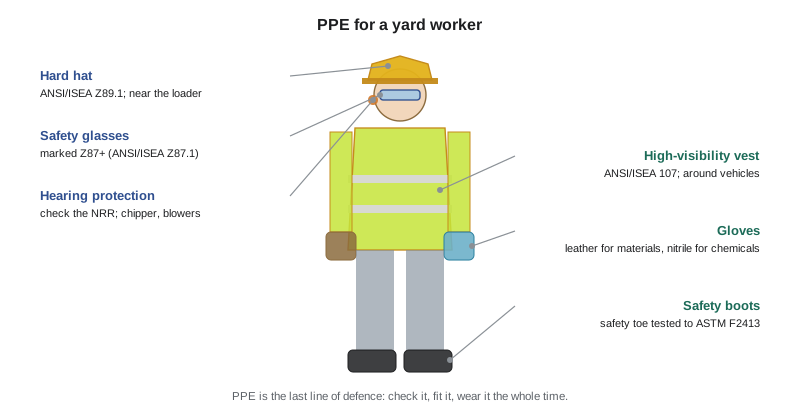
Types of PPE
Eye and face protection
Eye injuries come from flying particles, dust, splashes and sprays. Safety glasses with side shields protect against most flying particles and are worn in the yard and warehouse at Greenway. Goggles seal around the eyes and are used for chemical splashes and fine dust. A face shield protects the whole face, for example when using the wood chipper, but it is worn over safety glasses or goggles, never instead of them. OSHA requires eye and face protection to meet ANSI/ISEA Z87.1, and approved glasses are marked 'Z87', with 'Z87+' for impact rating.
Ordinary prescription glasses and sunglasses are not safety glasses. Workers who wear prescription glasses can use over-the-glasses safety frames, goggles that fit over glasses, or prescription safety glasses.
Hand protection
Hands are injured more often than almost any other part of the body. No single glove protects against everything, so the right glove depends on the hazard:
- Leather or heavy cotton gloves protect against rough materials, splinters and minor scrapes when handling stone, wood, pallets and wire.
- Cut-resistant gloves, rated by level, protect when handling sharp edges such as sheet metal edging or broken pots.
- Chemical-resistant gloves, such as nitrile, neoprene or butyl, protect against chemicals. The right material depends on the chemical; the safety data sheet or product label says which to use.
- Insulated or heat-resistant gloves protect against cold or hot surfaces.
Gloves can also create hazards. A glove can be caught in moving parts, pulling the hand in with it, so gloves are not worn near some rotating machinery, such as a drill press. Ask your supervisor which tasks have this rule.
Foot protection
Safety boots protect against crushing, punctures and slips. At Greenway, all yard and warehouse staff wear boots with protective toes, puncture-resistant soles and slip-resistant treads. In the United States, safety footwear is tested to ASTM F2413, and the label inside the boot shows what protection it gives, such as impact and compression for the toe and puncture resistance for the sole.
Boots wear out. Treads that have worn smooth lose their grip, and a toe cap that has taken a heavy blow may be damaged even if it looks fine. Replace boots when they are worn or after a serious impact.
Hearing protection
Noise above about 85 decibels, averaged over a shift, can damage hearing over time, and the damage is permanent. A rough test: if you have to raise your voice to talk to someone an arm's length away, the noise may be loud enough to need protection. At Greenway, the wood chipper, the leaf blowers and the loader are loud enough to need earplugs or earmuffs. Earplugs only work when they are inserted properly: roll foam plugs thin, pull the ear up and back, push the plug in, and hold it while it expands. Hearing protectors in the United States carry a noise reduction rating, or NRR, on the package.
Head protection
Hard hats protect against falling objects and bumps. At Greenway, they are worn near the loader and when working under the high racking in the warehouse. A hard hat must meet ANSI/ISEA Z89.1, be the right type and class for the hazard, and fit with the suspension adjusted. Check the date stamp: most makers say to replace the shell after a few years and the suspension more often, and any hat that has taken a heavy blow must be replaced.
High-visibility clothing
High-visibility vests and shirts make people easier to see, especially around vehicles. They have bright fluorescent background material and reflective stripes for low light. In the United States, they are covered by ANSI/ISEA 107, which sets classes by how much material they have. A dirty, faded vest loses much of its brightness and should be replaced.
Respiratory protection
Some jobs create dust, mists or fumes that can harm the lungs. The first answer is always better controls, such as ventilation or wetting dusty materials. When a respirator is still needed, it must be the right type for the hazard, and the wearer must be trained, medically able to wear it, and fit-tested so the mask seals on their face. A simple dust mask is not a respirator. At Greenway, only Marisol and one other greenhouse worker use respirators, for certain pesticides, and they are part of a written respiratory protection program. Jordan was told never to borrow one.
Protection against sun, heat and cold
Outdoor work brings its own needs. In Mesa, Greenway provides sunscreen at every station, wide-brimmed hats or hard-hat sun shades, cooling towels and light, loose long-sleeved shirts. These are not a substitute for water, rest and shade, but they help.
PPE in other workplaces
Every industry has its own mix of PPE, but the same ideas apply everywhere. In a restaurant kitchen, workers wear slip-resistant shoes, cut-resistant gloves for slicing, and heat-resistant gloves or mitts for ovens and fryers. In health care and personal care, disposable gloves, masks, gowns and eye protection protect against infection, and staff are trained to put them on and take them off in the right order so they do not contaminate themselves. On construction sites, hard hats, safety boots, high-visibility clothing and eye protection are standard, and anyone working at height where guardrails cannot be used wears a full-body harness connected to a proper anchor, which needs its own training. In offices, PPE is rare, but a worker changing a toner cartridge or using a paper cutter still benefits from knowing what protects them.
Wherever you work, the question is the same: what hazards will reach me if everything else fails, and what will stop them? The answer should be written down in the hazard assessment for the job, and your supervisor should be able to show it to you.
Wearing PPE properly
PPE that does not fit, is worn wrongly or is in poor condition gives a false sense of protection. A few rules apply to all of it:
- Check it before use. Look for cracks, tears, holes, worn treads, frayed straps or expired dates. Do not use damaged PPE; report it and get a replacement.
- Make sure it fits. Loose glasses slip, big gloves catch, a loose hard hat falls off. Ask for a different size if needed.
- Wear it the whole time you are exposed to the hazard, not just when someone is watching.
- Wear it the right way. No hard hats backwards unless the maker allows it, no earplugs half in, no safety glasses on top of the head.
- Do not alter it. Drilling holes in a hard hat or cutting the fingers off chemical gloves destroys the protection.
- Know its limits. Leather gloves do not stop chemicals, and safety glasses do not stop splashes from the side.
Worked problem
Doug's PPE check before the wood chipper
Show solution
- Hard hat: no cracks, date within the maker's limit, suspension snug.
- Face shield over safety glasses: shield is clear and not scratched so badly it blocks his view.
- Hearing protection: earmuffs with seals intact, worn over a hat liner that does not break the seal.
- Gloves: close-fitting leather gloves, no loose cuffs that could catch in the feed.
- Clothing: no loose sleeves, drawstrings or scarves near the feed; high-visibility vest zipped.
- Boots: treads in good condition for the muddy ground around the chipper.
Answer: Two minutes of checking made sure every item would actually protect him, and caught a worn earmuff seal that he swapped before starting.
Looking after PPE
PPE lasts longer and works better when it is cared for. Clean it as the maker says. Store it away from sunlight, heat and chemicals, which can weaken plastics and rubber. Keep safety glasses in a case so the lenses do not get scratched. Throw away single-use items like foam earplugs and disposable gloves after use. Report and replace anything damaged.
PPE that has been contaminated with chemicals needs special care. Chemical gloves are rinsed before they are taken off, then taken off without touching the outside with bare skin. Contaminated clothing is not taken home to wash with the family's laundry.
Why people do not wear PPE, and what helps
People skip PPE for real reasons: it is uncomfortable, hot, it fogs up, it does not fit, it gets in the way, it takes time to put on, or nobody else is wearing it. These are not excuses to ignore. They are signs that something needs fixing. Greenway's committee asked the yard team what made them skip their safety glasses. The answer was fogging in the morning and scratches. The company switched to an anti-fog, scratch-resistant model, and the problem mostly went away.
Common mistakes
MistakeTreating PPE as the main control.
InsteadUse PPE as a backup to elimination, substitution, engineering and administrative controls.
MistakeUsing leather gloves for chemical work.
InsteadCheck the label or safety data sheet and use the glove material it calls for.
MistakeWearing a face shield without safety glasses underneath.
InsteadWear safety glasses or goggles under a face shield.
MistakeUsing damaged or worn-out PPE.
InsteadCheck PPE before each use and replace anything cracked, torn, worn or past its date.
MistakeSkipping uncomfortable PPE without saying anything.
InsteadTell your supervisor; a different model or size often fixes the problem.
Summary and key terms
- PPE reduces harm only if the hazard reaches you, so it backs up stronger controls rather than replacing them.
- Under 29 CFR 1910.132, employers must assess hazards, provide suitable PPE, usually at their cost, train workers and certify the assessment.
- Common PPE includes eye and face protection, gloves, safety boots, hearing protection, hard hats, high-visibility clothing and respirators.
- The right PPE depends on the hazard; for example, glove material must match the chemical.
- PPE must be checked before use, fit properly, be worn correctly the whole time and be replaced when damaged.
- When workers skip PPE because it is uncomfortable or does not fit, the fix is often a better model or size.
- Personal protective equipment (PPE)
- Gear worn by a worker to reduce harm from a hazard, such as gloves, safety glasses and boots.
- Hazard assessment certification
- The written record, required by 29 CFR 1910.132, that the employer assessed the workplace for PPE needs.
- Fit test
- A test that checks a respirator mask seals properly on the wearer’s face.
- Noise reduction rating (NRR)
- A number on hearing protector packaging showing how much it can reduce noise in ideal conditions.
- Z87
- The marking on eye and face protection that meets ANSI/ISEA Z87.1.
Practice problems
Work each problem on paper first, then reveal the answer to check.
Why can a worker not use leather gloves for handling liquid weed killer?
Show answer
Liquid can soak through leather; chemical work needs gloves of the material the label or SDS calls for, such as nitrile.
What must be worn under a face shield?
Show answer
Safety glasses or goggles.
Give a rough test for whether noise is loud enough to need hearing protection.
Show answer
If you have to raise your voice to talk to someone an arm’s length away.
Who pays for most required PPE under OSHA’s rules?
Show answer
The employer, with exceptions such as ordinary safety-toe boots and prescription safety glasses worn off the job.
Why are gloves not worn near some rotating machines?
Show answer
A glove can catch in the moving parts and pull the hand in.
Lesson quiz · 5 questions
Score 60% or more to complete this lesson.
Create a free account to save your progress, take quizzes and earn a certificate.