
HSE-101 · Lesson 7 of 12 · 20 min
Controlling hazards: the hierarchy of controls
The committee meeting in June had one big item on the agenda: the yard. Over the spring, Greenway had logged seven near misses between people on foot and vehicles, including Jordan's first-week near miss with the customer's son. Nobody had been hurt yet. Tom asked the committee what they should do.
The first ideas were the ones people always think of first. 'Remind everyone to watch out.' 'Make the yard staff wear brighter vests.' 'Put up more signs.' Amara let the list grow, then asked a different question. 'What if people on foot and forklifts were never in the same place at the same time? What would that take?'
That question led to the best changes Greenway made all year. It is also the core idea of this lesson. Some ways of controlling a hazard are much stronger than others, and the strongest ones change the work itself rather than relying on people to behave perfectly. Safety professionals arrange them in an order called the hierarchy of controls.
The hierarchy of controls
The hierarchy of controls lists five kinds of controls, from most effective to least effective. The idea is to start at the top and work down, using the strongest control that is practical, and often several together.
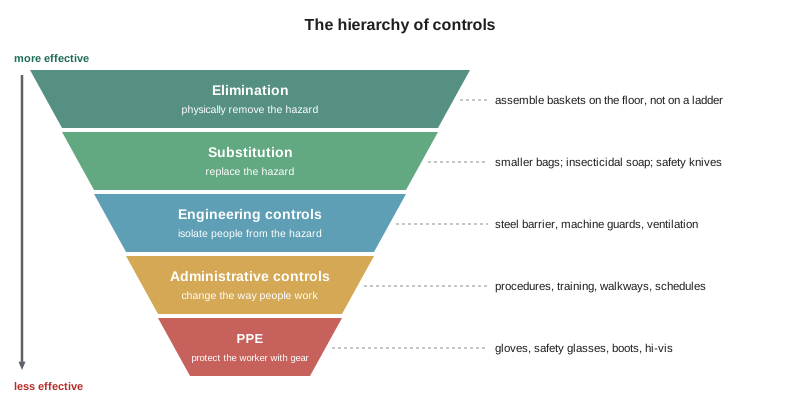
- Elimination removes the hazard completely. If the hazard is gone, it cannot hurt anyone.
- Substitution replaces something hazardous with something less hazardous.
- Engineering controls keep people away from the hazard, or the hazard away from people, by changing the equipment, the building or the process. They work without anyone having to remember anything.
- Administrative controls change the way people work: procedures, training, schedules, signs, permits and rules.
- Personal protective equipment, or PPE, is gear the worker wears to reduce harm if they are exposed: gloves, safety glasses, boots, hearing protection, high-visibility vests and so on.
The top three change the hazard or the workplace. The bottom two depend on people doing the right thing every time. People are human: they forget, they rush, they get tired, they take shortcuts when they are busy. Controls at the bottom of the hierarchy fail when people do. That is why they should be used to back up stronger controls, not instead of them.
The hierarchy is used in standards and guidance in both Canada and the United States, including CSA Z45001 and ANSI/ASSP Z10.0, and NIOSH publishes a well-known version of the diagram.
Elimination
Elimination is the strongest control because it removes the hazard. It is often easiest at the design stage, when a building, a process or a job is first planned. Some examples:
- Doing work at ground level instead of at height, so nobody can fall. Greenway now assembles its hanging basket displays on the floor and raises them with a pulley system, instead of having someone climb a ladder to hang each basket.
- Removing a task altogether. Greenway stopped breaking down cardboard by hand with box cutters at the store tills by having suppliers ship plants on returnable trays.
- Removing an unneeded hazard. An old, unused propane heater in the potting shed was taken out of the building.
Elimination is not always possible. Greenway cannot eliminate forklifts or soil bags; they are the business. But it is always worth asking first, because sometimes the answer is surprisingly simple.
Substitution
Substitution replaces a hazard with a less dangerous one. The job still gets done, but with less risk.
- A less toxic product for the same job, such as an insecticidal soap instead of a more hazardous insecticide for greenhouse pests.
- Fertilizer in pellets instead of fine powder, which makes far less dust.
- Smaller bags: Greenway asked its supplier for 22 lb (10 kg) bags of rock salt instead of 44 lb (20 kg) bags. Fewer back strains, and customers liked them too.
- Electric forklifts instead of propane ones inside the warehouse, which removes exhaust fumes and the work of changing propane cylinders.
- Self-retracting safety knives instead of fixed-blade box cutters, from Lesson 6.
Substitution needs care. A substitute can bring new hazards. An electric forklift is quieter, which is good for hearing but means people on foot may not hear it coming. That is why Greenway fitted blue warning lights that shine on the floor ahead of and behind each forklift.
Engineering controls
Engineering controls do not remove the hazard, but they put something physical between it and the people. Once installed, they work on their own. Examples include:
- Guards on machines, such as the cover on the wood chipper's feed and the interlocked door on the cardboard baler, which stops the machine if the door is opened.
- Barriers that separate people from vehicles, such as the steel barrier between the pickup lane and the forklift lane.
- Ventilation that removes dust or fumes, such as the extraction fan in the potting area where bags of soil mix are opened.
- Lifting aids, such as pallet stands that raise loads to waist height, carts, and a vacuum lifter for paving stones.
- Anti-slip surfaces, drains and handrails.
- Automatic shut-offs and alarms, such as a backup alarm on a forklift.
Engineering controls usually cost more up front than signs or training. But they keep working day after day, on busy Saturdays and slow Tuesdays, for new workers and old hands alike. Over time, they are often the cheapest choice too.
Administrative controls
Administrative controls change how people work. They are needed in almost every workplace, but they depend on people knowing them, remembering them and following them. Examples include:
- Safe work procedures, such as the steps for loading a trunk or operating the baler.
- Training, including the forklift course and the chemical training in Lesson 9.
- Scheduling, such as doing the heaviest loading early in the morning before the hottest part of the day, or rotating tasks so nobody lifts bags for a whole shift.
- Permits and sign-offs, such as the rule that only trained and signed-off staff may use the forklift or the baler.
- Signs and markings, such as painted walkways and the 'Customers stay with your vehicle' sign.
- Rules, such as no phones while walking in the yard, and keeping 10 ft (3 m) clear of a forklift carrying a load.
- Inspections and maintenance, such as the pre-shift forklift check.
A sign or a rule on its own is a weak control. 'Watch for forklifts' asks people to stay alert all day in a noisy, busy place. It is better than nothing, but it works best as one part of a set of controls.
Personal protective equipment
PPE is the last line of defense. It does not change the hazard at all. It only reduces the harm if the hazard reaches you, and only if it is the right equipment, fits properly, is in good condition and is worn correctly every time. Gloves that are the wrong material can let a chemical soak through. Safety glasses pushed up on someone's head protect nothing.
PPE is still very important. For many tasks, it is the control that stands between a worker and an injury when everything else fails. Lesson 8 covers it in detail.
Using the hierarchy together
Most hazards are controlled by several layers at once. If one layer fails, another catches the problem. Here is how the committee's yard plan used every level.
| Level | Greenway's yard controls for people and vehicles |
|---|---|
| Elimination | Customers no longer walk into the yard to pick out stones; staff bring orders to the pickup lane. |
| Substitution | Bulk soil and mulch for large orders delivered by truck, so fewer customer vehicles enter the yard. |
| Engineering | Fixed steel barrier with one gate between the pickup lane and forklift lane; blue floor lights and backup alarms on forklifts; a convex mirror at the blind corner. |
| Administrative | Painted walkways; a one-way route for forklifts; a 10 ft (3 m) clear zone around loads; staff must make eye contact with drivers before crossing; forklift training and pre-shift checks. |
| PPE | High-visibility vests and safety boots for all yard staff. |
Look at where the brighter vests ended up: at the bottom, as one small part of the plan. On their own, they would have made people slightly easier to see. With the barrier and the new pickup routine, people on foot and forklifts are rarely in the same space at all. In the six months after the changes, the yard logged one near miss between a person and a vehicle, down from seven in the spring.
Worked problem
Working up the hierarchy: pesticide spraying in the greenhouse
Show solution
- The hazard: Marisol sprays an insecticide on greenhouse plants twice a month. The product can irritate skin, eyes and lungs, and its label requires gloves, eye protection and a waiting time before others re-enter.
- Elimination: Can the pests be prevented instead? Yellow sticky traps, screens on vents and inspecting new stock before it goes in reduced the pest problem, so spraying dropped to once a month.
- Substitution: For aphids, an insecticidal soap now replaces the stronger product for most treatments. Beneficial insects, such as ladybugs, are used in one greenhouse.
- Engineering: A closed-transfer measuring system means the concentrate is never poured by hand, and spraying is done after closing with the greenhouse fans running to the outside.
- Administrative: Only trained staff may spray; a sign and a rope block the door until the re-entry time on the label has passed; the spray log records what, when and where.
- PPE: Marisol still wears the chemical-resistant gloves, goggles and coveralls the label requires, because some exposure is still possible.
Answer: Each level reduced the risk, and PPE became a backup instead of the only protection.
The hierarchy and the weather: working in heat
Mesa summers are brutal, and the yard stays busy. Heat can cause heat exhaustion and heat stroke, which can kill, and it makes people tired and more likely to make mistakes. Greenway's heat plan shows the hierarchy at work. Elimination and substitution: from June to September, the heaviest loading moves to the first hours after opening, and bulk deliveries are scheduled for early morning. Engineering: shade structures cover the pickup lane and the potting area, misting fans run in the loading area, and the forklift has a shaded cab. Administrative: new and returning workers build up their time in the heat gradually over their first week or two, everyone gets water, rest and shade breaks that get longer as the heat index climbs, workers watch each other for warning signs, and heavy outdoor work stops at the highest set point. PPE: light-colored, loose clothing, wide-brimmed hats or hard-hat shades, and cooling towels.
Look at the order again. Moving the heavy work out of the hottest hours does more than any hat ever could.
Choosing controls
When you are part of choosing controls, a few questions help:
- Can we get rid of the hazard altogether?
- Can we use something less dangerous?
- Can we put a physical barrier or device between people and the hazard?
- What procedures, training and supervision are needed?
- What PPE is still needed for what is left?
- Does the control create any new hazards?
- Will it work on the worst day, not just a good one?
- Have the people who do the job been asked? They often know which controls will actually work.
Checking that controls work
A control that is not working is not a control. Guards get removed and not replaced. Mirrors get knocked out of position. Procedures drift as people find shortcuts. So controls need checking: during inspections, in pre-shift checks, by watching how work is actually done, and by asking workers. When Greenway checked the yard plan after a month, they found the gate in the steel barrier was being propped open on busy days. The fix was a self-closing hinge.
Common mistakes
MistakeJumping straight to signs, reminders and PPE.
InsteadStart at the top of the hierarchy and use the strongest practical control.
MistakeRelying on one control alone.
InsteadUse several layers so that if one fails, another catches the problem.
MistakeAssuming a substitute is automatically safe.
InsteadCheck whether the substitute brings new hazards, like quiet electric forklifts.
MistakeInstalling a control and never checking it again.
InsteadCheck controls regularly to make sure they are still in place and working.
MistakeChoosing controls without asking the workers who do the job.
InsteadInvolve workers; they know what will work in practice.
Summary and key terms
- The hierarchy of controls ranks controls from most to least effective: elimination, substitution, engineering, administrative and PPE.
- Elimination and substitution change the hazard itself; engineering controls separate people from the hazard.
- Administrative controls and PPE depend on people doing the right thing every time, so they are weaker on their own.
- Most hazards are best controlled with several layers together.
- Substitutes and new controls can bring new hazards, which must be checked.
- Controls must be checked regularly to make sure they are still in place and working.
- Hierarchy of controls
- A ranking of ways to control hazards, from the most effective to the least.
- Elimination
- Removing a hazard completely.
- Substitution
- Replacing a hazard with something less dangerous.
- Engineering control
- A physical change, such as a guard, barrier or ventilation, that separates people from a hazard.
- Administrative control
- A change in how people work, such as a procedure, training, schedule or sign.
Practice problems
Work each problem on paper first, then reveal the answer to check.
List the five levels of the hierarchy of controls, from most to least effective.
Show answer
Elimination, substitution, engineering controls, administrative controls, PPE.
Classify: an interlocked door on the cardboard baler.
Show answer
Engineering control.
Classify: switching from 44 lb (20 kg) to 22 lb (10 kg) bags of rock salt.
Show answer
Substitution.
Why were brighter vests a weak answer to the yard near misses on their own?
Show answer
They depend on drivers seeing people and people staying alert; they do nothing to keep people and vehicles apart.
What new hazard came with electric forklifts, and how was it controlled?
Show answer
They are quiet, so people may not hear them; blue floor lights were fitted.
Lesson quiz · 5 questions
Score 60% or more to complete this lesson.
Create a free account to save your progress, take quizzes and earn a certificate.