
HSE-101 · Lesson 6 of 12 · 21 min
Reporting hazards, near misses and injuries
Six weeks into the job, Jordan cut his hand. He was opening a carton of plant pots with a box cutter, the blade slipped on the tape, and it caught the side of his left palm. It was not deep, but it bled a lot. One of the cashiers, a trained first aid responder, cleaned and bandaged it in the staff room. Jordan felt silly, and his first thought was to go back to work and say nothing more about it. It was only a cut. He did not want to be the new guy who made a fuss.
Priya found out anyway, because the first aid responder filled in the first aid record, as Greenway's procedure says. She came to see Jordan and asked him to fill in an injury report with her. 'This is exactly the kind of thing I want to know about,' she said. 'You got lucky. The next person might get the blade in their wrist. And if that cut gets infected next week, you'll want a record that it happened here.'
This lesson covers why reporting matters, what to report, how to report it, and what should happen after you do.
Why reporting matters
Every report is information. A hazard report tells the workplace about something that could hurt someone. A near-miss report shows where an injury almost happened. An injury report shows where the controls failed. Without reports, the people who can fix problems do not know the problems exist.
Reports also protect you. If you are hurt at work, a report made at the time is the best evidence that the injury happened on the job. It supports a workers' compensation claim if you need medical care or time off later. Many injuries that seem minor at first, like a strained back, a cut that gets infected, or a knock to the head, turn out to be worse a day or a week later.
And reports help everyone else. When Priya looked at the box cutter injury, she found two other cuts from box cutters in the past year, both reported only in the first aid book. Together, they showed a pattern. Greenway switched to self-retracting safety knives in receiving and the store, which pull the blade back as soon as it leaves the material. In the year after the change, there were no more box cutter cuts.
What to report
The rule at Greenway is simple: if in doubt, report it. In general, you should report:
- Hazards: anything you notice that could hurt someone, like a broken step, a missing guard, a leaking container, a blocked exit, a faulty tool or an unsafe way of doing a job.
- Near misses: events where nobody was hurt but someone could have been, like a pallet that slid off the forks, a customer who stepped into the forklift lane, or a ladder that wobbled.
- Injuries and illnesses, however small, including those treated with first aid only. Also report symptoms that you think might be from work, such as a rash after handling a product, or pain that builds up over days of lifting.
- Damage to equipment, vehicles or property, even if no one was near it.
- Violence, threats and harassment, which Lesson 11 covers.
- Unsafe acts that put people at risk, such as a co-worker riding the forks, after speaking to the person directly if you can.
How to report
Every workplace should have a clear way to report. At Greenway, there are several ways, so nobody has an excuse not to:
- Tell your supervisor in person, as soon as you can. This is always the first step for anything urgent.
- Fill in the online form through the QR code posted in every work area, or on the staff tablet in the yard office.
- Use the paper forms in the staff room for anyone who prefers paper.
- Talk to a committee member if you are not comfortable going to your supervisor.
Whatever the method, a good report answers a few simple questions. The more specific it is, the easier it is to fix.
| Question | Example from Jordan's report |
|---|---|
| What happened? | Box cutter slipped on packing tape while opening a carton of pots; blade cut left palm. |
| Where and when? | Receiving table in the warehouse, Tuesday at about 10:15 a.m. |
| Who was involved or saw it? | Jordan Reyes; first aid given by Sam Whitford. |
| What was the injury or damage? | Cut 0.8 in (about 2 cm) long, cleaned and bandaged; no stitches. |
| What could have happened? | A deeper cut to the wrist or thigh if the blade had slipped further. |
| Why do you think it happened? | Fixed-blade cutter, thick tape, cutting toward the other hand. |
| What would help? | Safety knives with a self-retracting blade; a short training on cutting away from the body. |
A report is not a confession, and it is not a complaint about a co-worker. It is information to fix a problem. Stick to the facts, describe what you saw, and say what you think would help. You do not need to know the cause for certain.
When to report
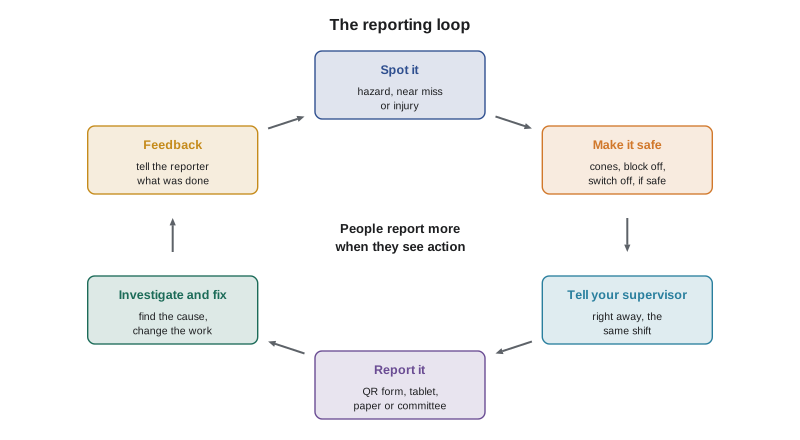
Report as soon as you can, ideally the same shift. Memories fade quickly. Conditions change: the spill gets mopped up, the broken pallet gets thrown out, the witness goes home. And a hazard that is not reported today might hurt someone tomorrow.
For anything that is an immediate danger, act first and report right after. Make the area safe if you can do it safely, for example by putting out cones, blocking off the area or switching off a machine, and get your supervisor straight away. Do not leave a hazard unattended while you go to fill in a form.
Reporting injuries: what the law requires
When a worker is injured at work in Arizona, a few legal steps follow:
- The worker should tell the employer about the injury as soon as possible, even if it seems minor. In Arizona, a worker can file a claim for compensation with the employer's insurer or with the Industrial Commission of Arizona, and the employer must tell the worker who its insurer is.
- The employer must report the injury to its workers' compensation insurer promptly.
- Serious injuries must be reported to ADOSH under OSHA's rules: a work-related death within 8 hours, and an inpatient hospitalization, an amputation or the loss of an eye within 24 hours.
- Most employers with more than 10 workers must keep the OSHA 300 log of work-related injuries and illnesses that need more than first aid, post a yearly summary called the 300A from February 1 to April 30, and keep the records for five years. Workers have the right to see the log.
Jordan's cut needed only first aid, so it was not recordable on the OSHA 300 log. It still went in Greenway's first aid record and on an internal injury report. If it had needed stitches from a doctor, or caused him to miss work, it would have gone on the log and been reported to the insurer.
OSHA's recordkeeping rule says employers must have a reasonable way for workers to report injuries and must not discourage or retaliate against workers who report. A rule that punishes workers for being hurt, or rewards teams for having no reported injuries, can lead people to hide injuries, which is dangerous and can break the rule.
What happens after you report
A report should never disappear into a drawer. At Greenway, every report gets the same treatment:
- Immediate action. The supervisor makes the area safe if that has not already been done.
- A look into it. For small things, the supervisor checks and fixes it. For injuries and serious near misses, the supervisor investigates with the worker and, for serious events, with a committee member. The goal is to find out why it happened, not who to blame.
- A fix. The supervisor decides what to change. Bigger fixes go to Tom or the committee.
- Feedback. The person who reported hears back about what was done, usually within a week. If nothing can be done right away, they are told why and what happens next.
- Review. The committee looks at all reports each month for patterns, like the three box cutter cuts.
Feedback is the part that most workplaces forget. If people report and never hear back, they stop reporting. When Priya told Jordan about the new safety knives, she made a point of saying his report was what started it. 'You'd be amazed how many reports we got after people heard that story,' she said.
Worked problem
Turning near misses into a fix
Show solution
- Over three weeks in April, the near-miss forms showed four reports of people slipping, but not falling, on the ramp from the store to the greenhouse.
- Each report alone looked minor. Together, they showed a problem at one spot, all in the morning.
- Marisol and Amara looked at the ramp at 8 a.m. The overhead sprinklers in the first greenhouse sprayed past the door, wetting the ramp's smooth painted surface every morning.
- The fix had three parts: the sprinkler heads near the door were adjusted, the ramp got a gritty anti-slip coating, and a drain mat was laid at the bottom.
- Marisol posted a note on the staff board thanking the four people who reported, and the slips stopped.
Answer: Four near-miss reports found a hazard before anyone was hurt, and the fix removed it rather than asking people to walk more carefully.
Reporting symptoms that build up
Not every work injury has a moment you can point to. Some build up slowly: an ache in the wrist after weeks of potting plants, a cough that gets worse on days spent bagging soil, a rash that keeps coming back after watering with a certain fertilizer mix, ringing in the ears after shifts near the wood chipper. These are harder to report, because there is no single event, and people often assume they will go away.
Report them anyway, and report them early. Tell your supervisor what you notice, when it started and what you were doing. Early reports give the workplace a chance to change the task before the problem becomes permanent, and they create a record linking the symptoms to work if you need treatment later. Marisol reported wrist pain in her second spring at Greenway. The fix, a set of lighter potting tools and swapping tasks every hour, cost less than one week of a lost-time claim.
Why people do not report, and what helps
Even in good workplaces, many hazards and injuries go unreported. Knowing why helps you and your workplace do better. Common reasons include:
- Fear of blame or discipline, which is the most powerful reason. Workplaces that respond to reports by asking 'who did it?' get fewer reports.
- Not wanting to look weak or make a fuss, which is common among new and young workers, and in jobs where toughness is admired.
- Thinking it is too small to matter.
- Thinking nothing will be done, often because past reports were ignored.
- Not knowing how, or finding the process too slow or complicated.
- Pressure to keep injury numbers low, especially when bonuses or awards depend on them.
Greenway tackled these one at a time. Tom told every staff meeting that reports would never lead to blame for honest mistakes. The QR code made reporting take under a minute. Feedback became routine. And the safety award the yard team used to get for 'days without an injury' was replaced with one for the best idea that came from a report.
Common mistakes
MistakeNot reporting a minor injury because it seems too small.
InsteadReport every injury, including first aid cases; small ones show where big ones can happen.
MistakeWaiting until the end of the week to report.
InsteadReport the same shift, while details are fresh and before conditions change.
MistakeLeaving a dangerous hazard to go and fill in a form.
InsteadMake it safe if you can, tell your supervisor, then report.
MistakeWriting reports that blame a person.
InsteadStick to facts about what happened, what could have happened and what would help.
MistakeNever telling the reporter what was done.
InsteadGive feedback, so people know reporting makes a difference.
Summary and key terms
- Reports of hazards, near misses and injuries are information that lets the workplace fix problems before someone is hurt.
- Report hazards, near misses, all injuries and illnesses, damage, violence and harassment, and unsafe acts.
- A good report says what happened, where and when, who was involved, what could have happened and what would help.
- Report the same shift; for immediate dangers, make the area safe and tell your supervisor first.
- Under OSHA's rules, deaths must be reported within 8 hours and hospitalizations, amputations and eye losses within 24 hours; most employers with more than 10 workers keep the 300 log.
- Every report should lead to action and feedback; people stop reporting when they never hear back.
- Hazard report
- A report of a condition or practice that could cause harm.
- Near-miss report
- A report of an event where nobody was hurt but someone could have been.
- First aid record
- A record of every injury treated with first aid, kept by the workplace.
- OSHA 300 log
- The log of work-related injuries and illnesses beyond first aid that most employers with more than 10 workers must keep.
- Recordable injury
- A work-related injury or illness that must go on the OSHA 300 log, such as one needing medical treatment beyond first aid or time away from work.
Practice problems
Work each problem on paper first, then reveal the answer to check.
Why did Priya want Jordan to report a small cut?
Show answer
To fix the cause before someone was hurt worse, and to have a record in case the injury got worse later.
What should you do first if you find a chemical spill in an aisle?
Show answer
Make the area safe if you can do so safely, such as by putting out cones and keeping people away, and tell your supervisor right away.
List four things a good report should include.
Show answer
Any four: what happened, where and when, who was involved, the injury or damage, what could have happened, why you think it happened, what would help.
Within how many hours must a work-related death be reported under OSHA’s rules?
Show answer
Eight hours.
Name two reasons people do not report, and one fix for each.
Show answer
Examples: fear of blame, fixed by a clear no-blame message; too slow, fixed by a quick QR form; nothing happens, fixed by routine feedback.
Lesson quiz · 5 questions
Score 60% or more to complete this lesson.
Create a free account to save your progress, take quizzes and earn a certificate.