
HSE-101 · Lesson 2 of 12 · 21 min
How health and safety law works in Saskatchewan
On Jordan's second day, a poster in the staff room caught his eye. It listed phone numbers for the OHS Division and for the WCB, and it said every worker had rights under the law. He asked Amara Okafor, a cashier who had worked at Greenway for six years, what the poster was for. 'It's the law that says it has to be there,' she said. 'I'm on the occupational health committee, so I'll tell you the short version over lunch.'
Most workers never read a health and safety law, and they do not need to read every word. But knowing how the system works helps you understand why your employer does what it does, what you can expect, and where to go if something is wrong. This lesson explains who makes the rules in Saskatchewan, who enforces them, and how the parts fit together.
Who makes the rules in Canada
In Canada, most workplace health and safety law is made by the provinces and territories, not the federal government. Each one has its own act and regulations. About nine out of ten Canadian workers are covered by the law of the province or territory where they work. The rest work in federally regulated industries, such as banks, airlines, railways, interprovincial trucking, telecommunications and the federal public service, and are covered by Part II of the Canada Labour Code.
Because each province writes its own law, the details differ across the country. The basic ideas are much the same everywhere: employers must keep the workplace safe, workers have rights to know, participate and refuse, and a government agency inspects and enforces. When you move to a job in another province, the main ideas will be familiar, but some details, such as when a committee is required or how a work refusal is handled, may change.
Saskatchewan's law
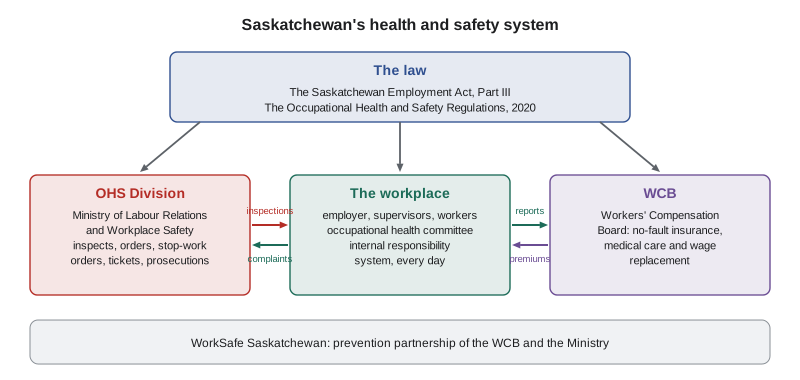
Greenway is a provincially regulated business in Saskatchewan, so the law that applies is The Saskatchewan Employment Act. Part III of the Act covers occupational health and safety. It sets out the general duties of employers, supervisors, workers and others, the rights of workers, the rules for occupational health committees, and the powers of inspectors. The details are filled in by The Occupational Health and Safety Regulations, 2020, which cover specific topics such as first aid, protective equipment, machine guarding, ladders, noise, chemicals, violence, working alone and much more.
The Act and regulations are enforced by the Occupational Health and Safety Division of the Ministry of Labour Relations and Workplace Safety, which this course calls the OHS Division. Its occupational health officers inspect workplaces, investigate serious incidents and complaints, and can order an employer to fix a problem.
Acts, regulations and guidance
It helps to know the difference between the main kinds of rules.
- An act is a law passed by the legislature. It sets out the big principles and gives the government power to make more detailed rules.
- Regulations are detailed rules made under the act. They have the force of law. A regulation might say exactly how high a guardrail must be or how many first aid kits a workplace needs.
- Codes of practice and guidelines explain how to meet the law. Some are referred to in the regulations; others are advice.
- Standards from groups such as CSA Group set out technical requirements for things like safety boots, eye protection and machinery. When a regulation refers to a standard, following it becomes part of the law.
When Amara explained this, Jordan asked why there needed to be so many layers. 'Because the act can't list every ladder and every chemical,' she said. 'It says the employer has to keep us safe. The regulations say how.'
The internal responsibility system
Canadian health and safety law is built on an idea called the internal responsibility system, or IRS. The idea is that the people inside the workplace, who know the work best, are responsible for making it safe, each within their own authority. The employer has the most responsibility, because it controls the money, equipment and organization. Supervisors are responsible for the work they direct. Workers are responsible for their own actions and for telling others about hazards. The occupational health committee brings workers and management together to find and solve problems.
Inspectors are not supposed to be the main way a workplace stays safe. They visit occasionally. The people inside the workplace are there every day. The IRS works when everyone does their part, and it fails when one link, such as a supervisor who ignores reports, breaks. Inspectors step in when the internal system is not working.
Inspections and enforcement
Occupational health officers can enter a workplace at any reasonable time to inspect it. They may come on a planned visit, after a complaint, or after a serious injury or death. During an inspection they can look at equipment and records, take photographs and samples, and talk to workers, supervisors and committee members.
If an officer finds a problem, they can require the employer to fix it by a certain date, often through a compliance undertaking or a notice of contravention. If there is an immediate risk of serious harm, the officer can issue a stop-work order until the hazard is controlled. Saskatchewan can also issue tickets for some offences, and employers can be prosecuted in court, with large fines for serious cases.
In the most serious cases, criminal law also applies. In 2004, after the Westray mine explosion killed 26 miners in Nova Scotia, the Criminal Code was changed. Section 217.1 says anyone who directs how work is done has a legal duty to take reasonable steps to prevent bodily harm. Organizations and individuals who show reckless disregard for workers' lives can be charged with criminal negligence.
Workers' compensation
Workers' compensation is a separate system from the OHS Division. In Saskatchewan, it is run by the Saskatchewan Workers' Compensation Board, or WCB, under The Workers' Compensation Act, 2013. It works like insurance. Employers pay premiums into the system. When a worker is injured or made ill by work, the WCB pays for medical care and replaces part of their lost wages, no matter who was at fault. In return, workers generally cannot sue their employer over a work injury.
The WCB also works on prevention. Together with the Ministry, it runs WorkSafe Saskatchewan, which publishes safety information and campaigns for the province.
A short history
Saskatchewan has a special place in this story. In 1972 it passed the Occupational Health Act, one of the first laws in North America to give workers the right to refuse dangerous work and to require joint worker and management committees. Bob Sass, who led the province's occupational health branch at the time, argued that workers should have a real voice in their own safety, not just be protected by inspectors. Those ideas, the rights to know, to participate and to refuse, spread to the rest of Canada over the following years and are now in every province's law.
Laws tend to change after tragedies. The Westray disaster led to changes in the Criminal Code. Deaths of young workers have led to new rules about training and supervision. The 2024 change that made every Saskatchewan employer adopt a violence policy and prevention plan came after years of reports about violence against workers in retail, health care and other jobs. The law keeps growing as people learn where workers are getting hurt.
What the law expects in practice
The details of the law fill thousands of pages, but for a new worker the main expectations of an employer can be summed up in a short list. Whatever the job, the law expects the employer to:
- find the hazards in the work and control them;
- give workers the information, training and supervision they need to work safely;
- provide and maintain safe equipment, tools and protective equipment;
- involve workers in safety, through a committee, a representative or other ways of taking part;
- keep the records the law requires, such as training records and injury reports;
- plan for emergencies and provide first aid;
- report serious incidents to the regulator; and
- never punish a worker for raising a safety concern or using their rights.
Workers have a shorter list. The law expects them to work safely, follow the rules and procedures, use the protective equipment they are given, report hazards and injuries, and not put others in danger. Lesson 4 looks at these duties more closely, including the important role of supervisors.
Amara made one more point. 'The law also cares about people who aren't employees,' she said. 'Customers, delivery drivers, contractors who come to fix the coolers. If we leave a pallet hanging over the aisle and it falls on a customer, that's on us too.'
Jordan asked what happens when a rule does not fit the job. Amara said it happens more than people think. A procedure might have been written for an old machine, or for a quiet day, or by someone who never did the job. 'You don't just ignore it, and you don't just suffer through it,' she said. 'You tell Priya, or you tell the committee, and we fix the procedure or fix the job. That's what the committee is for.' The law expects rules to be followed, but it also expects employers to listen when workers say a rule is not working, and to keep their procedures up to date.
Where to find the rules
You do not need to memorize the law, but you should know where to find help. At Greenway, Jordan found information in four places:
- The staff room board, which had the committee members' names, minutes of the last committee meeting, the poster with phone numbers for the OHS Division and the WCB, and the emergency plan.
- The safety binder and the staff tablet, with Greenway's safety program, written procedures and safety data sheets.
- The people: his supervisor, the committee members and the experienced workers.
- Government websites, including the Government of Saskatchewan's pages on workplace safety and WorkSafe Saskatchewan, which publish the Act, the regulations and plain-language guides.
Where Greenway fits in
After lunch, Amara showed Jordan how the system looked at Greenway. The company had a written safety program in a binder and on the staff tablet. It had a occupational health committee with members from the store, the greenhouse, the yard and management, which met every month. It had a way to report hazards and near misses, which Jordan had already used. It had trained first aiders on every shift, written procedures for the forklifts and the chemical room, and a plan for emergencies.
'All of that is the law asking for it,' Amara said, 'but it's also just how you run a decent place. The law sets the floor. Tom wants us above the floor.'
Worked problem
Finding the right rule
Show solution
- Jordan wondered whether Greenway had to give him training before he used the cardboard baler in the warehouse.
- Amara showed him how to look it up. The Act sets the general duty: the employer must make sure workers are trained in any matter needed to protect their health and safety.
- The regulations add detail about training and about machine safety, including guards and lockout.
- Greenway's own procedure for the baler, which follows those rules, says nobody uses it until they have been trained, signed off by a supervisor, and are 16 or older.
- Jordan's training on the baler was booked for his second week.
Answer: The act sets the general duty, the detailed rules say how, and the workplace procedure turns both into steps workers follow.
Common mistakes
MistakeThinking safety is the government's job.
InsteadRemember that the people in the workplace are responsible every day; inspectors are the backstop.
MistakeAssuming the law is the same in every province.
InsteadCheck the act and regulations where you work; the main ideas are similar, but details differ.
MistakeConfusing workers' compensation with the safety regulator.
InsteadKnow that the WCB pays for injuries and the OHS Division enforces the safety law.
MistakeTreating the law as the most a workplace should do.
InsteadSee the law as the minimum; good employers aim higher.
MistakeThinking you need to read every regulation.
InsteadKnow how the system works and where to look, and ask your supervisor or committee.
Summary and key terms
- In Canada, most workplace health and safety law is provincial; federally regulated workers are covered by the Canada Labour Code.
- In Saskatchewan, Part III of The Saskatchewan Employment Act and The Occupational Health and Safety Regulations, 2020 set the rules.
- The OHS Division enforces the law through inspections, orders, stop-work orders, tickets and prosecutions.
- The internal responsibility system makes everyone in the workplace responsible for safety within their authority.
- Section 217.1 of the Criminal Code allows criminal charges when those directing work show reckless disregard for safety.
- Workers' compensation is a separate, no-fault insurance system that pays for work injuries and illnesses.
- Act
- A law passed by a legislature that sets out the main principles and allows more detailed rules to be made.
- Regulation
- A detailed rule made under an act that has the force of law.
- Internal responsibility system (IRS)
- The principle that everyone in the workplace is responsible for health and safety within their own authority.
- Occupational health officer
- A government inspector who enforces health and safety law in Saskatchewan.
- Workers' compensation
- A no-fault insurance system that pays for medical care and lost wages after work injuries and illnesses.
Practice problems
Work each problem on paper first, then reveal the answer to check.
Which law covers health and safety at Greenway in Saskatoon?
Show answer
Part III of The Saskatchewan Employment Act, with The Occupational Health and Safety Regulations, 2020.
Name two industries covered by the Canada Labour Code instead of provincial law.
Show answer
Any two of banks, airlines, railways, interprovincial trucking, telecommunications and the federal public service.
What is the internal responsibility system?
Show answer
The idea that everyone in the workplace is responsible for safety within their own authority, with the employer carrying the most responsibility.
What can an occupational health officer do if there is an immediate risk of serious harm?
Show answer
Issue a stop-work order until the hazard is controlled.
What is the difference between the WCB and the OHS Division?
Show answer
The WCB runs no-fault compensation for work injuries; the OHS Division enforces the health and safety law.
Lesson quiz · 5 questions
Score 60% or more to complete this lesson.
Create a free account to save your progress, take quizzes and earn a certificate.