
HSE-101 · Lesson 1 of 12 · 24 min
Why workplace safety matters
Jordan Reyes was nineteen when he started as a yard and warehouse associate at Greenway Garden Supply Inc. in Mesa, Arizona. Greenway is a mid-size business: a garden center with a store and two greenhouses, a landscape supply yard full of soil, mulch, gravel and paving stones, a warehouse with two forklifts, and three delivery trucks. In the spring rush it employs about 85 people. In the quiet months it keeps about 40.
On his first morning, Jordan expected a tour, a uniform shirt and a name tag. He got all three. He also got two hours with his supervisor, Priya Nair, in the staff room, going through a binder and a short video. Near the end, Priya asked him a question. 'What do you think is the most dangerous thing you'll do here?'
Jordan guessed driving the forklift. Priya shook her head. 'You won't touch a forklift until you're trained, so that's not it. The thing most likely to hurt you this year is lifting bags of soil the wrong way. After that, slipping in the greenhouse. After that, a box cutter.' She paused. 'The thing most likely to kill someone here is a person on foot getting hit by a forklift or a truck in the yard. That's why the walkways are painted, and that's why you'll hear me nag about them.'
This course follows Jordan through his first weeks at Greenway. It is the first course in the HSM University safety stream, and it is written for anyone starting a new job in any industry: a store, a warehouse, an office, a kitchen, a farm, a factory, a clinic or a building site. The details change from one workplace to another, but the basic ideas are the same everywhere. This first lesson explains why safety matters, what the numbers say, and what the rest of the course will cover.
What we mean by safety
Workplace health and safety means preventing harm to people because of their work. That includes injuries that happen in a moment, like a cut, a fall or a crushed foot. It also includes illnesses that build up over time, like hearing loss from noise, lung disease from dust, back problems from years of lifting, or mental health problems caused by constant stress or harassment. People often say 'safety' for short, but health is half of the job.
Safety is not the same as having no accidents last month. A workplace can go a long time without an injury and still be dangerous, because the conditions that will hurt someone are still there. A forklift driving in a busy yard with no marked walkways may miss people for months. That is luck, not safety. Real safety means the hazards have been found and controlled, so the work stays safe even on a bad day.
The numbers
It is easy to think serious injuries happen somewhere else, to other people, in more dangerous jobs. The numbers say otherwise.
In 2024, private employers in the United States reported about 2.5 million injuries and illnesses, a rate of 2.3 cases for every 100 full-time workers, and 5,070 workers died from injuries at work, about one every 104 minutes, according to the Bureau of Labor Statistics (BLS).
In Arizona, 94 workers died from injuries at work in 2024, down from 103 the year before. Almost half of those deaths, 44, were transportation incidents, such as crashes on the road and people struck by vehicles at work.
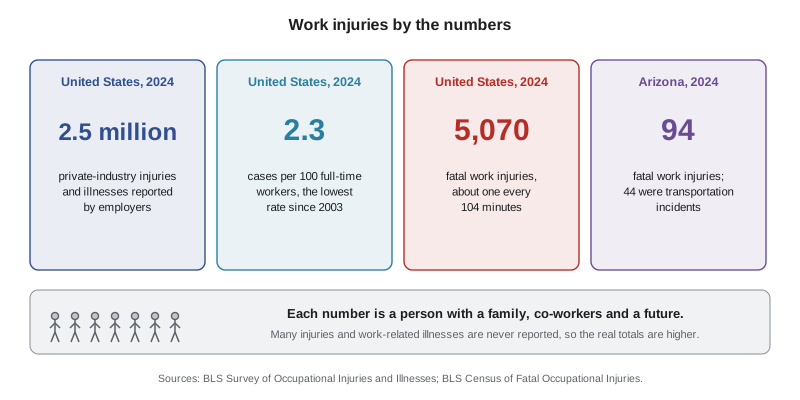
Behind each number is a person. A lost-time claim might be a warehouse worker with a broken wrist who cannot work for six weeks, or a cook with a burn that needs skin grafts. A fatality is someone who went to work in the morning and did not come home. Their family, their co-workers and the supervisor who was on shift that day carry that for the rest of their lives.
The numbers also hide a lot. Many injuries are never reported, because the worker is afraid of getting in trouble, does not know they should report, or thinks it is too small to matter. Many work-related illnesses, especially those that take years to appear, are never linked to the job at all. So the real total is higher than the official count.
Who gets hurt
Injuries are not spread evenly. Some patterns show up again and again in the data from both Canada and the United States:
- New workers. People in their first month on a job are much more likely to be hurt than people who have been there a year or more. Research from the Institute for Work & Health in Ontario found the risk of a lost-time injury was more than three times higher in the first month. This is true at any age, not only for young people.
- Young workers. Young people are often new, eager to please, and less likely to ask questions or say no. Lesson 12 covers the special rules for young workers.
- Workers in physical jobs. Warehousing, transportation, construction, manufacturing, health care and agriculture have higher rates of injury than office work.
- Workers who move around. Driving and vehicles cause a large share of work deaths, both on public roads and inside yards and warehouses.
Jordan fits two of those groups at once: he is new, and he is young. Priya knew that, which is why she spent two hours with him on his first morning instead of handing him a pair of gloves and pointing at the yard.
Why safety matters
There are several reasons to care about safety at work. They all point the same way.
It is about people
The first reason is the simplest. Nobody should be hurt or killed to earn a living. Every worker has people who depend on them. A serious injury can change a person's whole life: their ability to work, play sports, pick up their children, or sleep without pain. A workplace that takes safety seriously is one that respects the people in it.
It is the law
Every province, territory and state has laws that require employers to keep workplaces safe and give workers rights to protect themselves. In Arizona, the main law is the Occupational Safety and Health Act of 1970 (the OSH Act), enforced by the Arizona Division of Occupational Safety and Health (ADOSH). Lesson 2 explains how the law works. Breaking it can lead to orders, fines and, in the worst cases, criminal charges.
It costs money
Injuries are expensive. Some costs are easy to see: medical care, wage replacement through workers' compensation, and higher insurance or compensation premiums for the employer. Many costs are harder to see: overtime to cover the missing worker, training a replacement, damaged equipment and stock, time spent on the investigation, lost customers, and the effect on everyone else's morale. Many studies have found that these hidden costs are several times larger than the visible ones.
For the injured worker, compensation rarely covers everything. It usually replaces only part of their wages, and it cannot pay for pain, lost hobbies or the strain on a family.
It makes better workplaces
Safe workplaces tend to be well-run workplaces. When equipment is maintained, jobs are planned, people are trained and problems are reported early, work goes more smoothly. Workers stay longer when they feel safe and respected. Tom Bergeron, Greenway's general manager, put it this way at a staff meeting: 'Every time we fix a hazard, we usually fix something that was slowing us down too.'
Hazards, risks and incidents
A few words come up throughout this course. It helps to learn them now.
- A hazard is anything that could cause harm: a wet floor, a moving forklift, a sharp blade, a chemical, a heavy bag, a person who is angry, a work schedule that leaves no time for rest.
- Risk is how likely the hazard is to cause harm, combined with how bad the harm could be. A pallet of paving stones is a hazard. The risk is high if people walk under it while it is lifted, and low if it sits on the ground behind a barrier.
- An incident is an unplanned event that caused, or could have caused, injury, illness or damage.
- A near miss is an incident where nobody was hurt and nothing was damaged, but they could have been. A forklift that brakes just in time is a near miss.
- A control is a way of removing a hazard or reducing its risk, such as a guard, a barrier, a procedure or a pair of gloves.
| Example at Greenway | Hazard | What could happen | One control |
|---|---|---|---|
| Bags of soil, 40 lb (18 kg) each | Heavy, awkward load | Back or shoulder strain | Lift with a cart or two people for large orders |
| Greenhouse floor after watering | Wet, slippery surface | Slip and fall | Drain mats and slip-resistant boots |
| Box cutter in receiving | Sharp blade | Deep cut to hand or leg | Self-retracting safety knife |
| Forklift in the yard | Moving vehicle | Person struck or crushed | Painted walkways and a no-go zone around loads |
| Weed killer in the store | Chemical | Skin or eye burns, breathing problems | Labels, gloves and goggles, and training |
| Busy weekend checkout | Angry customer | Verbal abuse or assault | Training, a way to call for help, and two staff on shift |
Look at what the table does not say. It does not say 'be careful.' Being careful matters, but it is not a control. People get tired, rushed and distracted. Good controls keep working when people are human. Lesson 7 explains how to choose them.
Why accidents are rarely 'just accidents'
People often say an injury was 'just an accident,' as if nobody could have seen it coming. Usually somebody could have. When incidents are looked at closely, there are almost always warning signs before them: a near miss that was not reported, a broken guard that stayed broken, a rule that everyone ignored because it did not fit the job, a new worker who was not shown the right way.
The word 'accident' can also make people think the worker was clumsy or careless. That thinking is usually wrong and always unhelpful. A worker who slips on a greenhouse floor that is wet every morning has not been careless. The floor is a hazard that has been left in place. The useful question after an incident is not 'who messed up?' but 'what about the work let this happen, and how do we change it?'
Worked problem
Jordan's first near miss
Show solution
- On his third day, Jordan was helping load a customer's pickup with paving stones. Doug Halvorsen, the senior forklift operator, was bringing a second pallet from the back of the yard.
- A customer's teenage son wandered out of the pickup area and walked across the forklift lane, looking at his phone. Doug saw him late and stopped hard. The pallet slid forward on the forks but stayed on.
- Nobody was hurt. The customer laughed it off. Jordan asked Doug whether they had to report it. Doug said yes, every time, and showed him the near-miss form on the tablet in the yard office.
- When Priya read the report, she noticed it was the third near miss in the pickup area that spring. The rope barrier between the pickup lane and the forklift lane kept getting moved by customers.
- The fix was a fixed steel barrier with one gate, a sign telling customers to stay with their vehicles, and a rule that yard staff bring stones to the vehicle rather than customers walking into the yard.
Answer: A near miss that could easily have been shrugged off led to a permanent fix that protects every customer and worker in the yard.
A shared job
Safety is not only the safety manager's job, or the supervisor's job. Everyone in a workplace has a part. Employers have the biggest duty, because they control the money, the equipment and the way work is organized. Supervisors make sure the work is done safely day to day. Workers follow the safe ways of working, use the protection they are given, and speak up when something is wrong. Lessons 3 and 4 explain these rights and duties in detail.
Priya had a simple way of explaining it to new staff. 'I can't see everything. Tom can't see everything. You're the ones out there. If you see something, say something. If something feels wrong, stop and ask. Nobody here will ever be in trouble for asking.'
Measuring safety at work
Workplaces and governments measure injuries so they can compare one year with another, or one workplace with another of a different size. The most common measure is an injury rate: the number of injuries for a set amount of work. In Canada, compensation boards often report injuries per 100 workers. In the United States, employers and the BLS use a rate per 100 full-time workers, worked out from hours.
The idea is simple. A business with 1,000 workers will have more injuries than one with 10 workers, even if it is safer. Dividing by the amount of work makes the numbers fair to compare. The standard formula multiplies the number of cases by 200,000, which is roughly the hours 100 people work in a year at 40 hours a week for 50 weeks, and divides by the total hours actually worked.
Tom had the numbers for the last three years. The short program below works out Greenway's rate for each year.
# Greenway's recordable injury rate per 100 full-time workers
years = {2023: (6, 118_000), 2024: (5, 121_500), 2025: (3, 124_000)}  # (injuries, hours)

for year, (injuries, hours) in years.items():
    rate = injuries * 200_000 / hours
print(f"{year}: {injuries} injuries in {hours:,} hours -> rate {rate:.1f} per 100 workers")2023: 6 injuries in 118,000 hours -> rate 10.2 per 100 workers 2024: 5 injuries in 121,500 hours -> rate 8.2 per 100 workers 2025: 3 injuries in 124,000 hours -> rate 4.8 per 100 workers
The rate dropped from about 10 to about 5 over three years. Tom was pleased, but Priya pointed out two things. First, with numbers this small, one bad week can swing the rate a lot. Second, the near-miss reports had gone up over the same three years, which was good news: people were reporting more, and the business was fixing problems before they hurt anyone. Lesson 6 explains why near-miss reports are so valuable.
What this course covers
The rest of the course follows Jordan through his first weeks at Greenway. Each lesson covers one part of what every new worker needs to know.
- Lesson 2 explains how health and safety law works in Arizona, who makes the rules and who enforces them.
- Lesson 3 covers your rights as a worker, including the right to refuse work that poses an imminent danger.
- Lesson 4 covers the duties of workers, supervisors and employers.
- Lesson 5 shows how to recognize hazards.
- Lesson 6 explains how and why to report hazards, near misses and injuries.
- Lesson 7 introduces the hierarchy of controls.
- Lesson 8 covers personal protective equipment.
- Lesson 9 covers hazardous chemicals and HazCom.
- Lesson 10 covers emergencies: fire, evacuation and first aid.
- Lesson 11 covers workplace violence, harassment and psychological safety.
- Lesson 12 brings it all together for new and young workers in their first days.
Later courses in the safety stream go deeper into each topic, including HazCom in HSE-102, hazard recognition and risk assessment in HSE-103, protective equipment in HSE-104, fire safety in HSE-105, slips and falls in HSE-106, lifting in HSE-107, violence and harassment in HSE-108, psychological health in HSE-109, and first aid in HSE-110 and HSE-111.
Common mistakes
MistakeThinking a workplace is safe because nobody has been hurt lately.
InsteadLook at whether the hazards have been found and controlled. A long run without injuries can be luck.
MistakeCalling an injury 'just an accident.'
InsteadAsk what about the work allowed it to happen, and change that.
MistakeTreating 'be careful' as a control.
InsteadUse controls that keep working when people are tired, rushed or distracted.
MistakeAssuming only young workers are at higher risk.
InsteadRemember that anyone new to a job is at higher risk, whatever their age.
MistakeIgnoring near misses because nobody was hurt.
InsteadReport them; they show where the next injury is likely to happen.
Summary and key terms
- Workplace health and safety means preventing injuries and illnesses caused by work, including those that build up over years.
- Large numbers of workers are hurt and killed at work every year in Canada and the United States, and the official numbers undercount the real total.
- New workers in their first month have more than three times the risk of a lost-time injury of experienced workers.
- Safety matters because of people, the law, money and the quality of the workplace.
- A hazard is something that could cause harm; risk combines how likely and how bad the harm could be; a control removes or reduces the risk.
- Injury rates compare workplaces fairly by dividing injuries by hours worked and multiplying by 200,000.
- Hazard
- Anything that could cause harm to people, such as a moving vehicle, a chemical, a heavy load or a wet floor.
- Risk
- The chance that a hazard will cause harm, combined with how serious the harm could be.
- Incident
- An unplanned event that caused, or could have caused, injury, illness or damage.
- Near miss
- An incident in which nobody was hurt and nothing was damaged, but they could have been.
- Control
- A way of removing a hazard or reducing its risk, such as a guard, a barrier, a procedure or protective equipment.
Practice problems
Work each problem on paper first, then reveal the answer to check.
Name three hazards Priya described to Jordan on his first morning.
Show answer
Lifting bags of soil, slipping in the greenhouse, box cutters and people on foot being struck by forklifts or trucks in the yard.
Why is "nobody has been hurt this year" not proof that a workplace is safe?
Show answer
Hazards can still be present and uncontrolled; the lack of injuries may be luck rather than good control.
A workplace has 4 recordable injuries in 160,000 hours. What is its injury rate?
Show answer
4 × 200,000 ÷ 160,000 = 5.0 per 100 full-time workers.
What is the difference between a hazard and a risk?
Show answer
A hazard is the thing that could cause harm; risk is how likely it is to cause harm and how bad that harm could be.
What fix came out of Jordan’s first near miss?
Show answer
A fixed steel barrier with one gate between the pickup and forklift lanes, signs, and a rule that staff bring stones to customer vehicles.
Lesson quiz · 5 questions
Score 60% or more to complete this lesson.
Create a free account to save your progress, take quizzes and earn a certificate.