
GAS-110 · Lesson 11 of 12 · 21 min
Permits, inspections and the authority having jurisdiction
▶ Video coming soon A video version of this lesson is on the way.
Hank Morrow, Bayline's owner, likes to say that the paperwork is part of the gas line. In late October, he sat Jonah down at the shop with the file for a job they had just finished: a new gas line and an unvented garage heater replaced with a vented unit heater in a detached workshop. The file held the job order, the City of Columbus mechanical permit, Bayline's record of the pressure test with the gauge reading and test time, the inspector's approval, the appliance's installation manual, the combustion readings at start-up, and a note of the date Columbia Gas released the meter. "If something goes wrong in ten years," Hank said, "this file is how we show we did it right. And if we did it wrong, it's how the next person finds out what we did."
This lesson describes how gas work is approved and checked: who the authority having jurisdiction is, what permits and approvals are needed, how inspections work, what happens when an unsafe condition is found, and what records a gasfitter keeps.
The authority having jurisdiction
The authority having jurisdiction (AHJ) is the organization, office or individual responsible for enforcing a code and approving equipment, installations and procedures. For gas work, the AHJ is usually the local building department, sometimes a state agency, and for some matters the fire marshal or the gas utility. In Columbus, the main AHJ is the Department of Building and Zoning Services. Its roles include:
- enforcing the adopted code: the Ohio Mechanical Code, which brings in the International Fuel Gas Code, and the Residential Code of Ohio, with any local amendments;
- issuing permits: the department issues mechanical and building permits and keeps records of who holds them;
- registering contractors: Columbus requires contractors to hold a current state license and register with the city before taking out permits;
- inspecting: city inspectors inspect permitted work at set stages and approve it before gas is supplied; and
- enforcing: the department can stop work, refuse approval, issue orders and refer violations for prosecution.
Other players have authority too. The Ohio Construction Industry Licensing Board licenses contractors. The state fire marshal and local fire departments enforce the Ohio Fire Code, including propane storage rules based on NFPA 58. The Public Utilities Commission of Ohio regulates utilities such as Columbia Gas, which controls the meter and decides when gas is turned on. In other states, a state fuel gas board, plumbing board or fire marshal may license fitters and inspect work. A fitter who moves must learn the new jurisdiction's system before working.
Permits
In Columbus, as in most US cities, a permit is required before installing or altering gas piping or installing, replacing or relocating most gas appliances. The licensed, registered contractor applies for the permit, describing the work, and pays a fee. Small repairs, such as replacing a thermocouple or a gas valve on an existing appliance, usually do not need a permit, but replacing the appliance itself does. Work done without a required permit can be ordered uncovered, inspected and corrected, and the contractor can face penalties. Each jurisdiction's list of exempt work differs, so the contractor checks the local rules before starting.
The gas utility has its own requirements. Before gas is turned on to a new service or a new piping system, the utility needs to know that the piping has been installed and tested. Utilities have forms and procedures for this, and they will not turn on gas to a system that has not passed its test or that shows a leak or hazard when they arrive.
Inspections
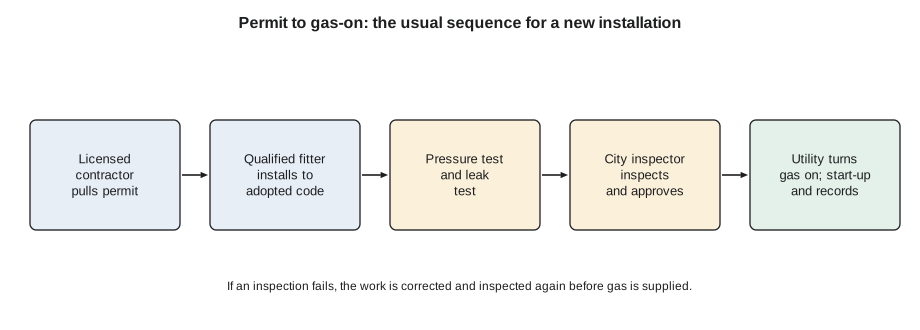
Inspections check that work meets the code before it is concealed or put into service. In Columbus, inspections follow the permit. Typical stages are a rough-in inspection of piping before it is covered, often with the pressure test witnessed or its gauge left in place, and a final inspection when the appliances are installed and vented. The inspector looks at materials, sizing, support, protection, valves, test results, venting, clearances, combustion and ventilation air, and the installation against the manufacturer's instructions.
An inspection is not a substitute for doing the work right. Inspectors see the installation for minutes; the gasfitter is responsible for every joint, every clearance and every reading. Codes make the installer responsible for compliance whether or not the work is inspected.
If an inspection finds a deficiency, the inspector writes it up. The contractor corrects it and asks for a reinspection. Serious or repeated problems can lead to orders, license discipline or prosecution. Being courteous, having the documents ready, and leaving the test gauge on the line for the inspector to see all make inspections go smoothly.
Unsafe conditions
Gasfitters often find unsafe conditions in existing installations that someone else installed: a missing vent connector screw, a corroded flexible connector, a water heater backdrafting into a basement, an appliance with no shutoff valve, or a gas line run through a cold-air return. The codes and regulations require a gasfitter who finds such a condition to act, even if it is not part of the job they were called for.
In general terms, unsafe conditions fall into two groups. An immediately hazardous condition, such as a gas leak, CO spillage, a blocked vent or a failed safety control, is one that could cause injury or damage at once. The gasfitter shuts off the gas to the affected equipment, or to the whole building if needed, attaches a tag that warns against use, and informs the owner or occupant in writing. A non-immediately hazardous condition, such as a missing clearance label or an improperly supported pipe that is not yet leaking, must be corrected within a reasonable time; the gasfitter tags it, explains the problem and records it.
In Ohio, utilities such as Columbia Gas have procedures for hazardous conditions; a utility technician who finds one shuts off the gas and leaves a red tag, and service is restored only after the condition is corrected. Contractors follow the code, the utility's procedures and the city's rules for reporting. Removing a tag or turning gas back on without correcting the hazard is dangerous and can be a violation of local law and utility tariffs.
The customer may object, especially in winter when shutting off a furnace means no heat. The gasfitter explains the hazard plainly, offers solutions, and documents the refusal if the customer will not allow repairs. Leaving an immediately hazardous appliance running is never an option. Lesson 12 shows what can happen when hazards are missed.
Records and documentation
Good records protect the customer, the next technician and the company. A complete file for a gas job usually includes:
| Record | Why it matters |
|---|---|
| Job order and scope of work | Shows what was asked for and agreed |
| Permit or approval numbers, where required | Links the job to the authority's records |
| Pressure test record: test medium, pressure, duration, gauge used, result | Proves the piping was tight before gas was introduced |
| Appliance make, model, serial number and input | Identifies the equipment for recalls and service |
| Start-up readings: inlet and manifold pressure, input, combustion analysis, draft or spillage test | Shows the appliance was set up to the manufacturer's specifications |
| Unsafe conditions found and actions taken, with the customer's signature | Shows the hazard was reported and handled |
| Installer's name and license number | Shows who did the work and that they were qualified |
Many companies now record all of this in a service app on a tablet, with photographs of the installation, rating plates and test gauges. Photographs are especially valuable: they show what was there before and after the work, and they settle disputes.
Worked problem
Planning for a contractor license
Hank tells Jonah that the Ohio Construction Industry Licensing Board requires at least five years of experience in the trade before an applicant can sit for a contractor license exam, among other requirements. If Jonah works about 2,000 hours a year, about how many hours of experience will he have logged by then? And if 10 in 100 of those hours are on commercial equipment, how many commercial hours is that?
Show solution
- Total hours over five years:
- \[5 \times 2{,}000 = 10{,}000 \text{ hours}\]
- Commercial hours:
- \[10{,}000 \times 0.10 = 1{,}000 \text{ hours}\]
Answer: Jonah would have about 10,000 hours, including about 1,000 on commercial equipment, by the time he meets the five-year requirement. Keeping careful records of jobs, dates and supervisors makes the application straightforward, because the board asks for proof of experience.
Certified appliances and manufacturers' instructions
The codes require that gas appliances and many components be certified by an accredited organization to a recognized standard, and bear the certification mark. In the United States, common marks include those of CSA Group, UL Solutions and Intertek (ETL), showing certification to ANSI standards such as the Z21 and Z83 series. Certification means a sample of the appliance was tested for safe ignition, combustion, controls and construction, and that the factory is audited. An appliance without a recognized mark cannot simply be installed; it needs approval by the authority having jurisdiction, often after evaluation by a testing laboratory.
Certification also gives the manufacturer's installation instructions special weight. The codes require appliances to be installed according to those instructions, so a clearance, vent length or gas pressure in the manual is as binding as a rule in the code. Where the code and the manual differ, the stricter requirement generally applies. Inspectors check installations against both, and keeping the manual with the appliance, as most manufacturers require, helps everyone who works on it later.
Staying current
Codes change on a regular cycle, and each change is debated by committees of manufacturers, utilities, regulators, contractors and other experts before it is published. Once a new edition is adopted, installations must follow it, and some changes apply to existing installations when they are altered. A professional gasfitter follows notices from the local building department and the state, the utility and the major manufacturers, takes updating courses when a new edition arrives, and reads the actual text of the adopted code rather than relying on summaries or memory.
| Common inspection finding | How to avoid it |
|---|---|
| Missing or wrong sediment trap or shutoff valve | Install one at each appliance as the code and manual require |
| Unsupported or unprotected piping | Support at the intervals required and protect where exposed to damage |
| Clearance to combustibles not met | Check the manual and rating plate before setting the appliance |
| Vent connector joints not fastened or sloped wrong | Fasten every joint and keep the required rise toward the chimney |
| No pressure test record or gauge on the line | Test before concealing and leave the gauge for the inspector |
| Combustion air not provided | Size and install the air supply before start-up |
Liability is the final reason the paperwork matters. If an installation is involved in a fire, explosion or CO incident, investigators and insurers will ask who did the work, to what code, with what tests, and what was told to the customer. A contractor with complete records can answer; one without them may be held responsible for problems it did not cause.
Professional conduct
Gasfitters hold the public's trust. A certificate or license can be suspended or revoked for doing work outside its scope, lending a certificate number to an unqualified person, falsifying test records, or knowingly leaving a hazard. Technicians also have a duty to cooperate with inspectors and investigators and to report hazards they find, even when the report is unwelcome to a customer or an employer. Most jurisdictions protect workers who raise safety concerns in good faith. Behaving professionally is not only about avoiding penalties; it is what makes customers, inspectors and utilities trust the work.
Common mistakes
MistakeThinking an inspection makes the inspector responsible for the work.
InsteadThe installer is responsible for code compliance whether or not the work is inspected.
MistakeLeaving an immediately hazardous condition in place because it was not part of the job.
InsteadShut off, tag, inform the owner in writing and report as required, whatever the original call.
MistakeRemoving an unsafe-condition tag left by the utility once a customer says the problem is fixed.
InsteadCorrect the hazard and follow the utility's and authority's procedure for restoring service.
MistakeKeeping test results only in your head.
InsteadRecord the test medium, pressure, duration, gauge and result in the job file.
Summary and key terms
- The authority having jurisdiction enforces the adopted code; in Columbus it is the Department of Building and Zoning Services, with OCILB licensing contractors and the utility controlling gas turn-on. Most new piping and appliance installations need a permit pulled by a licensed, registered contractor. Inspections check work before it is concealed or used, but the installer remains responsible.
- Immediately hazardous conditions are shut off, tagged and reported; others are tagged and corrected.
- Complete records protect the customer, the next technician and the company.
- Authority having jurisdiction
- The body that enforces the code and approves installations in a place.
- Permit
- Written permission from the authority to carry out regulated work.
- Inspection
- An examination of work by the authority to check compliance with the code.
- Immediately hazardous condition
- A condition that could cause injury or damage at once, such as a leak or CO spillage.
- Field approval
- Approval of a specific piece of equipment on site when it is not certified to a recognized standard.
- Job file
- The records of a gas job: scope, permits, tests, readings, conditions found and installer.
Practice problems
Work each problem on paper first, then reveal the answer to check.
What does the authority having jurisdiction do?
Show answer
Enforces the adopted code, issues permits, registers contractors, inspects work and enforces.
Why does the gas utility need to know a new system has been tested?
Show answer
It will not turn on gas to a system that has not passed its test or shows a hazard.
What is the difference between an immediately hazardous and a non-immediately hazardous condition?
Show answer
An immediately hazardous condition could cause harm at once and is shut off; the other must be corrected within a reasonable time.
Name four items in a complete gas job file.
Show answer
Scope of work, permit or approval numbers, pressure test record, appliance data, start-up readings, unsafe conditions and installer details.
Who is responsible for code compliance if the work is never inspected?
Show answer
The installer.
Lesson quiz · 5 questions
Score 60% or more to complete this lesson.
Create a free account to save your progress, take quizzes and earn a certificate.