
GAS-110 · Lesson 1 of 12 · 20 min
The gas trade and where gasfitters work
▶ Video coming soon A video version of this lesson is on the way.
Jonah Clarke started at Bayline Gas & Heating on Tuesday, September 8, 2026. He had finished the general trades courses, could read a tape and a drawing, and knew how to work safely on a construction site. He did not yet know much about gas. On his first morning, Rosa Delgado, the journey-level gas fitter he would work beside for the year, handed him a combustion analyzer in its case and a bottle of leak-detection solution. "These two tools tell you most of what you need to know about a gas job," she said. "One tells you whether the gas is staying in the pipe. The other tells you whether it is burning the way it should. Everything else we learn this year is about keeping both answers right."
This course is the first gas course in the gas fitter program. It covers what natural gas and propane are, how they behave and burn, how pressure and flow are measured, why carbon monoxide is the hazard that most often hurts people, how leaks are found and handled, and the safety rules, permits and inspections that govern the work. Later courses build on it: the gas codes, electricity for gas technicians, residential and commercial appliances, venting, controls and troubleshooting. This first lesson describes the trade itself: who does the work, where it is done, who regulates it, and how a new apprentice fits in.
What the trade does
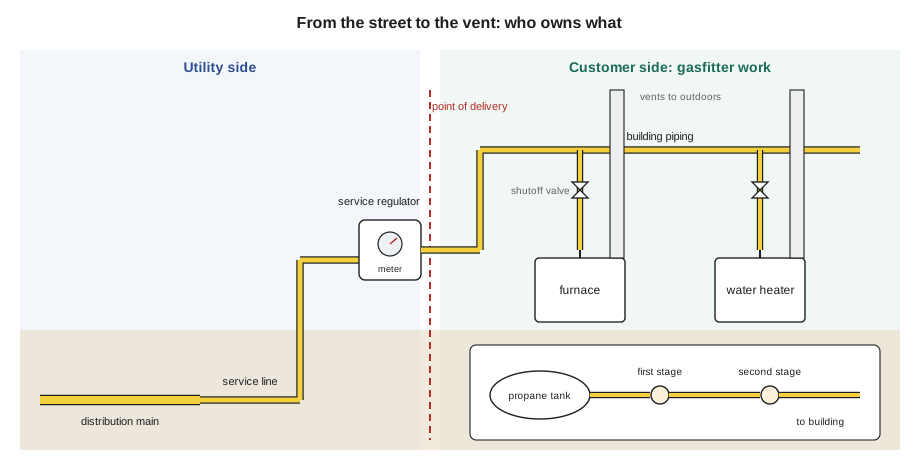
Gasfitters install, test, start up, service and repair the piping and equipment that carry and burn fuel gas. The two main gases are natural gas, piped to buildings by a utility, and propane, stored on site in cylinders or tanks. The work runs from the outlet of the utility's meter, or the outlet of the propane supplier's first regulator, to the appliances and their vents. Within that span a gasfitter may:
- size, install and support gas piping, and pressure test it before it is used;
- set regulators and check pressures at meters, manifolds and appliances;
- install appliances such as furnaces, boilers, water heaters, fireplaces, ranges, dryers, unit heaters, rooftop units, generators and commercial kitchen equipment;
- supply combustion and ventilation air and install the vents that carry flue gases outdoors;
- wire and adjust the controls and safety devices on appliances;
- start up appliances, measure their gas input and analyze their combustion;
- service, clean and repair appliances and find faults when they do not work;
- convert appliances from one gas to another with the manufacturer's kit; and
- respond to complaints about gas odors, carbon monoxide alarms and poor performance.
The common thread is that a mistake can kill. A small leak in a closed room can build up to a flammable mixture. A burner starved of air or a blocked vent can fill a home with carbon monoxide that nobody can see or smell. Because of that, gas work is one of the most tightly regulated trades. A person may do gas work only if they hold the certificate or license that covers it, the work must follow the adopted code, and most new installations need a permit and an inspection.
Where gasfitters work
Bayline's 22 people do a typical mix of work for a mid-sized gas contractor. Most of their calls are residential: replacing furnaces and water heaters, installing fireplaces and ranges, and answering no-heat calls through the winter. A second crew does light commercial work, such as rooftop heating and cooling units on plazas, unit heaters in garages, and restaurant equipment. Luis Ferreira's crew handles propane: rural homes, farm buildings, construction heaters and conversions. Across the industry, gasfitters also work for:
| Employer | Typical work |
|---|---|
| Residential service and installation contractors | Furnaces, boilers, water heaters, fireplaces, ranges, dryers and their venting; maintenance plans; no-heat calls |
| Commercial and industrial mechanical contractors | Rooftop units, make-up air units, boilers, process burners, kitchen equipment, large piping systems |
| Gas utilities | Meter sets, service lines, leak response, emergency calls and safety inspections at the customer's request |
| Propane suppliers | Tank and cylinder installation, regulator stations, leak checks before filling, delivery and conversion work |
| Equipment manufacturers and distributors | Start-up and warranty service, technical support, training |
| Facilities and institutions | In-house maintenance of hospitals, schools, plants and apartment buildings |
Many gasfitters also hold refrigeration, sheet metal or plumbing qualifications, because heating, cooling and ventilation equipment are often installed together. In small towns one technician may do all of it.
Who regulates the work
In the United States, gas work is regulated by states, counties and cities, which adopt a model fuel gas code into law. The two model codes are the National Fuel Gas Code, published as NFPA 54 (also ANSI Z223.1) by the National Fire Protection Association and the American Gas Association, and the International Fuel Gas Code (IFGC), published by the International Code Council. Propane storage and handling is covered by NFPA 58, the Liquefied Petroleum Gas Code. New editions appear every three years; the current NFPA 54 and NFPA 58 are the 2024 editions, and a 2027 NFPA 54 is in revision. What matters on a job is the edition the local jurisdiction has adopted, which may be several years old. In Ohio, the Board of Building Standards adopts the Ohio Building Code and the Ohio Mechanical Code; since March 1, 2024, commercial work follows the 2024 Ohio Mechanical Code, which brings in the 2021 International Fuel Gas Code, and houses follow the Residential Code of Ohio. In Columbus, the city's Building and Zoning Services department issues permits and inspects the work.
Licensing in the United States is set by each state or city. Ohio licenses contractors rather than individual gas fitters at the state level: the Ohio Construction Industry Licensing Board (OCILB) licenses heating, ventilating and air conditioning contractors, plumbing contractors and others, and the license holder must pass an exam and show experience and insurance. Columbus adds its own registration under the Columbus Building Code: the business must hold a current OCILB license, register with the city and post a 25,000-dollar contractor bond before it can take out permits. Other states license individual gas fitters directly, with apprentice, journeyman and master levels, and some cities run their own exams. A fitter who moves must check the rules in the new jurisdiction before doing any work.
The gas utility has a role too. It owns the main, the service line and the meter, and it controls when gas is turned on to a new or altered system. Utility technicians respond to emergency odor calls, and in most places only the utility may set or remove a meter.
How an apprentice learns
Jonah's year follows the pattern of most gas apprenticeships. He takes classroom training in blocks, learns on the job under Rosa's direct supervision, and logs his hours. On the job he will start with tasks that build habits: carrying and setting up the test gauges, leak testing joints Rosa has made, cleaning burners, and reading rating plates. As his skill and certificate allow, he will make joints, set appliances, and finally start them up, always with a qualified person checking the work.
Rosa gave him three rules on the first day. First, never work outside your certificate, even when someone asks you to. Second, never leave a job with a gas leak, a carbon monoxide problem or a disabled safety device: make it safe, tag it and tell the customer and the office. Third, write everything down, because a gas installation lasts decades and the next technician needs to know what was done and why.
| Habit | Why it matters |
|---|---|
| Read the rating plate before touching an appliance | It tells you the gas type, input, pressures and clearances the appliance was certified for |
| Leak test every joint you make or disturb | Most leaks are at joints that were just worked on |
| Measure, do not guess | Pressure, input and combustion readings show problems the eye cannot |
| Check the vent before and after | A vent that worked yesterday can be blocked or disconnected today |
| Carry a personal CO monitor | It warns you before symptoms do |
| Document the work | Inspectors, customers and the next technician rely on the record |
The work is changing
The trade is changing in several ways that a new apprentice should know about. High-efficiency condensing appliances, which vent through plastic pipe and produce acidic condensate, have replaced most older appliances in new homes. Electronic ignition and modulating burners have replaced standing pilots. Heat pumps are taking over more heating, often with a gas furnace kept as backup in cold weather, so gasfitters increasingly work on hybrid systems. Some utilities are testing blends of hydrogen in natural gas, and codes and certificates are being updated for it; training programs are adding hydrogen content as the rules catch up. And codes keep changing: a technician who learned the trade twenty years ago has worked under four or five code editions.
What does not change is the chemistry and physics of gas. A flammable gas still burns only within a narrow range of mixtures with air. A flame still needs the right amount of air to burn cleanly. Pressure still pushes gas through pipes and out of leaks. The rest of this course sets out those basics, because every rule in the code rests on them.
Worked problem
Logging apprenticeship hours
Jonah's first block runs from September 8 to November 13, 2026, ten weeks. He works 8.5-hour days, Monday to Friday, except for the Thanksgiving holiday on Thursday, November 26, which falls after the block. He also spent two days of the block in a safety course that his program counts as classroom time, not field time. How many field hours does he log in the block?
Show solution
- Count the working days in ten weeks:
- \[10 \times 5 = 50 \text{ days}\]
- The holiday falls outside the block, so remove only the two course days:
- \[50 - 2 = 48 \text{ days}\]
- Multiply by the hours per day:
- \[48 \times 8.5 = 408 \text{ hours}\]
Answer: Jonah logs 408 field hours in his first block. Recording them weekly, with the job addresses and the supervising technician, is what his program and any later certificate application will ask for.
A day in the trade
Jonah's third Thursday shows what an ordinary day looks like. The truck leaves the shop at 7:30 with a schedule Priya built the night before. The first call is a water heater replacement in a split-level house. Rosa and Jonah check the old unit's venting and gas line, shut off and disconnect it, carry it out, set the new one, connect the gas with a new shutoff valve and sediment trap, leak test, fill the tank, light it, check the manifold pressure, test the draft at the draft hood, and walk the homeowner through the controls. The second call is a furnace that short-cycles; a dirty flame sensor is the cause, and Rosa shows Jonah how to read the control board's flash code before touching anything. After lunch, they rough in a gas line for a kitchen renovation, run a pressure test and leave the gauge on the line for the inspection. The last call of the day is a carbon monoxide alarm that turns out to be fifteen years old and past its end of life; Rosa tests every appliance anyway before recommending a new alarm.
By 4:30 Jonah has carried, measured, tested and written more than he expected. Every job involved a gas line, a burner, a vent and a customer, and every one ended with a record of what was found and done.
Working with customers
Most gas work happens in people's homes and businesses, often when something has gone wrong and the customer is cold, worried or both. Rosa's habits are simple: introduce yourself, protect floors and furniture, explain what you are going to do before you do it, and explain what you found in plain language afterward. When a repair is needed for safety, say why in terms the customer can understand, put it in writing, and never let the customer's budget or impatience talk you into leaving a hazard. Customers remember technicians who are honest about safety, and those technicians get called back.
| Related trade or certificate | How it overlaps with gas work |
|---|---|
| Refrigeration and air conditioning | Rooftop units, heat pumps and hybrid systems combine gas heat with cooling |
| Sheet metal | Ductwork, plenums and some venting for furnaces and air handlers |
| Plumbing | Water heaters, boilers and their water piping; some jurisdictions license plumbers for gas piping |
| Electrical | Power supplies and branch circuits feeding appliances, done by electricians |
| Oil burner technician | Fuel-fired heating with a similar combustion and venting basis |
Common mistakes
MistakeDoing a small gas job outside your certificate or license because "it's only a connector".
InsteadWork only within the scope of the certificate or license you hold, however small the task.
MistakeAssuming the newest code edition applies everywhere.
InsteadUse the edition the jurisdiction has adopted, with its amendments.
MistakeTreating the utility meter as part of the customer's system you may adjust.
InsteadThe meter and service regulator belong to the utility; only the utility sets, adjusts or removes them.
MistakeLeaving a job with a known hazard because the customer refused the repair.
InsteadMake the appliance safe, shut it off and tag it, explain the hazard in writing and report it as your rules require.
Summary and key terms
- Gasfitters install, test, start up, service and repair fuel gas piping, appliances, controls and vents, from the meter or propane regulator outlet to the vent terminal.
- The work is regulated because leaks can ignite and poor combustion produces carbon monoxide.
- In the United States, states and cities adopt NFPA 54 or the IFGC and NFPA 58; Ohio uses the 2021 IFGC through its mechanical code. Ohio licenses contractors through OCILB, and Columbus requires city registration and a bond. The utility owns the meter and controls gas turn-on.
- Apprentices learn under direct supervision and log their hours.
- Gasfitter
- A person licensed or employed to install and service fuel gas piping and appliances; also written gas fitter.
- Point of delivery
- The point, usually the meter outlet, where the utility's system ends and the customer's piping begins.
- Authority having jurisdiction
- The body that adopts and enforces the code in a place and approves the work.
- Code adoption
- The legal step that makes a published code edition, with any amendments, the rule in a jurisdiction.
- Rating plate
- The label on an appliance that gives its gas type, input, pressures, electrical data and clearances.
Practice problems
Work each problem on paper first, then reveal the answer to check.
Name four kinds of employers that hire gasfitters.
Show answer
Residential contractors, commercial mechanical contractors, gas utilities, propane suppliers, manufacturers and facilities departments.
Which model codes do US jurisdictions adopt for fuel gas and propane?
Show answer
NFPA 54 or the IFGC for fuel gas piping and appliances, and NFPA 58 for propane storage and handling.
Why does the edition adopted by the jurisdiction matter more than the newest edition?
Show answer
Only the adopted edition, with its amendments, is the law that inspectors enforce on that job.
What three rules did Rosa give Jonah?
Show answer
Work only within your certificate, never leave a known hazard unmade-safe, and document everything.
Lesson quiz · 5 questions
Score 60% or more to complete this lesson.
Create a free account to save your progress, take quizzes and earn a certificate.