
GAS-110 · Lesson 8 of 12 · 22 min
Gas leaks: odorants, detection and response
▶ Video coming soon A video version of this lesson is on the way.
Priya Nair, Bayline's safety and dispatch coordinator, keeps a card by the phone with the questions she asks every caller who reports a gas smell: Where is the smell? How strong is it? Is anyone feeling unwell? Are you still inside? On a Friday afternoon in October, a caller from the Garfield Avenue area said she smelled gas strongly in her basement and was calling from her kitchen. Priya's answer did not change from the card: "Please leave the house now, leave the door open behind you, and call Columbia Gas from outside. Don't touch any switches on the way out. We'll send someone, but the utility comes first."
Leaks are the hazard gasfitters think about most often. This lesson explains how gas is given its smell, why that smell is not always reliable, how leaks are found with instruments and leak-detection solution, and how a gasfitter and the public should respond to a gas odor.
Why gas smells
Natural gas and propane have almost no smell of their own. To make leaks noticeable, suppliers add an odorant, a sulfur compound that people can smell at extremely low concentrations. The most common are mercaptans, such as tertiary butyl mercaptan, and tetrahydrothiophene (THT), often blended. Propane is usually odorized with ethyl mercaptan. People describe the smell as rotten eggs, skunk or cabbage.
Federal pipeline safety rules (49 CFR Part 192) require that gas in distribution lines be odorized so that it is readily detectable by a person with a normal sense of smell at one fifth of the lower explosive limit. NFPA 58 requires propane to be odorized before delivery to a bulk plant or customer, so that it is detectable at the same fraction of its lower limit. The utility adds and monitors the odorant at the city gate and samples it at points across its system.
Worked problem
What one fifth of the lower limit means
Odorant must make gas noticeable at no more than one fifth of its lower flammable limit. What concentration of gas in air is that for natural gas (LFL 5 in 100) and for propane (LFL 2.1 in 100), in parts in 100 and in ppm?
Show solution
- Natural gas:
- \[\frac{5}{5} = 1 \text{ in 100} = 10{,}000 \text{ ppm}\]
- Propane:
- \[\frac{2.1}{5} = 0.42 \text{ in 100} = 4{,}200 \text{ ppm}\]
Answer: A person with a normal sense of smell should notice natural gas by the time it reaches about 1 part in 100, and in practice odorant levels are set so that much lower concentrations are noticeable. A combustible gas detector reading in parts in 100 of the LFL would show 20 at that point.
When the smell fails
The odorant is a vital safety feature, but a gasfitter must never rely on it alone. Several things can weaken or hide the smell, a problem known as odor fade or odorant loss:
- New steel pipe and tanks. Clean steel can absorb odorant from the gas until its surface is saturated. Rust inside a new or poorly prepared propane tank can react with the odorant and destroy it. Water in a tank can do the same. New tanks are often purged and conditioned for this reason.
- Soil. Gas leaking from a buried pipe can lose its odorant as it passes through soil, so gas can enter a building with little or no smell. This has caused many explosions.
- Low flow and long pipes. Gas that sits in a pipe with little use, or travels a long distance, can lose odorant to the pipe wall.
- The person. Some people have a poor sense of smell because of age, illness, medication, smoking or a cold. Anyone smelling gas for a while gets used to it, called olfactory fatigue. Other strong smells in a kitchen, barn or shop can mask it.
For these reasons, propane suppliers and safety authorities recommend gas detectors in homes, especially with propane, and many recommend that customers test their own sense of smell with a scratch-and-sniff card. A gasfitter checks for leaks with instruments and leak solution, not with the nose.
Finding leaks
A gasfitter uses several methods, each suited to a different job.
| Method | How it works | Best use |
|---|---|---|
| Leak-detection solution | A liquid brushed or sprayed on a joint forms bubbles where gas escapes | Confirming and pinpointing leaks at joints, valves and fittings |
| Electronic combustible gas detector | A sensor responds to hydrocarbon gas and beeps or shows a level, often in ppm | Sniffing along piping, around appliances and in rooms to locate a leak |
| Combustible gas indicator (CGI) | Calibrated instrument reading in parts in 100 of the LFL and sometimes parts in 100 of gas | Measuring how dangerous an atmosphere is; confined space entry |
| Pressure or time test | The system is isolated and pressure watched for a drop on a manometer or gauge | Proving that a whole system or section is tight |
| Infrared or laser detectors | Detects methane by its absorption of light, sometimes from a distance | Utility surveys, hard-to-reach piping |
Leak-detection solution is the most common tool on the job. It must be a product made for gas leak testing; household detergents can contain chlorides or ammonia that corrode brass and copper, and they may not bubble reliably. Apply it to every joint you make or disturb, with the gas on at normal pressure, and watch for at least the time the product recommends. Small leaks may form a slow foam of tiny bubbles rather than large ones. Wipe the joints afterward.
Electronic detectors are good for searching; they lead you toward a leak that you then confirm with solution. Most are sensitive enough to respond to a few ppm and can be set off by other vapors such as solvents, alcohol or cleaning products, so a reading is a clue, not proof. Remember Lesson 3: search high for natural gas and low for propane, and move the probe slowly.
A pressure test or time test checks a whole system. New piping is tested with air or an inert gas at a pressure and for a time set by the code before gas is introduced. An existing system can be checked by shutting off all appliance valves, isolating the system at the meter and watching a manometer connected to the piping; any drop in pressure points to a leak. The procedures, pressures and durations are set out in the adopted NFPA 54 or IFGC edition and the utility's requirements, and are taught in the next course.
Never search for a leak with a flame. It sounds obvious, but match-testing was once common, and it still causes injuries.
Responding to a gas smell
The response depends on how strong the smell is and where it is. A strong smell inside a building is an emergency. A faint smell near one appliance is usually a service call. The figure shows the steps for the first case.
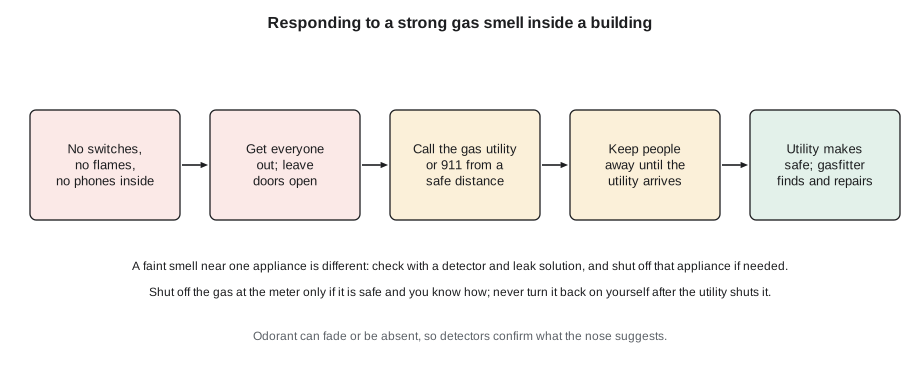
The reasons behind each step come straight from the fire triangle. Light switches, doorbells, thermostats, phones and appliance controls can spark when operated. Flames from lighters, matches or pilot lights ignite gas. Opening doors and windows on the way out helps dilute the gas, but people should not stay inside to do it. Calling from outside, at a safe distance, keeps the phone away from the gas. The utility has the authority, equipment and training to shut off gas and make the area safe, and in many places it responds to odor calls at no charge, any time of day.
In Ohio, the public is told to leave and call Columbia Gas's emergency line or 911 from a safe place. Propane customers call their supplier or 911. When the utility shuts off gas because of a hazard, it tags the meter or appliance, and only the utility restores service at the meter, after the hazard is corrected by a qualified contractor. A fitter who finds a hazardous condition must make it safe, shutting off the gas to the affected equipment, and report it according to the utility's and the jurisdiction's procedures.
A faint smell, or a smell only near one appliance, is handled differently. A gasfitter on site checks with a detector, finds the leak with solution, and tightens or remakes the joint, or shuts off the appliance valve and tags the appliance until it can be repaired. Gas leaks at a meter or service regulator belong to the utility. Outdoors, a strong smell near the ground can mean a buried leak, which is a utility emergency because the gas may be migrating into nearby buildings.
Preventing leaks
Most leaks a gasfitter finds come from a short list of causes: joints that were never tightened properly, thread sealant used wrongly, flare fittings that were over-tightened or not deburred, flexible connectors that were kinked, twisted or reused, corrosion where piping touches masonry or soil, physical damage from vehicles, renovations or digging, and valves whose packing has worn. Prevention is mostly good workmanship: use approved materials, support and protect piping, follow the manufacturer's instructions for connectors and fittings, and test every joint.
Digging is a special case. Before anyone excavates near a gas service, the locations of buried lines must be requested by calling 811, which in Ohio connects to OHIO811, so that the utility and other owners can mark their lines. Hitting a gas line is one of the most common causes of serious gas incidents.
Worked problem
Watching a time test
Rosa isolates a house piping system and connects a manometer. With all appliance valves closed, it reads 7.0 in. w.c. After 10 minutes, it reads 6.2 in. w.c. How much pressure was lost, and what fraction of the starting pressure is that?
Show solution
- Pressure lost:
- \[7.0 - 6.2 = 0.8 \text{ in. w.c.}\]
- Fraction of the starting pressure:
- \[\frac{0.8}{7.0} \approx 0.11\]
Answer: The system lost about 11 parts in 100 of its pressure in 10 minutes. A tight system holds steady, apart from small changes with temperature. Rosa treats this as a leak, checks that every appliance valve is really closed, and searches the piping with a detector and solution until she finds it.
After the repair
Fixing the leak is only part of the job. After a repair, the gasfitter retests the repaired joint and every joint disturbed in the process, with the system at normal operating pressure. If the gas was shut off, air may have entered the piping; the line must be purged of air to a safe place, as the code and manufacturer describe, before appliances will light reliably. Every appliance on the system is then relit, checked for proper operation and, where pilots were out, confirmed to be lit. The customer is told what was found and done, and the record goes in the job file.
Utilities often classify the leaks they find by urgency. A leak that is an existing or probable hazard to people or property needs immediate action and continuous attention until it is made safe. A leak that is not hazardous at the moment but could become so gets a scheduled repair. A minor leak that is expected to remain non-hazardous is monitored. The exact names and criteria come from each utility's procedures and the pipeline standards, but the idea of matching the response to the hazard applies to every leak a gasfitter finds.
| Common leak point | Typical cause |
|---|---|
| Threaded joints | Wrong or missing sealant, under-tightened, cross-threaded |
| Flare fittings | Over-tightened, poor flare, tubing not deburred |
| Flexible appliance connectors | Kinked, twisted, reused or corroded |
| Valves | Worn stem packing or seats |
| Pipe through masonry or soil | Corrosion where the pipe is unprotected |
Common mistakes
MistakeRelying on the smell to decide that a system has no leak.
InsteadOdorant can fade; check with leak solution and instruments.
MistakeUsing dish soap as leak-detection solution.
InsteadUse a solution made for gas leak testing that will not corrode fittings.
MistakeTurning on lights to see better when responding to a strong gas smell.
InsteadDo not operate switches; get out and call from a safe distance.
MistakeRestoring gas the utility has shut off once the customer says the problem is fixed.
InsteadRestore service only after the hazard is corrected, following the utility's procedure.
Summary and key terms
- Natural gas and propane are odorized with sulfur compounds such as mercaptans and THT so that leaks can be smelled well below the lower flammable limit, generally by one fifth of it.
- Odorant can fade in new steel pipe and tanks, through soil, or to people with a poor sense of smell or olfactory fatigue.
- Leaks are found with electronic detectors and confirmed with leak-detection solution; pressure and time tests prove whole systems.
- For a strong smell indoors, avoid sparks and flames, get everyone out, and call the utility or 911 from a safe distance.
- Hazardous conditions are shut off, tagged and reported, and buried lines must be located before digging.
- Odorant
- A chemical added to fuel gas, usually a mercaptan or THT, so leaks can be smelled.
- Odor fade
- Loss of odorant strength, so leaking gas smells weaker than expected or not at all.
- Olfactory fatigue
- Loss of the ability to notice a smell after breathing it for a while.
- Leak-detection solution
- A liquid made for gas work that bubbles where gas escapes from a joint.
- Combustible gas indicator
- An instrument that measures flammable gas, usually in parts in 100 of the lower flammable limit.
- Time test
- Isolating a gas system and watching for pressure loss to check for leaks.
Practice problems
Work each problem on paper first, then reveal the answer to check.
Why is odorant added to natural gas and propane?
Show answer
Both gases have almost no smell of their own, so odorant makes leaks noticeable.
Name three causes of odor fade.
Show answer
New steel pipe or tanks absorbing odorant, gas passing through soil, rust or water in tanks, and a person's poor sense of smell.
Why should household detergent not be used to test for leaks?
Show answer
It may corrode fittings and may not bubble reliably.
What should you avoid doing inside a building with a strong gas smell?
Show answer
Operating switches, phones or anything that could spark, and using any flame.
Who restores gas service after the utility shuts it off for a hazard?
Show answer
The utility, following its procedure, after the hazard is corrected.
Lesson quiz · 5 questions
Score 60% or more to complete this lesson.
Create a free account to save your progress, take quizzes and earn a certificate.