
GAS-110 · Lesson 12 of 12 · 20 min
Case study: investigating a gas incident
▶ Video coming soon A video version of this lesson is on the way.
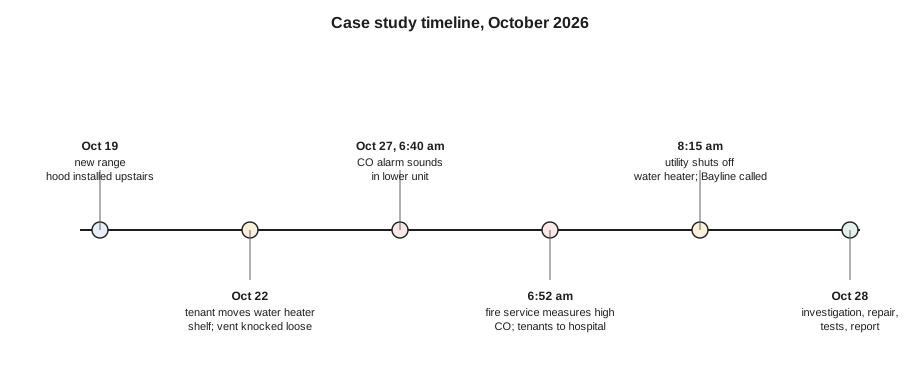
At 6:40 on the morning of Tuesday, October 27, 2026, the carbon monoxide alarm in the hallway of the lower unit of a rented duplex on Parsons Avenue in Columbus began to sound. The tenant, a man in his sixties, had woken with a headache and felt dizzy when he stood up; his adult daughter, visiting for the week, felt sick to her stomach. He thought the alarm was faulty and almost pulled it off the ceiling. His daughter called 911 instead. That decision probably saved their lives.
This final lesson follows the incident from the first call to the final report. It pulls together everything in the course: gas properties, combustion, carbon monoxide, leak and CO response, safe work practices and the role of the authority having jurisdiction. It also shows how a gasfitter investigates an incident: systematically, with evidence, looking for every cause rather than the first one.
The emergency response
The fire service arrived at 6:52. Firefighters entered with their own gas meters and measured about 240 ppm of carbon monoxide in the lower unit's hallway and over 400 ppm in the basement near the water heater. They moved both occupants outside, gave them oxygen and sent them to hospital, where tests showed elevated carboxyhemoglobin. Both were treated with oxygen and released later that day; the tenant was told to follow up with his doctor about lingering headaches. The upstairs unit, occupied by a young couple, measured under 10 ppm; its occupants were also moved out as a precaution.
The firefighters ventilated the building and called the gas utility. A Columbia Gas technician arrived at 8:15, found the water heater's vent connector separated from the chimney thimble, shut off the gas to the water heater, tagged it as immediately hazardous and left the furnace, which tested normally, in service. The landlord called Bayline. Because two people had gone to hospital, the utility filed its own incident report, and the city's building department and the fire marshal's office were informed, as local procedures require.
Arriving on site
Rosa and Jonah arrived at 9:30. Rosa had been doing gas work for 19 years and had investigated several CO incidents; for Jonah it was the first. Before they went in, Rosa explained the rules she follows.
- Protect yourself. Monitors on, readings watched on entry, and the building treated as hazardous until shown otherwise.
- Preserve the evidence. Photograph everything before touching it. Do not repair anything until the cause is understood and, where the authority wants to investigate, until it has been allowed to. An investigation that changes the scene before recording it can never be reconstructed.
- Collect facts, not opinions. Write down what people saw, heard and did, with times. Measure rather than estimate.
- Find all the causes. Incidents almost never have a single cause. Keep asking why until you reach causes you can fix.
Their personal monitors read 0 ppm in the yard and 3 ppm inside the lower unit, which had been ventilated for over two hours. Rosa photographed the basement from the stairs, then each appliance, its vent, the chimney, the area around the water heater and the utility's tag.
Gathering facts
Over the next hour, Rosa and Jonah gathered information from the people involved and from the building itself.
| Source | What they learned |
|---|---|
| Fire service report | About 240 ppm in the lower hallway and over 400 ppm in the basement at 6:52; upstairs under 10 ppm |
| Utility technician's notes | Water heater vent connector separated at the chimney; water heater shut off and tagged; furnace tested normal |
| Lower tenant (by phone, from hospital) | Had moved a wooden shelf in the basement on October 22 to make room for storage boxes; noticed a "rusty smell" in the basement since then; headaches in the mornings for several days |
| Upper tenants | New range hood installed on October 19 by a kitchen renovation company; they ran it on high every morning while cooking breakfast, starting around 6:15 |
| Landlord | Water heater about 12 years old; no recent gas work; CO alarm installed in the lower hallway two years ago; none in the basement |
| Building | Two-story brick duplex from the 1920s; natural-draft water heater and furnace in the shared basement sharing a masonry chimney; basement windows sealed shut; no make-up air for the kitchen hood |
The basement itself told part of the story. The water heater's single-wall vent connector ran from the draft hood up and across to the chimney thimble. Its joint at the thimble had no screws, and the connector had been pushed sideways about 2 inches, leaving a gap at the chimney. A shelf leaned against the wall nearby, with scuff marks on the connector at the same height. Soot streaks on the basement ceiling above the gap showed that flue gas had been escaping there. The draft hood rim showed light scorching, a sign of repeated spillage.
Testing the theory
A connector pushed loose by a shelf explained how flue gas could escape into the basement. But a natural-draft water heater with a gap in its connector will often still send much of its flue gas up the chimney, because the hot gas rises. The high readings, and the timing of the morning headaches, suggested that something was also pushing flue gas back into the house. Rosa suspected the new range hood.
With the landlord's permission, and after confirming that no authority wanted to inspect first, Rosa set up a test that recreated the morning conditions without anyone at risk. She temporarily reconnected and sealed the vent connector, so she could test the venting itself. She closed all windows and exterior doors, turned on the upstairs range hood on high, ran the bathroom fans, and fired the water heater. Within a minute, smoke from her test pencil at the water heater's draft hood was being pushed outward: the appliance was spilling even with the connector sealed. With the hood off, the draft hood drew smoke in normally. Her digital manometer, with one hose to the basement and one outdoors, showed the basement going about 0.03 inches of water column negative with the hood on high, enough to overpower a natural-draft vent in a cool masonry chimney.
Worked problem
How hard was the hood pulling?
The new range hood was rated at about 600 cubic feet per minute (cfm). The upper unit and basement together held about 9,000 cubic feet of air. If the hood removed air at its rating, how many times an hour would it exhaust the volume of that space?
Show solution
- Convert the hood rating to an hourly volume:
- \[600 \text{ cfm} \times 60 = 36{,}000 \text{ ft}^3\text{/h}\]
- Divide by the volume of the space:
- \[\frac{36{,}000}{9{,}000} = 4.0 \text{ air changes per hour}\]
Answer: At its rating, the hood would try to exhaust the whole space about four times an hour. In an old house with windows sealed shut and no make-up air, the air it removed had to come from somewhere, and one of the easiest paths was down the chimney, against the water heater's flue gas.
Finding the causes
Rosa wrote up the causes in three layers, as many investigators do.
- Direct cause: flue gas from the water heater entered the basement through a gap where the vent connector had separated from the chimney, and through the draft hood when the house was depressurized.
- Contributing causes: the connector joints had no screws to hold them, so a light bump moved it; the large new range hood had been installed without make-up air, depressurizing the house every morning; the basement windows were sealed, and there was no outdoor combustion air supply; storage was placed against the vent connector; and the tenants did not recognize several days of morning headaches as a warning.
- Underlying causes: no one had looked at how the hood would affect the existing natural-draft appliances when it was installed; there was no CO alarm in the basement where the appliances were; and the landlord had no regular service of the gas appliances, so the missing screws had never been noticed.
Several of these causes on their own would probably not have hurt anyone. The loose connector alone might have caused low-level CO in the basement; the hood alone might have caused brief spillage each morning. Together, with the water heater firing while the hood ran on high and the tenants asleep below, they produced a dangerous exposure. This pattern, several small failures lining up, is typical of serious gas incidents.
Making it right
Once the authority confirmed it did not need to see the scene further, Bayline made the repairs.
- Replaced the corroded section of the vent connector, fastened every joint with the screws the manufacturer specifies, supported it, and sealed it at the thimble.
- Moved the storage boxes and shelf away from the appliances and marked the clearance area on the floor.
- Recommended to the landlord a make-up air system interlocked with the range hood, and, until it was installed, had the hood rewired by an electrician to a lower maximum speed, with the agreement of the tenants. The make-up air requirement for kitchen exhaust is in the building and mechanical codes, and Rosa referred the landlord to the code edition in force and the renovation company.
- Recommended replacing the 12-year-old water heater with a sealed-combustion or power-vented unit that does not depend on natural draft, which the landlord approved for the following week.
- Installed a CO alarm in the basement near the appliances and replaced the hallway alarm with a new one.
Before leaving, Rosa repeated the worst-case test with the hood on high, every exhaust fan running and all doors closed. The water heater's draft hood drew smoke in. Flue CO and oxygen readings were within the manufacturer's range, CO in the basement and both units read 0 ppm, and the furnace, tested again with the same conditions, vented properly. Only then did she restore the water heater to service and remove the utility's tag according to the utility's procedure.
Reporting and follow-up
Bayline's report went to the utility and the city, as local procedures require for incidents in which people are injured. It included the timeline, the measurements, photographs, the causes, the corrective actions and the final test results. The city's building department reviewed whether the range hood installation had needed a permit and make-up air under the code, and followed up with the renovation company. Bayline also gave the landlord a written summary, a copy of the hazardous-condition notice, and a recommendation for annual servicing of both appliances.
Hank used the incident at the next Bayline safety meeting. His points were short. A vent connector without screws is not finished. Any time a large exhaust fan goes into a house with natural-draft appliances, someone has to check spillage under worst-case conditions. CO alarms belong near the appliances and outside sleeping areas. And every technician should ask, on every call, "What has changed in this house since the appliances were installed?" A new hood, new windows, a sealed basement or a finished room can turn a safe installation into a dangerous one.
| Course topic | Where it appeared in the case |
|---|---|
| Combustion and excess air | The water heater needed air from a basement with no outdoor supply |
| Incomplete combustion | Burner breathing its own spilled flue gas made more CO |
| Carbon monoxide | Morning headaches, alarm, hospital treatment, ppm readings |
| Pressure | House depressurization measured with a manometer |
| Leak and CO response | Evacuation, calling 911, utility shut-off and tagging |
| Safe work and evidence | Monitors on entry, photographs before repairs, worst-case testing |
| Permits and the authority | Incident reporting, follow-up on the hood installation |
Common mistakes
MistakeRepairing the obvious fault immediately and leaving.
InsteadRecord the scene, find every contributing cause, and confirm with worst-case testing before restoring service.
MistakeStopping the investigation at the first cause found.
InsteadKeep asking why until you reach the underlying causes that can be fixed.
MistakeTesting venting with exhaust fans off and doors open.
InsteadTest under the worst realistic conditions: exhaust appliances on, doors and windows closed.
MistakeIgnoring changes to the house since the appliances were installed.
InsteadAsk what has changed: new exhaust fans, windows, air sealing or finished rooms can cause spillage.
Summary and key terms
- A CO alarm on October 27, 2026 led to two people being treated in hospital after flue gas from a water heater entered a duplex basement.
- The direct cause was a vent connector knocked loose from the chimney and spillage from the draft hood; contributing causes were unfastened connector joints, a new range hood with no make-up air depressurizing the house, sealed windows, storage against the vent and unrecognized symptoms.
- Underlying causes were the lack of a review of the hood's effect, no CO alarm near the appliances and no regular servicing.
- The investigation protected the investigators, preserved evidence, gathered facts, tested the theory under worst-case conditions, corrected every cause, verified the repair and reported to the authority.
- Direct cause
- The immediate event or condition that produced the harm.
- Contributing cause
- A condition that made the incident possible or worse without causing it alone.
- Underlying cause
- A gap in systems, planning or maintenance that allowed contributing causes to exist.
- Worst-case depressurization test
- A spillage test with exhaust appliances running and the house closed up.
- Make-up air
- Outdoor air supplied to replace air removed by exhaust equipment.
- Incident report
- A written account of an incident, its causes and the actions taken, sent to the authority.
Practice problems
Work each problem on paper first, then reveal the answer to check.
Why did Rosa photograph the scene before touching anything?
Show answer
To preserve evidence; a changed scene cannot be reconstructed.
Why was the loose connector alone not a full explanation?
Show answer
Hot flue gas would still rise up the chimney; the high readings and timing pointed to depressurization as well.
How did Rosa show the range hood was reversing the vent?
Show answer
She ran a worst-case test with the hood on high and saw smoke pushed out at the draft hood, and measured the basement going negative.
Name two underlying causes in the case.
Show answer
No review of the hood's effect on existing appliances, no CO alarm near the appliances, no regular servicing.
What question did Hank want technicians to ask on every call?
Show answer
What has changed in this house since the appliances were installed?
Lesson quiz · 5 questions
Score 60% or more to complete this lesson.
Create a free account to save your progress, take quizzes and earn a certificate.