
GAS-110 · Lesson 9 of 12 · 21 min
Personal protective equipment and hot work
▶ Video coming soon A video version of this lesson is on the way.
Jonah's second month brought his first rooftop job: replacing the gas line to a rooftop heating unit on a plaza in the east end. Before anyone climbed the ladder, Priya went through the job package with the crew in the parking lot. The roof had a low parapet, so they would use a travel-restraint system tied to an anchor the building owner had installed. The new gas line would be brazed copper for a short section near the unit and threaded steel for the rest, so there was a hot work permit to fill out, a fire extinguisher to carry up and a fire watch to assign. Jonah was the fire watch. "It sounds like the easy job," Priya told him. "It isn't. You're the person who notices the smoldering insulation before it becomes a roof fire."
This lesson covers the personal protective equipment (PPE) gasfitters wear, the rules for handling hazardous products, and the precautions for hot work: brazing, soldering, cutting and welding. The next lesson covers confined spaces and energized equipment.
The hierarchy of controls
PPE is the last line of defense, not the first. Safety professionals rank ways of controlling a hazard from most to least effective:
- Elimination: remove the hazard entirely, for example by doing work at ground level instead of on a roof.
- Substitution: replace a hazard with a lesser one, such as using press-connect fittings instead of brazing in an occupied building.
- Engineering controls: isolate people from the hazard, such as guardrails, ventilation fans or shields.
- Administrative controls: change how work is done, with permits, procedures, training and scheduling.
- PPE: protect the individual worker when the hazard cannot be removed.
On the rooftop job, the crew used several levels at once. They could not eliminate the roof work, but they used press fittings wherever the code and the manufacturer allowed, which reduced the amount of brazing (substitution); they used a travel-restraint system and kept away from the edge (engineering and administrative); they had a hot work permit and a fire watch (administrative); and each of them wore PPE.
Personal protective equipment for gas work
| Hazard | PPE | Notes for gas work |
|---|---|---|
| Falling objects, bumps | Hard hat | Required on construction sites and wherever overhead hazards exist |
| Foot injuries, punctures | Safety footwear | Grade-rated toe and sole protection; slip-resistant for roofs |
| Eye injuries | Safety glasses, goggles, face shield | Goggles or a shield when cutting, grinding, using solvents or working near pressurized lines |
| Brazing and welding light | Shaded lenses | Shade suited to the process; welding needs a much darker shade than brazing |
| Cuts, burns, cold | Gloves | Cut-resistant for sheet metal; leather for brazing; insulated gloves for liquid propane |
| Noise | Earplugs or earmuffs | Cutting, hammer drilling, mechanical rooms, power burners |
| Falls from height | Harness with lanyard or restraint | Used with guardrails, anchors and training as the regulations require |
| Dust and fumes | Respirator | Fit-tested and suited to the hazard; ordinary respirators do not protect against CO or low oxygen |
| CO exposure | Personal CO monitor | Worn near the breathing zone on every call |
Two points need special emphasis. First, liquid propane causes freeze burns. When liquid escapes from a cylinder valve or hose, it boils at about −44 °F and can freeze skin and eyes in seconds. Wear insulated gloves and eye protection when connecting or disconnecting cylinders, and never let liquid propane contact skin. Second, a dust or particle respirator does nothing against carbon monoxide or lack of oxygen. Only supplied-air or self-contained breathing apparatus protects in those atmospheres, and only trained workers may use it.
In the United States, OSHA's construction standards (29 CFR Part 1926) set PPE requirements, including head, eye, face and foot protection where hazards exist, and fall protection when a worker on a walking or working surface with an unprotected edge is 6 feet or more above a lower level. OSHA's general industry standards (Part 1910) apply to service work in existing buildings. Employers must assess the hazards, provide the PPE, train workers in its use, and pay for most required PPE. Ohio follows federal OSHA for private employers.
Hazardous products
Gasfitters handle many products that can harm health or start fires: propane, acetylene and other fuel gases, oxygen for brazing, solvent cements and primers for plastic vent pipe, thread sealants, cutting oils, leak-detection solutions, brazing fluxes, refrigerants and cleaners. Each comes with information about its hazards.
In the United States, this information is provided under OSHA's Hazard Communication Standard (HazCom, 29 CFR 1910.1200), which is aligned with the international Globally Harmonized System (GHS). Manufacturers and importers must label hazardous chemicals with pictograms, signal words (Danger or Warning), hazard and precautionary statements, and must provide a safety data sheet (SDS) with 16 standard sections. Employers must keep SDSs available, label workplace containers and train workers. Propane, for example, carries the flame pictogram for flammable gases and the gas cylinder pictogram for gases under pressure. OSHA updated the standard in 2024 to align with a newer GHS edition, with compliance dates phased in from 2026.
Before using a product, read its label and know where its SDS is. The SDS tells you the PPE to wear, how to store the product, what to do in case of a spill or exposure, and what fire-fighting measures apply. Solvent cements for plastic vent pipe, for example, give off flammable vapors, so they must be used with ventilation and away from pilot lights and other ignition sources.
Compressed gas cylinders
Brazing outfits use cylinders of fuel gas, usually acetylene or propane, and often oxygen. Air-acetylene and air-propane torches use only the fuel cylinder. Cylinders hold a large amount of energy and must be handled with care:
- Keep cylinders upright and secured with a chain or strap so they cannot fall. A cylinder whose valve breaks off can be propelled with great force.
- Keep valve caps on when cylinders are not in use or are being moved.
- Store oxygen cylinders apart from fuel gas cylinders, as the regulations specify, or separated by a fire-resistant barrier.
- Never use oil or grease on oxygen fittings. Oil and pure oxygen can ignite violently.
- Use flashback arrestors and check valves on oxy-fuel torches, and inspect hoses for cracks before use.
- Never use oxygen to blow out piping, dust off clothing or test for leaks. Oxygen-enriched air makes clothing and other materials burn fiercely.
- Open acetylene cylinder valves only part way, as the supplier directs, so they can be closed quickly in an emergency, and never draw acetylene faster than the supplier's limit.
Hot work
Hot work is any work that produces flames, sparks or enough heat to ignite materials: brazing, soldering with a torch, cutting with a torch or abrasive saw, welding, and grinding. Hot work causes many fires each year, often hours after the work is finished, when a spark that landed in a wall cavity or on insulation finally bursts into flame.
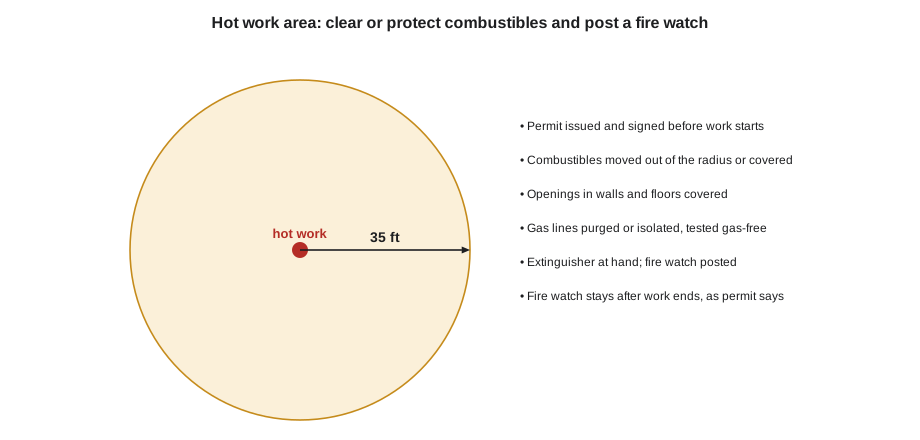
Most employers, building owners and insurers require a hot work permit. The permit system makes someone check the area before work starts, write down the precautions taken, and sign off when the area has been checked afterward. Typical precautions are:
- Move combustible materials at least 35 feet away, or protect them with fire-resistant covers or shields if they cannot be moved.
- Cover openings in floors and walls within that distance, so sparks cannot fall or travel into hidden spaces.
- Make sure the work is not near flammable liquids, gases or vapors. On a gas line, the section being worked on must be shut off, isolated, purged of gas and tested with a combustible gas indicator before any flame is applied.
- Have a suitable fire extinguisher at hand and know how to use it.
- Post a fire watch: a trained person whose only job is to watch for fires during the work and for a set time after it ends.
In the United States, OSHA's welding, cutting and brazing rules (29 CFR 1910.252 and 1926.352) require precautions such as moving combustibles 35 feet away or protecting them, and a fire watch kept for at least half an hour after the work is finished where a fire watch is required. NFPA 51B, Standard for Fire Prevention During Welding, Cutting, and Other Hot Work, which many fire codes, owners and insurers adopt, requires a permit and a longer watch. The Ohio Fire Code, based on the International Fire Code, adds its own hot work rules.
On the plaza roof, Jonah kept his post for the full time on the permit after Luis finished brazing. He watched the roofing membrane around the curb, felt the nearby surfaces with the back of his glove, and checked inside the rooftop unit's cabinet, where a spark could land on insulation. Then he signed the permit, and Priya filed it.
Worked problem
Sizing the area to clear
The hot work permit calls for combustibles to be cleared or protected within 35 ft of the brazing point in every direction. What floor area is that on a flat roof?
Show solution
- Use the area of a circle:
- \[A = \pi r^2\]
- Substitute the radius:
- \[A = 3.1416 \times 35^2 = 3.1416 \times 1{,}225 \approx 3{,}848 \text{ ft}^2\]
Answer: The area to check is about 3,850 square feet, much larger than most people picture when they think of the space around a torch. On a roof, it may include other units, vents, skylights and the edge of the membrane. Indoors, it extends through the floor and ceiling as well.
Torches and gas lines
Gasfitters often use torches near gas piping. A few rules prevent serious accidents. Never apply a flame to a pipe that contains gas; shut it off, isolate it, purge it and test it first. Never use a torch flame to look for a leak. Keep the torch away from flexible connectors, plastic pipe, wiring and the appliance's controls. And remember that a hot pipe stays hot after the flame is removed: let it cool or mark it before others handle it.
Ladders, roofs and tools
Falls are among the leading causes of serious injury in the construction trades, and gasfitters climb often: to rooftop units, attic furnaces, unit heaters and high vents. Inspect a ladder before use, set it on firm footing at the correct angle, extend it far enough above the landing to give a handhold, and keep three points of contact while climbing. Never carry heavy loads up a ladder in your hands; use a rope or hoist. On roofs, stay well back from unprotected edges, watch for skylights, which are not designed to bear weight, and use the guardrails, warning lines or fall protection the job plan calls for.
Hand and power tools cause many cuts and eye injuries. Keep blades and bits sharp and guards in place, use the right tool for the job, cut away from your body, and unplug tools before changing blades. Pipe threaders and cutters can catch gloves and sleeves; follow the manufacturer's instructions on gloves near rotating equipment.
Heat and cold
Gas work is done in attics in summer and on roofs and in unheated buildings in winter. In heat, drink water often, take breaks in shade or cool areas, and watch for heat exhaustion: heavy sweating, weakness, dizziness, nausea. Confusion or hot, dry skin can mean heat stroke, a medical emergency. In cold, dress in layers, keep dry, protect hands and face, and watch for frostbite and hypothermia, especially when handling propane, whose boiling liquid chills fittings and skin. Employers are required to protect workers from both.
Housekeeping and site safety
Many injuries on gas jobs come from ordinary hazards: tripping over hoses and cords, slipping on wet basement floors, cutting a hand on a sheet metal edge, or straining a back carrying a water heater down narrow stairs. Keep work areas tidy, route hoses and cords where people will not trip, clean up spills at once, and use a dolly or a second person for heavy appliances. Bend at the knees and keep loads close to the body. On construction sites, follow the site's orientation rules, sign in, and know where the first aid kit, the fire extinguishers and the emergency assembly point are. Good housekeeping also reduces fire risk, because sawdust, packaging and rags are fuel for any spark that escapes.
Common mistakes
MistakeWearing a dust mask for protection against carbon monoxide.
InsteadDust masks do not protect against CO or low oxygen; leave the area and use instruments.
MistakeConnecting a propane cylinder without gloves or eye protection.
InsteadLiquid propane causes freeze burns; wear insulated gloves and eye protection.
MistakeEnding the fire watch as soon as the torch is shut off.
InsteadKeep the fire watch for the full time the permit and rules require after work ends.
MistakeBrazing on a pipe section that has not been purged and tested.
InsteadIsolate, purge and test any gas line with an indicator before applying a flame.
Summary and key terms
- PPE is the last of the hierarchy of controls, after elimination, substitution, engineering and administrative controls.
- Gasfitters use head, foot, eye, hand and hearing protection, fall protection at height, respirators suited to the hazard and a personal CO monitor.
- Liquid propane causes freeze burns, and dust masks do not protect against CO or low oxygen.
- OSHA's Hazard Communication Standard requires labels, safety data sheets and training.
- Cylinders are secured upright, capped and kept away from oil.
- Hot work needs a permit, combustibles cleared or protected within 35 ft, purged and tested gas lines, an extinguisher and a fire watch that continues after the work ends.
- Personal protective equipment
- Equipment worn by a worker to reduce exposure to a hazard.
- Hierarchy of controls
- The ranking of hazard controls from elimination, the most effective, to PPE, the least.
- Safety data sheet
- A 16-section document from the supplier describing a product's hazards and safe use.
- Hot work
- Work producing flames, sparks or heat that can ignite materials, such as brazing, cutting and welding.
- Hot work permit
- A written authorization listing the precautions checked before, during and after hot work.
- Fire watch
- A trained person assigned to watch for and put out fires during and after hot work.
Practice problems
Work each problem on paper first, then reveal the answer to check.
List the hierarchy of controls from most to least effective.
Show answer
Elimination, substitution, engineering controls, administrative controls, PPE.
Why must insulated gloves be worn when handling propane cylinders?
Show answer
Escaping liquid propane boils at a very low temperature and causes freeze burns.
Why must oxygen never be used to blow out a pipe?
Show answer
Oxygen-enriched air makes materials burn fiercely and can ignite oil.
What must be done to a gas line before brazing on it?
Show answer
Shut it off, isolate it, purge it and test it gas-free with an indicator.
Why does the fire watch continue after hot work ends?
Show answer
Sparks can smolder in hidden places and ignite later.
Lesson quiz · 5 questions
Score 60% or more to complete this lesson.
Create a free account to save your progress, take quizzes and earn a certificate.