
GAS-110 · Lesson 2 of 12 · 20 min
Natural gas and propane: sources and composition
▶ Video coming soon A video version of this lesson is on the way.
On a cold morning in late September, Rosa took Jonah to a supply house to pick up a 20-pound propane cylinder for a construction heater and a box of fittings for a furnace job. In the truck she asked him a question he could not answer: "Where does the gas in that furnace line come from, and how is it different from the gas in this cylinder?" By the end of the day he knew that the two fuels come from the same underground source, that they behave very differently once they leave the ground, and that those differences shape almost every rule a gasfitter follows.
This lesson traces natural gas and propane from the ground to the appliance. It explains what each gas is made of, how it is processed and delivered, how propane is stored as a liquid, and why the composition of the fuel matters to a technician setting up a burner.
What natural gas is
Natural gas is a mixture of light hydrocarbons, molecules made of carbon and hydrogen, together with small amounts of other gases. It formed over millions of years as the remains of tiny plants and animals were buried under layers of sediment, then heated and compressed. The gas moved through porous rock until it was trapped under a layer it could not pass through, or it stayed locked in the fine-grained shale where it formed.
The main ingredient is methane, the simplest hydrocarbon, with one carbon atom and four hydrogen atoms. Pipeline gas delivered to homes is usually between 87 and 97 parts in 100 methane by volume. The rest is mostly ethane, with smaller amounts of propane, butane, nitrogen and carbon dioxide. Raw gas from a well contains much more: water vapor, heavier hydrocarbons, hydrogen sulfide, carbon dioxide, sand and sometimes helium. Those are removed before the gas enters a transmission pipeline.
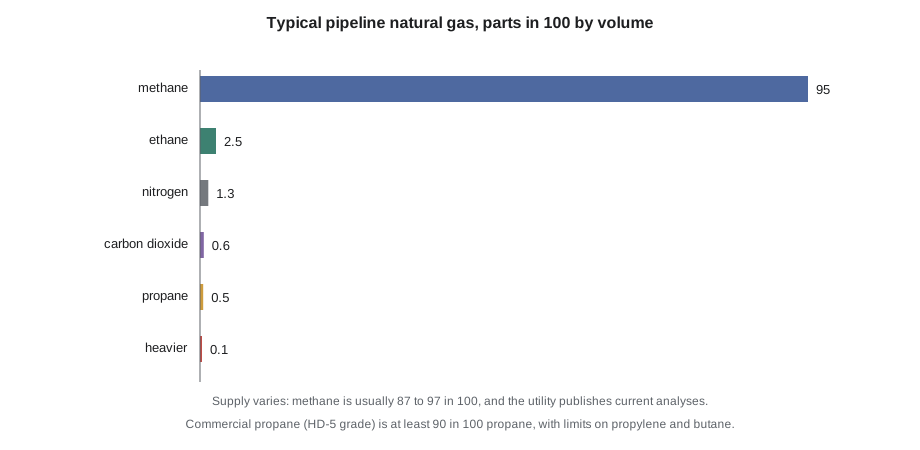
Because methane dominates, most of what a gasfitter needs to know about natural gas follows from methane's properties: it is lighter than air, it has no color or smell of its own, it burns with a clean blue flame when mixed with the right amount of air, and it produces carbon dioxide and water vapor when it burns completely. The small amounts of heavier gases raise the heating value slightly; the nitrogen and carbon dioxide lower it slightly, because they do not burn.
From the well to the meter
Natural gas passes through several stages before it reaches an appliance, and the pressure falls at each stage.
- Production. Wells drilled into gas-bearing rock bring raw gas to the surface. Many modern wells are drilled horizontally into shale and the rock is fractured with water and sand under pressure to release the gas.
- Processing. At a gas plant, water, sulfur compounds, carbon dioxide and the heavier hydrocarbons are removed. The heavier hydrocarbons, called natural gas liquids, are separated into ethane, propane, butane and natural gasoline. This is the main source of propane in North America.
- Transmission. Large steel pipelines carry the processed gas across the continent at high pressure. Compressor stations every 60 to 160 kilometers (about 40 to 100 miles) push it along.
- Storage. Gas is stored in depleted reservoirs, salt caverns and aquifers near markets, so that summer supply can meet winter demand.
- City gate. Where gas leaves a transmission line for a local distribution system, a station reduces the pressure, measures the flow and adds the odorant, the chemical that gives gas its smell.
- Distribution. The local utility's mains run under streets, and a service line branches to each building. A service regulator at the meter drops the pressure to what the building needs.
In central Ohio, homes are served mainly by Columbia Gas of Ohio, whose system draws heavily on the Appalachian Basin. The Marcellus and Utica shales under Pennsylvania, West Virginia and eastern Ohio became some of the most productive gas fields in the world after horizontal drilling spread in the late 2000s. The United States is the world's largest natural gas producer and a major exporter of liquefied natural gas.
A gasfitter never sees most of this system, but it explains three things that matter on the job. First, the gas arrives already odorized; the gasfitter does not add the smell. Second, the composition can vary a little from day to day as the utility blends supplies, which is one reason combustion is checked with an analyzer rather than assumed. Third, everything upstream of the meter belongs to the utility.
Renewable natural gas and hydrogen blends
Not all pipeline methane comes from wells. Renewable natural gas (RNG) is biogas from landfills, farm digesters and wastewater plants, cleaned up until it meets pipeline quality. Once cleaned, it is mostly methane and behaves like conventional natural gas, so appliances need no change.
Hydrogen is different. Some utilities are testing blends of a small amount of hydrogen into natural gas to cut carbon emissions. Hydrogen burns faster, has a much wider flammable range and a lower heating value per unit volume, and it can make some metals brittle. Small blends, generally up to about 5 to 20 parts in 100 by volume depending on the study, appear to work in most existing appliances, but higher blends require equipment designed for them. Codes and training are being updated for hydrogen, and a gasfitter should follow the utility's notices and the adopted code edition on any system carrying a blend.
What propane is
Propane has three carbon atoms and eight hydrogen atoms. It is one of the natural gas liquids separated at gas plants, and a smaller share is made at oil refineries. Today most North American propane comes from natural gas processing. What is sold as propane for heating is not pure: the common grade, known as HD-5, must be at least 90 parts in 100 propane, with limits on propylene (no more than 5 in 100) and on butane and heavier gases. Other grades with more propylene or butane are sold for some industrial uses.
The property that sets propane apart is that it becomes a liquid under modest pressure at ordinary temperatures. At atmospheric pressure it boils at about −44 °F. Above that temperature, liquid propane in a closed container boils until the pressure of the vapor above it stops further boiling. That pressure, the vapor pressure, depends only on the temperature of the liquid, not on how much liquid is left.
| Liquid temperature | Approximate propane vapor pressure (gauge) |
|---|---|
| −40 °F | about 2 psi |
| 0 °F | about 24 psi |
| 32 °F | about 55 psi |
| 70 °F | about 110 psi |
| 100 °F | about 175 psi |
Two practical points follow. A tank gauge that reads pressure tells you nothing about how much propane is left; a float gauge or the cylinder's weight does. And on a very cold day, the vapor pressure in a small tank can drop so low that the tank cannot boil off vapor fast enough to supply a large appliance. Gasfitters size tanks with that winter case in mind.
Propane containers are never filled completely. They are filled to about 80 parts in 100 of their volume as liquid, leaving vapor space so that the liquid can expand as it warms. Liquid propane expands much more with temperature than water does, and a container filled with liquid and then warmed would build up enough pressure to open its relief valve or rupture. The fill limits are set by the propane code and container standards; delivery drivers use fixed liquid level gauges and weight to stay within them.
When liquid propane boils into vapor, it expands about 270 times. One liter of liquid makes roughly 270 liters of vapor at atmospheric pressure. That is why a small liquid leak is far more dangerous than a vapor leak of the same size, and why liquid propane on skin causes frostbite: the boiling liquid pulls heat from whatever it touches.
Butane and other fuel gases
Butane has four carbon atoms. It boils at about 31 °F, so it does not vaporize well in cold weather and is rarely used alone for heating in Canada or the northern United States. It is found in lighters, portable stoves and some propane-butane blends used in warmer climates or for vehicle fuel. Gasfitters may also meet manufactured gas in old records, digester gas on farms and treatment plants, and hydrogen in new projects. Each has its own properties and its own appliance requirements; an appliance must be used only with the gas shown on its rating plate.
| Property | Natural gas (mostly methane) | Propane |
|---|---|---|
| Chemical formula of main part | CH4 | C3H8 |
| How it is delivered | Piped by a utility | Trucked and stored on site as a liquid |
| Weight compared with air | Lighter; rises | Heavier; sinks and pools |
| Heating value per unit volume | about 1,000 to 1,050 Btu/ft³ | about 2,500 Btu/ft³ |
| Typical appliance supply pressure | about 7 in. w.c. | about 11 in. w.c. |
| Smell | Added at the city gate | Added before delivery to the customer |
The next lesson looks at those properties in detail. For now, the key point is that the two gases are not interchangeable. Propane carries about two and a half times the energy of natural gas per unit volume, so a burner orifice sized for natural gas would deliver far too much heat on propane, with a large, sooty, carbon monoxide-producing flame. Converting an appliance from one gas to the other is done only with the manufacturer's certified conversion kit, by a qualified person, and the conversion is labeled on the appliance.
Why composition matters on the job
Rosa's furnace job that afternoon showed why the chemistry matters. The furnace was a 20-year-old unit in the Garfield Avenue bungalow, and the homeowner wanted to know why it left a faint black film on the heat exchanger. Rosa explained that natural gas, burned with the right amount of air, should leave nothing but carbon dioxide and water vapor. Soot is unburned carbon: a sign that some of the fuel did not find enough oxygen. The cause was not the gas; it was a dirty burner and a partly blocked air opening. But to see that, a technician has to know what the fuel is made of and what its combustion products should be.
Composition also matters when a home or business has two fuels. On Luis's rural propane jobs, many farms have propane for the house and a natural gas line nearby for a future connection. Each appliance must match the fuel actually supplied, and every regulator, orifice and setting must be checked when a system changes from one gas to the other.
Worked problem
How long will the cylinder last?
The construction heater Rosa picked the cylinder up for is rated 40,000 Btu per hour. A full 20-pound propane cylinder holds about 20 pounds of liquid. Propane releases about 21,600 Btu per pound. If the heater runs at full input, about how many hours will one cylinder last?
Show solution
- Find the energy in the cylinder:
- \[20 \text{ lb} \times 21{,}600 \text{ Btu/lb} = 432{,}000 \text{ Btu}\]
- The heater rating is already in Btu per hour:
- \[40{,}000 \text{ Btu/h}\]
- Divide the energy by the hourly use:
- \[\frac{432{,}000}{40{,}000} = 10.8 \text{ h}\]
Answer: One cylinder runs the heater for about 10.8 hours at full fire. In cold weather the cylinder may not keep up: the liquid chills as it boils, the pressure drops and the heater's output falls, which is why construction sites often manifold several cylinders together or use a larger tank.
Common mistakes
MistakeReading a propane tank's pressure gauge to judge how much fuel is left.
InsteadPressure depends on temperature, not quantity; use the float gauge or weigh the cylinder.
MistakeAssuming natural gas and propane appliances are interchangeable.
InsteadUse each appliance only with the gas on its rating plate; convert only with the maker's certified kit.
MistakeThinking the gasfitter adds odorant to natural gas.
InsteadThe utility adds odorant at the city gate; propane is odorized before delivery.
MistakeTopping up a propane container until it is full of liquid.
InsteadContainers are filled to about 80 in 100 of their volume to leave room for expansion.
Summary and key terms
- Natural gas is mostly methane, with small amounts of ethane, other hydrocarbons, nitrogen and carbon dioxide.
- It is produced from wells, processed to remove water, sulfur compounds and liquids, carried by high-pressure transmission lines, odorized at the city gate and distributed by the local utility.
- Propane is a natural gas liquid separated at gas plants or refineries; HD-5 grade is at least 90 in 100 propane.
- Propane is stored as a liquid under its own vapor pressure, which rises with temperature, and containers are filled to about 80 in 100 of volume.
- One volume of liquid makes about 270 volumes of vapor.
- Appliances must match the gas they are certified for.
- Methane
- The simplest hydrocarbon (CH4), the main part of natural gas.
- Propane
- A hydrocarbon (C3H8) separated from natural gas or oil, stored as a liquid under pressure.
- Natural gas liquids
- Ethane, propane, butane and heavier hydrocarbons separated from raw gas at a processing plant.
- City gate
- The station where gas passes from a transmission line to a local distribution system, with pressure reduction, metering and odorization.
- Vapor pressure
- The pressure of the vapor above a liquid in a closed container; it depends on the liquid's temperature.
- HD-5
- The common heating grade of propane, at least 90 in 100 propane with limits on propylene and heavier gases.
Practice problems
Work each problem on paper first, then reveal the answer to check.
What makes up most of pipeline natural gas?
Show answer
Methane, usually 87 to 97 parts in 100 by volume.
Where is odorant added to natural gas?
Show answer
At the city gate station where gas enters the local distribution system.
Why can a propane pressure gauge not show how much fuel is left?
Show answer
The vapor pressure depends on the liquid's temperature, not on the amount of liquid remaining.
About how many volumes of vapor does one volume of liquid propane make?
Show answer
About 270.
Why are propane containers not filled completely?
Show answer
To leave vapor space for the liquid to expand as it warms.
Lesson quiz · 5 questions
Score 60% or more to complete this lesson.
Create a free account to save your progress, take quizzes and earn a certificate.