
GAS-110 · Lesson 7 of 12 · 20 min
Carbon monoxide: how it forms and how it harms
▶ Video coming soon A video version of this lesson is on the way.
The personal CO monitor clipped to Rosa's shirt pocket was the first thing she told Jonah to buy with his first paycheck. On a no-heat call in the Garfield Avenue neighborhood in mid-October, it chirped as they came down the basement stairs: 38 ppm. Rosa stopped, backed up the stairs, opened the side door and called the homeowner outside. The old furnace had a cracked vent connector, rusted through where it met the chimney, and the burner was short of air because the furnace room door had been weather-stripped to stop a draft. Nobody in the house had symptoms yet. "That is how most CO cases start," Rosa said. "Not with a crisis. With a number nobody was looking at."
Carbon monoxide is the hazard most closely tied to gas work. It is produced by the incomplete combustion described in the previous lesson, it cannot be seen or smelled, and it kills people in their homes every year. This lesson explains what CO is, how it harms the body, the exposure limits that apply to workers and homes, how CO alarms and monitors work, and what a gasfitter does when CO is found.
What carbon monoxide is
Carbon monoxide is a molecule of one carbon atom and one oxygen atom. It forms whenever carbon-containing fuel burns without enough oxygen or is cooled before burning completely. Its key properties are:
- No color, smell or taste. The odorant in natural gas and propane does not survive combustion, so a CO leak gives no warning to the senses.
- About the same weight as air. Its specific gravity is about 0.97, so it mixes evenly through a room rather than rising or sinking. That is why CO alarms can be mounted at various heights, following the manufacturer's instructions.
- Flammable at high concentrations. It burns in air between about 12.5 and 74 parts in 100, levels far above those that kill, so its fire hazard is rarely the concern.
- Toxic at low concentrations. Levels measured in parts per million (ppm) cause harm. One ppm is one part in a million; 10,000 ppm is one part in 100.
CO comes from many sources besides gas appliances: vehicles running in attached garages, portable generators, charcoal grills and hibachis used indoors, gasoline-powered tools, wood stoves and fireplaces with blocked chimneys, and oil-fired equipment. During an investigation, a gasfitter should keep all of them in mind.
How CO harms the body
Oxygen travels through the blood bound to hemoglobin in red blood cells. Carbon monoxide binds to hemoglobin roughly 200 to 250 times more strongly than oxygen does, forming carboxyhemoglobin (COHb). Each hemoglobin site taken by CO can no longer carry oxygen, and CO also makes the remaining hemoglobin hold onto its oxygen more tightly, so less is released to the tissues. The brain and heart, which use the most oxygen, are harmed first.
Because CO binds so strongly, even a small concentration in air builds up in the blood over time. Breathing 100 ppm for several hours can raise COHb to levels that cause headaches; breathing a few thousand ppm can cause unconsciousness in minutes. Once exposure stops, COHb falls slowly in fresh air, with a half-life of several hours; breathing pure oxygen shortens that, and hyperbaric oxygen shortens it further.
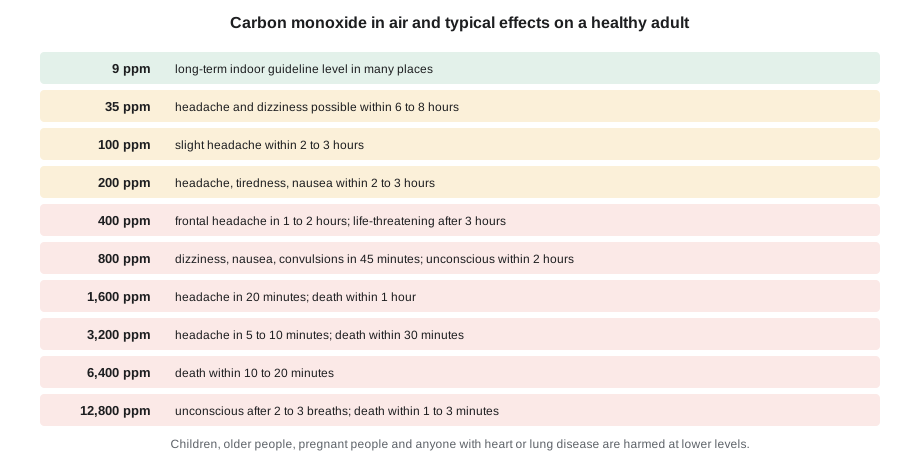
The early symptoms of CO poisoning are easy to mistake for the flu or food poisoning: headache, dizziness, tiredness, nausea, shortness of breath and confusion. Clues that point to CO instead include symptoms that affect several people or pets in the same building at once, symptoms that ease when people leave the building and return when they come back, and symptoms that appear when a heating appliance first runs in the fall. At higher levels come vomiting, chest pain, loss of muscle control, collapse and death.
Some people are at greater risk. Unborn babies, infants, children, older people, people with heart or lung disease, people with anemia and people who are asleep or intoxicated can be harmed at levels a healthy adult tolerates. Survivors of serious poisoning may have lasting memory, mood and movement problems that appear days or weeks later, so anyone with symptoms should be seen by a doctor.
Exposure limits
Limits for carbon monoxide are set separately for workers and for homes.
For workers in the United States, OSHA's permissible exposure limit (PEL) for CO is 50 ppm as an eight-hour time-weighted average. NIOSH, the federal research agency, recommends a lower limit of 35 ppm over eight hours with a ceiling of 200 ppm never to be exceeded, and lists 1,200 ppm as immediately dangerous to life or health (IDLH). Many employers and the ACGIH use 25 ppm. For outdoor air, the EPA's national standard is 9 ppm averaged over eight hours and 35 ppm over one hour, and those figures are often used as reference points for indoor air in homes.
A time-weighted average (TWA) weights each concentration by how long a person breathes it, then divides by the length of the shift, usually eight hours. It lets a worker spend short periods at higher levels as long as the average stays below the limit, within any short-term or ceiling limits that also apply.
Worked problem
Checking a time-weighted average
During a shift, Jonah's personal monitor logs about 40 ppm for 2 hours while he works near a construction heater in a partly enclosed space, then about 10 ppm for the remaining 6 hours. What is his eight-hour TWA, and is it below the OSHA limit of 50 ppm and the NIOSH recommendation of 35 ppm?
Show solution
- Multiply each level by its time and add:
- \[40 \times 2 + 10 \times 6 = 80 + 60 = 140 \text{ ppm-hours}\]
- Divide by the eight-hour shift:
- \[\frac{140}{8} = 17.5 \text{ ppm}\]
Answer: His TWA is 17.5 ppm, below both the OSHA limit and the NIOSH recommendation. But the 40 ppm readings show that the space needed better ventilation, and a technician should ask why any CO was present at all. A properly vented construction heater, or one used with enough fresh air, should not raise CO that much.
CO alarms and monitors
In Ohio, the Residential Code of Ohio requires CO alarms in new houses that have fuel-fired appliances or attached garages, installed outside each sleeping area, and the Ohio Building Code requires CO detection in certain other occupancies. Requirements for existing homes and rentals vary by city. Nationally, most states now require CO alarms in at least some homes. Residential CO alarms sold in the United States are listed to UL 2034.
Residential CO alarms are designed to avoid nuisance alarms, so they do not sound at low levels. The certification standard requires an alarm only after a sustained exposure: roughly within 1 to 4 hours at 70 ppm, within 10 to 50 minutes at 150 ppm, and within 4 to 15 minutes at 400 ppm. An alarm that has not sounded does not prove that the air is free of CO. Low-level CO monitors that display readings from about 5 to 10 ppm are available for people at higher risk.
Gasfitters carry two kinds of instruments. A personal CO monitor clipped near the breathing zone warns the technician on entry and during work; most alarm at a preset level such as 25 or 35 ppm. An ambient CO meter gives continuous readings for testing rooms, appliances and flue gas. Combustion analyzers also measure CO in flue gas, which is far higher than room air and must never be confused with it. All of these instruments need bump testing and calibration on schedule.
What a gasfitter does when CO is found
Bayline's procedure, like most companies', follows a sequence:
- Protect yourself. Watch your personal monitor on entry. If readings are high, leave and ventilate before going further; do not become a second victim.
- Get people out. If occupants have symptoms or room readings are high, get everyone outside to fresh air and call 911 for medical help. Emergency services and the gas utility have their own procedures and should be called as the situation requires.
- Find the source. With the building ventilated and safe to enter, test each fuel-burning appliance: room readings near it, spillage at its draft hood, CO and oxygen in its flue. Check vents, chimneys, combustion air and anything that could depressurize the house. Check non-gas sources too.
- Make it safe. Shut off and tag any appliance producing excessive CO or spilling flue gas, and explain the hazard to the owner in writing. Do not leave it operating.
- Report. In Ohio, report to the utility and local authorities as their rules require; Columbia Gas and the City of Columbus have procedures for unsafe appliances and incidents. Lessons 11 and 12 cover reporting in detail.
| Situation | Typical response |
|---|---|
| Personal monitor alarms on entry | Leave, ventilate, re-enter only when safe; find the source |
| CO alarm sounding, occupants with symptoms | Get everyone out, call emergency services, do not re-enter until cleared |
| Appliance flue CO above maker's limit | Find and correct cause; shut off and tag if not corrected |
| Spillage at a draft hood | Correct venting or depressurization; shut off and tag if not corrected |
| No appliance fault found, CO still present | Look for other sources: vehicles, generators, neighbors, chimneys |
At Garfield Avenue, Rosa shut off the furnace, tagged it, showed the homeowner the rusted connector and explained the weather-stripping problem. A new connector and a louvred door fixed both causes. Before leaving, she ran the furnace with the door closed and all exhaust fans on, measured CO at the registers and in the flue, and confirmed that the house had working CO alarms outside the bedrooms. The homeowner had one alarm, eleven years old, in the basement; Rosa recommended replacing it and adding one upstairs.
Special situations
Some situations produce CO problems again and again, and experienced technicians check for them on every CO call.
- Attached garages. A car warmed up in an attached garage, even with the door open, can push CO into the house through the connecting door and any gaps in the shared wall.
- Portable generators and fuel-burning tools. Run indoors, in garages or near windows during power outages, they produce very high CO levels quickly. Many winter-storm deaths are caused this way.
- Tight homes. Air sealing, new windows and added insulation reduce the air available to natural-draft appliances and make depressurization from exhaust fans more likely.
- Shared vents and chimneys. An appliance on a shared chimney can be affected by changes to another appliance, such as removing a furnace and leaving a water heater alone in an oversized chimney that stays too cold to draft.
- Seasonal start-up. The first cold days of fall bring blocked vents from bird nests, debris and leaves, and a burst of CO calls.
Talking to customers about CO
When a technician finds a CO problem, the customer often feels frightened, guilty or doubtful. Rosa explains what she measured, what it means in plain terms, and what has to happen next. She avoids alarming language but never minimizes the hazard. If anyone has symptoms, she urges them to see a doctor and tell the doctor about the CO exposure, because blood tests are most useful soon after exposure. She leaves the customer a written notice and, where the appliance is shut off, a clear statement of what must be fixed before it can be used again.
Treatment for CO poisoning starts with removing the person from the exposure and giving high-flow oxygen. Hospitals measure carboxyhemoglobin in the blood; for severe cases, especially with loss of consciousness, pregnancy or neurological symptoms, doctors may use hyperbaric oxygen in a pressurized chamber. A gasfitter's role is to get people out and get medical help, not to judge how serious the exposure is.
Common mistakes
MistakeAssuming a quiet CO alarm means there is no CO.
InsteadResidential alarms sound only after sustained exposure; measure with a meter.
MistakeUsing the odorant to detect CO.
InsteadCO has no smell; the odorant does not survive combustion. Use instruments.
MistakeRe-entering a building with high CO to finish testing.
InsteadLeave, ventilate and re-enter only when your monitor shows it is safe.
MistakeConfusing flue-gas CO readings with room-air CO.
InsteadFlue samples are far higher than room air; compare each with the right limit.
Summary and key terms
- Carbon monoxide is a colorless, odorless, tasteless gas formed by incomplete combustion; it mixes evenly with air.
- It binds to hemoglobin about 200 to 250 times more strongly than oxygen, starving the brain and heart.
- Early symptoms resemble the flu; several people affected at once, or relief away from home, point to CO.
- OSHA's worker limit is 50 ppm over eight hours; NIOSH recommends 35 ppm with a 200 ppm ceiling and lists 1,200 ppm as IDLH. Residential alarms sound only after sustained exposure.
- Gasfitters protect themselves, get people out, find the source, make it safe and report.
- Carbon monoxide
- A toxic gas, CO, formed when carbon-based fuel burns incompletely.
- Carboxyhemoglobin
- Hemoglobin bound to carbon monoxide, which can no longer carry oxygen.
- Parts per million
- A unit of concentration; 10,000 ppm equals 1 part in 100.
- Time-weighted average
- An exposure averaged over a work shift, weighting each level by how long it was breathed.
- Personal CO monitor
- A small alarm worn near the breathing zone to warn a worker of CO.
- IDLH
- Immediately dangerous to life or health; a level that can kill or cause lasting harm without protection.
Practice problems
Work each problem on paper first, then reveal the answer to check.
Why does CO not rise or sink in a room?
Show answer
Its specific gravity is about 0.97, almost the same as air.
How does CO harm the body?
Show answer
It binds to hemoglobin far more strongly than oxygen, so the blood carries less oxygen to the tissues.
Name two clues that symptoms are caused by CO rather than flu.
Show answer
Several people or pets affected at once; symptoms ease away from the building.
Why can a home have CO even when the alarm is silent?
Show answer
Residential alarms sound only after sustained exposure above set levels.
What is the first thing a gasfitter does when the personal monitor alarms on entry?
Show answer
Leave and ventilate before going further.
Lesson quiz · 5 questions
Score 60% or more to complete this lesson.
Create a free account to save your progress, take quizzes and earn a certificate.