
ENGG-404 · Lesson 4 of 12 · 24 min
Contract law II: performance, breach and remedies
Once a contract is formed, each party must do what it promised. Most contracts are performed without drama: the engineer delivers the design, the client pays, and everyone moves on. But on any project of real size, something goes wrong. A site turns out to be different from what the borings showed, a supplier fails, a client changes its mind, a flood stops work, or a party simply does not pay. This lesson covers what the law says when performance goes off track: what counts as performance, what counts as breach, when a contract can be ended, and what the injured party can recover.
Lesson 3 dealt with formation and terms. Here we follow the Northbridge bridge into construction, where Northbridge acts as the owner's contract administrator for the construction contract as well as the designer under its own services agreement. That dual role is common for consulting engineers and brings its own legal responsibilities, which we will flag along the way.
Performance and substantial performance
A party performs a contract by doing exactly what it promised, on time. In practice, construction and engineering contracts are almost never performed perfectly, and the law recognizes this. Under the doctrine of substantial performance, a contractor that has completed the work in all essential respects, with only minor defects or omissions, is entitled to the contract price, less the cost of correcting the defects. It cannot be refused payment altogether because of trivial shortcomings.
Substantial completion has a related contractual meaning in most US construction contracts: the stage when the work is sufficiently complete that the owner can occupy or use it for its intended purpose. It typically triggers the release of most retainage (the portion of each payment withheld as security), the start of warranty periods, the end of liquidated damages, and in many states the start of the statute of repose. Engineers acting as the owner's representative often certify substantial completion, and the date has legal consequences for everyone.
Some obligations are conditions, essential terms whose breach goes to the root of the contract, and others are lesser terms (sometimes called warranties in this context) whose breach gives a right to damages but not to end the contract. Contracts often state which terms are essential, for example by saying that time is of the essence. Without such a statement, courts look at the importance of the term and the seriousness of the consequences of breach.
Breach
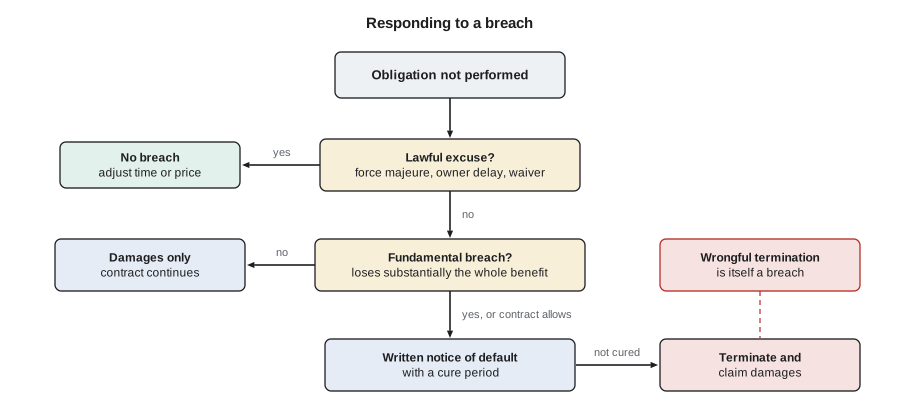
A breach is a failure to perform a promise without lawful excuse. It may be a complete failure, a defective performance or a late performance. An anticipatory breach, also called repudiation, happens when a party, before performance is due, shows clearly that it will not perform: for example, a client tells the engineer to stop work and says it will not pay for anything further. The innocent party may then choose to accept the repudiation, ending the contract and claiming damages, or to affirm the contract and keep insisting on performance. The choice must be made clearly and promptly.
For a breach to justify termination, it usually must be fundamental: it must deprive the innocent party of substantially the whole benefit of the contract. Less serious breaches give only a right to damages. A party that terminates for a breach that turns out not to be serious enough is itself in repudiatory breach, which is one of the most expensive mistakes in construction law. That is why well-drafted contracts set out a termination procedure: written notice identifying the default, a cure period, and only then the right to terminate.
American courts apply the implied covenant of good faith and fair dealing during performance, and many construction contracts give the owner a right to terminate for convenience. Federal government contracts include a termination for convenience clause by regulation, and courts have held that the government must act in good faith in using it. Where a contractor is wrongly terminated for default, many contracts convert the termination into one for convenience, which limits the contractor's recovery to costs incurred and some profit on work performed.
Giving notice
Construction and engineering contracts are full of notice requirements. A contractor that encounters differing site conditions must give notice before disturbing them. A party claiming extra time or money must give written notice within a set number of days of the event. A party wanting to terminate must give a notice of default and a cure period. These provisions exist so that the other side can investigate, mitigate and plan while the facts are fresh.
American courts vary in how strictly they enforce notice requirements. Many enforce them as written, especially where the contract makes timely notice a condition precedent to recovery. Others excuse late notice where the owner had actual knowledge of the problem and was not prejudiced by the delay. Federal contract law tends toward the more forgiving view, while some state courts are strict. Engineers advising clients should never rely on forgiveness: give the notice the contract requires, in the form and within the time it requires, and keep proof of delivery.
For the engineer as contract administrator, notice provisions cut both ways. The engineer must recognize when a contractor's letter is a notice of claim and process it under the contract's procedure, and must make sure the owner gives the notices the owner is required to give. Missing a contractual deadline can waive the owner's rights or expose the engineer to a claim from its own client.
Excuses for non-performance
Sometimes a party's failure to perform is excused. The law excuses performance only in narrow circumstances; contracts commonly widen them.
Impossibility and commercial impracticability excuse performance when, without the fault of the party seeking the excuse, an event whose non-occurrence was a basic assumption of the contract makes performance impossible or impracticable. Frustration of purpose excuses performance when such an event destroys the principal purpose of the contract for one party. UCC section 2-615 codifies impracticability for the sale of goods. Courts apply these doctrines narrowly: a large increase in cost, by itself, is rarely enough.
Force majeure clauses define events beyond a party's control, such as natural disasters, wars, epidemics, government orders and strikes, and say what happens if one occurs. Usually the affected party gets extra time but not extra money, and either party may terminate if the event lasts long enough. The clause applies only to the events it lists, interpreted according to its wording; the COVID-19 pandemic produced many disputes about whether epidemic, government action or catch-all wording covered pandemic delays. The affected party normally has to give prompt notice and show that the event actually caused the delay and could not be avoided with reasonable effort.
Delay
Delay is the most common source of construction disputes. Engineers, whether as designers or contract administrators, need to understand the vocabulary. An excusable delay is one for which the contractor is entitled to more time, such as owner changes, differing site conditions or force majeure events. A compensable delay is an excusable delay for which the contractor is also entitled to extra money, usually because the owner caused it. A non-excusable delay is one for which the contractor is responsible, which may expose it to liquidated damages. Concurrent delays, where owner and contractor delays overlap, are the hardest to resolve; contracts and courts deal with them in different ways, often by granting time but not money.
Liquidated damages are a sum the parties agree in advance will be paid for each day of non-excusable delay. They save the owner from having to prove its actual loss, which is often hard on public projects like a pedestrian bridge where the loss is the public's inconvenience rather than lost revenue, and they give the contractor a known limit on its exposure. They are enforceable if they are a genuine pre-estimate of the likely loss at the time of contracting, and unenforceable as a penalty if they are extravagant compared with any loss that could be expected. Many contracts cap total liquidated damages at a percentage of the contract price.
On the Westbrook bridge, the construction contract sets completion for June 30, 2028, liquidated damages of $1,100 per day and a cap of 10 percent of the $2.8 million price. The contractor finishes on September 15. Northbridge, as the owner's representative, has granted 21 days for an owner design change and nine days for a flood. The program calculates the chargeable damages.
from datetime import date

CONTRACT_PRICE = 2_800_000
LD_PER_DAY = 1_100          # pre-estimate of the owner's daily loss
LD_CAP = 0.10               # liquidated damages capped at 10% of the price

completion_due = date(2028, 6, 30)
actual_completion = date(2028, 9, 15)
excusable_days = {"Owner design change": 21, "Flood (force majeure)": 9}

late = (actual_completion - completion_due).days
excused = sum(excusable_days.values())
chargeable = max(0, late - excused)
ld = min(chargeable * LD_PER_DAY, LD_CAP * CONTRACT_PRICE)

print(f"Days late: {late}")
for cause, days in excusable_days.items():
    print(f"  less {days:2} days excused: {cause}")
print(f"Chargeable days: {chargeable}")
print(f"Liquidated damages: ${ld:,.0f} (cap ${LD_CAP * CONTRACT_PRICE:,.0f})")Days late: 77 less 21 days excused: Owner design change less 9 days excused: Flood (force majeure) Chargeable days: 47 Liquidated damages: $51,700 (cap $280,000)
The calculation is simple; the hard part is the inputs. Whether the flood was a force majeure event, whether the design change really caused 21 days of delay on the critical path, and whether the contractor gave timely notice of both are the questions on which a delay claim turns. That is why contract administrators need accurate schedules, daily records and prompt written decisions.
Remedies
The main remedy for breach of contract is damages: money to put the injured party in the position it would have been in if the contract had been performed. These are expectation damages. Where expectation is hard to prove, a party can sometimes claim reliance damages instead, the expenses it incurred in reliance on the contract. Three limiting principles apply.
- Causation: the loss must be caused by the breach.
- Remoteness: under the rule from Hadley v. Baxendale (1854), still applied throughout the common law world, recoverable losses are those that arise naturally from the breach, or that both parties would reasonably have contemplated as a probable result when they made the contract. Unusual losses are recoverable only if the defendant knew of the special circumstances.
- Mitigation: the injured party must take reasonable steps to limit its loss, and cannot recover losses it could reasonably have avoided.
Engineering contracts often exclude consequential or indirect damages, such as lost profits, loss of use and business interruption, which would otherwise be recoverable if they were within the parties' contemplation. Because the line between direct and consequential losses is notoriously unclear, the better contracts list the excluded categories rather than relying on those labels.
In some cases a court will order a party to do what it promised, a remedy called specific performance, or to stop doing something, an injunction. These equitable remedies are discretionary and rare in construction and services contracts, because courts are reluctant to supervise ongoing work and because damages are usually adequate. They are more common for contracts involving land or unique goods, and for enforcing confidentiality and non-competition obligations.
| Remedy | Purpose | When it fits |
|---|---|---|
| Expectation damages | Put the party where performance would have | The usual remedy for breach |
| Reliance damages | Recover wasted expenditure | When lost profit is too uncertain to prove |
| Liquidated damages | Agreed pre-estimate of loss | Delay on construction projects |
| Restitution or quantum meruit | Pay for benefits conferred | No enforceable contract price, or contract ended |
| Specific performance | Order the promised act | Land or unique goods; rare for services |
| Injunction | Order a party to stop | Confidentiality, non-competition, trespass |
Getting paid
For engineers and contractors, the commonest breach is non-payment. Every state has a mechanics lien statute that gives contractors, subcontractors and suppliers, and in many states design professionals, a right to record a lien against private property they improved, subject to strict notice and filing deadlines. Liens cannot usually attach to public property, so on public projects payment is protected by bonds instead: the federal Miller Act requires payment bonds on federal construction contracts over $100,000, and state Little Miller Acts do the same for state and local work. The federal Prompt Payment Act requires federal agencies to pay proper invoices on time or pay interest, and most states have prompt payment statutes for public and often private construction that set payment deadlines and interest on late payments.
Worked problem
Responding to a stop-work instruction
Halfway through detailed design, the city council votes to defer the bridge for a year. The city engineer emails Northbridge: "Stop all work immediately. We won't be paying for anything after today." The services agreement allows the client to suspend for up to 90 days and to terminate for convenience on 30 days' written notice, with payment for work done and reasonable demobilization costs.
Show solution
- The email is an instruction to stop. Northbridge should stop work promptly to mitigate its losses; continuing would increase costs that it may not recover.
- The refusal to pay for anything may be an anticipatory breach if it includes work already done. But the contract gives the client a termination for convenience right, so the email is probably best read, or clarified, as a suspension or termination under the contract.
- Northbridge should reply in writing, asking the client to confirm whether this is a suspension or a termination for convenience, and stating that it will invoice for work done to date and demobilization costs as the contract provides.
- Northbridge should secure its records, issue its invoice promptly, note any notice deadlines and consider lien or prompt payment rights if payment does not follow.
Answer: Treat the email as an exercise of the contract's suspension or termination rights, mitigate, and claim what the contract allows. Do not walk away or keep working as if nothing happened.
Common mistakes
MistakeAny breach lets the other party terminate.
InsteadOnly a fundamental breach, or a breach the contract makes grounds for termination after notice and cure, justifies termination.
MistakeA late notice of claim is fine if the owner knew about the problem.
InsteadMany courts enforce notice requirements strictly; give the notice the contract requires.
MistakeHigher costs make a contract frustrated.
InsteadIncreased cost or difficulty rarely excuses performance.
MistakeLiquidated damages can be set as high as the owner likes.
InsteadThey must be a genuine pre-estimate of loss, or they may be struck down as a penalty.
MistakeAn injured party can recover every loss, however unusual.
InsteadRemoteness and mitigation limit recoverable losses.
Summary and key terms
- Substantial performance entitles a party to the price less the cost of correcting minor defects.
- Only fundamental breaches justify termination; wrongful termination is itself a breach.
- Provisions requiring notice are often conditions precedent; follow them exactly.
- Frustration, impossibility and force majeure excuse performance only in narrow, defined situations.
- Delays are excusable, compensable or non-excusable; liquidated damages compensate the owner for the last kind.
- Damages aim to put the injured party where performance would have; remoteness and mitigation limit them.
- Mechanics liens, payment bonds and prompt payment statutes protect payment down the construction chain.
- Substantial performance
- Completion of a contract in all essential respects, with only minor defects.
- Fundamental breach
- A breach that deprives the innocent party of substantially the whole benefit of the contract.
- Anticipatory breach
- A clear indication, before performance is due, that a party will not perform.
- Force majeure
- An event beyond the parties' control, as defined in the contract, that excuses or delays performance.
- Liquidated damages
- A sum agreed in advance as compensation for a defined breach, usually delay.
- Mitigation
- The injured party's duty to take reasonable steps to limit its loss.
- Remoteness
- The rule limiting damages to losses within the parties' reasonable contemplation.
- Retainage
- A portion of each payment withheld as security for lien claims or completion.
Practice problems
Work each problem on paper first, then reveal the answer to check.
What is the difference between excusable and compensable delay?
Show answer
Excusable delay earns more time; compensable delay earns time and money, usually because the owner caused it.
Change the program so the flood is not excused. What are the liquidated damages?
Show answer
56 chargeable days, so $61,600.
Why should a party be cautious about terminating a contract?
Show answer
If the breach was not serious enough, the terminating party commits a repudiatory breach itself.
State the two limbs of the rule in Hadley v. Baxendale.
Show answer
Losses arising naturally from the breach, and losses both parties would have contemplated as probable when contracting.
Name two ways an unpaid engineer might secure payment.
Show answer
A mechanics lien where allowed, or a claim on a payment bond.
What should a party claiming force majeure usually do first?
Show answer
Give prompt written notice and document how the event caused the delay.
Lesson quiz · 5 questions
Score 60% or more to complete this lesson.
Create a free account to save your progress, take quizzes and earn a certificate.