
ENGG-404 · Lesson 1 of 12 · 24 min
The engineering profession and how it is regulated
Engineering is one of a small number of occupations that the law treats as a profession. That word carries legal weight. It means that only people who have shown the right education, experience and character may practice, that they answer to a body set up by statute, and that their first duty runs to the public rather than to their employer or client. This course is about the rules that follow from that status: the law that governs engineering work, the ethics that guide engineers where the law is silent, and the practical habits that keep engineers, their firms and the public out of trouble.
It is a fourth-year course, and it assumes you have met some of these ideas before. ENGG-100 introduced the profession and its history, ENGG-401 covered engineering economics, BUS-210 surveyed business law, and the construction courses (CON-220 and CON-420 especially) dealt with construction contracts, changes and claims. This course does not repeat those. It applies law and ethics to the work engineers actually do: designing, certifying, advising, supervising and signing.
Throughout the course we follow an invented firm, Northbridge Engineering LLC, a 40-person consulting practice in Kansas City, Missouri. Northbridge has been retained by the invented City of Westbrook, Kansas to design a 150-foot steel pedestrian bridge over a creek, with a fee of $310,000. The engineer of record is Maya Okafor, PE; her team includes Daniel Ruiz, an engineer intern (EI), and the firm's principal, Ken Larsson, PE. Every contract, dispute and ethical problem in the course happens to this firm and this project, so you can watch the legal pieces connect.
A word of caution before we begin. This course explains the general principles of engineering law and ethics for education. Laws differ between jurisdictions and change over time, and the outcome of any real dispute depends on its facts. When you face a real legal question in practice, talk to a lawyer licensed where the work is done, and to your regulator about professional obligations.
What makes engineering a profession
Sociologists and courts have described the features that set a profession apart. There is a specialized body of knowledge acquired through long formal education. There is a commitment to serve the public that ranks above personal gain. There is a monopoly, granted by law, over a defined area of practice. And there is self-regulation: members of the profession, through a statutory body, set entry standards, write codes of conduct and discipline those who break them. Medicine, law and accounting share these features; engineering acquired them in the twentieth century after a series of disasters persuaded legislators that bad engineering kills people.
The bargain is simple to state. Society grants engineers the exclusive right to practice and the privilege of governing themselves. In return, engineers promise competence, honesty and loyalty to the public interest, and accept discipline when they fall short. If the profession fails to police itself, legislators can and do take the privilege back or attach conditions. That is why regulators take their public-protection mandate seriously and why discipline decisions are published.
Licensing in the United States
In the United States, engineering is licensed by the states, the District of Columbia and the territories, because regulating professions is a state police power. Each jurisdiction has a licensing law, usually called an engineering practice act, and a board of licensure that issues licenses, writes rules and disciplines licensees. The boards cooperate through NCEES, the National Council of Examiners for Engineering and Surveying, which writes and administers the Fundamentals of Engineering (FE) and Principles and Practice of Engineering (PE) exams, publishes a Model Law and Model Rules that many states follow in part, and runs a records program that makes it easier to obtain licenses in more than one state. NCEES does not license anyone; the state boards do. Undergraduate programs are accredited by ABET, a nonprofit federation of professional societies.
Because licensing is by state, a license is valid only in the state that issued it. An engineer who seals drawings for a project in Kansas must hold a Kansas license, even if she is licensed in Missouri. Comity, the process of obtaining a license in another state on the strength of the first one, is usually straightforward for engineers who passed the NCEES exams, and the NCEES Record helps, but each license is separate, with its own fees, continuing education rules and disciplinary authority. Firms need their own authorization too: most states require a certificate of authorization or firm registration for any business that offers engineering services to the public, and many require a licensed engineer in responsible charge at each office.
Defining the practice of engineering
Each practice act defines the practice of engineering, and the definitions share a pattern, often borrowed from the NCEES Model Law: any service or creative work requiring engineering education, training and experience in applying special knowledge of mathematics, physical sciences and engineering sciences to activities such as consultation, investigation, evaluation, planning, design and design coordination of engineering works and systems, where the public welfare or the safeguarding of life, health or property is concerned. The key elements are that the work requires engineering knowledge and that it affects the public. Routine technical work done under the responsible charge of a licensed engineer generally falls outside the definition.
Two kinds of protection follow. Practice protection means that only licensed engineers, or people working under their responsible charge, may do work that falls within the definition. Title protection means that only licensed people may call themselves professional engineers or use the designation PE. Unlike Canada, most states do not restrict the bare word engineer in job titles, and many have an industrial exemption, discussed below, that lets unlicensed engineers design products for their employer. The PE license is therefore essential for consulting engineers who sign plans for public works and buildings, and optional for many engineers in manufacturing.
The path to a PE license
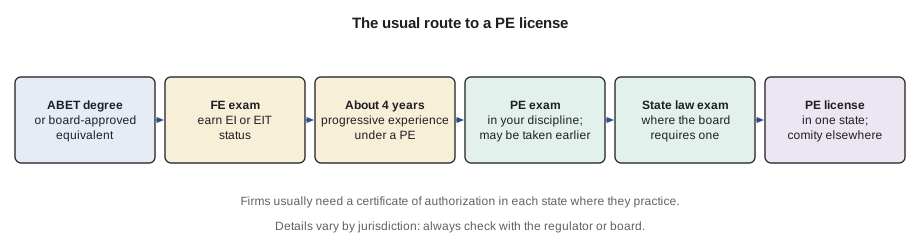
The route to licensure has four parts in almost every state. First, education: usually a bachelor's degree from an ABET-accredited program; some states accept other degrees with more experience. Second, the Fundamentals of Engineering (FE) exam, which most students take near graduation; passing it, plus the degree, earns certification as an engineer intern (EI) or engineer-in-training (EIT). Third, experience: typically four years of progressive engineering experience, much of it under the supervision of a licensed PE. Fourth, the Principles and Practice of Engineering (PE) exam in a chosen discipline. Many boards now allow candidates to take the PE before completing the experience, a change sometimes called decoupling, and issue the license once the experience is verified. Some states also require a separate state-specific law and ethics exam or course, often open-book and online.
The PE exam is now computer-based in every discipline, delivered at Pearson VUE test centers year-round, and most disciplines are about eight hours of appointment time with roughly 80 to 85 questions; check the current NCEES specification for your discipline. The FE exam is also computer-based, about six hours of appointment time, and includes a section on ethics and professional practice. Neither exam is mainly a law exam, but both test the professional responsibilities this course covers, and several states add a law and ethics component. Lesson 11 returns to these exams.
# Licensure path planner for an engineering graduate in the United States (illustrative).
# The usual path: ABET-accredited degree -> FE exam -> engineer intern (EI/EIT)
# -> about 4 years of progressive experience under a PE -> PE exam -> license.
# Many boards now let you sit the PE before the 4 years are complete.
from datetime import date

grad = date(2024, 5, 1)
fe_passed = date(2024, 4, 15)    # took the FE in the final semester
start_work = date(2024, 6, 3)
months_needed = 48

def add_months(d, m):
    y, mo = divmod(d.month - 1 + m, 12)
    return date(d.year + y, mo + 1, 1)

licensable = add_months(start_work, months_needed)
print(f"FE passed: {fe_passed:%B %Y}; EI certificate requested from the state board")
print(f"Four years of qualifying experience complete: {licensable:%B %Y}")
# If the board allows decoupling, the PE exam can be taken earlier,
# for example after 24 months, and the license issued when experience is complete.
early_pe = add_months(start_work, 24)
print(f"Earliest PE attempt if the board allows taking it early: {early_pe:%B %Y}")
print("Steps: FE -> EI -> log experience with PE supervisors -> PE exam -> references -> license")FE passed: April 2024; EI certificate requested from the state board Four years of qualifying experience complete: June 2028 Earliest PE attempt if the board allows taking it early: June 2026 Steps: FE -> EI -> log experience with PE supervisors -> PE exam -> references -> license
The program above simply adds months, but it makes a useful point: licensure takes years, and planning saves time. Writing the professional practice exam early, while you are still in study mode, and logging experience against the required competencies as you go are the two habits that most often shorten the path.
Regulators and what they do
Regulators have four main jobs. They admit people to the profession, which means assessing education and experience and administering exams. They set standards, through codes of ethics, practice standards and guidelines on topics such as authenticating documents, using software or retaining project records. They monitor competence, through continuing professional development programs and practice reviews. And they discipline members who fall below the standard, through a complaints and hearing process that resembles a court but is run by the regulator. Most regulators also prosecute unlicensed practice and misuse of protected titles.
It helps to be clear about what regulators are not. They are not trade unions or advocacy bodies for engineers; their mandate is to protect the public, not to promote the profession's economic interests. That is why many jurisdictions also have separate member societies, such as provincial engineering societies or national technical societies, that do advocate for engineers, run conferences and publish technical standards. Joining a technical society is voluntary; holding a license when you practice is not.
| United States | Notes | |
|---|---|---|
| Who licenses | State boards in 50 states, DC and territories | A license is valid only where it was issued |
| National body | NCEES (exams and model law; no licensing) | Coordinates standards and mobility |
| Accreditation | ABET | Mutual recognition through the Washington Accord |
| Law and ethics exam | FE ethics section; some state law exams | Content overlaps this course |
| Intern status | Engineer intern (EI) or EIT | May not take responsibility for work |
| Firm authorization | Certificate of authorization or firm registration | Separate from the individual license |
Who needs a license, and when
Practice protection means that work within the statutory definition must be done by, or under the responsible charge of, a licensed engineer. In practice that covers almost all consulting work on buildings, infrastructure and public works: building departments and public agencies will not accept plans without a PE seal. Many states have an industrial exemption, which lets engineers employed by a manufacturer design the company's own products without a license, on the theory that the company, through product liability law, is responsible to the public. Federal government engineers are often exempt as well. Critics argue that these exemptions leave large areas of safety-critical design to unlicensed engineers; supporters say they reflect how product engineering actually works.
An engineer who practices without the required license, or a firm that offers services without authorization, commits a provincial or state offense that can bring fines and injunctions. There are also civil consequences: in many jurisdictions an unlicensed person cannot sue to recover fees for engineering work, and insurers may deny coverage. Signing or sealing a document for work you did not do or supervise is treated even more seriously, as it misleads the public about who is responsible.
Why the history matters
American engineers can trace licensure to Wyoming, which passed the first engineering licensing law in 1907 after unqualified people filed incompetent water-rights surveys, and to disasters such as the St. Francis Dam failure in California in 1928, which killed several hundred people and led California to license civil engineers the next year. By 1947 every state had a licensing law. The Order of the Engineer, founded in 1970 and inspired by the Canadian iron ring tradition, gives graduates a stainless steel ring and an obligation to serve humanity. Like the Canadian ritual it is voluntary and is not a licensing step, but it captures the idea at the center of this course, that engineering decisions carry moral weight.
The pattern in these stories is worth noticing. Licensure and codes of ethics did not arise from abstract principle; they arose because people died when unqualified or careless engineers were trusted with public safety. When you read a code clause that seems obvious, remember that it was usually written in response to a failure.
Worked problem
Does this work require a license?
Daniel Ruiz, EI, has designed the bridge's abutment footings using Northbridge's spreadsheet. Maya Okafor is traveling and suggests Daniel seal the footing drawings himself so the bid package can go out on time. Separately, a technician on the team has prepared the drainage layout. Who may do what?
Show solution
- Footing design applies engineering knowledge and affects public safety, so it is the practice of engineering. Daniel may do the work as an EI only under the responsible charge of a licensed PE who takes responsibility for it.
- Daniel may not seal the drawings: an EI has no seal, and using someone else's would misrepresent responsibility, a violation of the practice act for him and misconduct for anyone who encourages it.
- Maya, or another licensed engineer who has reviewed the design closely enough to take responsibility for it, must check and seal the drawings. If she cannot review them before the deadline, the deadline must move.
- The technician's drainage layout is acceptable if a licensed PE reviews it and takes responsibility for it under responsible charge.
Answer: Only a licensed engineer who designed or genuinely supervised and reviewed the work may seal it. Schedule pressure does not change that.
Common mistakes
MistakeA license from one province or state lets you seal drawings anywhere in the country.
InsteadLicenses are valid only in the issuing jurisdiction; you need a license where the work is located.
MistakeThe iron ring or the Order of the Engineer ring shows that someone is licensed.
InsteadBoth rings are voluntary traditions; licensure comes only from a regulator or board.
MistakeRegulators exist to promote engineers' interests.
InsteadRegulators exist to protect the public; advocacy is the job of separate member societies.
MistakeAn engineer-in-training may sign off minor work.
InsteadInterns may not take responsibility for engineering work; a licensed engineer must.
MistakeA firm can offer engineering services as long as one employee is licensed.
InsteadMost jurisdictions also require the firm itself to hold a permit, certificate of authorization or registration.
Summary and key terms
- Engineering is a self-regulating profession: in return for an exclusive right to practice, engineers owe competence, honesty and a paramount duty to the public.
- Licensing is by state; NCEES writes the exams and model law but does not license.
- Practice protection reserves defined engineering work for licensed people; title protection reserves the professional titles.
- The usual route is an ABET degree, the FE exam and EI status, about four years of experience, and the PE exam.
- Firms usually need their own authorization in addition to individual licenses.
- Regulators admit, set standards, monitor competence and discipline; they are not advocacy bodies.
- Licensure and codes of ethics grew out of failures that killed people.
- Profession
- An occupation with specialized knowledge, a public-service commitment, a legal monopoly and self-regulation.
- Practice protection
- A rule that only licensed people, or people they supervise, may do work within the legal definition of engineering.
- Title protection
- A rule that only licensed people may use the protected professional titles.
- Regulator
- The state board that licenses and disciplines engineers.
- Engineer-in-training
- A graduate registered while gaining experience, who may not take responsibility for engineering work.
- Certificate of authorization
- A permit that allows a firm to offer engineering services to the public.
- Accreditation
- Formal recognition that an engineering degree program meets national standards.
- Comity
- Obtaining a license in another jurisdiction on the strength of an existing one.
Practice problems
Work each problem on paper first, then reveal the answer to check.
Name the four main functions of an engineering regulator.
Show answer
Admission, setting standards, monitoring competence and discipline.
Why is a license valid only in one province or state?
Show answer
Because professions are regulated at the provincial or state level, so each jurisdiction issues its own license.
What is the difference between practice protection and title protection?
Show answer
Practice protection reserves the work itself; title protection reserves the professional titles.
Rerun the planner allowing the PE exam after 18 months. When is the earliest attempt?
Show answer
December 2025: 18 months after June 2024.
Name two disasters that led to engineering licensure or professional rituals.
Show answer
Examples: the Quebec Bridge collapses (1907 and 1916) and the St. Francis Dam failure (1928).
Who must seal the bridge drawings in the example, and when?
Show answer
A licensed engineer who designed or supervised and reviewed the work, before the drawings are issued for tender or bidding.
Lesson quiz · 5 questions
Score 60% or more to complete this lesson.
Create a free account to save your progress, take quizzes and earn a certificate.