
ENGG-404 · Lesson 6 of 12 · 23 min
Standard form contracts and risk allocation
Every construction project carries risks: the ground may be worse than expected, steel prices may rise, a design may contain an error, a permit may be late, the owner may change its mind. A contract cannot make these risks go away. What it does is decide who carries each one if it happens. Good risk allocation puts each risk on the party best able to control it, or, if no one can control it, the party best able to absorb or insure it, and it prices the risk honestly. Bad allocation pushes risks onto parties who cannot manage them, which produces inflated bids, disputes and sometimes insolvency.
Most of this allocation happens through standard form contracts, documents drafted by industry bodies so that the same risk-sharing rules apply across many projects. In the United States the main families are the American Institute of Architects (AIA) documents, the Engineers Joint Contract Documents Committee (EJCDC) documents and ConsensusDocs, backed by a coalition of contractor, owner and design associations. Federal agencies use the clauses mandated by the Federal Acquisition Regulation instead, and many state transportation departments use their own standard specifications. This lesson looks at those forms, the delivery methods they support, and the clauses that do most of the allocating.
Why standard forms matter
Standard forms have three advantages. They are familiar, so contractors and insurers can price them quickly and courts have interpreted many of their clauses. They are balanced, at least in their unamended form, because they are negotiated by committees representing different interests. And they are coordinated: the owner-contractor form, the owner-engineer form and the subcontract forms use the same definitions and procedures, so obligations line up across the project.
The advantage is often eroded by owner-written amendments and supplementary conditions that change the standard terms. Some are reasonable adjustments to local law or the project; others shift large risks to the contractor or consultant. Engineers who prepare contract documents for owners must understand what every supplementary condition does, and advise the owner when an amendment is likely to raise prices, invite disputes or conflict with state law, such as an anti-indemnity statute.
| Purpose | US form | Notes |
|---|---|---|
| Stipulated price construction | AIA A101 with A201-2017; EJCDC C-520 with C-700 | The traditional lump-sum contract |
| Unit price construction | EJCDC C-525; AIA A101 with unit price exhibits | Common for civil works with uncertain quantities |
| Design-build | AIA A141; EJCDC D-525; ConsensusDocs 410 | One party designs and builds |
| Construction management | AIA A133 and A134; ConsensusDocs 500 | Manager advises or takes price risk |
| Owner-engineer services | EJCDC E-500; AIA B101 for architects | Scope, fee, standard of care, liability |
| Subcontracts | AIA A401; ConsensusDocs 750 | Flows down the prime contract terms |
Delivery methods
The delivery method is the overall arrangement of who designs, who builds and how they are related. It is the biggest single risk allocation decision on a project.
- Design-bid-build is the traditional method. The owner hires an engineer to produce complete design documents, then procures a contractor to build to those documents, usually for a stipulated price. Design risk stays with the owner, which warrants (in effect) to the contractor that the design is buildable; the engineer is responsible to the owner for its own negligence. The method gives the owner control over the design and a firm price for a defined scope, but it is sequential and slow, and every design gap becomes a change.
- Design-build combines design and construction in one contract with a single entity, usually a contractor with engineers as subconsultants. The design-builder takes design risk, often under a fitness-for-purpose obligation, and can overlap design with construction to save time. The owner gives up detailed control of the design and must write a good performance specification. The engineer of record works for the design-builder, which can create tension between cost and quality.
- Construction management splits the contractor role. Under construction management for services (or agency), the manager advises the owner, which contracts directly with trade contractors. Under construction management at risk, the manager holds the trade contracts and guarantees a maximum price, usually agreed when the design is well advanced.
- Public-private partnerships (P3s) bundle design, construction, financing and often operation and maintenance into a single long-term contract with a private consortium, which is paid through availability payments or user fees. Collaborative models such as integrated project delivery and alliancing share risk and reward among the owner, designer and builder under a single multi-party agreement.
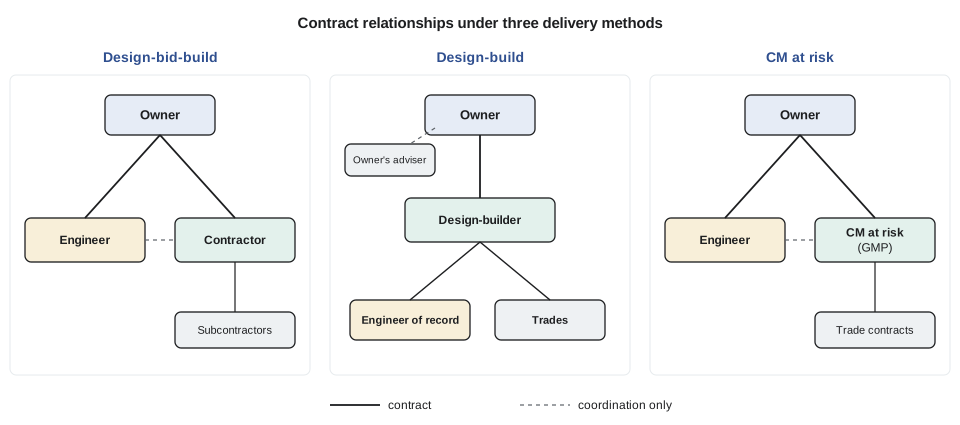
No method is best for every project. A small pedestrian bridge with a standard design and a competitive local contractor market suits design-bid-build. A large, schedule-driven project with innovation potential may suit design-build. A complex project whose design will evolve may suit construction management or a collaborative model. The program below gives a crude illustration of how the delivery method shifts expected risk between the owner and the contractor for the bridge.
# Who carries each risk under two delivery methods? Values in $ thousands.
risks = [
    # name, probability, cost if it happens, owner share DBB, owner share DB
    ("Design error",            0.15, 400, 1.0, 0.0),
    ("Differing site conditions", 0.25, 600, 1.0, 0.5),
    ("Steel price escalation",  0.30, 250, 0.0, 0.0),
    ("Owner scope change",      0.40, 300, 1.0, 1.0),
    ("Permit delay",            0.20, 200, 1.0, 0.5),
]

def exposure(method_index):
    owner = contractor = 0.0
    for name, p, cost, dbb, db in risks:
        share = (dbb, db)[method_index]
        owner += p * cost * share
        contractor += p * cost * (1 - share)
    return owner, contractor

for i, method in enumerate(["Design-bid-build", "Design-build"]):
    o, c = exposure(i)
    print(f"{method:17} expected owner risk {o:6.1f}k  contractor risk {c:6.1f}k")
print("Contractors price retained risk, so a lower owner risk usually means a higher bid.")Design-bid-build expected owner risk 370.0k contractor risk 75.0k Design-build expected owner risk 215.0k contractor risk 230.0k Contractors price retained risk, so a lower owner risk usually means a higher bid.
The numbers are illustrative only, but the lesson holds: shifting risk to the contractor does not make it disappear. The contractor prices it into its bid, adds a margin for uncertainty, and fights hard over it if it materializes. Owners that transfer risks the contractor cannot control often pay more than if they had kept them.
Differing site conditions
The ground is the classic uncontrollable risk. If the subsurface conditions differ from what the contract documents indicate or from what a reasonable contractor would expect, the cost of dealing with them can be large. Most standard forms allocate this risk to the owner, through a differing site conditions clause: the contractor must give prompt notice before disturbing the conditions, the owner's consultant investigates, and if the conditions differ materially, the contract price and time are adjusted. The logic is that the owner controls the site investigation, and making contractors price unknown ground conditions would inflate every bid.
In federal contracts, FAR 52.236-2 provides a two-type differing site conditions clause: Type I conditions differ materially from those indicated in the contract, and Type II conditions are unknown physical conditions of an unusual nature, differing materially from those ordinarily encountered. AIA A201-2017 section 3.7.4 and EJCDC C-700 contain similar clauses. Owners sometimes delete the clause or add disclaimers to geotechnical reports. Courts may enforce clear risk transfers, but disclaimers do not always defeat claims based on the owner's positive representations of site conditions.
The Spearin doctrine
In United States v. Spearin (1918), the US Supreme Court held that when an owner provides detailed design specifications, it impliedly warrants that a contractor who follows them will produce an adequate result. A contractor that builds as specified is not responsible for the consequences of defects in the plans. The Spearin doctrine applies to design specifications (which tell the contractor how to build), not performance specifications (which tell it what result to achieve), and courts are divided on how far general disclaimers or site inspection clauses can override it. Spearin is a major reason why design risk stays with the owner, and through the owner's contract with its engineer, ultimately with the engineer, in design-bid-build.
In both countries, then, the owner who gives a contractor a design generally bears the risk that the design is wrong, and the owner's remedy is against its own engineer, if the engineer was negligent. This makes the engineer's own services agreement, and the way it limits liability, extremely important.
Indemnities, limitations and waivers
Three kinds of clauses do most of the explicit risk allocation between the parties.
- An indemnity is a promise to compensate another party for specified losses, usually losses from claims by third parties. A typical clause has the contractor indemnify the owner and engineer against claims arising from the contractor's work. Broad-form indemnities that require a party to cover losses caused by the other party's own negligence are dangerous and, in many jurisdictions, unenforceable. A duty to defend, in which the indemnifying party must pay for the indemnified party's defense costs as claims arise, is particularly risky for engineers, because professional liability insurance often does not cover it.
- A limitation of liability clause caps the amount a party can be liable for, for example at the fee, at a fixed sum or at available insurance. Engineers commonly seek a cap, because their fee is small compared with the potential losses from a design error on a large project. Clauses also often exclude consequential losses, as discussed in lesson 4.
- A waiver of subrogation prevents a party's insurer, after paying a claim, from suing another project participant to recover. Combined with project-wide property insurance, such as builder's risk insurance, it avoids circular litigation among parties who are all insured.
Many states have anti-indemnity statutes that void construction contract clauses requiring a party to indemnify another for the other's sole negligence, and some go further, voiding indemnities for the indemnitee's partial negligence or applying specific rules to design professionals. Some states limit or regulate limitation of liability clauses, particularly in public contracts. AIA A201-2017 section 15.1.7 contains a mutual waiver of consequential damages between owner and contractor. EJCDC E-500 offers optional liability limits for the engineer. Engineers should check that any indemnity they give is limited to their own negligence, does not include an uninsurable duty to defend, and fits within the cap and the insurance.
Insurance
Contracts allocate risk, and insurance funds it. The usual insurance on a construction project includes commercial general liability insurance (for bodily injury and property damage to third parties), builder's risk or course of construction insurance (for damage to the work itself), automobile and equipment insurance, and for design professionals, professional liability insurance (errors and omissions insurance), which covers claims arising from negligent professional services. Professional liability policies are usually written on a claims-made basis, so coverage depends on having a policy in force when the claim is made, not when the work was done; firms must keep coverage in place, or buy extended reporting coverage, long after a project ends.
Contract requirements and insurance must match. A contract that requires an engineer to warrant a result, indemnify for others' negligence or accept unlimited liability can leave the firm uninsured for exactly the claims most likely to bankrupt it. Before signing, engineers should send unusual clauses to their insurer or broker for review.
The engineer as contract administrator
Under AIA A201 and EJCDC C-700, the architect or engineer administers the construction contract for the owner. It interprets the contract documents, reviews submittals, makes site visits, evaluates claims and changes, certifies payments and certifies substantial completion. When it decides questions between owner and contractor, it must act impartially and in good faith, even though the owner pays it. The AIA forms state that the architect will not be liable for interpretations or decisions rendered in good faith, but an engineer that favors its client in deciding a claim, or refuses to certify payment to pressure the contractor, can still expose itself and the owner to liability. Its decisions are usually subject to the contract's dispute resolution procedure.
Submittal review is a particular source of risk. Engineers review shop drawings for general conformance with the design intent, not to check every dimension or to take responsibility for the contractor's means and methods. The review stamp should say so, and the engineer's conduct should match it: an engineer who redesigns the contractor's temporary works in the course of review may take on responsibility for them.
Worked problem
Reviewing the owner's draft agreement
The city sends Northbridge its standard professional services agreement for the bridge. It requires Northbridge to (a) perform services to the highest standard of the profession, (b) indemnify and defend the city against all claims arising from the project, (c) accept unlimited liability, and (d) carry professional liability insurance of $2 million per claim. What should Northbridge do?
Show solution
- (a) "Highest standard" may raise the standard above reasonable care and may not be insured. Ask to replace it with the ordinary standard of a reasonably competent engineer in similar circumstances.
- (b) An indemnity for all claims arising from the project would cover losses caused by others, including the client. Ask to limit it to losses caused by Northbridge's negligence, and to delete the duty to defend, which is usually uninsured.
- (c) Unlimited liability exposes the firm far beyond its insurance. Propose a cap, for example the greater of the fee or the insurance limit, and a mutual waiver of consequential damages.
- (d) The insurance requirement is reasonable and should be confirmed with the broker. Send the marked-up agreement to the insurer before signing.
Answer: Negotiate the standard of care, indemnity and liability cap so that the contract matches the firm's insurance, and get advice before signing.
Common mistakes
MistakeStandard forms can be used as-is because they are balanced.
InsteadSupplementary conditions often change the balance; read every amendment.
MistakeDesign-build removes design risk from the project.
InsteadIt moves design risk to the design-builder, which prices it.
MistakeA disclaimer on a geotechnical report always protects the owner and engineer.
InsteadCourts often hold the owner to positive representations despite general disclaimers.
MistakeAn engineer should agree to defend the client against all claims.
InsteadA duty to defend is often uninsured; limit indemnities to the engineer's own negligence.
MistakeAs contract administrator, the engineer should always side with the owner.
InsteadDecisions between owner and contractor must be impartial and in good faith.
Summary and key terms
- Contracts allocate risk; the best allocation puts each risk on the party best able to control or absorb it.
- AIA, EJCDC and ConsensusDocs forms, and FAR clauses for federal work, govern US projects.
- Delivery methods (design-bid-build, design-build, construction management, P3s) are the largest allocation decision.
- Differing site conditions clauses keep ground risk with the owner, subject to prompt notice.
- Spearin makes the owner warrant its design specifications to the contractor.
- Indemnities, liability caps and waivers of subrogation must match insurance.
- As contract administrator, the engineer must decide impartially.
- Standard form contract
- A contract drafted by an industry body for repeated use across projects.
- Supplementary conditions
- Project-specific amendments to a standard form.
- Delivery method
- The arrangement of who designs and who builds, and how they contract.
- Differing site conditions
- Physical conditions that differ materially from those indicated or ordinarily expected.
- Indemnity
- A promise to compensate another party for specified losses.
- Limitation of liability
- A clause capping the amount a party can be liable for.
- Waiver of subrogation
- An agreement that prevents insurers from suing other project parties after paying a claim.
- Claims-made policy
- Insurance that covers claims made while the policy is in force.
Practice problems
Work each problem on paper first, then reveal the answer to check.
Why do most forms put differing site conditions risk on the owner?
Show answer
The owner controls the site investigation, and making bidders price unknown ground would inflate every bid.
In the program, how does moving design error risk to the contractor change expected owner risk?
Show answer
It reduces owner exposure by the expected cost of design errors, 60k, but the contractor will price it.
Name two problems with a duty to defend for an engineer.
Show answer
It covers defense costs as claims arise, often before fault is decided, and it is often not insured.
What does a claims-made policy require of a firm after a project ends?
Show answer
Continuous coverage, or extended reporting coverage, until claims can no longer be made.
What is the difference between a design specification and a performance specification?
Show answer
A design specification tells the contractor how to build; a performance specification states the required result.
What must the engineer do when deciding a contractor's claim?
Show answer
Act impartially and in good faith, applying the contract.
Lesson quiz · 5 questions
Score 60% or more to complete this lesson.
Create a free account to save your progress, take quizzes and earn a certificate.