
ENGG-404 · Lesson 10 of 12 · 24 min
Ethics codes and case studies
Law sets the minimum that society will enforce. Ethics asks what an engineer ought to do, including in the many situations the law does not reach: whether to accept a gift from a supplier, how hard to push back on a client who wants to cut a field review, when to tell an employer that a colleague's design is wrong, whether to stay silent about a danger outside one's own project. Engineering ethics is not a matter of personal taste. It is written into codes that have the force of law, enforced by discipline, and tested on the professional practice exams.
This lesson sets out what the codes say, offers a practical method for working through an ethical problem, and then studies several failures where engineers' ethical choices mattered. Lesson 11 turns to the disciplinary machinery that enforces the codes.
Ethics, morals and law
Three overlapping ideas are worth separating. Morals are an individual's beliefs about right and wrong. Law is the set of rules the state will enforce. Professional ethics is the set of standards a profession adopts for its members' conduct in their professional role. The three usually point the same way, but not always: an act can be legal and unethical (accepting a lucrative contract outside your competence), and in rare cases an ethical duty can require an engineer to act against an employer's lawful instruction. When professional ethics conflict with an employer's instructions, the code wins.
Philosophers offer several frameworks for reasoning about ethics, and engineers use them informally. Consequentialist reasoning asks which option produces the best outcomes for everyone affected. Duty-based reasoning asks what obligations the engineer has, regardless of outcome: to tell the truth, to keep promises, to respect people's rights. Virtue ethics asks what a person of good professional character would do. The codes blend all three: they protect the public because outcomes matter, they impose duties such as honesty and confidentiality, and they appeal to the honor and integrity of the profession.
What the codes say
In the United States, the codes with legal force are the rules of professional conduct adopted by each state board, many based on the NCEES Model Rules. The best-known voluntary code is the NSPE Code of Ethics for Engineers, which most engineers meet in school and which the NSPE Board of Ethical Review interprets in published case opinions. Its six fundamental canons say that engineers, in the fulfillment of their professional duties, shall hold paramount the safety, health and welfare of the public; perform services only in areas of their competence; issue public statements only in an objective and truthful manner; act for each employer or client as faithful agents or trustees; avoid deceptive acts; and conduct themselves honorably, responsibly, ethically and lawfully so as to enhance the honor, reputation and usefulness of the profession. Technical societies such as ASCE, ASME and IEEE have their own codes along similar lines.
Across both countries, the codes contain the same core duties.
- Public welfare is paramount. When the interests of the public conflict with those of the client, employer or engineer, the public comes first.
- Competence. Engineers undertake only work they are competent to do by education and experience, and they keep their competence current.
- Honesty and objectivity. Engineers do not falsify, exaggerate or omit material facts, they sign and seal only work they have done or supervised, and they give opinions only on adequate knowledge and honest conviction.
- Faithful service and conflicts of interest. Engineers act as faithful agents of their clients and employers, disclose any interest that could influence their judgment, and do not accept compensation from more than one party for the same work without everyone's knowledge and consent.
- Confidentiality, as lesson 9 discussed, subject to the duty to the public.
- Fairness to colleagues. Engineers do not review another engineer's work for the same client without notifying that engineer, do not maliciously injure another's reputation, do not supplant a colleague who has been engaged, and give credit for others' work.
- Integrity of the profession. Engineers do not offer or accept bribes, do not use improper means to obtain work, report to the regulator conduct by other engineers that endangers the public or breaches the code, and conduct themselves in ways that maintain public trust.
Hard cases: conflicts, gifts and reporting
The duties are easy to state and hard to apply. Most real ethical problems involve two duties pulling against each other, or a duty pulling against self-interest. A few patterns recur.
Conflicts of interest arise whenever an engineer's personal interest, or a duty to another party, could influence professional judgment. Owning shares in a supplier the engineer specifies, reviewing bids from a firm that employs a spouse, acting for two parties on opposite sides of a dispute, and being offered future employment by a contractor whose work the engineer is certifying are all conflicts. The usual remedy is full disclosure to everyone affected and, where disclosure is not enough, withdrawal. Some conflicts, such as acting as expert witness for both sides, cannot be cured by consent.
Gifts and hospitality are a matter of degree. A modest lunch or a branded pen rarely influences anyone; tickets to a playoff game from a contractor whose claim the engineer is about to decide are another matter. Most firms set dollar limits and require disclosure, and public owners often prohibit gifts entirely. The test is whether a reasonable observer would think the gift could affect the engineer's judgment.
Reporting is the hardest. When an engineer discovers a danger that her client or employer will not fix, the codes require escalation: first raise it clearly and in writing with the person responsible, then with higher management, and if the danger persists, with the regulator or other public authority. Whistleblowing has real personal costs, and most situations can be resolved well before that point by clear, documented communication. But the duty does not disappear because it is uncomfortable.
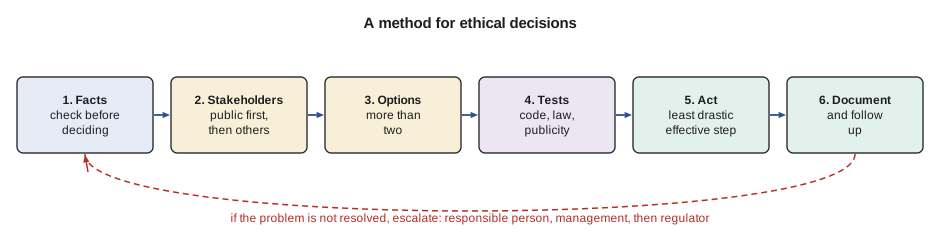
A method for ethical decisions
Regulators and textbooks offer similar step-by-step methods. A practical version has six steps.
- Establish the facts. Many apparent dilemmas dissolve when the facts are checked: the colleague's design may be right, the client may not know about the problem, the deadline may move.
- Identify the stakeholders and the duties owed to each: the public, the client, the employer, colleagues, the profession and yourself.
- Generate options. There are almost always more than two. Between silent compliance and public whistleblowing lie a dozen intermediate steps.
- Test each option against the code, the law and the firm's policies. Ask the publicity test: would I be comfortable if this decision were reported in tomorrow's newspaper, or explained to a disciplinary panel? Ask whether a respected senior engineer would make the same choice.
- Act on the best option, starting with the least drastic step likely to protect the people at risk.
- Document what you knew, what you did and why, and follow up to make sure the problem is actually resolved.
Case studies
The cases below are taught in engineering schools across North America because each turned on decisions engineers made under pressure. Summaries necessarily simplify; the official inquiry reports are worth reading in full.
The Hyatt Regency walkways (1981). In Kansas City, two suspended walkways in a hotel atrium collapsed during a crowded tea dance, killing 114 people. The original design hung both walkways from continuous rods. During shop drawing preparation, the fabricator changed the detail to two offset rods, so that the fourth-floor walkway's box beam carried the second-floor walkway as well as its own. The change was approved without the calculations being rechecked. The program after the next case shows the effect on the critical connection. The Missouri licensing board found the engineer of record and the project engineer guilty of gross negligence and misconduct and revoked their licenses, holding that responsibility for the change remained with the engineers who sealed the design.
The Quebec Bridge (1907). The cantilever bridge over the St. Lawrence River in Canada collapsed during construction, killing 75 workers. The consulting engineer, Theodore Cooper, had lengthened the main span without recalculating the dead load, and the actual member weights were far above the design assumptions. Field engineers reported growing deflections in compression chords for days, but work continued until the collapse. A second accident in 1916 killed 13 more. Canada's iron ring ceremony traces its symbolism to these failures.
# Hyatt Regency walkways (1981): how the hanger rod change doubled the
# load on the fourth-floor box beam connection. P = load from one walkway.
P = 1.0

# Original detail: one continuous rod from the ceiling through both walkways.
# Each walkway's nut carries only that walkway.
original_4th = P
# As built: the 4th-floor walkway hangs from the ceiling, and a second rod
# hangs the 2nd-floor walkway from the 4th-floor box beam.
as_built_4th = P + P

print(f"Load on 4th-floor connection, original detail: {original_4th:.1f} P")
print(f"Load on 4th-floor connection, as built:        {as_built_4th:.1f} P")
print(f"Increase: {as_built_4th / original_4th:.0f} times")

# Investigators found the original detail itself fell short of code.
# Illustrative only: suppose capacity is 60 percent of the code requirement.
code_required = 1.67 * P            # an assumed factored demand per hanger
capacity = 0.60 * code_required
print(f"Assumed connection capacity: {capacity:.2f} P")
print(f"Demand/capacity as built: {as_built_4th / capacity:.1f}")Load on 4th-floor connection, original detail: 1.0 P Load on 4th-floor connection, as built: 2.0 P Increase: 2 times Assumed connection capacity: 1.00 P Demand/capacity as built: 2.0
The Citicorp Center (1978). After the New York tower opened, structural engineer William LeMessurier learned, prompted by a question from a student, that wind striking the building diagonally produced larger forces in some braces than the perpendicular winds the design had checked, and that the contractor had substituted bolted for welded connections. He calculated that a storm likely to occur every few decades could cause collapse. Facing professional ruin, he informed the owner, the city and his insurer, and the connections were secretly reinforced at night with welded plates while an evacuation plan stood ready. The case is usually taught as a model of an engineer accepting responsibility for his own error, although critics note that the public was not told for nearly two decades.
The Space Shuttle Challenger (1986). The night before launch, engineers at Morton Thiokol, which made the solid rocket boosters, recommended against launching because forecast temperatures were far below any previous launch and they had evidence that cold stiffened the O-ring seals in the booster joints. Under pressure from NASA, Thiokol's managers reversed the recommendation after one was urged to take off his engineering hat and put on his management hat. An O-ring failed after launch and all seven crew members died. The Rogers Commission found a flawed decision-making process in which engineering concerns were not communicated to the people who made the launch decision.
The FIU pedestrian bridge (2018). A concrete pedestrian bridge under construction at Florida International University in Miami collapsed onto a busy road, killing six people. Cracks had been growing in a critical node for weeks, and the engineer of record had concluded that they did not threaten safety. The road below was not closed while workers re-tensioned a member the morning of the collapse. The National Transportation Safety Board found errors in the design of the node, a failure to recognize the significance of the cracking, and weak independent peer review. For engineers working on pedestrian bridges, the parallel to this course's running example is direct.
| Case | What went wrong | Ethical lesson |
|---|---|---|
| Quebec Bridge, 1907 | Design assumptions not rechecked; warnings acted on too late | Recheck when the design changes; stop work when evidence of distress appears |
| Hyatt Regency, 1981 | Shop drawing change doubled a connection load | Responsibility for sealed work cannot be delegated to a fabricator |
| Citicorp Center, 1978 | Unchecked load case and substituted connections | Disclose your own errors and fix them, whatever the cost |
| Challenger, 1986 | Engineering recommendation overruled by management | Safety judgments must not be traded for schedule or business pressure |
| FIU bridge, 2018 | Growing cracks not recognized as a danger; road left open | When evidence of distress appears, protect the public first and investigate second |
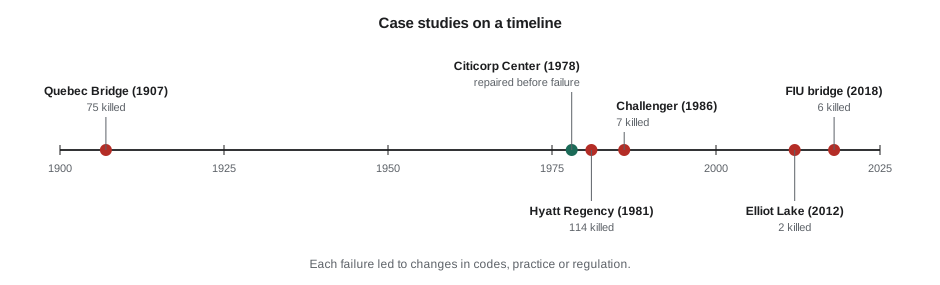
Several threads run through all of these. There were warnings before every failure. Design changes or new information were not checked against the original assumptions. Schedule and cost pressure pushed decisions away from engineering judgment. And responsibility was blurred among owners, designers, contractors and managers, so that each could believe someone else was checking. The codes of ethics respond to each thread: recheck, speak up, put the public first, and do not seal or certify what you have not verified.
Worked problem
Cracks in the bridge
During construction of the Westbrook bridge, the contractor reports hairline cracks in the concrete deck panels near two connections after a heavy pour. The contractor's superintendent says cracks like these are normal and asks Maya Okafor not to hold up the next pour, which is scheduled tomorrow; the city engineer adds that the ribbon cutting is already booked. Work through the method.
Show solution
- Facts: Maya needs to see the cracks, measure their widths and pattern, and compare them with what the design predicts. Hairline shrinkage cracks may be harmless; cracks at connections may signal a load path problem.
- Stakeholders and duties: the public and the workers come first; the client is owed faithful service; the contractor is owed fair decisions; Northbridge has its own liability at stake.
- Options: proceed as scheduled; proceed while monitoring; delay the pour a day for an inspection and calculation check; stop all work and close the area below.
- Tests: proceeding without understanding cracks at connections fails the code and would not survive a disciplinary panel. A short delay for inspection and analysis passes every test. If the check shows a structural problem, stopping work and protecting people below is required.
- Act and document: Maya inspects that day, has the connection design rechecked, records the crack widths with photographs, and confirms her instruction to hold the pour in writing until the check is complete.
Answer: A short, documented delay to understand distress near connections is the ethical choice; schedule pressure is not a reason to proceed.
Common mistakes
MistakeEthics is personal opinion, so the codes are just guidance.
InsteadThe codes have legal force and are enforced through discipline.
MistakeLoyalty to the employer is the engineer's first duty.
InsteadThe duty to the public is paramount; loyalty operates within it.
MistakeA fabricator's change to a detail is the fabricator's responsibility.
InsteadThe engineer who seals the design remains responsible for approving the change (Hyatt Regency).
MistakeWhistleblowing to the media is the first step when a client ignores a danger.
InsteadEscalate in stages: the responsible person, senior management, then the regulator or authority.
MistakeA conflict of interest is fine if the engineer is confident it will not affect her judgment.
InsteadConflicts must be disclosed, and some require withdrawal.
Summary and key terms
- Professional ethics are written into codes with legal force and enforced by discipline.
- The NSPE code's first canon, echoed in state rules, holds public safety, health and welfare paramount.
- Core duties: public welfare, competence, honesty, faithful service, disclosure of conflicts, confidentiality, fairness to colleagues and integrity.
- Hard cases usually involve two duties in conflict; disclosure and escalation resolve most of them.
- A six-step method: facts, stakeholders and duties, options, tests, action, documentation.
- The Quebec Bridge, Hyatt Regency, Citicorp, Challenger and recent failures show the same pattern of ignored warnings and unchecked changes.
- Responsibility for sealed work and safety judgments cannot be handed to others.
- Professional ethics
- Standards a profession adopts for its members' conduct in their professional role.
- Paramountcy
- The principle that public safety, health and welfare come before other interests.
- Conflict of interest
- A situation in which a personal interest or competing duty could influence professional judgment.
- Supplanting
- Taking over work from a colleague who is already engaged, by improper means.
- Publicity test
- Asking whether a decision could be defended if it were made public.
- Whistleblowing
- Reporting wrongdoing or danger to authorities outside the normal chain of command.
- Faithful agent
- An engineer acting loyally for a client or employer within the bounds of the code.
- Shop drawing
- A drawing prepared by a fabricator or supplier showing how it will make and install a component.
Practice problems
Work each problem on paper first, then reveal the answer to check.
Name three core duties found in every engineering code of ethics.
Show answer
Examples: hold public safety paramount, practice only within competence, be honest, disclose conflicts, keep confidences.
What did the Hyatt Regency rod change do to the fourth-floor connection?
Show answer
It doubled the load, because that connection carried both walkways.
What is the usual remedy for a conflict of interest?
Show answer
Full disclosure to everyone affected and, if that is not enough, withdrawal.
In what order should an engineer escalate a danger that is not being fixed?
Show answer
The person responsible, then higher management, then the regulator or public authority.
What common threads link the case studies?
Show answer
Ignored warnings, unchecked changes, schedule pressure and blurred responsibility.
Apply the publicity test to accepting playoff tickets from a contractor whose claim you are deciding.
Show answer
It fails: a reasonable observer would think the gift could affect your judgment.
Lesson quiz · 5 questions
Score 60% or more to complete this lesson.
Create a free account to save your progress, take quizzes and earn a certificate.