
ELEC-120 · Lesson 10 of 12 · 31 min
Damp, wet and corrosive locations, cords and temporary wiring
Water, chemicals and rough handling are the enemies of electrical installations. Water reduces the resistance of the human body and of insulation, corrodes terminals and enclosures, and provides paths for leakage current; corrosive vapors eat through steel boxes and conduit; and flexible cords, which are meant to be moved, are easily crushed, cut and overloaded. This lesson covers how the code classifies locations by moisture and corrosion and what it requires in each, the proper and improper uses of flexible cords, and the rules for temporary wiring on construction sites, where all of these hazards meet.
In the National Electrical Code, damp and wet locations are defined in Article 100 and addressed in each equipment article (for example 314.15 for boxes, 406.9 for receptacles, 410.10 for luminaires), flexible cords in Article 400, and temporary installations in Article 590.
Dry, damp and wet locations
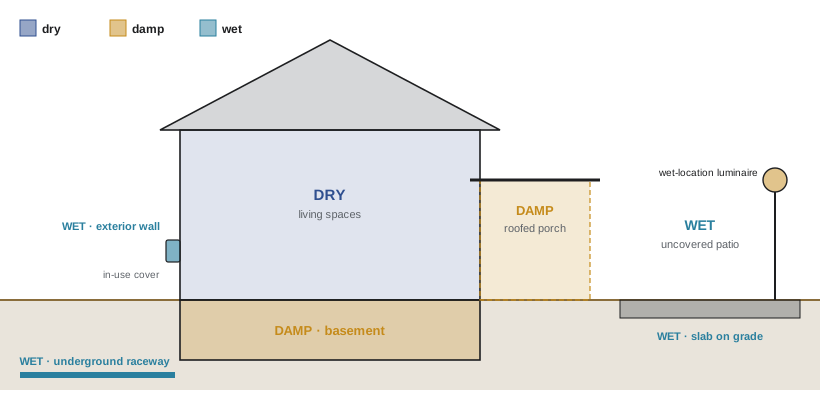
The code classifies locations by their exposure to moisture:
- Dry locations are not normally subject to dampness or wetness, though they may be temporarily damp, such as a building under construction.
- Damp locations are protected from weather but subject to moderate moisture: partially protected locations under canopies and roofed porches, basements, some barns and cold-storage warehouses.
- Wet locations are subject to saturation with water or other liquids: underground installations, locations in concrete slabs in contact with earth, areas exposed to weather, and areas washed down with hoses.
Equipment must be identified for the location: boxes, receptacles, luminaires, enclosures and wiring methods carry markings such as "suitable for damp locations" or "suitable for wet locations". Inside a raceway in a wet location, including underground and above ground outdoors, conductors are considered to be in a wet location and must be rated for it, because condensation and water ingress are inevitable.
Worked problem
Classifying locations
Classify (a) a receptacle on a wall under a deep roofed porch, (b) a receptacle on an exterior wall exposed to rain, (c) conductors in PVC conduit buried in a garden, (d) a luminaire in a walk-in cooler.
Show solution
- (a) Protected from direct weather: damp.
- (b) Exposed to weather: wet.
- (c) Underground, inside a raceway: wet.
- (d) Cold storage with condensation: damp, or wet if it is washed down.
Answer: Damp, wet, wet, and damp (or wet). The classification drives every choice of device, cover, enclosure and conductor insulation.
Receptacles outdoors
Outdoor receptacles need protection matched to how they are used. In wet locations, receptacles where a plug may be left in for a long time (such as for holiday lights or a pool pump) need "in-use" (extra-duty bubble) covers that keep the receptacle weatherproof with the plug inserted; flat flip covers protect only when nothing is plugged in. Outdoor receptacles must be weather-resistant types and, in most cases, GFCI-protected (Lesson 9 and ELEC-130).
The NEC (406.9(B)) requires 15 A and 20 A, 125 V and 250 V receptacles in wet locations to have enclosures that are weatherproof whether or not a plug is inserted, marked "extra duty", and to be listed weather-resistant types; GFCI requirements are in 210.8.
Corrosive locations
Corrosive environments include agricultural buildings with manure and fertilizer vapors, swimming pool equipment rooms with chlorine, wastewater plants, chemical plants and coastal sites with salt spray. Ordinary galvanized steel boxes and conduit can corrode through in a few years, exposing conductors and breaking bonding paths. Solutions include:
- Non-metallic wiring methods: rigid PVC conduit, non-metallic boxes, and cables with corrosion-resistant jackets.
- Corrosion-resistant metals: PVC-coated rigid steel, stainless steel and aluminum where suitable.
- Enclosures rated type 4X (Lesson 8).
- Equipment located outside the corrosive area where possible, for example panelboards in a separate clean room.
- Special attention to bonding, because corroded metal raceways cannot be relied on as bonding paths; separate bonding conductors are used instead.
Worked problem
Wiring a fertilizer storage building
An electrician must wire lighting and receptacles in a storage building for granular fertilizer, which gives off corrosive dust and absorbs moisture. Propose a wiring method and enclosures.
Show solution
- Raceways: rigid PVC conduit, which is unaffected by the fertilizer, with a separate insulated bonding conductor.
- Boxes and fittings: non-metallic, with gasketed covers.
- Luminaires and devices: corrosion-resistant, wet-location rated, in type 4X enclosures; panelboard outside the storage area.
Answer: PVC conduit with a separate bonding conductor, non-metallic gasketed boxes, 4X equipment and the panel located elsewhere. Agricultural buildings also need equipotential bonding where livestock are present, because animals are far more sensitive to small voltages than people.
Flexible cords and cables
Flexible cords are made for equipment that is moved or needs flexibility: portable appliances, pendants, connections to equipment that vibrates or must be removed for service. They are identified by type letters indicating their construction and use, such as SJOW (junior service, oil-resistant jacket, weather-resistant) or SOOW (hard service, oil-resistant jacket and insulation, weather-resistant). Hard-service cords (S) suit rough use; junior-service cords (SJ) lighter use.
Because cords are easily damaged, the code limits their use. Flexible cords must not be used:
- As a substitute for the fixed wiring of a building.
- Run through holes in walls, ceilings or floors, or through doorways and windows.
- Concealed behind walls, ceilings or floors, or above suspended ceilings.
- Attached to building surfaces.
- Where subject to physical damage.
The NEC (400.10 and 400.12) lists the permitted and prohibited uses of flexible cords, and Table 400.5(A)(1) gives their ampacities.
Worked problem
Voltage drop in an extension cord
A contractor runs a 30 m (100 ft) 16 AWG extension cord to a 120 V saw drawing 12 A. 16 AWG copper has a resistance of about 13.2 Ω per km. Find the voltage drop and the voltage at the saw. What if a 12 AWG cord (5.2 Ω per km) is used?
Show solution
- Loop length: \(2 \times 30 = 60\) m.
- 16 AWG: \(R = 0.060 \times 13.2 = 0.79\) Ω; drop \(= 12 \times 0.79 = 9.5\) V (7.9%); saw voltage about 110.5 V.
- 12 AWG: \(R = 0.060 \times 5.2 = 0.31\) Ω; drop \(= 3.7\) V (3.1%).
Answer: About 9.5 V with 16 AWG, enough to make the motor run hot and slow and to make the cord itself warm; about 3.7 V with 12 AWG. Long extension cords should be heavy gauge, and a 16 AWG cord carrying 12 A is close to its ampacity as well.
Temporary wiring
Construction sites, events and emergencies need power for a limited time. Temporary wiring rules relax some permanent requirements (for example, allowing cables to be run on the surface) but strengthen others, because sites are wet, wiring is exposed and tools are abused:
- Time limits: temporary installations are permitted only for the duration of construction, remodeling, repair, testing or emergencies, or for limited periods for decorative lighting and events.
- GFCI protection for receptacles used by personnel, typically all 125 V, 15 A to 30 A receptacles on construction sites, including those on portable generators.
- Protection from damage: cords and cables kept off the ground where vehicles pass, supported and protected at sharp edges.
- Overcurrent protection and disconnecting means as for permanent wiring, with all wiring removed promptly when no longer needed.
In the US, temporary installations are covered by NEC Article 590, which requires GFCI protection for all 125 V, single-phase, 15 A, 20 A and 30 A receptacle outlets used by personnel (590.6), and OSHA (29 CFR 1926.404) requires ground fault protection on construction sites.
Worked problem
Temporary power for a renovation
A renovation crew uses a portable generator to run saws and lights for two weeks. What must be in place before work starts?
Show solution
- GFCI protection for all 125 V receptacles used by the crew, either built into the generator or with portable GFCIs.
- Cords of hard-service type and adequate gauge, inspected daily and removed from service if damaged.
- Cords kept out of water and away from traffic; the generator located outdoors, away from openings, because of carbon monoxide.
Answer: GFCI protection, suitable and inspected cords, and safe placement of the generator. Portable generators also must not be connected to a building's wiring except through a transfer switch or interlock, to prevent backfeeding the utility lines and electrocuting line workers.
Pools, hot tubs and fountains
Water, bare skin and electricity together lower the current that can cause harm, so pools, hot tubs, spas and fountains have their own sections of the code. Their rules are detailed and change often, so an installer works directly from the current requirements; the principles behind them are consistent:
- Ground-fault protection for pool pump motors, underwater luminaires above low voltage, and receptacles near the water.
- Distances: receptacles, switches and luminaires must be set back minimum distances from the inside wall of a pool or tub, or be specially protected.
- Equipotential bonding: all metal parts within a set distance, including the pool steel, ladders, pump motors and a copper grid or the reinforcing steel in the deck, are bonded together with a solid copper conductor so that there is no voltage difference between anything a swimmer can touch. This is not grounding to clear faults, but making everything the same potential.
- Underwater luminaires supplied through listed transformers at low voltage, or protected by GFCI, in listed wet-niche or dry-niche housings.
- Overhead conductors kept well clear of the water and diving structures.
Worked problem
Why equipotential bonding matters
A stray voltage of 3 V exists between the water and an unbonded metal handrail. A wet swimmer touches both, with a body resistance through wet skin of about 500 Ω. What current flows? With bonding, the difference is reduced to 0.1 V. What then?
Show solution
- Unbonded: \(I = 3/500 = 6\) mA.
- Bonded: \(I = 0.1/500 = 0.2\) mA.
Answer: 6 mA is enough to be felt strongly and can cause panic in water; 0.2 mA is below perception. Bonding works by removing the voltage difference, so no device has to trip.
In the NEC, pools, spas, hot tubs and fountains are covered in Article 680, including equipotential bonding in 680.26.
Common mistakes
MistakeUsing damp-location devices in wet locations.
InsteadUse equipment identified for wet locations where exposed to weather or saturation.
MistakeUsing flip covers on outdoor receptacles that will have plugs left in.
InsteadUse in-use (extra-duty) covers.
MistakeRelying on corroding steel raceways as the bonding path.
InsteadInstall a separate bonding conductor in corrosive locations.
MistakeRunning extension cords through walls or above ceilings as permanent wiring.
InsteadInstall fixed wiring; cords are not a substitute.
MistakeUsing construction power without GFCI protection.
InsteadProtect all personnel receptacles with GFCIs.
Summary and key terms
- Locations are dry, damp or wet; equipment must be identified for the location.
- Raceways underground or outdoors are wet locations inside.
- Outdoor receptacles need weather-resistant devices, in-use covers where plugs stay in, and GFCI protection.
- Corrosive locations call for non-metallic or corrosion-resistant materials, 4X enclosures and separate bonding conductors.
- Flexible cords are for movable equipment and must not replace fixed wiring.
- Long, light extension cords cause large voltage drops.
- Temporary wiring is time-limited and requires GFCI protection and protection from damage.
- Dry location
- A location not normally subject to dampness or wetness.
- Damp location
- A protected location subject to moderate moisture.
- Wet location
- A location subject to saturation with water or exposed to weather.
- In-use cover
- A cover that stays weatherproof with a plug inserted.
- Weather-resistant receptacle
- A receptacle built for damp and wet locations.
- Corrosive location
- A location where vapors or liquids attack materials.
- Hard-service cord
- A flexible cord built for rough use (S types).
- Temporary wiring
- An installation permitted for a limited time.
- GFCI
- A device that opens a circuit when current leaks to ground.
- Backfeed
- Power flowing from a generator into the utility system.
Practice problems
Work each problem on paper first, then reveal the answer to check.
Classify a basement laundry room.
Show answer
Damp (usually).
Classify conductors in conduit on an exterior wall.
Show answer
Wet location.
What cover suits an outdoor receptacle for a pool pump?
Show answer
An in-use (extra-duty) weatherproof cover.
Name two corrosion-resistant wiring methods.
Show answer
Rigid PVC conduit; PVC-coated or stainless steel conduit.
Why add a separate bonding conductor in corrosive locations?
Show answer
Corroded metal raceways cannot be relied on as bonding paths.
What does the O in SJOW mean?
Show answer
Oil-resistant jacket.
May a cord be run through a hole in a wall to power a fixed appliance?
Show answer
No.
Voltage drop of 20 m of 14 AWG cord (8.3 Ω/km) at 10 A?
Show answer
0.04 × 8.3 × 10 = 3.3 V.
What protection is needed on construction-site 125 V receptacles?
Show answer
GFCI protection.
Why must generators not be plugged into building wiring without a transfer switch?
Show answer
They can backfeed the utility and electrocute line workers.
Lesson quiz · 5 questions
Score 60% or more to complete this lesson.
Create a free account to save your progress, take quizzes and earn a certificate.