
DCE-420 · Lesson 3 of 12 · 32 min
Interconnection studies and queues
For most data center projects since 2023, the question has not been what power costs but when it can be connected. Utilities that once connected a 20 MW facility within a year or two now face requests for hundreds or thousands of megawatts at single sites, totaling many times their existing peak demand. Each request must be studied to determine what transmission and generation additions are needed, who pays for them and how long they will take. This lesson explains how large loads and generators are connected to the grid, how interconnection studies work, why queues have grown so long, and what developers can do to secure power on a predictable schedule.
Load versus generator interconnection
Connecting a large load and connecting a generator are different processes with different rules:
- Generator interconnection to the transmission system is regulated by FERC through each transmission provider's open access transmission tariff (OATT). Order 2003 standardized procedures, and Order 2023 (2023) reformed them substantially.
- Load interconnection has traditionally been handled by utilities under state regulation, with retail service and transmission connection governed by utility tariffs and state commission rules. FERC began asserting a role in large-load interconnection to the interstate transmission system in 2025 and 2026.
For a data center, both matter: the load connection determines when the campus can draw power, and generator interconnection determines how quickly the new supply needed to serve it (and any co-located or contracted generation) can come online.
The study process
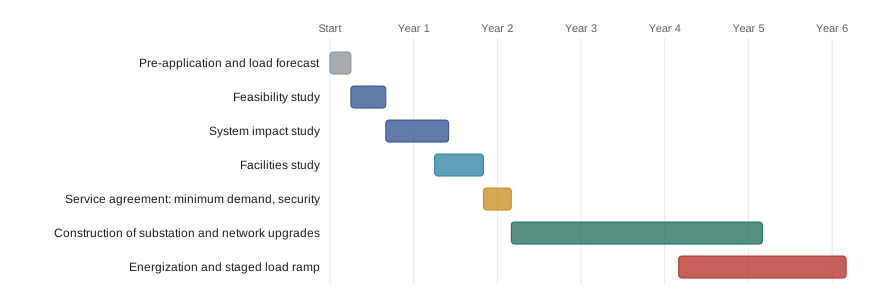
Whether for a load or a generator, interconnection studies follow a similar sequence of increasingly detailed analyses:
- Pre-application or scoping: the customer describes the project, location, size and ramp schedule; the utility gives preliminary information about nearby facilities and capacity.
- Feasibility or preliminary study: steady-state power flow analysis (ELE-380) identifies thermal overloads and voltage violations under normal and N-1 contingency conditions.
- System impact study: detailed power flow, short-circuit, stability and sometimes electromagnetic transient studies under many scenarios and contingencies, identifying the required network upgrades.
- Facilities study: engineering design and cost estimates for the connection facilities (substation, lines, protection, metering) and network upgrades.
- Agreement: an interconnection or connection agreement specifying the facilities, costs, security, schedule, operating requirements and, for loads, the contracted demand and ramp.
Each stage takes months; the whole process for a large load or generator commonly takes two to four years before construction of upgrades even begins. Upgrades themselves may take years more: a new 500 kV line can take a decade from conception to energization, while large power transformers have had lead times of two to four years.
What studies look for
A large load affects the grid in several ways that studies must evaluate:
- Thermal capacity: whether lines and transformers can carry the additional flow under normal conditions and after contingencies. A 500 MW load at a single point can overload multiple circuits.
- Voltage: large loads depress voltage, especially after contingencies; reactive power support (capacitor banks, STATCOMs) may be needed.
- Resource adequacy: whether there is enough generation to serve the load at peak, which in many regions is now the binding constraint rather than transmission.
- Stability and ride-through: data center loads are dominated by power electronics (UPS rectifiers and server power supplies). When a fault depresses voltage, many UPS systems transfer to battery within milliseconds, removing their load from the grid. In July 2024, a 230 kV fault in Virginia caused about 1,500 MW of data center load to transfer to backup simultaneously, creating a sudden surplus that operators had to manage. NERC has since identified large-load ride-through behavior as a reliability risk, and system operators increasingly require data centers to remain connected through specified voltage and frequency disturbances.
- Power quality: harmonics and, for AI training clusters, rapid load swings of tens of megawatts as computation synchronizes across thousands of GPUs.
Worked problem
Thermal capacity check
A substation is supplied by two 230 kV lines, each rated 400 MVA. Existing load at the substation peaks at 280 MVA. Under N-1 (one line out), how much new load can be added without overloading the remaining line, allowing a 5% margin?
Show solution
- With one line out, the remaining line carries all the load: limit \(0.95 \times 400 = 380\) MVA.
- Available capacity: \(380 - 280 = 100\) MVA.
- At 0.95 power factor (ELEC-210): \(100 \times 0.95 = 95\) MW.
Answer: About 95 MW, even though the two lines together are rated 800 MVA. A 300 MW data center would need a third line, larger conductors, or a new connection elsewhere. This N-1 limit, rather than total capacity, usually decides how much load a location can accept (ELE-380 Lesson 7).
Why queues grew
Generator queues grew from about 500 GW in 2014 to more than 2,500 GW at the end of 2023, more than the entire installed US fleet, mostly solar, storage and wind. Most projects never get built: historically, only about one in five projects requesting interconnection reached commercial operation, and the median time from request to operation grew to about five years. Large-load requests grew even faster: ERCOT reported more than 200 GW of large-load requests by late 2025, against a peak demand of about 85 GW, and several utilities reported requests exceeding their entire system peak.
Many requests are speculative: developers file at multiple sites, hoping to secure capacity at one, and utilities have no way to tell which are real. This inflates queues, slows studies for everyone and makes load forecasts unreliable, which in turn affects resource planning and rates.
Worked problem
Queue attrition and real demand
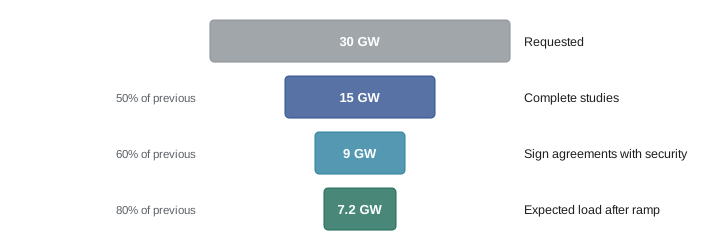
A utility has 30 GW of data center requests. Experience suggests that 70% of requests will withdraw before signing an agreement and that signed projects ramp to an average of 80% of their contracted demand. Estimate the real load to plan for.
Show solution
- Remaining after withdrawals: \(30 \times 0.30 = 9\) GW.
- Expected load: \(9 \times 0.80 = 7.2\) GW.
Answer: About 7 GW, less than a quarter of the requested 30 GW. Overestimating demand leads to stranded investments paid for by other customers; underestimating leads to shortages. This uncertainty is why utilities and regulators are adding financial commitments and readiness requirements that force speculative requests out early.
Federal reforms
FERC Order 2023 replaced the "first-come, first-served" serial study of generators with "first-ready, first-served" cluster studies. Key features:
- Cluster studies: requests received in a window are studied together, sharing upgrade costs.
- Readiness requirements: site control, study deposits that increase at each stage, and commercial readiness evidence.
- Withdrawal penalties: projects that drop out forfeit part of their deposits, discouraging speculative requests.
- Study deadlines: transmission providers face penalties for late studies.
For large loads, the Department of Energy directed FERC in October 2025 to consider a rulemaking asserting jurisdiction over the interconnection of loads above 20 MW to the interstate transmission system, with standardized procedures, study deposits and the option for loads that agree to be curtailable, or that bring their own generation, to be studied faster. In June 2026, rather than a single national rule, FERC issued orders to each RTO and ISO requiring them to show that their tariffs have clear, consistent large-load interconnection rules or to propose reforms covering study processes, cost protection for other customers, co-location and behind-the-meter generation, and new transmission services for flexible loads. Responses and filings were due in late 2026, so details will continue to change. In December 2025, FERC had already required PJM to create three new transmission services for co-located loads.
State responses
States and utilities have adopted large-load tariffs that require commitments from data centers:
- Minimum demand charges: AEP Ohio's data center tariff, approved in 2025, requires new data centers above 25 MW to pay for at least 85% of their contracted demand for up to 12 years, even if they use less; after it was proposed, AEP's data center queue shrank from about 30 GW to 13 GW.
- Texas SB 6 (2025): loads of 75 MW and above must disclose duplicate requests elsewhere in Texas, pay study fees, show site control and provide financial security; ERCOT can curtail them in emergencies, and the PUCT is developing interconnection standards.
- Other states, including Georgia, Virginia, Indiana and Pennsylvania, have adopted or are considering similar tariffs with exit fees, collateral and long contract terms, aiming to protect residential customers from paying for infrastructure built for data centers that never arrive.
Cost responsibility
Who pays for the facilities needed to connect a large load is one of the most contested questions in the industry:
- Direct connection facilities (the customer's substation, the tap line) are normally paid by the customer.
- Network upgrades (reinforcing shared lines and substations) may be paid by the customer, by all customers through rates, or split; rules vary widely.
- Generation needed to serve the load is paid by all customers through rates or capacity markets, unless the customer brings its own supply.
Many utilities use a revenue credit approach: the customer pays for facilities up front or through contribution in aid of construction (CIAC), credited by expected revenue, with minimum bills or collateral guaranteeing that revenue.
Worked problem
Economic evaluation of a connection
Connecting a 100 MW data center requires $90 million of transmission facilities. The utility expects net revenue of $9 million a year from the load over 25 years, discounted at 6%, toward these facilities. What contribution in aid of construction is required?
Show solution
- Present value of revenue: annuity factor \((1 - 1.06^{-25})/0.06 = 12.78\).
- PV \(= 9 \times 12.78 = \$115\) million.
- Since $115 million exceeds $90 million, no contribution is needed on this basis, provided the load materializes.
- If the load ramps to only 40 MW (revenue $3.6 million a year): PV \(= 46\) million; shortfall \(90 - 46 = \$44\) million.
Answer: No up-front contribution if the full load appears, but about $44 million of exposure for other customers if it does not. This is why utilities require security (letters of credit, guarantees) or minimum demand commitments tied to the forecast ramp, and why true-up provisions recalculate contributions if load falls short.
Strategies for securing power
Data center developers use several approaches to obtain power faster and more reliably:
- Early engagement: file requests years ahead, share accurate load forecasts and ramp schedules, and build relationships with utility planners.
- Site selection for available capacity: target locations with existing transmission headroom, retired generation sites with existing connections, or areas with surplus generation (DCE-410).
- Phased ramps: request capacity in stages that match the utility's ability to build, with firm early phases and options for later ones.
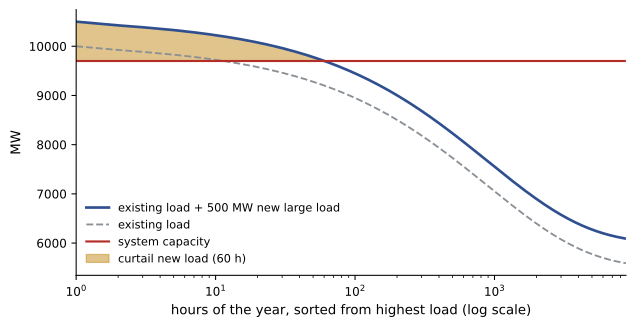
- Flexibility: agree to curtail load during system emergencies or peak periods in exchange for faster connection. Studies suggest that if large loads could curtail for a fraction of a percent of hours, existing grids could connect tens of gigawatts more load without new capacity.
- Bring your own generation: on-site or co-located generation (Lessons 7 and 10) can serve the load initially ("bridging") or permanently, reducing the burden on the grid.
- Fund upgrades: offer to pay for network upgrades or provide security, making the request more credible and protecting other customers.
- Buy existing positions: acquire sites or projects with existing connection agreements or queue positions.
Worked problem
Value of a flexible connection
A utility can connect 300 MW of firm load to a site in 2027, or 500 MW if the customer agrees to reduce to 300 MW for up to 60 hours a year. The extra 200 MW would otherwise wait until 2030. If each MW of capacity earns $1.5 million a year in gross margin for the operator, what is the value of three extra years for 200 MW, and what is the cost of 60 hours of curtailment of 200 MW?
Show solution
- Extra margin: \(200 \times 1.5 \times 3 = \$900\) million over three years.
- Curtailed energy: \(200 \times 60 = 12{,}000\) MWh a year, or 0.68% of the 200 MW block's annual energy.
- Lost margin at the same rate: \(0.0068 \times 200 \times 1.5 = \$2.1\) million a year (or less if workloads shift elsewhere or on-site generation covers the gap).
Answer: The flexible connection is worth roughly $900 million against about $2 million a year of curtailment cost. Even if curtailment requires on-site generation, the trade is strongly favorable, which is why flexible connections are becoming common.
Lesson 4 examines how flexibility can unlock capacity sooner, and Lesson 9 the contract terms, such as minimum bills and collateral, that come with large-load connections.
Common mistakes
MistakeAssuming that total line ratings determine how much load can connect.
InsteadN-1 contingency limits, voltage and resource adequacy usually bind first.
MistakeFiling at many sites without committing to any.
InsteadNew rules impose deposits, penalties, disclosure and security that make speculation costly.
MistakeIgnoring ride-through requirements.
InsteadUPS and power electronics must stay connected through specified disturbances, not drop off together.
MistakeAssuming that a signed agreement guarantees energization on schedule.
InsteadUpgrades, transformers and generation can be delayed; plan for phased ramps and bridging.
MistakeTreating curtailment agreements as cost-free.
InsteadPrice the lost output or on-site generation and include it in the business case.
Summary and key terms
- Connection timing is now the binding constraint for many data center projects.
- Generator interconnection is FERC-regulated; load interconnection has been mainly state and utility, with FERC now involved.
- Studies progress from feasibility to system impact to facilities studies and agreements, taking years.
- Studies check thermal capacity, voltage, resource adequacy, stability, ride-through and power quality.
- Queues are inflated by speculative requests, so real load is much less than requested.
- Order 2023 introduced cluster studies and readiness rules; 2025–2026 FERC actions and state tariffs target large loads.
- Cost responsibility depends on economic evaluations, contributions, security and minimum demand commitments.
- Early engagement, phasing, flexibility and bringing generation speed connection.
- Order 2023
- FERC rule reforming generator interconnection with cluster studies and readiness requirements.
- Cluster study
- Interconnection study of a group of requests together.
- System impact study
- A study identifying the network upgrades a connection requires.
- Contribution in aid of construction
- A customer payment toward utility facilities built to serve it.
- Minimum demand charge
- A charge for a minimum share of contracted demand regardless of use.
- Network upgrade
- Reinforcement of shared transmission facilities for a new connection.
- N-1 contingency
- Loss of any single element, which the system must withstand.
- Ride-through
- The ability of equipment to stay connected through voltage or frequency disturbances.
- Flexible connection
- A connection allowing more load in exchange for curtailment when needed.
- Load ramp
- The schedule by which a facility's demand grows to its contracted level.
Practice problems
Work each problem on paper first, then reveal the answer to check.
List the main stages of an interconnection study.
Show answer
Pre-application, feasibility, system impact, facilities study, agreement.
Two 300 MVA lines supply a substation with 180 MVA of load. Under N-1 with no margin, how much more load (MVA) can connect?
Show answer
300 − 180 = 120 MVA.
Why can UPS systems create a grid stability problem?
Show answer
During faults many may transfer to battery simultaneously, suddenly removing large amounts of load.
A utility receives 12 GW of requests; 75% withdraw and the rest reach 85% of contract. Expected load?
Show answer
12 × 0.25 × 0.85 = 2.55 GW.
What is a contribution in aid of construction?
Show answer
A customer payment toward facilities built to serve it, often reduced by expected revenue.
What is the 25-year, 6% annuity factor, and the PV of $5 million a year?
Show answer
12.78; $63.9 million.
What did Order 2023 replace "first-come, first-served" with?
Show answer
"First-ready, first-served" cluster studies with readiness requirements.
Give three strategies to secure power faster.
Show answer
Any three: early engagement, choosing sites with headroom, phased ramps, flexibility, bringing generation, funding upgrades, buying existing positions.
A load curtails 150 MW for 40 hours a year. Curtailed energy?
Show answer
6000 MWh.
Why do utilities require financial security from large loads?
Show answer
To protect other customers from paying for facilities if the load never materializes.
Lesson quiz · 5 questions
Score 60% or more to complete this lesson.
Create a free account to save your progress, take quizzes and earn a certificate.