
DCE-420 · Lesson 7 of 12 · 33 min
On-site generation: gas turbines, fuel cells and storage
Data centers have always had on-site generation, but traditionally only diesel standby generators that run a few hours a year (DCE-340). Since 2024, with grid connections taking years, many developers have turned to prime power: generation that runs continuously to supply the campus, either until the grid connection arrives ("bridging") or permanently. Natural gas turbines and reciprocating engines, solid oxide fuel cells and large battery systems are now being installed at hundreds of megawatts per site. This lesson compares these technologies, explains how on-site plants are designed for data center reliability, and examines their costs, emissions and regulatory treatment.
Configurations
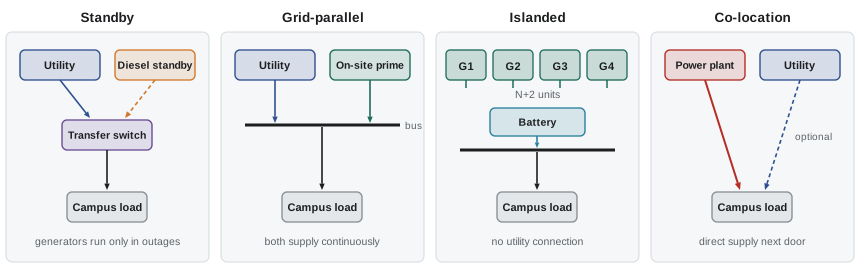
On-site generation can relate to the grid in several ways:
- Standby only: grid supplies the load; generators run during outages and tests (the traditional model).
- Grid-parallel prime power: on-site generation runs continuously alongside a grid connection, which provides backup, absorbs surplus and supplies shortfalls.
- Bridging: on-site generation supplies the load (islanded or with a small grid connection) until full grid capacity arrives, after which it becomes backup or is relocated.
- Islanded (off-grid): the campus has no grid connection, so the on-site plant must provide all energy, reserves, frequency control and redundancy.
- Co-location: the data center is built next to an existing or new power plant and connects to it directly, with or without a grid connection (also discussed in Lesson 10 for nuclear plants).
Gas turbines
Gas turbines (combustion turbines) compress air, burn fuel in it and expand the hot gases through a turbine that drives a generator. Three main types are used:
- Aeroderivative turbines (about 20 to 70 MW), derived from aircraft engines: light, fast-starting (under 10 minutes), good at following load, with simple-cycle efficiency of 38 to 42%.
- Industrial frame (heavy-duty) turbines (50 to over 500 MW): rugged and efficient at large size, but slower to start and best run at steady output.
- Combined cycle: the hot exhaust from one or more turbines makes steam in a heat recovery steam generator (HRSG) that drives a steam turbine, reaching 55 to 63% efficiency. This is the most efficient fossil option but takes longer to build and start.
Efficiency is usually stated as heat rate, the fuel energy per unit of electricity, in Btu/kWh (on a higher heating value basis in the US). 100% efficiency corresponds to 3412 Btu/kWh, so a 40% efficient turbine has a heat rate of about 8530 Btu/kWh and a 60% combined cycle about 5690 Btu/kWh (higher on an HHV basis, typically 6200 to 6600). Natural gas is priced per MMBtu, with Henry Hub as the benchmark.
Turbine output falls in hot weather because air is less dense: an aeroderivative may lose 15 to 25% of its rated output between 15 °C and 40 °C, unless inlet cooling (evaporative or chilling) is used. On-site plants must be sized for the hottest conditions, which are also when data center cooling loads peak.
Turbine supply became a major constraint in 2025: with orders surging from utilities and data centers, the three main manufacturers of large frame turbines reported order books extending to around 2030. This led developers to use smaller aeroderivative and industrial turbines, reciprocating engines, fuel cells and even refurbished or mobile units.
Reciprocating engines
Large gas reciprocating engines (about 4 to 20 MW each) are similar to the diesel engines used for standby but run on natural gas for continuous duty. They reach 44 to 50% efficiency, start in a few minutes, hold efficiency at part load, lose little output in hot weather and come in modular sizes that allow many units for redundancy. They have higher maintenance costs and emit more NOx and methane slip than turbines unless controlled. Plants of 100 to 400 MW with dozens of engines now serve data centers.
Fuel cells
Fuel cells convert fuel to electricity electrochemically without combustion. Solid oxide fuel cells (SOFCs) operate at 600 to 800 °C, reform natural gas internally, and achieve 50 to 60% electrical efficiency. They emit almost no NOx or particulates (because there is no flame), are quiet, and are built in modular units of a few hundred kilowatts that can be installed quickly in arrays of tens to hundreds of megawatts. Their CO₂ emissions per MWh are similar to or slightly lower than combined cycle, and they can run on hydrogen or biogas. Data center operators and utilities have signed agreements for hundreds of megawatts to more than 1 GW of SOFCs. Disadvantages include higher capital cost per kW, stack replacement every few years, and limited ability to follow rapid load changes without batteries.
Comparing technologies
| Technology | Unit size | Electrical efficiency | Start time | Strengths | Weaknesses |
|---|---|---|---|---|---|
| Aeroderivative turbine | 20–70 MW | 38–42% | 5–10 min | Fast, flexible, compact | Hot-weather derate, lower efficiency |
| Frame turbine (simple cycle) | 50–500 MW | 33–40% | 10–30 min | Low cost per kW at scale | Lead times, less flexible |
| Combined cycle | 200–1500 MW | 55–63% | 1–3 h | Highest efficiency | Size, time to build, slower response |
| Gas reciprocating engine | 4–20 MW | 44–50% | 2–5 min | Modular, good part-load and hot-weather performance | Maintenance, emissions control |
| Solid oxide fuel cell | 0.3 MW modules | 50–60% | Hours (kept hot) | Low NOx, quiet, fast to deploy | Cost, stack life, slow ramping |
| Battery storage | Any | 85–90% round trip | Milliseconds | Instant response, peak shaving | Limited duration |
Worked problem
Cost of on-site energy
A 300 MW combined-cycle plant costs $2,200/kW, with a capital recovery factor of 0.09, fixed O&M of $30/kW-year, variable O&M of $4/MWh and a heat rate of 6.4 MMBtu/MWh. Gas costs $3.50/MMBtu delivered. Estimate the cost per MWh at a 90% capacity factor.
Show solution
- Energy per kW per year: \(8760 \times 0.9 = 7884\) kWh \(= 7.884\) MWh.
- Capital: \(2200 \times 0.09 = 198\) per kW-year; \(198/7.884 = \$25.1\)/MWh.
- Fixed O&M: \(30/7.884 = \$3.8\)/MWh. Fuel: \(6.4 \times 3.50 = \$22.4\)/MWh. Variable O&M: $4/MWh.
- Total: \(25.1 + 3.8 + 22.4 + 4 = \$55\)/MWh.
Answer: About $55/MWh, before the cost of redundancy, emission controls and gas transport. Because the plant runs at high capacity factor, capital is spread over many MWh; the same plant at 50% capacity factor would cost much more per MWh.
Designing for data center reliability
A grid connection backed by standby generators is very reliable. An islanded on-site plant must achieve similar reliability on its own, which requires redundancy: more generating units than needed to carry the load, so that some can be out for maintenance or fail without interrupting supply. With \(n\) identical units, each available with probability \(a\), the probability that at least \(k\) are available is given by the binomial distribution:
Worked problem
Redundancy for an islanded plant
A 100 MW load is served by 20 MW reciprocating engines, each with a forced outage availability of 0.98. Five engines are needed. Compare the probability of a shortfall with 5, 6 and 7 engines.
Show solution
- With 5 (N): all must run: \(0.98^5 = 0.904\); shortfall probability 9.6%.
- With 6 (N+1): \(P = 0.98^6 + 6 \times 0.98^5 \times 0.02 = 0.886 + 0.108 = 0.994\); shortfall 0.6%.
- With 7 (N+2): shortfall about 0.03%.
Answer: N+1 gives about 0.6% probability of being short at any moment (about 50 hours a year), and N+2 about 0.03% (about 2 hours a year), before planned maintenance. Islanded plants are usually designed N+2 or better, with batteries to carry load during the seconds to minutes needed to start reserve units, and standby diesels as a further layer.
from math import comb

def p_short(n, k, a):
    # probability that fewer than k of n units are available
    return sum(comb(n, i) * a**i * (1 - a)**(n - i) for i in range(k))

load, unit, a = 100, 20, 0.98
k = -(-load // unit)                      # units needed, rounded up
print("units needed:", k)
for n in range(k, k + 4):
    p = p_short(n, k, a)
    print(f"{n} units (N+{n-k}): shortfall {p:.5f} = {p*8760:7.1f} h/yr")

# with one unit on planned maintenance, does N+2 still cover a forced outage?
print("N+2 with one unit in maintenance:", round(p_short(k + 1, k, a) * 8760, 1), "h/yr")units needed: 5 5 units (N+0): shortfall 0.09608 = 841.7 h/yr 6 units (N+1): shortfall 0.00569 = 49.8 h/yr 7 units (N+2): shortfall 0.00026 = 2.3 h/yr 8 units (N+3): shortfall 0.00001 = 0.1 h/yr N+2 with one unit in maintenance: 49.8 h/yr
While one unit is down for planned maintenance, an N+2 plant is effectively N+1 and its exposure rises to about 50 hours a year, so maintenance is scheduled for periods when batteries, standby diesels or a partial grid connection can cover the gap, or the plant is built N+3.
Beyond unit count, islanded and grid-parallel plants must handle:
- Frequency and voltage control: without the grid, the on-site plant must hold frequency and voltage as loads change. AI training clusters can swing tens of megawatts within a second as thousands of GPUs start and stop computation together; turbines and engines cannot follow such steps alone, so batteries, supercapacitors or flywheels, and software that smooths GPU power draw, are used.
- Fuel supply: a single gas pipeline is a common-mode failure. Firm transportation contracts, a second pipeline, on-site liquefied natural gas or dual-fuel units with stored diesel provide backup. Pipeline capacity, not just gas price, often limits large on-site plants.
- Maintenance: major overhauls take units out for days or weeks, so redundancy must cover planned and forced outages together.
- Protection and grounding: the plant must provide fault current to operate protection and must coordinate with the data center's electrical system (DCE-340).
Battery energy storage
Large battery energy storage systems (BESS), usually lithium iron phosphate, serve several roles at data centers:
- Fast response: covering the seconds to minutes before generators start, and absorbing rapid load swings.
- Peak shaving: reducing grid demand charges and peak-based allocations (Lesson 1).
- Grid services: providing frequency regulation or demand response for revenue when not needed on site.
- Shifting renewable output: improving hourly matching (Lesson 5).
- Enabling flexible connections: supplying load during grid curtailment periods (Lesson 3).
Worked problem
Battery for load swings
An AI training cluster draws 80 MW but can drop to 20 MW and return within a second, repeatedly. Gas engines serving it can ramp at 5 MW per second. What battery power rating is needed to absorb or supply the difference during a 60 MW step?
Show solution
- Engines take \(60/5 = 12\) s to follow a 60 MW change.
- The battery must absorb or supply up to 60 MW instantly, declining as the engines respond.
- Energy during the ramp: triangle \(\tfrac12 \times 60 \times 12 = 360\) MJ \(= 0.1\) MWh.
Answer: About 60 MW of battery power, but only about 0.1 MWh of energy per event, so a high-power, short-duration battery or supercapacitor fits. In practice operators also limit swings in software, because repeated cycling and the resulting mechanical stress on generators is costly.
Emissions and permitting
Natural gas emits about 50 kg CO₂ per GJ (53 kg per MMBtu) of fuel. A combined-cycle plant emits about 0.33 to 0.38 t CO₂/MWh, a simple-cycle turbine or engine plant about 0.40 to 0.55 t/MWh. Methane leaks along the gas supply chain add to the climate impact. Large on-site plants therefore conflict with operators' climate commitments unless paired with carbon capture, renewable natural gas or hydrogen, or treated as a bridge to cleaner supply.
Worked problem
Annual CO₂ of an on-site plant
A 200 MW load is served by a reciprocating engine plant at 44% efficiency (on a higher heating value basis), running all year. Estimate annual CO₂ emissions.
Show solution
- Electricity: \(200 \times 8760 = 1.752 \times 10^6\) MWh.
- Fuel: \(1.752 \times 10^6 \times 3.6/0.44 = 14.3 \times 10^6\) GJ.
- CO₂: \(14.3 \times 10^6 \times 0.050 = 717{,}000\) t, or \(717{,}000/1.752 \times 10^6 = 0.41\) t/MWh.
Answer: About 720,000 t CO₂ a year. This exceeds the annual emissions of many medium-sized cities, which is why air permits, carbon pricing and corporate climate goals all bear on on-site gas plants.
In the US, on-site generation requires air permits under the Clean Air Act. Plants with potential emissions above major source thresholds (typically 100 or 250 tons per year of a criteria pollutant, lower in nonattainment areas) need Prevention of Significant Deterioration or nonattainment new source review permits with best available control technology and air quality modeling, plus Title V operating permits; turbines and engines must meet New Source Performance Standards. Permitting can take 12 to 18 months or more. In 2024 and 2025, xAI's Memphis supercomputer site ran temporary gas turbines before obtaining permits, prompting community opposition and legal challenges that illustrate the scrutiny such plants now receive. State rules (such as Texas SB 6 disclosure of backup generation) and FERC's co-location decisions also affect grid-parallel and co-located plants.
Behind-the-meter and co-location rules
When on-site or co-located generation serves a load that is also connected to the grid, questions arise about who pays for the grid services the load still uses (backup, frequency regulation, black start) and whether the arrangement shifts costs to other customers.
In the US, FERC's November 2024 rejection of an amended interconnection agreement that would have expanded co-located load at the Susquehanna nuclear plant, and its December 2025 order requiring PJM to create new transmission services for co-located loads (including interim, non-firm and firm options), set the framework in PJM, and FERC's 2026 show-cause orders extend similar questions to other RTOs. States determine whether a customer can buy power directly from a co-located generator without going through the utility.
In all jurisdictions, developers must decide early whether on-site generation is temporary or permanent, because that choice affects equipment selection (mobile or permanent units), permits, fuel contracts, financing and how the plant will be used once the grid arrives: as backup, for grid services, or relocated to another site.
Lesson 8 covers the gas supply, transport and price risk behind on-site generation, and Lesson 11 how to compare its economics with grid supply and the value of time to power.
Common mistakes
MistakeSizing on-site turbines at their nameplate rating.
InsteadSize for output at the hottest ambient temperature, with inlet cooling if needed.
MistakeDesigning an islanded plant at N or N+1.
InsteadCover forced and planned outages together, usually N+2 or better plus batteries.
MistakeRelying on a single gas pipeline.
InsteadProvide firm transport, alternative supply or dual-fuel capability.
MistakeIgnoring rapid AI load swings.
InsteadUse batteries or other fast storage and smooth GPU power in software.
MistakeTreating on-site gas plants as climate-neutral.
InsteadAccount for CO₂ and methane, carbon pricing and corporate goals.
Summary and key terms
- On-site prime power is used for bridging, grid-parallel operation, islanded campuses and co-location.
- Aeroderivative turbines are flexible; frame turbines and combined cycle are efficient at scale but have long lead times.
- Gas reciprocating engines are modular with good part-load and hot-weather performance.
- Solid oxide fuel cells offer low NOx and fast deployment at higher cost.
- Heat rate times fuel price gives fuel cost per MWh; high capacity factor spreads capital.
- Islanded plants need N+2 or better redundancy, fast storage, fuel security and frequency control.
- Batteries provide fast response, peak shaving, grid services and renewable shifting.
- Clean Air Act permits, state rules and FERC co-location decisions govern on-site plants.
- Prime power
- Generation that runs continuously to supply a load.
- Bridging power
- Temporary generation until a grid connection is available.
- Aeroderivative turbine
- A gas turbine derived from an aircraft engine.
- Combined cycle
- Gas turbines with heat recovery driving a steam turbine.
- Heat rate
- Fuel energy input per unit of electricity output.
- Solid oxide fuel cell
- A high-temperature fuel cell producing electricity electrochemically.
- Capacity factor
- Actual energy produced divided by maximum possible.
- N+2
- Two more units than needed to carry the load.
- Co-location
- Siting a load next to a generator and connecting directly.
- BESS
- Battery energy storage system.
Practice problems
Work each problem on paper first, then reveal the answer to check.
Convert 45% efficiency to a heat rate in Btu/kWh.
Show answer
3412/0.45 = 7582 Btu/kWh.
Fuel cost at 7.6 MMBtu/MWh and $3.00/MMBtu?
Show answer
$22.8/MWh.
Why do gas turbines lose output in hot weather?
Show answer
Hot air is less dense, so less mass flows through the turbine.
Give two advantages of reciprocating engines over turbines for data centers.
Show answer
Modularity for redundancy, good part-load efficiency, little hot-weather derate, fast start.
Why do SOFCs emit little NOx?
Show answer
There is no flame; fuel is oxidized electrochemically at lower temperatures than combustion.
Four units are needed and each has availability 0.97. Probability that all of 4 are available?
Show answer
0.97⁴ = 0.885.
Capital cost $1,500/kW, CRF 0.1, capacity factor 85%. Capital cost per MWh?
Show answer
150/7.446 = $20.1/MWh.
What roles can a battery play at a data center?
Show answer
Ride-through until generators start, absorbing load swings, peak shaving, grid services, renewable shifting, flexible connections.
A 100 MW combined cycle at 0.37 t/MWh runs 8000 h. Annual CO₂?
Show answer
296,000 t.
Why decide early whether on-site generation is temporary or permanent?
Show answer
It affects equipment choice, permits, fuel contracts, financing and later use.
Lesson quiz · 5 questions
Score 60% or more to complete this lesson.
Create a free account to save your progress, take quizzes and earn a certificate.