
DCE-420 · Lesson 10 of 12 · 29 min
Nuclear and emerging sources
Wind, solar and batteries can supply most of a data center's energy cheaply, but as Lesson 5 showed, matching a constant 24-hour load with clean energy in every hour requires firm resources that produce whenever needed. Since 2024, data center operators have become the leading private buyers of firm clean power: restarting retired nuclear plants, contracting the output of existing ones, funding uprates, ordering small modular reactors, and investing in enhanced geothermal, long-duration storage and even fusion. This lesson examines these sources, their costs and timelines, and how data center owners contract for them.
Why firm clean power
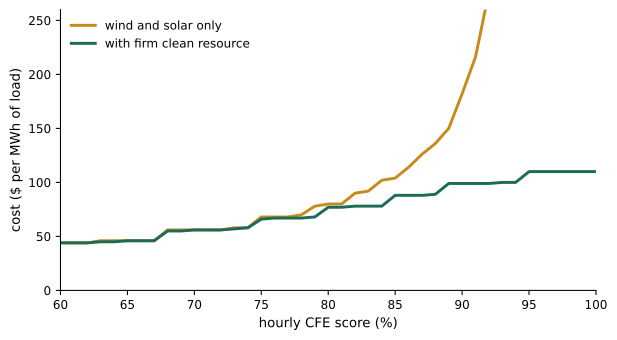
A firm resource can produce at its rated output whenever called upon, apart from planned and forced outages. Nuclear plants run at capacity factors above 90%, geothermal similarly, and hydro with storage can follow demand. The value of firm resources rises steeply as the target for hourly clean matching rises, because meeting the last 10 to 20% of hours with wind, solar and short-duration batteries requires large overbuilding.
import numpy as np

rng = np.random.default_rng(7)
H = 8760
h = np.arange(H) % 24
day = np.arange(H) // 24
season = 1 + 0.3 * np.cos(2 * np.pi * (day - 172) / 365)      # more sun in summer
clouds = np.repeat(rng.uniform(0.3, 1.0, 365), 24)
solar = np.clip(np.sin(np.pi * (h - 6) / 12), 0, None) * season * clouds
solar /= solar.mean()                                          # 1 MW average per unit
w = np.zeros(H)
for t in range(1, H):                                          # slowly varying wind
    w[t] = 0.97 * w[t - 1] + rng.normal(0, 0.25)
wind = np.clip(0.35 + 0.25 * w, 0, 1)
wind /= wind.mean()
load = np.full(H, 100.0)

# cost of each resource per MWh of its output (illustrative)
cost = {"solar": 50, "wind": 60, "firm": 110}

def score(s, wd, f):
    gen = s * solar + wd * wind + f
    matched = np.minimum(load, gen).sum()
    spend = (cost["solar"] * s * solar.sum() + cost["wind"] * wd * wind.sum()
             + cost["firm"] * f * H)
    return matched / load.sum(), spend / load.sum()

best = {}
for s in range(0, 401, 20):
    for wd in range(0, 401, 20):
        for f in range(0, 101, 10):
            c, k = score(s, wd, f)
            for target in (0.8, 0.9, 0.95, 0.99):
                key = (target, f > 0)
                if c >= target and (key not in best or k < best[key][0]):
                    best[key] = (k, s, wd, f)

for target in (0.8, 0.9, 0.95, 0.99):
    for firm in (False, True):
        tag = "with firm" if firm else "no firm  "
        if (target, firm) not in best:
            print(f"CFE {target:.0%} {tag}: not reached with up to 400 MW each")
            continue
        k, s, wd, f = best[(target, firm)]
print(f"CFE {target:.0%} {tag}: ${k:4.0f}/MWh solar {s:3d}, wind {wd:3d}, firm {f:3d} MW")CFE 80% no firm : $ 80/MWh solar 40, wind 100, firm 0 MW CFE 80% with firm: $ 77/MWh solar 20, wind 20, firm 50 MW CFE 90% no firm : $ 182/MWh solar 100, wind 220, firm 0 MW CFE 90% with firm: $ 99/MWh solar 0, wind 0, firm 90 MW CFE 95% no firm : not reached with up to 400 MW each CFE 95% with firm: $ 110/MWh solar 0, wind 0, firm 100 MW CFE 99% no firm : not reached with up to 400 MW each CFE 99% with firm: $ 110/MWh solar 0, wind 0, firm 100 MW
In this simplified model (one year of synthetic hourly solar and wind, firm clean power at $110/MWh, and no credit for surplus energy), reaching 80% hourly matching with wind and solar alone costs about $80/MWh of load. Reaching 90% without firm power more than doubles the cost, because large amounts of wind and solar must be built to cover calm, cloudy periods, and 95% cannot be reached at all within the range searched. With a firm resource, even 99% costs about $110/MWh, far less than the wind and solar cost at 90%. Adding storage, selling surplus energy and using real weather data changes the numbers, but the pattern — rapidly rising costs without firm resources as targets approach 100% — appears in most studies.
Existing nuclear plants
The US has about 94 operating reactors supplying nearly 20% of its electricity and nearly half of its carbon-free electricity. Most received 20-year license renewals to 60 years, and several have been approved to operate to 80 years. Between 2013 and 2022, about a dozen reactors closed, mainly because cheap natural gas and subsidized renewables made them unprofitable in wholesale markets. Data center demand has reversed their economics: in 2024 and 2025, large technology companies signed long-term contracts for existing plants' output, including Amazon's 1.92 GW agreement with Talen Energy for power from the Susquehanna plant in Pennsylvania (restructured in 2025 from a co-location arrangement to a grid-delivered contract) and Meta's 20-year agreement for the Clinton plant in Illinois.
Ways to obtain power from existing nuclear plants include:
- Contracts for existing output: long-term PPAs that keep plants running and support license extensions; critics note that they may simply move existing clean power from other customers to data centers, raising prices for others, unless paired with new capacity.
- Uprates: modifications to increase a reactor's output by a few percent to over 10%, often funded by data center contracts. Constellation and others plan more than 1 GW of uprates across their fleets.
- Restarts: returning recently retired plants to service. Holtec has been restarting the 800 MW Palisades plant in Michigan, the first US restart of a plant that had entered decommissioning, after NRC approval in 2025. Constellation is restarting Three Mile Island unit 1 (renamed the Crane Clean Energy Center, 835 MW) under a 20-year agreement with Microsoft, targeted for 2027 to 2028, and NextEra plans to restart the Duane Arnold plant in Iowa for Google.
Worked problem
Cost of a restart compared with new build
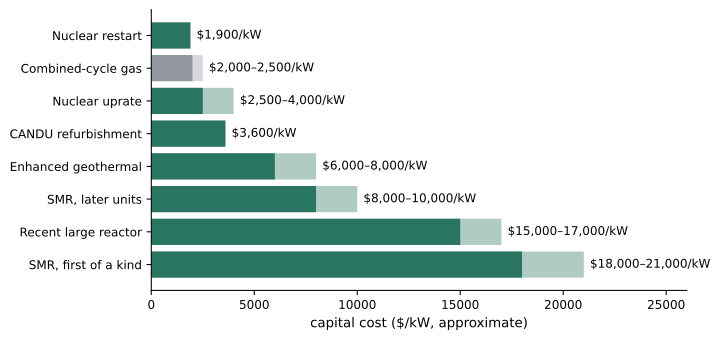
Restarting an 835 MW reactor is estimated at $1.6 billion. A new 300 MW SMR is estimated at $6 billion for the first unit, and recent large reactors cost about $16,000/kW. Compare the capital cost per kW.
Show solution
- Restart: \(1.6 \times 10^9/835{,}000 = \$1{,}920\)/kW.
- First SMR: \(6 \times 10^9/300{,}000 = \$20{,}000\)/kW.
Answer: A restart costs about a tenth as much per kW as new build, which is why the few restartable plants were contracted quickly. Few retired plants remain restartable, because decommissioning removes or damages key equipment.
New large reactors
Vogtle units 3 and 4 in Georgia, the first new US reactors in decades (AP1000 design, 1,117 MW each), entered service in 2023 and 2024, years late and at a total cost of over $30 billion. Their experience shows the cost of first-of-a-kind construction, but also that later units are cheaper: unit 4 was built faster than unit 3. In 2025, the federal government set a goal of 400 GW of nuclear capacity by 2050, ordered the NRC to decide on license applications within 18 months, and announced an agreement with Westinghouse for at least $80 billion of new AP1000 reactors.
Small modular reactors
Small modular reactors (SMRs) are reactors of up to about 300 MW per unit, designed to be built from factory-made modules with simpler, passive safety systems. Their promise is lower construction risk, shorter schedules, and costs that fall as more identical units are built. Advanced designs use different coolants (sodium, molten salt, helium gas) and fuels, offering higher temperatures and new capabilities. Microreactors of a few MW to tens of MW target remote sites and specialized uses.
| Design | Type | Size | Status and data center links |
|---|---|---|---|
| GE Vernova Hitachi BWRX-300 | Boiling water reactor | 300 MW | Planned by TVA at Clinch River, Tennessee; first unit under construction at Darlington, Ontario |
| NuScale | Pressurized water reactor | 77 MW modules | NRC design approval; large agreements announced with data center-focused developers |
| X-energy Xe-100 | High-temperature gas | 80 MW | Amazon-backed project with Energy Northwest in Washington State; Dow project in Texas |
| Kairos Power | Fluoride salt-cooled | 50–75 MW | Google agreement for up to 500 MW by 2035; Hermes test reactors in Tennessee |
| TerraPower Natrium | Sodium-cooled with molten salt storage | 345 MW (500 MW peak) | Under construction in Kemmerer, Wyoming; agreements with data center operators |
| Oklo Aurora | Sodium-cooled fast microreactor | 75 MW | Agreements with data center companies |
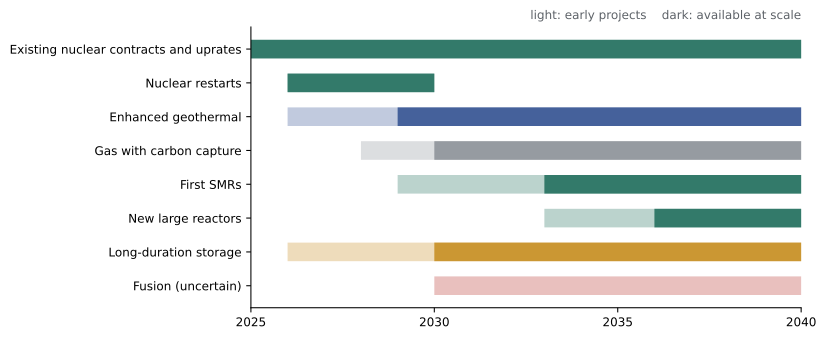
In the US, the NRC has been modernizing its licensing framework, and DOE's Reactor Pilot Program aimed for at least three advanced test reactors to reach criticality by July 4, 2026; three achieved zero-power criticality by that date. Most commercial SMRs serving data centers are targeted for the early to mid 2030s. Technology companies typically sign agreements to purchase power, invest in developers or fund early project development, sharing first-of-a-kind risk.
SMRs face challenges: first units are expensive (NuScale's first project in Utah was canceled in 2023 when estimated prices rose to $89/MWh even with subsidies), fuel for many advanced designs (high-assay low-enriched uranium, HALEU) is not yet produced at commercial scale outside Russia, supply chains and skilled workforces must be built, and licensing new technologies takes time. Data center owners should treat SMRs as a 2030s resource and plan bridging supply accordingly.
Worked problem
Levelized cost of a nuclear unit
A 300 MW SMR costs $18,000/kW, has a capital recovery factor of 0.07 (low-cost financing over 40 years), fixed O&M of $150/kW-year, and fuel and variable costs of $10/MWh, at a 93% capacity factor. Estimate its levelized cost. How does it change at $9,000/kW for later units?
Show solution
- Energy per kW: \(8760 \times 0.93 = 8.147\) MWh/year.
- Capital: \(18{,}000 \times 0.07 = 1260\) per kW-year \(\Rightarrow 1260/8.147 = \$155\)/MWh.
- Fixed O&M: \(150/8.147 = \$18\)/MWh. Total \(= 155 + 18 + 10 = \$183\)/MWh.
- At $9,000/kW: capital \(= \$77\)/MWh; total \(= \$105\)/MWh.
Answer: About $180/MWh for a first-of-a-kind unit, falling to about $105/MWh if costs halve. Capital cost and financing dominate nuclear economics, which is why government support, low-cost financing, and series construction are crucial, and why data center buyers willing to sign long-term contracts at premium prices can make early projects possible.
Contracting for nuclear power
Data centers access nuclear power through several structures:
- Grid-delivered PPAs: the plant sells into the grid, and the buyer receives energy attribute certificates and a financial hedge (as in a VPPA) or physical delivery through its utility.
- Co-location: the data center connects directly to the plant, reducing transmission use. This raises the cost-allocation questions discussed in Lesson 7, and regulators have scrutinized it closely.
- Utility tariffs: some utilities offer clean transition or firm clean tariffs letting a data center pay a premium for new nuclear or geothermal supply procured by the utility.
- Equity and development funding: investing in reactor developers or early project costs in exchange for rights to future output.
Contract terms for new nuclear typically include long durations (20 years or more), price escalation, risk sharing for construction delays and cost overruns, and provisions for license changes. Because first units carry high risk, buyers increasingly commit to fleets of several units to earn lower prices on later ones.
Geothermal and hydro
Conventional geothermal power uses naturally permeable hot rock and is limited to specific regions (in the US mainly California and Nevada). Enhanced geothermal systems (EGS) apply horizontal drilling and hydraulic stimulation, techniques from the oil and gas industry, to create permeable reservoirs in hot dry rock, greatly expanding the potential resource. Closed-loop systems circulate fluid through sealed wellbores without fractures.
Fervo Energy's Cape Station in Utah, using EGS, is expected to deliver first power in 2026 and about 100 MW by early 2027; in September 2026 Google signed a 396 MW agreement for its expansion, with an option for about 600 MW more. Google had earlier contracted geothermal from Fervo in Nevada and through a clean transition tariff with NV Energy, and Meta has contracted EGS in New Mexico. Geothermal retains its tax credits longer than wind and solar under the 2025 law.
Hydro supplies about 6% of US electricity, mostly in the Northwest and Southeast, and pumped storage provides most existing grid storage. New large dams are unlikely, but upgrades of existing dams, adding generation to non-powered dams, and imports of Canadian hydro through new lines (such as the Champlain Hudson Power Express to New York City) add firm clean supply.
Longer-term options
- Long-duration storage: technologies such as iron-air batteries (about 100 hours), compressed air, pumped hydro and thermal storage can shift wind and solar energy across days, partly substituting for firm generation.
- Gas with carbon capture and storage (CCS): capturing 90% or more of CO₂ from gas plants and storing it underground. Several projects are planned near data center markets, especially where geology suits storage (Alberta, Texas, Louisiana, North Dakota), but costs and capture rates at scale are still being proven.
- Hydrogen: hydrogen produced with clean electricity can fuel turbines or fuel cells, but conversion losses (about 60 to 70% of the original energy) make it expensive for power generation except for long-duration backup.
- Fusion: private fusion companies have signed agreements with data center operators, including Helion's agreement to supply Microsoft from about 2028 and Commonwealth Fusion Systems' agreement with Google for its ARC plant in Virginia in the early 2030s. No fusion device has yet produced net electricity, so these are high-risk, long-term options rather than planning assumptions.
Putting it together
A data center owner planning a decade ahead might combine:
- Near term (now to 2028): grid supply with renewables PPAs, existing nuclear or hydro contracts where available, on-site gas or fuel cells for bridging, and batteries for flexibility.
- Medium term (2028 to 2032): restarts, uprates, geothermal and gas with CCS, plus 24/7 matching programs with utilities.
- Long term (2030s): SMRs and new large reactors, long-duration storage, and possibly fusion, with on-site gas transitioning to backup or being replaced.
Each choice must weigh cost, timing, risk, emissions, community acceptance and regulatory approval. The owners that secured power early with diverse, flexible portfolios have been able to grow; those that waited for the grid alone often could not.
Lesson 11 compares these long-term options with other paths on cost, risk and timing, and Lesson 12 combines them into a staged power strategy.
Common mistakes
MistakePlanning a campus around an SMR expected before 2030.
InsteadTreat SMRs as a 2030s resource with bridging supply until then.
MistakeAssuming that contracting existing nuclear output always reduces emissions.
InsteadUnless paired with new capacity, it may shift clean power from other customers.
MistakeEvaluating firm resources on cost per MWh alone.
InsteadValue their contribution to hourly matching and reliability, which wind and solar cannot provide.
MistakeIgnoring fuel supply for advanced reactors.
InsteadMany designs need HALEU, which is not yet produced at commercial scale outside Russia.
MistakeCounting fusion in capacity plans.
InsteadTreat it as a long-term option until net electricity is demonstrated.
Summary and key terms
- Firm clean resources become essential as hourly clean matching targets approach 100%.
- Data centers have signed long-term contracts for existing nuclear plants and funded uprates.
- Palisades, Crane and Duane Arnold restarts cost a fraction of new build per kW.
- SMRs such as BWRX-300, Xe-100, Kairos and Natrium target the early to mid 2030s.
- Capital cost and financing dominate nuclear economics; costs should fall with series construction.
- Contracts include PPAs, co-location, utility tariffs and equity funding.
- Enhanced geothermal and hydro upgrades add firm clean supply.
- Long-duration storage, gas with CCS, hydrogen and fusion are longer-term options of varying maturity.
- Firm resource
- A resource able to produce at rated output whenever needed.
- Uprate
- A modification increasing a reactor's rated output.
- Refurbishment
- Replacing major reactor components to extend operating life.
- Small modular reactor
- A reactor of up to about 300 MW built from factory-made modules.
- Microreactor
- A very small reactor of a few to tens of megawatts.
- HALEU
- High-assay low-enriched uranium, enriched to between 5% and 20% U-235.
- CANDU
- Canadian heavy-water reactor design using natural uranium.
- Enhanced geothermal system
- Geothermal plant using stimulated reservoirs in hot rock.
- Long-duration storage
- Storage able to discharge for many hours to days.
- Carbon capture and storage
- Capturing CO₂ from emissions and storing it underground.
Practice problems
Work each problem on paper first, then reveal the answer to check.
Why do firm resources become more valuable at high hourly matching targets?
Show answer
Wind and solar must be heavily overbuilt to cover calm, cloudy periods, so costs rise steeply without firm supply.
A 1,000 MW reactor at 92% capacity factor produces how much energy per year?
Show answer
8,059 GWh, about 8.1 TWh.
Why were the few restartable US nuclear plants contracted quickly?
Show answer
Restarts cost a small fraction of new build per kW and deliver firm clean power within a few years.
Capital $12,000/kW, CRF 0.08, capacity factor 90%. Capital cost per MWh?
Show answer
960/7.884 = $122/MWh.
What is HALEU and why does it matter?
Show answer
Uranium enriched to 5–20%; many advanced reactors need it, and commercial supply outside Russia is limited.
Give two ways data centers contract for nuclear power.
Show answer
Grid-delivered PPAs, co-location, utility firm clean tariffs, equity or development funding.
How does enhanced geothermal differ from conventional geothermal?
Show answer
It creates permeability in hot rock by drilling and stimulation, so it is not limited to natural hydrothermal reservoirs.
Hydrogen made and burned for power returns about what share of the original electricity?
Show answer
Roughly 30 to 40%, given 60 to 70% losses.
Why is fusion not a planning assumption?
Show answer
No fusion device has produced net electricity; timelines are uncertain.
Outline a near-term power strategy for a new campus.
Show answer
Grid supply with PPAs, existing firm contracts where available, on-site bridging generation and batteries, with options on future firm clean resources.
Lesson quiz · 5 questions
Score 60% or more to complete this lesson.
Create a free account to save your progress, take quizzes and earn a certificate.