
DCE-420 · Lesson 4 of 12 · 27 min
Data center load, flexibility and demand response
For decades data centers were treated as the least flexible loads imaginable: constant, critical and never to be interrupted. That view is changing. Grid capacity has become the main constraint on new data centers, and the grid is stressed only in a small number of hours each year. A data center able to reduce its demand during those hours can often be connected sooner and larger, pay less for capacity and energy, and support the grid instead of straining it. This lesson examines the shape of data center load, including the new patterns created by AI training, the ways a data center can be flexible, the analysis showing how much grid capacity flexibility can unlock, demand response programs and their economics, and the contractual and operational requirements for flexible connections.
The shape of data center load
Conventional cloud and enterprise data centers have high, steady load factors, often 70% to 90% of their contracted capacity, with modest daily cycles following user activity and seasonal changes in cooling energy. Load grows in steps as halls are fitted out and leased, often more slowly than planned, which matters for capacity reservations and hedging (Lesson 2).
AI training has added two new features. First, training clusters run at very high, steady utilization for weeks or months, pushing load factors toward their maximum. Second, synchronized training jobs cause rapid power swings: thousands of accelerators alternate between computation and communication phases together, so a cluster's power can swing by tens of percent within seconds, and drop sharply when a job stops or a checkpoint is written. Utilities and grid operators have raised concerns about the effect of such swings on voltage and frequency and about large loads that suddenly drop off the grid during disturbances (DCE-340). Rack-level storage, facility batteries and power-smoothing software in training frameworks are used to present a steadier load to the grid.
Inference workloads, which answer user requests, follow daily usage patterns and are latency-sensitive, while training and batch processing can often be scheduled.
Sources of flexibility
A data center can reduce its draw from the grid in several ways:
- Shifting workloads in time: deferring batch jobs, model training steps or non-urgent processing for a few hours. Training jobs that checkpoint regularly can pause and resume.
- Shifting workloads in space: moving computation to another data center in a different grid region, which large cloud operators already do for reliability and carbon reasons.
- Reducing power without stopping: lowering accelerator clock speeds and power caps reduces power substantially with a smaller loss of throughput.
- On-site storage: facility batteries (DCE-340) can supply part of the load for an hour or more.
- On-site generation: backup generators or permanent gas generation (Lesson 7) can carry load during grid emergencies, subject to air permits that often limit non-emergency hours.
- Cooling: pre-cooling thermal mass or chilled water storage shifts some cooling energy away from peak hours.
Each source has a cost: deferred computation, emissions from generators, battery wear. The key insight is that the grid needs flexibility only in relatively few hours, so the total cost can be small.
How much capacity can flexibility unlock?
A grid is planned for its peak demand, which occurs in a few hours a year. In most other hours there is substantial spare capacity. A new load that agrees to curtail during the peak hours can be connected beyond the firm headroom. A widely cited 2025 study from Duke University estimated that the US grid could accommodate roughly 76 GW of new load if that load accepted curtailment for about 0.25% of its annual energy, and about 100 GW at 0.5%, without new generation capacity.
import numpy as np

rng = np.random.default_rng(3)
h = np.arange(8760)
# Synthetic system load: seasonal and daily cycles plus weather noise (MW); the grid can serve up to 20,000 MW
season = 2500 * np.cos(2 * np.pi * (h / 8760 - 0.55)) ** 2
daily = 1800 * np.sin(2 * np.pi * (h % 24 - 9) / 24).clip(0)
load = 13000 + season + daily + rng.normal(0, 500, 8760)
limit = 20000
print(f"existing peak {load.max():,.0f} MW; headroom at peak {limit - load.max():,.0f} MW")
for dc in (1000, 2500, 4000):
    excess = np.clip(load + dc - limit, 0, None)
    hours = int((excess > 0).sum())
    curtailed = excess.sum()
print(f"new flexible load {dc:5,} MW: curtailment needed in {hours:4d} hours, {curtailed / (dc * 8760) * 100:.2f}% of its energy, largest cut {excess.max():,.0f} MW")existing peak 18,501 MW; headroom at peak 1,499 MW new flexible load 1,000 MW: curtailment needed in 0 hours, 0.00% of its energy, largest cut 0 MW new flexible load 2,500 MW: curtailment needed in 109 hours, 0.12% of its energy, largest cut 1,001 MW new flexible load 4,000 MW: curtailment needed in 1573 hours, 2.98% of its energy, largest cut 2,501 MW
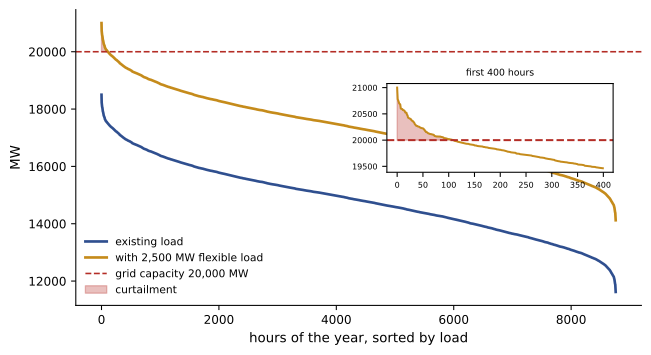
With about 1,500 MW of firm headroom, a 2,500 MW flexible load needs curtailment in only about 100 hours a year, losing about 0.1% of its energy. At 4,000 MW, curtailment rises steeply to nearly 1,600 hours and 3% of energy, showing that flexibility extends capacity substantially but not without limit. Real analyses must also check transmission constraints, contingencies (N−1 limits rather than total capacity, Lesson 3) and the correlation between grid peaks and the data center's own cooling peak.
Demand response programs
Utilities and system operators pay customers to reduce load when needed. Common program types:
- Emergency or interruptible programs: customers commit to reduce load to a specified level when the operator declares an emergency, typically a limited number of times and hours per year, in exchange for capacity payments or discounted rates.
- Economic demand response: customers reduce load when prices are high, bidding reductions into energy markets or responding to price signals.
- Capacity market participation: demand response counted as a capacity resource, paid the capacity price and subject to penalties for non-performance.
- Peak-based charge management: reducing load during the hours that set transmission or capacity charges, such as Ontario's Global Adjustment peaks or coincident peak transmission charges in Texas (the four summer coincident peaks).
- Ancillary services: fast-responding loads and batteries providing reserves or frequency response (Lesson 2).
In Texas, ERCOT's transmission charges are allocated by each customer's load during the four monthly summer coincident peaks (4CP), and large loads routinely curtail on predicted peak days; ERCOT also operates emergency response services and allows large flexible loads to provide ancillary services. Texas Senate Bill 6 (2025) requires new large loads above 75 MW to disclose backup generation and to be curtailable or deploy backup power during grid emergencies.
The economics of flexibility
Whether flexibility pays depends on what the data center gives up and what it gains:
# Value of flexibility for a 100 MW data centre that can cut 30 MW using batteries, deferrable jobs or generators
cap_price = 270 * 365                 # $/MW-year in a capacity market
coincident_cut = 30                   # MW reduced during the system peak hours that set capacity obligations
energy_hours, avg_spike = 40, 600     # hours a year of high prices avoided, and the average price in those hours ($/MWh)
normal_price = 50
capacity_saving = coincident_cut * 1.15 * cap_price
energy_saving = coincident_cut * energy_hours * (avg_spike - normal_price)
dr_payment = coincident_cut * 40000   # demand response program payment, $/MW-year
print(f"capacity obligation saving ${capacity_saving / 1e6:.2f}M; energy price avoidance ${energy_saving / 1e6:.2f}M; DR payment ${dr_payment / 1e6:.2f}M")
print(f"total about ${(capacity_saving + energy_saving) / 1e6:.2f}M per year (DR payments often overlap with the capacity saving)")
# Cost side: lost revenue from deferring AI training jobs during those hours
gpu_value_per_mwh = 2000              # revenue earned per MWh of compute, $/MWh of IT energy
print(f"cost if the 30 MW were productive compute for 60 hours: ${30 * 60 * gpu_value_per_mwh / 1e6:.2f}M")capacity obligation saving $3.40M; energy price avoidance $0.66M; DR payment $1.20M total about $4.06M per year (DR payments often overlap with the capacity saving) cost if the 30 MW were productive compute for 60 hours: $3.60M
The capacity saving dominates the value, about $3.4 million a year at recent PJM capacity prices, with a smaller saving from avoided price spikes. Deferring 30 MW of computation for 60 hours costs about $3.6 million if every megawatt-hour of compute is worth $2,000 in revenue, roughly canceling the benefit. That is why flexibility comes mostly from sources other than stopping valuable work: batteries and on-site generation, workloads with genuinely low urgency, and power capping that reduces energy more than throughput. But the largest benefit of flexibility is often not on this list at all: being connected one to three years sooner, or with more megawatts, can be worth far more than any annual saving (Lesson 3).
Worked problem
Value of an earlier connection
A 200 MW AI campus generates gross margin of about $1.5 million per MW per year once operating. A utility offers connection two years earlier if the campus accepts curtailment of up to 25% of its load for up to 100 hours a year, served by on-site batteries and generators. What is the value of the earlier connection, roughly?
Show solution
- Margin for two years: \(200 \times 1.5 \times 2 = \$600\) million.
- Cost of flexibility: batteries and generator operating costs for up to 100 hours, likely a few million dollars a year plus capital already planned for backup.
Answer: On the order of $600 million, dwarfing the cost of providing flexibility. This arithmetic explains the rapid shift of data center developers toward flexible connection agreements.
Making flexibility credible
Grid operators can only rely on flexibility that is firm, measurable and enforceable. Requirements typically include:
- Clear contractual terms: the maximum curtailment (MW), notice time, maximum duration and frequency, and penalties for failure to perform.
- Telemetry and control: real-time metering and communication with the operator, sometimes direct control of a breaker or a firm service level that is automatically enforced.
- Testing: periodic demonstrations that the load can drop as promised.
- Ride-through behavior: in addition to planned curtailment, large loads must not trip unexpectedly during grid disturbances, which would itself destabilize the grid; operators are developing ride-through requirements for large loads similar to those for generators.
- Transition to firm service: flexible connections are often temporary, converting to firm service once network upgrades are complete.
Worked problem
Is the curtailment covered?
A 300 MW campus agrees to reduce to 225 MW for up to 4 hours per event, with 30 minutes notice. It has a 75 MW, 2-hour battery and generators that can carry 50 MW (permit-limited to 100 hours a year of non-emergency use). Can it meet a 4-hour event without curtailing computation?
Show solution
- Required reduction: 75 MW for 4 hours = 300 MWh.
- Battery: 75 MW for 2 hours = 150 MWh. Generators: 50 MW for 4 hours = 200 MWh.
- Plan: run generators at 50 MW for the full event (200 MWh), with the battery covering the remaining 25 MW for 4 hours (100 MWh, within its 150 MWh).
Answer: Yes: generators supply 50 MW and the battery 25 MW for the full four hours, with battery energy to spare. Over a season, the 100-hour generator permit limits the number of events, so the agreement and permits must be aligned.
Common mistakes
MistakeAssuming data center load cannot be flexible.
InsteadBatteries, generators, workload shifting and power capping provide real flexibility.
MistakeValuing flexibility only by annual bill savings.
InsteadInclude the value of earlier or larger connections, often the largest benefit.
MistakeOffering curtailment that relies on generators without checking permits.
InsteadAlign curtailment commitments with air permit hour limits and fuel.
MistakeIgnoring AI training power swings.
InsteadSmooth them with storage and software, and model them in interconnection studies.
MistakeTreating total system capacity as the only limit.
InsteadCheck transmission and contingency limits at the specific connection point.
Summary and key terms
- Data centers have high load factors; AI training adds sustained full load and rapid power swings.
- Flexibility comes from workload shifting in time and space, power capping, batteries, generation and cooling storage.
- Because grid stress occurs in few hours, modest curtailment can unlock much more capacity than firm headroom.
- Demand response programs pay for emergency, economic, capacity and peak-based reductions.
- Capacity savings and especially earlier connection drive the economics of flexibility.
- Credible flexibility requires contracts, telemetry, testing and ride-through behavior.
- Load factor
- Average load divided by peak or contracted capacity.
- Curtailment
- A reduction in load at the request of the grid operator.
- Firm headroom
- Capacity available to serve new load in all hours without curtailment.
- Load duration curve
- Hourly loads sorted from highest to lowest.
- Demand response
- Paid reductions in load in response to grid needs or prices.
- Coincident peak
- A customer's load at the time of the system peak.
- Power capping
- Limiting the power drawn by servers or accelerators.
- Workload shifting
- Moving computation to other times or locations.
- Flexible connection
- A connection agreement allowing curtailment in exchange for earlier or larger service.
- Ride-through
- Remaining connected through grid disturbances.
Practice problems
Work each problem on paper first, then reveal the answer to check.
A 150 MW data center averages 120 MW. Load factor?
Show answer
80%.
What is the main new load pattern created by AI training?
Show answer
Sustained full load with rapid synchronized power swings.
Curtailing 0.25% of the energy of a 500 MW load: MWh per year?
Show answer
10,950 MWh.
Name three sources of data center flexibility.
Show answer
Workload shifting, power capping, batteries, generators, cooling storage.
Capacity saving from cutting 20 MW at peak at $200/MW-day (15% reserve)?
Show answer
\(20 \times 1.15 \times 73{,}000 = \$1.68\)M.
How are ERCOT transmission charges allocated?
Show answer
By load in the four summer monthly coincident peaks (4CP).
How does Ontario allocate Global Adjustment to large customers?
Show answer
By share of demand in the five highest peak hours.
Energy needed to reduce 50 MW for 3 hours?
Show answer
150 MWh.
Why must flexible loads also ride through disturbances?
Show answer
Sudden unplanned load loss destabilizes the grid.
Value of connecting 100 MW one year earlier at $1M/MW-year margin?
Show answer
$100 million.
Lesson quiz · 5 questions
Score 60% or more to complete this lesson.
Create a free account to save your progress, take quizzes and earn a certificate.