
DCE-420 · Lesson 1 of 12 · 33 min
Utilities, ISOs and FERC
Electricity is the largest operating cost of a data center and, increasingly, the factor that decides whether a project can be built at all. A 100 MW campus running at high load factor consumes about 800 GWh a year, as much as 70,000 to 80,000 homes, and its electricity bill can exceed $50 million a year. How that power is bought, at what price, with what reliability and carbon content, and how quickly it can be connected, depends on the structure of the electricity sector where the campus is located. This course examines power supply from the data center owner's point of view: market and regulatory structures, wholesale prices, interconnection, flexibility, renewable procurement, storage, on-site generation and gas supply, contracts, nuclear and emerging sources, and the economics of choosing among them; the section at the end of this lesson sets out how the twelve lessons fit together. It builds on the power systems of ELE-380 and the site selection of DCE-410.
In the US, electricity is regulated at both federal and state levels, and the industry structure differs greatly between regions. This lesson explains the roles of utilities, regional transmission organizations and regulators, how wholesale markets work, how large customers are billed, and the features that matter most to data centers.
Industry structures
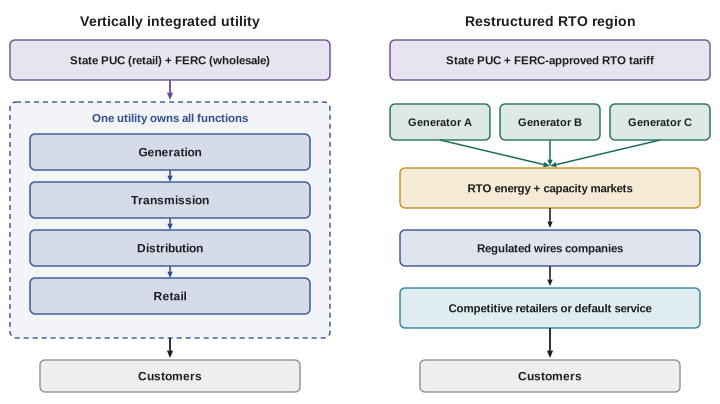
An electricity system has four functions: generation, transmission, distribution and retail (selling to customers). Around the world, these have been organized in two broad ways:
- Vertically integrated utilities own generation, transmission and distribution in their territory and sell to customers at rates set by a regulator based on their costs plus an allowed return. Planning is centralized: the utility decides what to build, subject to regulatory approval.
- Restructured (deregulated) systems separate the functions. Generators compete to sell into a wholesale market run by an independent system operator; transmission and distribution remain regulated monopolies ("wires companies"); and in some places customers can choose a competitive retailer.
The US contains both models side by side:
| Region | Structure | Key bodies | Notes for data centers |
|---|---|---|---|
| PJM (13 states and DC, Mid-Atlantic and Midwest) | RTO wholesale market; mix of restructured and regulated states | PJM; state PUCs; utilities such as Dominion | Largest data center market; capacity market prices at their cap in recent auctions |
| ERCOT (most of Texas) | Energy-only competitive market; retail choice | ERCOT; Public Utility Commission of Texas | Not FERC-jurisdictional for wholesale; SB 6 (2025) sets large-load rules |
| MISO, SPP | RTO markets with mostly vertically integrated utilities | MISO, SPP; state commissions | Growing data center interest; capacity resource adequacy concerns |
| CAISO, NYISO, ISO-NE | ISO markets; restructured states (California partly) | State commissions; ISOs | High prices; strong clean energy policies |
| Southeast and much of the West | Vertically integrated utilities without an RTO market | Southern Company, Duke Energy, TVA, APS and others; state commissions | Utility plans and large-load tariffs dominate |
Federal and state roles
The Federal Energy Regulatory Commission (FERC) regulates interstate transmission and wholesale electricity sales, approves the tariffs of regional transmission organizations (RTOs) and independent system operators (ISOs), and approves reliability standards developed by the North American Electric Reliability Corporation (NERC). State public utility commissions (PUCs) regulate retail rates, distribution, the siting of most generation and transmission, and the resource planning of vertically integrated utilities. Retail customers, including data centers, deal mainly with state-regulated utilities and tariffs, but wholesale market rules approved by FERC drive much of the cost.
Regional transmission organizations
Seven RTOs and ISOs (PJM, MISO, SPP, ERCOT, CAISO, NYISO and ISO-NE) operate the transmission grid and wholesale markets in regions covering about two-thirds of US electricity demand. They dispatch generation economically every five minutes, run day-ahead and real-time energy markets that set locational marginal prices (LMPs) at thousands of nodes, procure ancillary services, plan regional transmission and, in most cases, run capacity markets or resource adequacy programs.
Capacity markets
Energy markets pay generators for the energy they produce; capacity markets pay resources to be available in future years, ensuring enough capacity to meet peak demand plus a reserve margin. PJM's Reliability Pricing Model auction sets a price per MW-day for each delivery year, charged to load-serving entities in proportion to their peak load contribution. Rapid data center growth has pushed PJM capacity prices from about $29/MW-day for 2024/25 to $269.92 for 2025/26 and to the temporary price cap of about $329 and $333/MW-day for 2026/27 and 2027/28, with the 2027/28 auction procuring less reserve than the target. For a large load, capacity costs now rival energy costs in parts of PJM.
Worked problem
Capacity cost of a large load in PJM
A data center with a peak load contribution of 150 MW is in a PJM zone where the capacity price is $333/MW-day. What is the annual capacity cost, and what is it per MWh if the campus consumes 1.1 TWh a year?
Show solution
- Annual cost: \(150 \times 333 \times 365 = \$18.2\) million.
- Per MWh: \(18{,}200{,}000/1{,}100{,}000 = \$16.6\)/MWh.
Answer: About $18 million a year, or $17/MWh on top of energy, transmission and distribution charges. Reducing load during the peak hours used to set the peak load contribution can lower this cost in future years.
ERCOT and Texas
ERCOT's grid is largely isolated from the rest of the US, so its wholesale market is regulated by the Public Utility Commission of Texas rather than FERC. It is an energy-only market with prices that can rise to a cap of $5000/MWh during scarcity, rewarding flexible loads that can curtail. Transmission costs are allocated partly by each customer's load during the four monthly system peaks of summer (4CP). Senate Bill 6 (2025) set new requirements for loads of 75 MW and above, including disclosure of on-site backup generation, interconnection standards, cost sharing for studies, and the ability for ERCOT to direct large loads to curtail or switch to backup generation during emergencies. It also directs the commission to review whether 4CP allocation should continue, so peak-avoidance value may change.
Worked problem
Transmission charges under 4CP
A Texas data center normally draws 80 MW. Its transmission charges are about $5.50 per kW of its average load during the four summer coincident peak intervals, per year. What is the annual charge at 80 MW, and what if it reduces to 20 MW (using backup generation or curtailment) during each peak interval?
Show solution
- At 80 MW: \(80{,}000 \times 5.50 = \$440{,}000\) per year.
- At 20 MW: \(20{,}000 \times 5.50 = \$110{,}000\), saving $330,000.
Answer: About $330,000 saved for reducing load in four 15-minute intervals, if they can be predicted. Peak-avoidance programs like this, along with demand response payments, reward data centers that can flex load or run on-site generation, though doing so has emissions and permitting consequences (DCE-410).
How large customers are billed
A data center's electricity bill typically combines several components:
- Energy: the cost of the electricity consumed, per kWh or MWh, at a fixed rate, time-of-use rates, or wholesale market prices passed through.
- Demand: a charge per kW or kVA of the highest demand in the billing period, recovering the cost of capacity in transmission, distribution and sometimes generation. Demand ratchets may bill a minimum percentage of the highest demand in the previous 11 months.
- Transmission and distribution: delivery charges, often based on peak demand, coincident peaks or contracted capacity.
- Capacity or adequacy charges, where separate.
- Riders and taxes: environmental programs, regulatory charges, debt retirement, carbon pricing pass-throughs and sales taxes.
- Power factor charges (ELEC-210).
Large data centers often take service at transmission voltage (69 kV and above), owning their own substations. This avoids distribution charges and losses but requires the customer to fund, build and maintain the substation.
Worked problem
An annual electricity bill
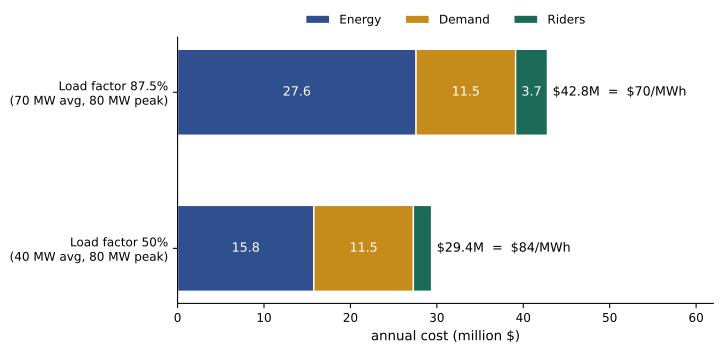
A campus averages 70 MW with a peak of 80 MW. Its tariff charges $45/MWh for energy, $12/kW-month for demand and $6/MWh in riders. Estimate the annual bill and the average cost per MWh.
Show solution
- Energy: \(70 \times 8760 = 613{,}200\) MWh; \(613{,}200 \times 45 = \$27.6\) million.
- Demand: \(80{,}000 \times 12 \times 12 = \$11.5\) million.
- Riders: \(613{,}200 \times 6 = \$3.7\) million.
- Total: \$42.8 million; per MWh \(42.8 \times 10^6/613{,}200 = \$69.8\)/MWh.
Answer: About $43 million a year, averaging $70/MWh. Because demand charges are spread over very high load factor, data centers achieve low average costs per MWh compared with peaky loads; a load with the same peak but half the energy would pay much more per MWh.
Managing price risk
Where customers buy at or near wholesale prices, as in ERCOT and many restructured states, the price of energy can change dramatically from hour to hour and year to year. ERCOT prices rose to the $9000/MWh cap then in force for days during Winter Storm Uri in February 2021, and annual average prices at major hubs have varied by a factor of two or more. A large customer chooses how much of this risk to keep:
- Fixed-price contracts: a retailer supplies all energy at a fixed price for one to five years, taking the price and volume risk for a premium.
- Index pricing: the customer pays the hourly wholesale price plus a retailer fee, keeping all the risk and all the potential savings.
- Block and index: the customer buys fixed blocks of energy (for example 50 MW around the clock) at fixed prices and pays index prices for the remainder, hedging most of its constant load.
- Financial hedges: swaps or options with banks or generators fix the price of a quantity of energy without changing physical supply. A virtual PPA (Lesson 5) is a long-term hedge of this kind.
- Demand response: agreeing to reduce load when prices spike or the system is stressed, earning payments and avoiding the highest prices.
Because a data center's load is nearly constant, it is easy to hedge with flat blocks, unlike loads that vary with weather. The remaining risks are mainly that load ramps more slowly than planned (leaving the customer over-hedged and selling surplus blocks at market prices) and changes in regulated charges, which hedges do not cover.
Worked problem
Block-and-index hedge
A Texas data center uses a constant 60 MW. It buys a 50 MW around-the-clock block at $55/MWh and pays the real-time price for the rest. In a month of 720 hours, the average real-time price is $110/MWh. Compare its energy cost with buying entirely at the real-time price.
Show solution
- Block: \(50 \times 720 \times 55 = \$1.98\) million.
- Remainder: \(10 \times 720 \times 110 = \$0.79\) million. Total \$2.77 million.
- All at real-time price: \(60 \times 720 \times 110 = \$4.75\) million.
Answer: The hedge saves about $2 million in this high-price month. In a low-price month (say $30/MWh), it would cost more than the market: \(50 \times 720 \times 25 = \$0.9\) million extra. Hedging reduces variability rather than guaranteeing savings.
Large-load tariffs and special rates
Since 2024, many utilities and regulators have created rate classes or contracts specifically for very large new loads. Typical features include minimum bills or take-or-pay provisions based on contracted demand, contract terms of 10 to 20 years, exit fees if the customer leaves early, collateral requirements, and in some cases higher energy rates or a requirement to pay the full incremental cost of new generation. The aim is to ensure that other customers do not pay for generation and transmission built for data centers, and that speculative projects do not tie up capacity. Lesson 3 examines these provisions in the context of interconnection. For the data center owner, they turn electricity from a variable operating cost into a long-term fixed commitment that must be weighed against uncertain demand for computing capacity.
What matters to a data center
From the owner's perspective, the electricity sector is evaluated on:
- Availability and timing: whether the system can supply new large loads and when.
- Price level and volatility: regulated rates offer stability; markets offer opportunities and risks; hedging strategies (Lesson 5) manage them.
- Carbon intensity and procurement options: whether clean energy can be bought locally, through PPAs or utility programs.
- Reliability: transmission strength, outage history, and exposure to extreme weather and supply shortfalls.
- Regulatory direction: whether policy makers welcome large loads or are adding conditions, special rates, curtailment obligations or approval requirements, as many jurisdictions have done since 2024.
Because rules change quickly, data center developers employ energy specialists and regulatory counsel, participate in rate proceedings, and build relationships with utilities and system operators years before they need power.
How this course is organized
The twelve lessons follow the decisions a data center owner makes about power:
- Lesson 1 (this lesson): utilities, RTOs and regulators, and how large customers are billed.
- Lesson 2: wholesale electricity markets, prices, capacity and hedging.
- Lesson 3: interconnection studies, queues and strategies for securing power.
- Lesson 4: data center load, flexibility and demand response.
- Lesson 5: renewables, carbon accounting and power purchase agreements.
- Lesson 6: energy storage and firm clean power portfolios for hourly matching.
- Lesson 7: on-site generation with gas turbines, engines, fuel cells and batteries.
- Lesson 8: natural gas supply, pipelines, price risk and winter reliability.
- Lesson 9: electric service agreements, large-load tariffs and PPA terms.
- Lesson 10: nuclear, geothermal and other firm clean sources.
- Lesson 11: comparing the economics of power options, including time to power.
- Lesson 12: building a staged power strategy for a large campus.
Common mistakes
MistakeComparing jurisdictions by energy price alone.
InsteadInclude demand, transmission, capacity and peak-based charges, which can rival energy costs.
MistakeIgnoring capacity prices in PJM or 4CP in ERCOT.
InsteadPeak-based charges reward predicting and reducing load in a few hours a year.
MistakeAssuming rules will stay as they are for the facility's life.
InsteadLarge-load rules and rates are changing rapidly; build in flexibility and monitor proceedings.
MistakeOverlooking the costs of taking transmission-level service.
InsteadThe owner must fund, build and maintain the substation and associated equipment.
MistakeTreating curtailment for peak avoidance as free.
InsteadRunning backup generators has fuel, wear, emissions and permit implications.
Summary and key terms
- Data centers are among the largest electricity customers; supply structure shapes cost, timing and carbon.
- Vertically integrated utilities plan centrally under cost-of-service regulation; restructured systems use wholesale markets.
- FERC regulates wholesale markets and interstate transmission; states regulate retail rates and utility planning.
- RTOs run energy markets with LMPs and, in PJM, capacity auctions now at their cap.
- ERCOT is energy-only with 4CP transmission allocation and SB 6 large-load rules.
- Bills combine energy, demand, delivery, capacity, riders and power factor charges.
- High load factor spreads demand charges, lowering average cost per MWh.
- Availability, price, carbon, reliability and regulatory direction decide where to build.
- Vertically integrated utility
- A utility owning generation, transmission, distribution and retail.
- FERC
- The Federal Energy Regulatory Commission.
- RTO / ISO
- An organization operating the transmission grid and wholesale markets in a region.
- Locational marginal price
- The wholesale price of energy at a specific node, including congestion and losses.
- Capacity market
- A market paying resources to be available to meet future peak demand.
- Peak load contribution
- A customer's share of system peak used to allocate capacity costs.
- 4CP
- ERCOT transmission cost allocation based on the four summer coincident peaks.
- Energy-only market
- A market paying only for energy produced, without capacity payments.
- Demand charge
- A charge based on the highest demand in a billing period.
- Load factor
- Average load divided by peak load.
- Demand ratchet
- A minimum billed demand based on past peaks.
Practice problems
Work each problem on paper first, then reveal the answer to check.
How much energy does a 100 MW campus use in a year at 90% load factor?
Show answer
100 × 8760 × 0.9 = 788,400 MWh, about 0.79 TWh.
What is the main difference between vertically integrated and restructured systems?
Show answer
Integrated utilities own all functions under cost-of-service regulation; restructured systems separate them, with competitive generation in a wholesale market.
How are PJM capacity costs allocated to customers?
Show answer
In proportion to each customer's peak load contribution, measured at system peak hours.
In ERCOT, what does an energy-only market mean for prices?
Show answer
Generators earn revenue only from energy, so prices rise very high during scarcity to reward available capacity.
A 60 MW peak load pays $10/kW-month demand. Annual demand charge?
Show answer
60,000 × 10 × 12 = $7.2 million.
Why do high-load-factor customers pay less per MWh?
Show answer
Fixed demand charges are spread over more energy.
What is a demand ratchet?
Show answer
A provision billing a minimum percentage of the highest demand in a prior period, often 11 months.
Give two costs of taking service at transmission voltage.
Show answer
Building and maintaining the substation, protection and transformers; responsibility for equipment failures.
What did Texas SB 6 introduce for large loads?
Show answer
Standards for loads of 75 MW and above: interconnection rules, backup generation disclosure, study cost sharing and emergency curtailment.
Why should data center developers monitor regulatory proceedings?
Show answer
Large-load rates, connection rules and curtailment obligations are changing quickly and can alter project economics.
Lesson quiz · 5 questions
Score 60% or more to complete this lesson.
Create a free account to save your progress, take quizzes and earn a certificate.