
DCE-410 · Lesson 3 of 12 · 26 min
Zoning, land use and entitlements
Owning land does not give the right to build a data center on it. In the US, land use is controlled mainly by local governments, cities and counties, under authority granted by the states through zoning enabling acts and planning statutes. A data center developer must show that the project is consistent with the local comprehensive plan and permitted by the zoning ordinance, or obtain a rezoning or special approval, and then obtain approval of the detailed site plan. Together these approvals are called entitlements, and securing them is often the longest and least predictable part of a data center project. This lesson explains the hierarchy of plans and approvals, the issues that planners and elected officials focus on, and how to plan a realistic entitlement schedule.
The planning hierarchy
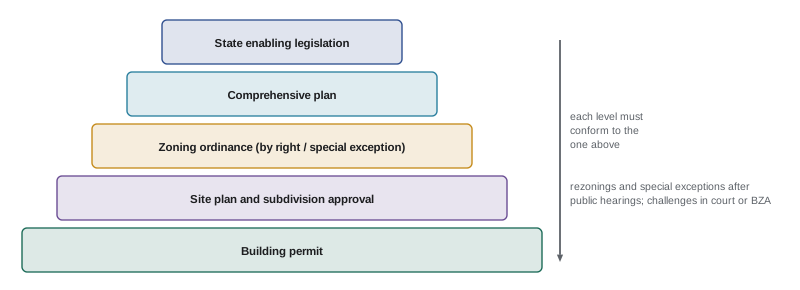
Land use control in the US works through a hierarchy of documents:
- State enabling legislation: state zoning and planning statutes authorize local governments to adopt plans and zoning, and set procedures for notices, hearings and appeals. Some states also have growth management laws or state-level siting rules.
- The comprehensive plan (also called a general plan or master plan): the local government's long-range policy document, with a future land use map designating areas for industry, commerce, housing, agriculture and open space. Rezonings are generally expected to be consistent with it.
- The zoning ordinance: the legally binding rules for each parcel, specifying permitted uses (by right, conditional or by special exception), building height, lot coverage, setbacks, parking, landscaping and other standards.
- Site plan review and subdivision approval: approval of the detailed design of a specific project, covering building placement, access, grading and stormwater, landscaping, lighting and appearance, and the division or consolidation of parcels.
How zoning treats data centers
Many zoning ordinances written before the data center boom do not mention data centers at all, so planners must decide whether a data center falls under an existing defined use, such as "warehouse", "light industrial", "office" or "utility", or requires a new definition. The answer affects which districts permit it and under what process. A use permitted by right needs only site plan and building approvals; a conditional use or special exception requires a public hearing and a discretionary decision, usually with conditions. Increasingly, counties are adding specific data center definitions and standards. Loudoun County, Virginia, the largest data center market in the world, removed by-right approval for new data centers in 2025, requiring a special exception with public hearings and a board vote, and in 2026 considered pausing applications and ending protections for previously filed projects. Where zoning does not allow a data center at all, the developer applies for a rezoning (zoning map amendment), sometimes with proffers or conditions; small deviations from standards can be handled by a variance from the board of zoning appeals.
Typical zoning standards that data centers must meet or negotiate include:
- Height limits, which affect multi-story data centers and rooftop equipment.
- Setbacks and buffers from property lines, roads and especially residential areas, sometimes 50 to 150 m or more for generator yards and mechanical equipment.
- Screening of generators, cooling equipment and substations with walls, berms and landscaping.
- Architectural design requirements, to avoid long blank walls facing roads and neighbors.
- Lighting, signage, parking and landscaping standards.
- Noise limits at property lines, set by the zoning or by a separate noise bylaw or ordinance.
- Lot coverage and impervious area limits, which interact with stormwater management.
Noise
Noise is the most common complaint from neighbors of data centers. The main sources are cooling equipment (chillers, dry coolers and their fans), which run continuously, and generators, which run for tests and outages. Continuous hum at night is particularly disturbing even when it is below typical limits, and tonal components (a distinct pitch from fans or transformers) are more annoying than broadband noise of the same level. Planners commonly require an acoustic study showing predicted levels at the nearest homes, by day and night, with and without generators running.
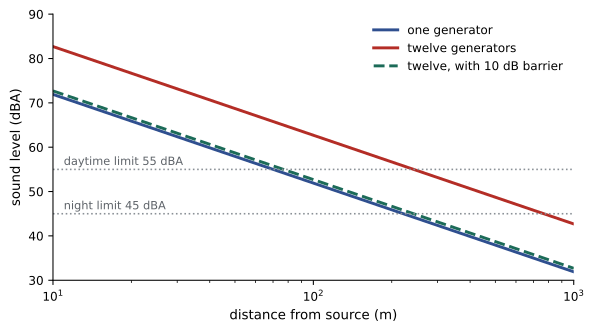
For a point source in a free field, sound pressure level falls by 6 dB for each doubling of distance:
Several sources combine on an energy basis, \(L = 10\log_{10}\sum 10^{L_i/10}\), so ten identical sources are 10 dB louder than one. Barriers, berms and enclosures add attenuation, typically 5 to 15 dB when they block the line of sight.
Worked problem
Generator noise at a property line
A generator enclosure produces 75 dBA at 7 m. The nearest home is 150 m away, and the night-time limit at the property line is 45 dBA. What level reaches the home from one generator? From 12 generators running together in a test? How much additional attenuation is needed?
Show solution
- One generator: \(75 - 20\log_{10}(150/7) = 75 - 26.6 = 48.4\) dBA.
- Twelve generators: \(48.4 + 10\log_{10}12 = 48.4 + 10.8 = 59.2\) dBA.
- Required attenuation: \(59.2 - 45 = 14.2\) dB if tests run at night.
Answer: One generator would already exceed the night limit by 3 dB, and twelve by 14 dB. Typical solutions are scheduling tests in the daytime, when limits are higher, testing one generator at a time, higher-performance enclosures and silencers, a sound wall or berm, and moving the generator yard farther from the homes.
The approval process
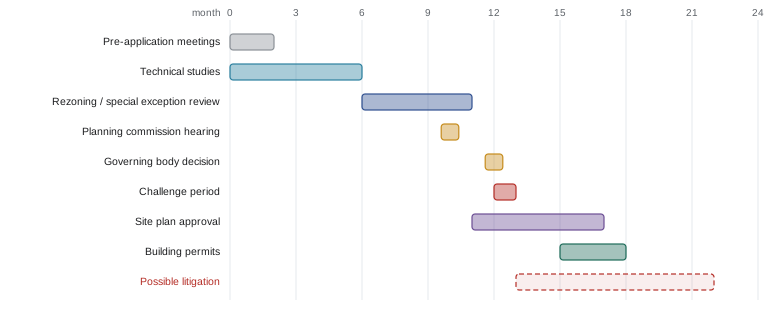
A typical US entitlement sequence for a data center on land that needs rezoning or a special exception is:
- Pre-application meetings with planning staff to identify required studies, the applicable process and likely conditions.
- Application for rezoning, conditional use or special exception, with supporting studies: traffic impact analysis, noise, utilities and stormwater, environmental and cultural resources, and sometimes visual impact, fiscal impact and water supply studies.
- Review by planning staff and other agencies (transportation, utilities, environmental agencies), and revisions in response to comments.
- Public hearings before the planning commission, which makes a recommendation, and before the governing body (county board or city council), which decides.
- A period for legal challenges: decisions can be appealed to a board of zoning appeals or challenged in court, depending on the state and the type of decision.
- Site plan approval for the detailed design, often with performance bonds securing public improvements such as roads and utilities.
Entitlement timelines vary widely: a by-right site may need only a few months of site plan review, while a contested rezoning or special exception commonly takes 9 to 18 months, and longer if challenged in court.
Other land use approvals
- Agricultural land: many states and counties protect farmland through agricultural zoning, conservation easements or preferential tax programs whose benefits must be repaid (rollback taxes) when land is converted.
- Consolidating or dividing parcels: data center campuses often assemble several parcels, requiring consolidation, subdivision or lot line adjustments.
- Road access: new entrances onto highways require approval from the road authority, and traffic studies may require turn lanes or signals, especially during construction.
- Airports: tall buildings, stacks and cranes near airports need clearance from the aviation authority to protect flight paths.
- Transmission lines and substations: new high-voltage lines and substations serving the site may need separate siting approvals from the state public utility commission or siting board, often obtained by the utility.
Working with planners and councils
Successful developers treat the approval process as a design input rather than an obstacle. Early, candid meetings with planning staff reveal the issues that will matter, and studies that address them directly, such as a noise study showing compliance at night with all equipment running, or a traffic plan for construction, make approval easier to grant. Elected officials respond to their constituents, so community engagement before a formal application (Lesson 10) is usually worthwhile. Proposals that offer real design improvements, such as greater setbacks, landscaped berms, architectural treatment, quieter equipment and limits on generator testing hours, often reach approval faster than those that argue for the minimum.
Worked problem
Estimating an approvals critical path
Studies take 5 months. The rezoning application then needs 4 months of review, 1 month to the public meeting, 2 months to the council decision and a 1-month appeal period. Site plan approval takes 6 months but can start 2 months before the council decision. Building permits take 3 months after site plan approval. When can construction start, without appeals? What if an appeal adds 8 months?
Show solution
- Council decision: \(5 + 4 + 1 + 2 = 12\) months; appeal period ends at 13 months.
- Site plan: starts at month 10, ends at month 16. Building permits: months 16 to 19.
- With an appeal adding 8 months after month 13, site plan cannot be finally approved before the zoning is in force (month 21), so site plan ends about month 21 and permits at month 24.
Answer: About 19 months without appeals and about 24 months with one. Early works, such as site clearing or the substation, are sometimes permitted earlier under separate approvals, but investors should treat appeal risk as a real schedule contingency.
Lesson 4 covers the land agreements and due diligence that run alongside zoning, and Lesson 6 develops the noise, visual and traffic studies that councils most often ask for.
Common mistakes
MistakeAssuming a data center is permitted wherever warehouses are.
InsteadCheck the definitions; many jurisdictions now treat data centers as a distinct use with special standards or processes.
MistakeModeling generator noise one unit at a time.
InsteadCombine sources: ten identical units are 10 dB louder; test schedules matter.
MistakeScheduling construction from the council or board decision.
InsteadAllow for appeal periods, site plan approval and building permits after the decision.
MistakeArguing for the minimum standards.
InsteadAddressing neighbors' concerns with design improvements often shortens approval.
MistakeOverlooking farmland protection or aviation clearances.
InsteadIdentify every separate approval in due diligence.
Summary and key terms
- States delegate land use control to local governments; comprehensive plans set long-range policy.
- Zoning ordinances permit uses by right or by special exception/conditional use; rezonings, variances and site plan approval adjust and implement them.
- Many jurisdictions now define data centers as a distinct use with specific standards, and some have restricted approvals.
- Common standards: height, setbacks and buffers, screening, design, lighting, noise and lot coverage.
- Noise falls 6 dB per doubling of distance; n identical sources add 10 log n dB; barriers add 5 to 15 dB.
- Entitlements involve pre-application meetings, studies, staff review, planning commission and governing body hearings, and possible challenges.
- Other approvals: farmland, parcel changes, road access, aviation and transmission siting.
- Treat approvals as a design input and plan for appeal risk in the schedule.
- Official plan / comprehensive plan
- A municipality's long-range land use policy document.
- Zoning
- Legally binding rules on land use and development standards for each parcel.
- Rezoning
- An amendment to the zoning that changes the permitted uses or standards.
- Special exception / conditional use
- A use allowed only after a discretionary review and public hearing.
- By right
- Permitted without discretionary approval if standards are met.
- Variance
- Permission to deviate slightly from a zoning standard.
- Site plan approval
- Approval of the detailed layout and design of a development.
- Entitlements
- The collection of land use approvals needed to build.
- Setback
- Required distance between a building or equipment and a property line.
- Acoustic study
- A study predicting noise levels at sensitive receptors.
- Appeal
- A challenge to a land use decision before a tribunal or court.
- Critical path
- The sequence of dependent activities that determines the earliest completion date.
Practice problems
Work each problem on paper first, then reveal the answer to check.
Why must a project conform to the official plan or comprehensive plan as well as the zoning?
Show answer
The plan sets policy; zoning implements it. A rezoning inconsistent with the plan is likely to be refused or overturned without a plan amendment.
What is the practical difference between a by-right use and a special exception?
Show answer
By right needs only administrative approvals; a special exception requires a public hearing and a discretionary decision with conditions.
A chiller produces 70 dBA at 10 m. What level reaches 320 m away?
Show answer
70 − 20 log(32) = 70 − 30.1 = 39.9 dBA.
Four identical sources each give 42 dBA at a home. What is the combined level?
Show answer
42 + 10 log 4 = 48 dBA.
Name four supporting studies typically required for a data center rezoning.
Show answer
Planning justification, traffic, noise, servicing/stormwater, environmental, archaeology/cultural resources, visual impact.
Why are tonal noises a particular concern?
Show answer
They are more noticeable and annoying than broadband noise of the same level, and some limits apply penalties for tones.
Give three design measures that can ease approval near homes.
Show answer
Larger setbacks, berms and landscaping, sound walls, quieter equipment, daytime-only generator testing, architectural treatment.
In the critical path example, what is the effect of starting site plan review only after the council decision?
Show answer
Site plan ends at month 18 instead of 16, and permits at month 21, delaying construction by 2 months.
Why might farmland be unavailable even if a municipality supports a project?
Show answer
Provincial or state farmland protection may require separate approvals that are rarely granted for industrial uses.
Which approvals might the utility, rather than the developer, obtain?
Show answer
Siting and construction approvals for new transmission lines and substations.
Lesson quiz · 5 questions
Score 60% or more to complete this lesson.
Create a free account to save your progress, take quizzes and earn a certificate.