
DCE-410 · Lesson 5 of 12 · 29 min
Environmental review: NEPA, state rules and air permits
A data center is not a chemical plant, but it is a large industrial facility with real environmental effects: diesel generators emit air pollutants, cooling systems may draw large volumes of water and discharge warm blowdown, construction disturbs tens or hundreds of acres and changes stormwater runoff, and the site may contain wetlands, endangered species habitat, historic resources or contamination from past uses. In the US, environmental regulation is shared between federal agencies, chiefly the Environmental Protection Agency, and the states, which administer most federal permit programs. This lesson explains when NEPA and state environmental review laws apply, the Clean Air Act permits for generators, water and stormwater permits, the protections for wetlands, species and historic resources, tribal consultation, and how to manage the process.
When does an environmental assessment apply?
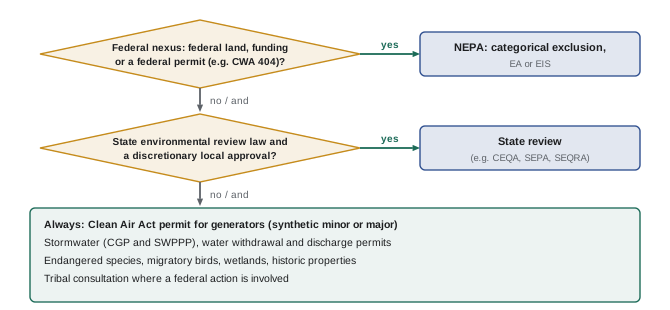
Environmental review is a planning process that predicts a project's effects, considers alternatives and mitigation, involves the public, and informs the decisions of the agencies that must approve it. It is triggered differently at each level:
- Federal: the National Environmental Policy Act (NEPA) applies only to "major federal actions": projects on federal land, receiving significant federal funding, or needing federal permits, such as a Clean Water Act Section 404 permit to fill wetlands. A purely private data center on private land with no federal permits usually has no NEPA review. Where NEPA applies, the agency may use a categorical exclusion, prepare an environmental assessment (EA) leading to a finding of no significant impact, or prepare a full environmental impact statement (EIS). Executive Order 14318 (2025) directed agencies to use categorical exclusions and expedited procedures for qualifying data center projects over 100 MW or $500 million.
- State: about 15 states and several cities have their own environmental review laws ("little NEPAs"), some broader than NEPA. California's Environmental Quality Act (CEQA), Washington's State Environmental Policy Act (SEPA) and New York's State Environmental Quality Review Act (SEQRA) apply to discretionary local approvals, such as a rezoning or special permit, so a data center in those states may need an environmental impact report even with no federal involvement.
- Local: many counties require environmental studies, such as wetland delineations, tree surveys and water supply analyses, as part of rezoning or site plan review even where no formal environmental review law applies.
Air permits for generators
A large campus may have 50 to 200 diesel generators totaling hundreds of megawatts. Even though they run only for testing and outages, regulators assess their potential emissions, and air permits are often the most demanding environmental approval for a data center.
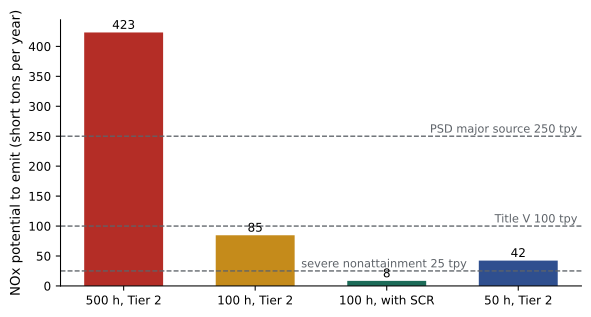
In the US, the Clean Air Act requires new stationary sources to obtain preconstruction permits, usually from the state air agency. The key concept is potential to emit (PTE): the maximum emissions the facility could produce under its physical and legally enforceable limits. EPA guidance allows emergency generators to be assessed at 500 hours per year rather than continuous operation, and a permit limit on hours (for example, 100 hours a year for testing and maintenance) can reduce PTE further. If PTE exceeds major source thresholds, the project needs a Prevention of Significant Deterioration (PSD) permit in areas meeting air quality standards (250 tons per year for most source categories, or 100 for listed categories) or a Nonattainment New Source Review permit in areas that do not (with thresholds as low as 10 to 50 tons per year for ozone precursors in serious to extreme ozone areas), plus a Title V operating permit at 100 tons per year. Major source permits require best available control technology or lowest achievable emission rate, offsets in nonattainment areas, modeling and public hearings. Most data centers accept enforceable limits to stay below these thresholds as "synthetic minor" sources.
Worked problem
Potential emissions from a generator plant
A campus has 40 generators of 3 MW, each emitting 6.4 g/kWh of NOx (typical of an emergency-rated Tier 2 engine). Estimate the potential to emit at 500 hours of full-load operation per generator, and with an enforceable limit of 100 hours. Compare with the 250 ton per year PSD threshold and the 100 ton per year Title V threshold.
Show solution
- Energy at 500 hours: \(40 \times 3000\ \mathrm{kW} \times 500\ \mathrm{h} = 60{,}000{,}000\) kWh.
- NOx: \(60 \times 10^6 \times 6.4\ \mathrm{g} = 384\) metric tons = 423 short tons per year.
- At 100 hours: \(423/5 = 85\) short tons per year.
Answer: The 500-hour PTE of 423 short tons per year would make the campus a PSD major source. With a 100-hour enforceable limit it falls to 85 tons, below both the PSD and Title V thresholds, so it can be permitted as a synthetic minor source, unless it is in a serious or worse ozone nonattainment area, where much lower thresholds would require further limits or controls such as selective catalytic reduction.
Air permits also address particulate matter, carbon monoxide and sometimes hazardous air pollutants, stack heights (taller stacks improve dispersion), and conditions such as limiting how many generators may be tested at once. Some jurisdictions restrict or prohibit routine generator operation on high-pollution days, and generators that are run for non-emergency purposes, such as demand response or peak shaving, usually face much stricter standards than emergency engines.
Water
- Water withdrawal: water rights and withdrawal permits are governed by state law. Eastern states generally follow riparian doctrine with permits or registration for large withdrawals; western states follow prior appropriation, where new rights may be unavailable and water must be purchased or leased. Many states require registration or permits for withdrawals above about 100,000 gallons per day, and regional compacts govern the Great Lakes basin.
- Discharge: cooling tower blowdown discharged to a municipal sewer must meet the local pretreatment and sewer use limits; discharge to surface waters requires a National Pollutant Discharge Elimination System (NPDES) permit, usually issued by the state.
- Stormwater: replacing fields with roofs and paving increases runoff. Construction disturbing one acre or more requires coverage under the EPA or state Construction General Permit and a stormwater pollution prevention plan (SWPPP) for erosion and sediment control; post-construction, local and state rules require stormwater management to control peak flows, volume and quality, usually with ponds, infiltration and green infrastructure.
Worked problem
Water taking for evaporative cooling
A campus averages 20 MW of IT load and uses evaporative cooling with a water use of 1.8 L per kWh of IT energy. What is the daily water use in gallons? Does it exceed a typical 100,000 gallon per day state registration threshold if drawn from wells?
Show solution
- IT energy per day: \(20{,}000\ \mathrm{kW} \times 24\ \mathrm{h} = 480{,}000\) kWh.
- Water: \(480{,}000 \times 1.8 = 864{,}000\) L/day.
- In gallons: \(864{,}000/3.785 = 228{,}000\) gal/day, more than twice the threshold.
Answer: About 228,000 gallons per day, so a withdrawal permit or registration would be required, with hydrogeological studies showing no unacceptable effects on other users. On hot days the peak use could be two to three times the average, and the permit must cover the peak.
Worked problem
Stormwater peak flow
A 20 ha (49 acre) field with a runoff coefficient of 0.3 is developed into a data center campus with a coefficient of 0.85. For a design rainfall intensity of 100 mm/h, use the rational method \(Q = CiA/360\) (Q in m³/s, i in mm/h, A in ha) to find the increase in peak runoff.
Show solution
- Before: \(Q = 0.3 \times 100 \times 20/360 = 1.67\) m³/s.
- After: \(Q = 0.85 \times 100 \times 20/360 = 4.72\) m³/s.
Answer: Peak flow nearly triples, rising by about 3.1 m³/s. Stormwater ponds and other measures must hold the post-development peak to the pre-development rate, which typically requires several percent of the site area for storage, a significant land use that must be planned from the start.
Natural and cultural heritage
- Endangered species: the Endangered Species Act prohibits "take" of listed species. Where a federal action is involved, the agency consults the Fish and Wildlife Service under Section 7; otherwise, a private project that might take listed species needs an incidental take permit with a habitat conservation plan under Section 10. Seasonal surveys are needed.
- Migratory birds and wetlands: the Migratory Bird Treaty Act protects birds and active nests, so clearing is scheduled outside the nesting season. Filling wetlands or other waters of the United States requires a Section 404 permit from the Army Corps of Engineers, which is a federal action that brings in NEPA, Section 7 and Section 106.
- Historic properties: Section 106 of the National Historic Preservation Act requires federal agencies to consider effects on historic properties, including archaeological sites and historic landscapes, in consultation with the State Historic Preservation Officer and tribes. Some states have their own historic and archaeological protections for private projects.
- Contamination: a Phase I environmental site assessment to ASTM E1527-21, followed if needed by a Phase II investigation, identifies contamination and protects the buyer under CERCLA's "all appropriate inquiries" rule; brownfield programs can provide liability protection and funding for cleanup.
- Visual and community effects, such as light, noise and traffic, may also be addressed in state environmental review documents.
Indigenous consultation
Where a federal action is involved, federal agencies must consult federally recognized tribes on a government-to-government basis, including under Section 106 for sites of religious and cultural significance, which may lie outside current reservations. Some states have their own tribal consultation requirements. Beyond legal requirements, early and respectful engagement with tribes whose ancestral lands include the site is good practice and can identify concerns, such as burial sites or water resources, before they become conflicts.
Managing the environmental process
Environmental approvals are often on the critical path because several require field work in particular seasons: breeding bird and species surveys in spring and summer, wetland delineation in the growing season, and archaeological field work when the ground is not frozen. A missed survey window can delay a project by a year. Good practice is to:
- Start a desktop review and a constraints map during due diligence, before buying the land.
- Schedule seasonal field surveys early, in parallel with zoning.
- Design to avoid sensitive features where possible, which is cheaper and faster than mitigation or compensation.
- Decide the generator strategy (number, size, emission controls, test hours) early, because it drives the air permit and often the noise study.
- Choose a cooling design that fits local water availability (DCE-330, DCE-460).
- Keep an environmental commitments register, so that conditions in permits are carried into design, construction and operations.
Lesson 7 turns to the engineering of water, wastewater and stormwater servicing, and Lesson 9 to the approvals for substations, transmission lines, fuel storage and on-site generation.
Common mistakes
MistakeAssuming that no NEPA review means no environmental approvals.
InsteadAir, water, stormwater, species and heritage approvals are usually still required.
MistakeCalculating generator emissions from expected test hours only.
InsteadRegulators use potential emissions with enforceable limits; plan limits and controls deliberately.
MistakeMissing seasonal survey windows.
InsteadSchedule field surveys early; a missed season can delay a project by a year.
MistakeIgnoring peak water demand.
InsteadPermits and supply contracts must cover hot-day peaks, not just averages.
MistakeLeaving Indigenous or tribal engagement until permits are filed.
InsteadEngage early; consultation and partnerships take time and shape the project.
Summary and key terms
- NEPA applies only with a federal nexus; state laws such as CEQA and SEPA can require review of local discretionary approvals.
- EO 14318 (2025) aims to speed federal reviews of large data center projects.
- Generator PTE (500 h guidance, enforceable limits) decides between synthetic minor and PSD/NNSR major permits; Title V at 100 tpy.
- Water withdrawals follow state law; discharges need pretreatment compliance or NPDES permits; construction over one acre needs a SWPPP.
- Development greatly increases stormwater peaks, requiring storage and treatment.
- Endangered species, migratory birds, wetlands (Section 404), historic properties (Section 106) and contamination must be assessed.
- Federal actions require tribal consultation; early engagement is good practice regardless.
- Seasonal surveys, generator strategy and cooling design drive environmental schedules.
- Environmental assessment
- A process that predicts and evaluates a project's environmental effects before approval.
- NEPA
- The US National Environmental Policy Act, applying to major federal actions.
- Categorical exclusion
- A class of actions found not to need an EA or EIS under NEPA.
- Potential to emit
- Maximum emissions a source could produce under physical and enforceable limits.
- Synthetic minor
- A source that stays below major thresholds by accepting enforceable limits.
- PSD
- Prevention of Significant Deterioration, the major source permit program in attainment areas.
- Rational method
- A simple estimate of peak runoff: Q = CiA.
- Section 106
- The US requirement for federal agencies to consider effects on historic properties.
- Phase I environmental site assessment
- A records-based investigation of potential contamination.
- Environmental commitments register
- A list tracking all permit conditions and commitments through the project.
Practice problems
Work each problem on paper first, then reveal the answer to check.
Does a private data center on private land with no federal permits normally need NEPA review?
Show answer
No; NEPA requires a federal nexus such as federal land, funding or permits.
Why are generators assessed on potential rather than expected emissions?
Show answer
Regulators must ensure air quality is protected under the worst case the facility could legally operate; enforceable limits define that case.
Twenty 2.5 MW generators emit 6.4 g/kWh NOx. What are annual emissions at 100 hours each?
Show answer
20 × 2500 × 100 × 6.4 g = 32 t (35 short tons).
Why is NO₂ modeling often decisive for generator approvals?
Show answer
Many generators running together during an outage or test can produce high short-term NO₂ concentrations near the property line.
A 10 MW IT site uses 1.5 L/kWh of IT energy for cooling. What is the daily water use?
Show answer
10,000 × 24 × 1.5 = 360,000 L/day (about 95,000 gal/day).
With C rising from 0.35 to 0.9 on 12 ha at 80 mm/h, what is the increase in peak flow?
Show answer
(0.9 − 0.35) × 80 × 12/360 = 1.47 m³/s.
Why should tree clearing be scheduled outside the nesting season?
Show answer
Destroying active nests of migratory birds is prohibited.
What is the purpose of a Phase I environmental site assessment?
Show answer
To identify potential contamination from past uses before purchase, protecting the buyer and guiding further investigation.
When is tribal consultation legally required for a data center?
Show answer
When a federal action (funding, land, permit) is involved, and under some state laws; it is good practice in any case.
Give two design decisions that strongly affect environmental approvals.
Show answer
Generator number, size, controls and test hours; cooling technology and water use; site layout avoiding sensitive features.
Lesson quiz · 5 questions
Score 60% or more to complete this lesson.
Create a free account to save your progress, take quizzes and earn a certificate.