
CSCO-190 · Lesson 12 of 12 · 22 min
After the exam: next steps toward the CCNA
▶ Video coming soon A video version of this lesson is on the way.
Jordan's plan for the moment the exam ends is already written in his study log: read the score report slowly, whatever it says; photograph it or save it; text Marisol one word; and go for a walk before deciding anything. Marisol has seen technicians make poor decisions in the hour after an exam, either booking the next exam in a rush of relief or giving up in a wave of disappointment. "The result is information," she tells him. "Use it tomorrow, when you can think." This lesson covers what to do with the result in either case: how to record and share a pass, how to turn a fail into a focused retake, how to keep a CCST current, and how to plan the step from CCST to the associate level, where the CCNA sits.
Reading the score report
Cisco's frequently asked questions say that you see a score report showing pass or fail immediately after a CCST exam, and Cisco's exam policy says that written exam candidates receive their performance broken down by exam section. Cisco does not publish passing scores, so the report tells you the result and how you did in each area relative to the exam, rather than a simple mark out of a published total. Keep a copy. If you passed, it is a record of your strengths; if you did not, it is the most important study document you will have, because it shows exactly where to focus.
Cisco's policy also says that candidates and their employers must verify official results online, and that scores can be revised after testing if there is evidence of misconduct or a scoring error. In practice, your result appears in your Cisco certification profile within a short time, and the profile, not the printed report, is the official record. Check that it shows the correct exam and date.
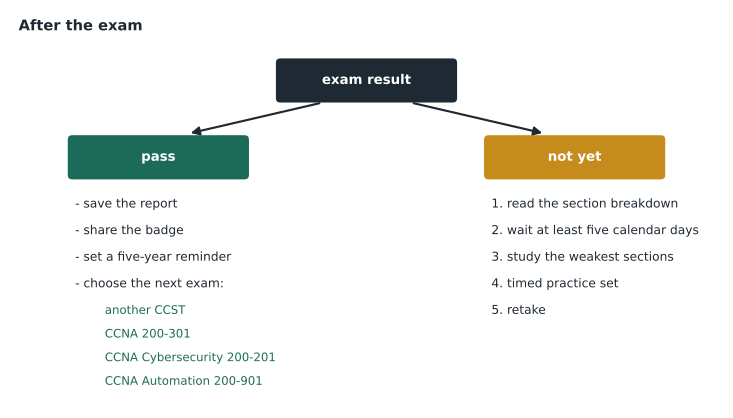
If you passed
A pass earns the certification. Cisco issues a digital badge through Credly that you can add to a professional networking profile, an email signature or an online résumé, and that anyone can click to verify. Add the certification to your résumé with its full name and the month and year you earned it: Cisco Certified Support Technician (CCST) IT Support, January 2027, for example. If your employer paid for the exam, tell them and send a copy of the badge link; Brightline adds every new certification to its client proposals, because clients like to see that technicians are certified.
Then note the expiry. Under Cisco's current policy, a CCST earned on or after July 15, 2025 is valid for five years from the pass date. Put a reminder in your calendar six months before that date. You renew by passing any current CCST exam or any associate, professional or expert Cisco certification exam before it expires; continuing education credits do not count for the CCST. For most people, the renewal happens naturally, because they pass another Cisco exam long before the five years are up.
Before moving on, spend half an hour with your study log. Note which methods worked and which did not, which sections of the score report were strongest and weakest, how your timing went and what you would do differently. That reflection is the start of your plan for the next exam, and it is easy to forget once the relief wears off. Jordan's log already has a page headed Next time, with three lines on it from his practice sets: start timed sets a week earlier, read every NOT item twice, and keep the subnetting table going even when the exam is not about networking.
| Task | When | Why |
|---|---|---|
| Save the score report | Immediately | It records your strengths and is the guide for any retake |
| Check the Cisco certification profile | Within a few days | The profile is the official record |
| Accept and share the digital badge | When the email arrives | Employers can verify it in one click |
| Update your résumé and professional profile | Within a week | Show the full certification name and date |
| Set an expiry reminder | Now | CCSTs earned since July 15, 2025 last five years |
If you did not pass
Not passing a first attempt is common and recoverable. Cisco's CCST frequently asked questions say that candidates have unlimited attempts, and Cisco's exam policy sets a wait of five calendar days, beginning the day after the failed attempt, before an entry-level written exam can be retaken, as lesson 2 explained. The wait is short, but do not book the retake for the first possible day unless the gap was small and you know exactly what went wrong. For most people, two to four weeks of focused study on the weakest sections is a better plan.
Use the section breakdown to build that plan. Rank the sections from weakest to strongest, and spend most of your time on the weakest two or three, using the same methods as lesson 6: retrieval practice, a fresh mistakes log and labs. Think honestly about whether timing or reading was part of the problem, and review lessons 5 and 11 if so. Take at least one full timed practice set before the retake. Do not try to remember the questions you saw: the confidentiality agreement forbids sharing them, the retake will almost certainly use different items, and studying the topics is what works.
Worked problem
Building a retake plan from a score report
Suppose a candidate's CCST Networking report shows strong results in standards and concepts, endpoints and media, and security; middling in infrastructure; and weak in addressing and subnet formats and in diagnosing problems. The exam was on a Tuesday. What should the retake plan look like?
Show solution
- The earliest retake under the five-calendar-day rule would be the following Monday: the wait covers Wednesday to Sunday.
- That is too soon for two weak areas. Plan three weeks instead and book the retake for a date at the end of them.
- Weeks 1 and 2: daily subnetting practice by hand, checked with a script, and simulator labs that break and fix addressing; diagnosis drills working up the layers.
- Week 3: mixed practice with extra infrastructure items, two timed sets and review of the new mistakes log.
- Keep the strong areas warm with a few mixed items each week, but do not spend much time there.
Answer: Book about three weeks out, focus on addressing and diagnosis, keep strong areas warm, and rehearse under time pressure before the retake.
The step to the associate level
For many CCST holders, the CCNA is the next goal. Cisco's exam page lists the CCNA exam, 200-301, as a 120-minute exam costing 300 US dollars. It covers network fundamentals, network access, IP connectivity, IP services, security fundamentals, and automation and programmability, going much deeper than CCST Networking into switching, routing, wireless and services. Third-party training providers report that Cisco has published a new version of the CCNA exam topics, keeping the number 200-301, with the change taking effect in early February 2027; check Cisco's exam page for the current version before you choose study materials, because a book or course written for an older version may cover topics that have been removed or miss ones that were added.
Two other associate certifications are natural next steps from the CCST. CCNA Cybersecurity, exam 200-201, renamed in 2026 from CyberOps Associate, focuses on security monitoring and analysis in a security operations center, and follows naturally from CCST Cybersecurity. CCNA Automation, exam 200-901, renamed in 2026 from DevNet Associate, focuses on software development, APIs and automation for network engineers, and suits people who enjoy scripting. Associate certifications are valid for three years and can be renewed by passing exams or, unlike the CCST, through Cisco's continuing education program.
How big a step is the CCNA?
The CCNA is a substantial step up. It is more than twice as long as a CCST exam, costs more than twice as much, and expects hands-on configuration skills on Cisco devices, including the command line. Candidates who pass CCST Networking usually need several more months of study and much more lab time before they are ready. That is not a reason to wait; it is a reason to plan. A realistic CCNA plan for a working technician is four to eight months of regular study, built on the same habits as this course: a diagnostic, spaced practice, a mistakes log, labs and timed rehearsals.
Cisco Networking Academy offers CCNA courses through schools and colleges, and Cisco and other publishers offer self-study books, video courses and labs. Packet Tracer remains useful, and many CCNA candidates add Cisco Modeling Labs or secondhand equipment for practice with real device software. Lesson 7's rules for a home lab apply just as strongly at the associate level.
Jordan's and Lila's next steps
Jordan's plan, which he and Marisol have agreed and written down, depends on his January result. If he passes, he will start CCST Networking preparation with Dev in February, aiming for an exam in late spring 2027, and CCST Cybersecurity with Keisha in the summer. Brightline will then support him in a CCNA plan starting in the autumn, with the aim of sitting the exam in 2028. If he does not pass in January, he will use the score report to plan a retake within a month and shift the rest of the plan back. Either way, the plan stays the same shape: one exam at a time, each building on the last.
Lila's plan is different. If she passes CCST Networking in April 2027, she will add the badge to her university applications and to her résumé for summer jobs, where it may help her find work at a help desk or a computer repair shop. Her teacher has suggested that she consider CCST Cybersecurity in the autumn if her university program allows, and the CCNA during her second year. For a student, a CCST is an early, concrete signal of interest and ability that stands out on an application.
Certifications and careers
Certifications open doors, but they do not walk through them for you. Employers hiring for support, network or security roles look for evidence of skill, which certifications provide, and for evidence of reliability, communication and learning, which come from experience and references. Keep a record of what you have done: tickets you resolved, labs you built, projects you contributed to. Talk about them in interviews using the structured approach this program teaches: the problem, what you checked, what you found, what you did and how you confirmed it worked. That story, backed by a certification, is what convinces a hiring manager.
Keep learning between exams too. Technology changes, exam topics change, and the best technicians are curious. Read vendor advisories, follow a few reputable industry sources, join a local user group or an online community, and keep your lab running. The habits that got you through this course are the habits that will carry you through the next one.
Common mistakes
MistakeBooking the next exam in the first hour after passing.
InsteadWait a day, then plan the next step calmly.
MistakeBooking a retake for the first possible day after a large gap.
InsteadPlan two to four weeks of focused study on the weakest sections.
MistakeTrying to remember and share the questions you saw.
InsteadThe confidentiality agreement forbids it, and the retake will use different items.
MistakeForgetting the CCST's expiry date.
InsteadSet a reminder; certifications earned since July 15, 2025 last five years.
MistakeUsing CCNA materials written for an older exam version.
InsteadCheck Cisco's exam page for the current version first.
Summary and key terms
- The score report shows pass or fail and performance by section; the Cisco certification profile is the official record.
- After a pass: save the report, share the verifiable badge, update your résumé and set an expiry reminder.
- CCSTs earned on or after July 15, 2025 last five years and renew by passing a qualifying Cisco exam.
- After a fail: wait at least five calendar days, study the weakest sections, rehearse and retake; attempts are unlimited.
- The CCNA, 200-301, is a 120-minute exam listed at 300 US dollars, and a substantial step up from the CCST.
- CCNA Cybersecurity (200-201) and CCNA Automation (200-901) are other associate-level next steps.
- Certifications plus documented experience and good communication make a strong career case.
- Score report
- The result shown after the exam, with a breakdown by section.
- Digital badge
- A verifiable online credential issued for a certification.
- Retake plan
- A focused study plan based on the score report before a second attempt.
- Associate level
- The level of Cisco certification above the CCST, including the CCNA.
- CCNA Cybersecurity
- The associate certification for security operations, exam 200-201.
- CCNA Automation
- The associate certification for network automation, exam 200-901.
Practice problems
Work each problem on paper first, then reveal the answer to check.
What is the official record of your Cisco exam result?
Show answer
Your Cisco certification profile, which Cisco says candidates and employers should use to verify results.
How should you list a CCST on a résumé?
Show answer
With its full name and the month and year earned, for example Cisco Certified Support Technician (CCST) IT Support, January 2027.
A CCST was earned on April 15, 2027. Roughly when should the renewal reminder go off?
Show answer
Around October 2031, six months before the five-year expiry in April 2032.
Why not retake on the first possible day after a poor result?
Show answer
A short gap rarely leaves enough time to fix weak areas; two to four weeks of focused study is usually better.
How long is the CCNA exam, and what does Cisco list as its price?
Show answer
120 minutes and 300 US dollars.
Which associate certification follows most naturally from CCST Cybersecurity?
Show answer
CCNA Cybersecurity, exam 200-201.
What story structure helps in interviews?
Show answer
The problem, what you checked, what you found, what you did and how you confirmed it worked.
Lesson quiz · 5 questions
Score 60% or more to complete this lesson.
Create a free account to save your progress, take quizzes and earn a certificate.