
CSCO-190 · Lesson 1 of 12 · 22 min
How Cisco certifications fit together
▶ Video coming soon A video version of this lesson is on the way.
On a gray Thursday in the second week of November 2026, Marisol Tran books the small meeting room at Brightline IT Services in Omaha for an hour and writes three exam numbers on the whiteboard: 100-140, 100-150 and 100-160. Jordan Pelletier, ten weeks into his first support job, has finished the two IT Support courses and wants to know what comes next. Dev Anand, the network technician, has come in with a coffee because he is going to coach Jordan on networking in the spring, and Keisha Moreau, the security analyst, has joined because cybersecurity follows after that. "Before we talk about studying," Marisol says, "you need a map. If you know where each exam sits and what it leads to, you will study the right things and stop worrying about the wrong ones." This course is that map, plus the practical preparation that turns knowledge into a pass on test day.
CSCO-190 is the readiness course shared by all three Cisco Certified Support Technician programs on this site. If you are preparing for CCST IT Support, you will have taken CSCO-101 and CSCO-102. For CCST Networking, CSCO-111 and CSCO-112. For CCST Cybersecurity, CSCO-121 and CSCO-122. The lessons here cover how the exams are booked and delivered, what happens on the day, the kinds of questions you will see, how to manage fifty minutes, how to plan and practice, and then a review of each track's objectives with original practice items. The last lesson looks beyond the exam to the associate level, where the CCNA sits.
The levels of Cisco certification
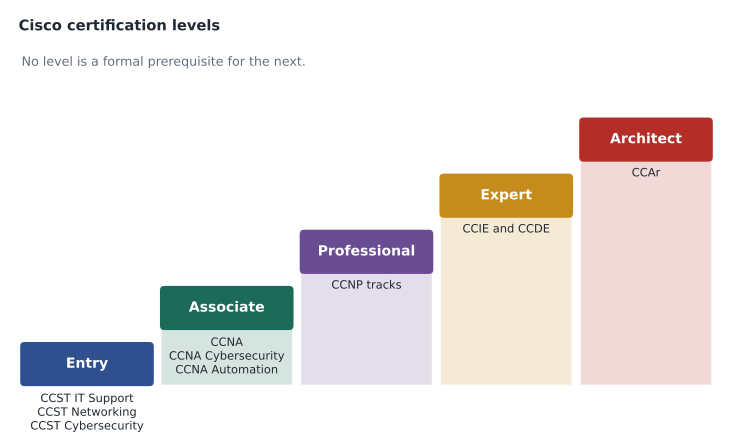
Cisco arranges its certifications in levels. Each level assumes more experience and asks more of the candidate. At the bottom is the entry level, where the CCST certifications sit. Above it is the associate level, home of the CCNA and its siblings. Then comes the professional level, with the CCNP certifications in areas such as enterprise networking, security, data center and collaboration. The expert level holds the CCIE and CCDE, which require a demanding written exam and a hands-on lab or practical exam. Above all of these, Cisco has an architect credential for a very small number of senior designers. Most people reading this course will spend the next few years at the bottom two levels, and that is exactly where most technicians start.
The levels are not a strict ladder. Cisco's own frequently asked questions state that the CCST certifications are not prerequisites for associate-level certifications, and that the CCNA has no formal prerequisites at all: no degree and no earlier certification. You could, in principle, sit the CCNA without ever taking a CCST exam. Many people take the CCST first anyway, because it is shorter, cheaper and narrower, and passing it confirms that their study habits work. Cisco describes the CCST certifications as providing a solid foundation for associate-level study, which is a fair description of how they are used in practice.
The three CCST certifications
The CCST family covers three subjects, each earned by passing one exam. CCST IT Support, exam 100-140, covers the work of a first-line support technician: hardware, operating systems, connecting users to resources, common security threats, support tools and the job itself, from managing a queue to talking with frustrated users. CCST Networking, exam 100-150, covers networking standards and concepts, addressing and subnets, endpoints and media, network infrastructure, diagnosing problems and basic security. CCST Cybersecurity, exam 100-160, covers security principles, network and endpoint security concepts, vulnerability assessment and risk management, and incident handling.
Cisco's exam pages, checked for this course in November 2026, list each of the three exams at 50 minutes and 125 US dollars, offered in several languages including English, French, Spanish, Arabic, Chinese, Japanese and Portuguese. Cisco does not publish a question count or a passing score on those pages, and its general exam policy states that passing scores are set by statistical analysis, are subject to change and are not published. Study guides and training companies commonly report that the exams have roughly 40 to 50 questions, but treat that as an estimate, not a rule. Lesson 5 shows how to plan your time without knowing the exact count.
| Certification | Exam | Main subjects | Courses on this site |
|---|---|---|---|
| CCST IT Support | 100-140 | Hardware, operating systems, connectivity and resource access, threats and preventions, job tasks and tools | CSCO-101, CSCO-102, CSCO-190 |
| CCST Networking | 100-150 | Standards and concepts, addressing and subnets, endpoints and media, infrastructure, diagnosing problems, security | CSCO-111, CSCO-112, CSCO-190 |
| CCST Cybersecurity | 100-160 | Security principles, network and endpoint security, vulnerability and risk, incident handling | CSCO-121, CSCO-122, CSCO-190 |
How long a CCST certification lasts
For many years Cisco described the CCST certifications as lifetime credentials. That changed in 2025. Cisco's current policy page says that CCST certifications earned on or after July 15, 2025 are valid for five years from the date you pass, while those earned before that date do not expire. Cisco's frequently asked questions explain that the change followed a requirement in a US state law. To renew a CCST earned under the five-year rule, you pass any current CCST exam or any associate, professional or expert Cisco certification exam before the five years run out. Cisco also says that CCST certifications do not use its continuing education credit program, so courses and conferences do not count toward renewing them.
Some older pages on Cisco's site still describe the CCST as a lifetime credential, which is a good example of why you should read the policy page itself rather than a summary. Jordan, Lila and anyone else passing in 2026 or 2027 should note their pass date and put a reminder in their calendar for four and a half years later. In practice, most technicians move on to an associate exam well before then, and passing that exam renews their CCST along the way.
Where the associate level begins
The associate level is where most technicians aim next. The best known associate certification is the CCNA, earned by passing exam 200-301, which Cisco's exam page lists as a 120-minute exam costing 300 US dollars. The CCNA covers network fundamentals, network access, IP connectivity, IP services, security fundamentals, and automation and programmability. Alongside it sit two other associate certifications that Cisco renamed in 2026: the security operations certification formerly called CyberOps Associate is now CCNA Cybersecurity, still earned with exam 200-201, and the automation certification formerly called DevNet Associate is now CCNA Automation, exam 200-901. Lesson 12 looks at these in more detail and at reports that a new version of the CCNA exam is due early in 2027.
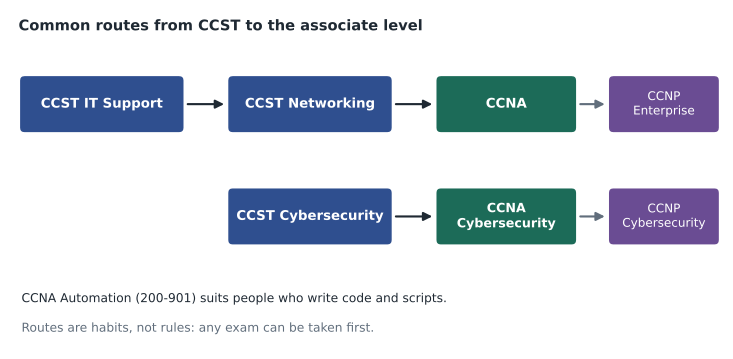
Each CCST lines up naturally with one or more associate certifications. CCST Networking is the gentlest introduction to the CCNA, which goes much deeper into the same subjects: switching, routing, addressing and services. CCST Cybersecurity is the natural stepping stone to CCNA Cybersecurity, which is about monitoring, analyzing and responding to security events in a security operations center. CCST IT Support stands slightly apart: it is about the support role itself, and many people who pass it go on to CCST Networking before tackling the CCNA. That is the route Marisol sketches for Jordan.
Other entry-level credentials you will hear about
Cisco is not the only organization offering entry-level IT certifications, and employers often mention several in the same job posting. CompTIA's A+, Network+ and Security+ are widely recognized and cover similar ground to the three CCST exams, usually in more depth and with longer, more expensive exams. Some cloud and software vendors offer their own fundamentals certifications. None of these is a substitute for the others, and none is better in every way. The CCST exams are shorter and cheaper, are closely tied to Cisco's free and low-cost Networking Academy courses, and lead directly into Cisco's associate track. If a job posting asks for A+ and you hold CCST IT Support, say so in your application and explain what it covered; many hiring managers will treat the two as comparable for a first job.
Certifications also sit alongside formal education. A college diploma in IT, like Jordan's, gives breadth and a supervised introduction to many subjects. A certification proves a specific, current skill set measured against a published list of objectives. Employers usually value both, and experience most of all. That is why this course keeps tying each exam topic back to real tickets at Brightline: the goal is not just a badge but the ability to do the work the badge describes.
Meet the candidates
Two candidates appear throughout this course. Jordan Pelletier is 22, a recent college graduate who joined Brightline in September 2026. He has booked CCST IT Support for January 2027 and plans CCST Networking in the spring and CCST Cybersecurity after that, with Dev and Keisha as coaches. Lila Haddad is 17 and in her final year of high school. She is taking a Cisco Networking Academy course in the computer lab at Northfield Community Center, where Brightline supports the public computers, and her teacher has arranged for the class to sit CCST Networking at their school in the spring. Between them, they show the two most common ways people reach a CCST exam: through work and through school.
The two have different advantages. Jordan has real tickets every day, which give him experience that no textbook can match, but he has limited time to study around a full-time job. Lila has a teacher, a structured course and classmates to study with, but no workplace experience to draw on, so she will rely more on labs and simulators. Lessons 6 and 7 build a study plan and a practice lab for each of them, and you can borrow whichever parts suit your own situation.
Worked problem
Choosing a first CCST exam
Three people ask Marisol which CCST exam to take first. (a) Priya runs the front desk at a clinic and is often the person who fixes printers and resets passwords; she wants a first IT job. (b) Tomás is a construction electrician who has started installing network cabling and wants to understand what happens on the other end of the cable. (c) Aaliyah is a bookkeeper who has been asked to handle her firm's security awareness training and wants to understand threats. Which exam suits each, and what might come next?
Show solution
- (a) Priya's experience is first-line support. CCST IT Support matches it closely; CCST Networking would be a natural second step.
- (b) Tomás needs to understand addressing, devices and how traffic moves. CCST Networking fits, and the CCNA is the logical next goal if he moves into network work.
- (c) Aaliyah's interest is threats, policies and protections. CCST Cybersecurity fits her best; CCNA Cybersecurity would follow only if she moves into a security operations role.
- In each case the choice follows the job the person does or wants, not the order of exam numbers.
Answer: IT Support for Priya, Networking for Tomás, Cybersecurity for Aaliyah. Match the first exam to the work, then build toward the associate level.
Marisol finishes the meeting by circling 100-140 on the whiteboard and writing a date beside it. "January," she says. "The rest of this course is about getting you from here to there without surprises." Jordan takes a photo of the whiteboard. It becomes the first page of his study log.
Common mistakes
MistakeAssuming the CCST is a required step before the CCNA.
InsteadCisco says the CCST is not a prerequisite; it is a useful foundation.
MistakeTreating third-party question counts or passing scores as official.
InsteadCisco does not publish them; plan for uncertainty and check the exam page.
MistakeBelieving every CCST is a lifetime credential.
InsteadThose earned on or after July 15, 2025 are valid for five years.
MistakePlanning to renew a CCST with continuing education credits.
InsteadCCST renewal is by passing a qualifying exam, not by credits.
MistakePicking an exam by its number.
InsteadPick the exam that matches the work you do or want to do.
Summary and key terms
- Cisco certifications run from entry (CCST) through associate (CCNA), professional (CCNP), expert (CCIE, CCDE) and architect levels.
- The three CCST exams are IT Support 100-140, Networking 100-150 and Cybersecurity 100-160.
- Cisco lists each CCST exam at 50 minutes and 125 US dollars; it does not publish question counts or passing scores.
- No Cisco level is a formal prerequisite for the next; the CCNA has no prerequisites.
- CCST certifications earned on or after July 15, 2025 are valid for five years and renew by passing a qualifying exam.
- Common routes: IT Support to Networking to CCNA; Cybersecurity to CCNA Cybersecurity.
- Choose a first exam by the work you do or want to do.
- CCST
- Cisco Certified Support Technician, Cisco's entry-level certification family.
- Associate level
- The second level of Cisco certification, home of the CCNA.
- CCNA
- Cisco Certified Network Associate, earned with exam 200-301.
- Recertification
- Renewing a certification before it expires, for the CCST by passing a qualifying exam.
- Prerequisite
- Something that must be completed before something else can be attempted.
- Exam topics
- Cisco's published list of what an exam can cover.
Practice problems
Work each problem on paper first, then reveal the answer to check.
Which exam number earns CCST Networking?
Show answer
100-150.
How long does Cisco list each CCST exam?
Show answer
50 minutes.
Is a CCST required before the CCNA?
Show answer
No. Cisco states that the CCST is not a prerequisite and the CCNA has no formal prerequisites.
A CCST was earned on August 3, 2025. When does it expire?
Show answer
Five years after the pass date, on or around August 3, 2030, unless renewed by passing a qualifying exam.
Can a CCST be renewed with continuing education credits?
Show answer
No. Cisco says continuing education credits do not apply to CCST certifications.
Which associate certification follows most naturally from CCST Cybersecurity?
Show answer
CCNA Cybersecurity, exam 200-201.
Why does Marisol tie each topic to real tickets?
Show answer
Because the goal is the ability to do the work, and the exam tests practical judgment.
Lesson quiz · 5 questions
Score 60% or more to complete this lesson.
Create a free account to save your progress, take quizzes and earn a certificate.