
CRE-210 · Lesson 4 of 12 · 25 min
Structure and story in under a minute
After the hook, the body of a short video must keep viewers moving toward the payoff. Structure is what makes this possible: a clear shape that tells viewers where they are, sets up expectations and resolves them. Even the shortest videos have structure, and the most memorable ones often tell a story, with a character, a problem, tension and a resolution, compressed into seconds. This lesson covers core short-form structures in depth, compressed storytelling, open loops and retention devices, beats and escalation, endings and loops, structuring educational content, and planning structure with beat sheets.
Why structure matters in short form
Viewers decide continuously whether to keep watching. A clear structure helps them by signaling progress and promising more: "three mistakes" tells viewers how long the video will last and gives them a reason to wait for the third; a story with rising tension makes them want the outcome. Without structure, videos feel like a string of unrelated moments, and viewers drift away. Structure also helps creators: it makes scripting, filming and editing faster, because each beat has a clear purpose.
Core structures
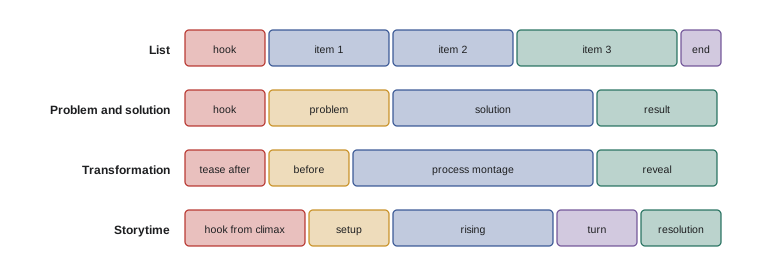
Lesson 1 listed common short-form structures. Each has a characteristic shape:
- List: hook stating the number and topic; items in order, often strongest first and strongest last, with the weakest in the middle; quick ending. Numbering on screen helps viewers track progress.
- Problem and solution: relatable problem; failed approaches or why it is hard (optional); solution demonstrated; result. Particularly effective for products and practical tips.
- Transformation: the "after" teased in the hook; the "before" shown; the process compressed into a montage; the full reveal.
- Tutorial or process: result or goal; steps in sequence, each one clear and labeled; result; optional tip or common mistake.
- Storytime: hook from the most intriguing moment; setup with context; rising tension; turning point; resolution and reflection.
- Comparison: two or more options; criteria; results; recommendation.
- Myth versus fact: the myth stated; why people believe it; the evidence; the correct understanding.
Compressed storytelling
Stories are among the most engaging forms of short content, but they must be compressed ruthlessly. Techniques include:
- Start in the middle: begin at the most dramatic or intriguing moment, then explain how you got there. "I was locked out of my apartment in a towel" is a better opening than "So last Tuesday I woke up early".
- Cut exposition: include only the context needed to understand the stakes. Viewers do not need every detail, only those that matter to the outcome.
- Use visual shorthand: show a location, a facial expression or an object instead of describing it.
- Keep one main character and one clear problem.
- Build tension in steps: each beat should raise the stakes or add a complication.
- Land the ending: deliver the resolution clearly, then end quickly, with a short reflection or punchline.
Storytime videos told directly to camera can run longer than other short videos because tension keeps viewers watching, but every sentence still needs a purpose. Multi-part stories, split across several videos, can build anticipation, but each part must be satisfying on its own and should end on a genuine cliffhanger rather than an arbitrary cut.
Open loops and retention devices
An open loop is a question raised and not yet answered, which motivates viewers to keep watching. Hooks open the main loop; good structures open smaller loops along the way: "but the third one surprised me", "and that's when it went wrong", "the trick is in the last step". Other retention devices include visible progress, such as step numbers or a timer; previews of what is coming, such as a quick flash of the final result; changes of scene, angle or energy at moments where attention might dip; and direct questions to the viewer. Use these devices honestly: each loop must be closed with something worth waiting for.
Beats and escalation
A beat is a single unit of action or information: one step in a tutorial, one item in a list, one moment in a story. In short videos, beats are short, often two to six seconds, and each should feel like progress. Escalation, making each beat bigger, funnier, more surprising or more useful than the last, keeps energy rising toward the payoff. In comedy, the rule of three is common: two set-up beats establish a pattern, and the third breaks it. In tutorials, escalation might mean moving from basic steps to the clever trick. In lists, placing the strongest item last rewards viewers who stayed.
Worked problem
Escalating a list video
A creator has five travel packing tips: rolling clothes, a packing list, packing cubes, wearing your heaviest shoes on the plane, and a little-known trick for using hotel shower caps to wrap shoes. How should they be ordered for a 35-second video?
Show solution
- Hook with the most intriguing promise: "Five packing tips, and the last one changed everything."
- Open with a strong, visual tip to reward early viewers: packing cubes, shown with a satisfying compression.
- Put the most familiar tips in the middle, quickly: rolling clothes, packing list, heaviest shoes.
- End with the most surprising and visual tip: shower caps on shoes, with a clear demonstration.
- Close fast with the packed bag zipping shut, looping to the opening image of an overflowing bag.
Answer: Strong visual tip first, familiar tips quickly in the middle, the surprising shower-cap trick last, and a quick looping close.
Endings and loops
Short videos often end abruptly by long-form standards, and that is usually right: once the payoff lands, viewers have what they came for, and lingering invites a swipe before the end, reducing completion. Effective endings include the payoff itself as the final moment; a quick punchline or reaction; a seamless loop, where the last frame or sentence connects back to the first so that the video replays naturally, encouraging rewatches; a short call to action, such as asking a question to prompt comments or pointing to part two; and an open question that invites discussion. Avoid long outros, repeated requests to like and follow, and end screens that add seconds without value. Seamless loops can be created by ending a sentence that the opening completes, or by matching the final shot to the first.
| Ending type | How it works | Best for |
|---|---|---|
| Payoff end | Video ends on the result or punchline | Most videos |
| Seamless loop | Last frame or line flows into the first | Short, visual or comedic videos |
| Question | Asks viewers for their view or experience | Discussion, opinions |
| Series pointer | Directs to part two or a related video | Multi-part stories, series |
| Reflection | One-line takeaway after a story | Storytime, personal content |
Structuring educational short videos
Educational shorts must teach clearly in limited time. Effective approaches include focusing on one idea per video rather than covering a whole topic; leading with the most useful or surprising point; using concrete examples and visuals rather than abstract explanation; showing rather than telling where possible; using on-screen text to reinforce key terms; and ending with a clear takeaway. Accuracy matters: simplification is necessary, but it should not become misinformation. Cite sources in captions or on screen for factual claims, especially in health, finance and science, and consider follow-up videos or long-form content for nuance.
Planning with beat sheets
A beat sheet is a simple plan listing each beat of the video with its purpose, what is seen, said and written, and its approximate duration. It is shorter and more flexible than a full script and well suited to short form. For a 30-second video, a beat sheet might list eight to twelve beats. Planning beats before filming ensures that the video has a clear structure, that every shot serves a purpose, and that the payoff arrives on time. During editing, the beat sheet becomes a checklist, and beats that do not work can be cut or rearranged. CRE-120 covers short-form scripting in detail; beat sheets combine that writing with the shot planning of Lesson 5.
Story structure in comedy shorts
Comedy shorts follow their own structure. A typical sketch establishes a recognizable situation in the first second or two, introduces a character or premise, escalates the absurdity through a few beats, and ends on a punchline or twist, often followed by a quick reaction. Timing is crucial: punchlines land best when they arrive slightly earlier than viewers expect, and pauses before them build tension. Many comedy creators play multiple characters, using costume changes, camera angles and editing to distinguish them, and keep each sketch tightly focused on one joke. Recurring characters become series, and audiences return to see familiar characters in new situations.
Emotional arcs
Even very short videos can carry an emotional arc: from frustration to relief, from doubt to pride, from fear to laughter. Viewers remember how a video made them feel more than what it said. Planning the emotional arc, as well as the information, helps decide which moments to emphasize with music, pacing and expression. Transformation videos often move from dissatisfaction to delight; storytime from tension to resolution; motivational content from struggle to achievement. Authentic emotion, rather than performed emotion, is what audiences connect with.
Information density
Short videos can feel rushed if they carry too much information, or empty if they carry too little. A good rule is one main idea per video, with supporting details only where they make the idea clearer. If an explanation needs many steps or caveats, consider splitting it into a series, linking to a longer video, or using on-screen text to carry secondary details. Watching the edit once at normal speed, as a viewer who knows nothing about the topic, shows whether the information is clear or overwhelming.
Structure and the platform interface
Platform interfaces affect structure. On some platforms, the first frame of a video may be seen as a cover on the profile grid, so it doubles as branding. Videos loop automatically on most short-form platforms, which rewards endings that flow into the beginning. Progress bars on some platforms let viewers see how much remains, which favors videos that feel short and full of value. Comments are visible while watching on some platforms, so a strong prompt in the video can spark conversation that keeps other viewers engaged. Designing structure with these behaviors in mind makes videos feel native to each platform.
Testing structure before editing
Before editing, read the beat sheet aloud with a timer, or record a rough voice draft over still images, to check that the structure fits the intended length and that the payoff arrives at the right moment. Ask someone unfamiliar with the topic to watch a rough cut and describe what the video is about and what happens; if they cannot, the structure needs simplifying. Small structural changes at this stage, such as moving the strongest example earlier or cutting a weak beat, are much easier than rebuilding a finished edit.
Structure for different lengths
Structure scales with length. A ten-second video may have only a hook, one beat and a payoff. A 30-second video typically has a hook, a short setup, three to five beats and a payoff. A two-minute storytime may have a hook, a setup, several rising beats, a turning point, a resolution and a reflection, with small open loops every 15 to 20 seconds to sustain attention. When a video runs longer than its structure supports, viewers feel it drag; when it is shorter than its content needs, they feel rushed. Matching structure to length is one of the most important judgments in short form.
Common mistakes
MistakeTelling stories in chronological order from the start.
InsteadStart in the middle at the most intriguing moment.
MistakeIncluding every detail of the context.
InsteadKeep only details that matter to the outcome.
MistakePutting the best item first and ending weakly.
InsteadOpen strong and save the strongest for last.
MistakeLong outros and repeated calls to action.
InsteadEnd on the payoff or a brief prompt.
MistakeOpening loops that are never closed.
InsteadClose every loop with something worthwhile.
Summary and key terms
- Structure signals progress and promises more.
- Lists, problem-solution, transformation, tutorial and story have distinct shapes.
- Compressed stories start in the middle and cut exposition.
- Open loops and visible progress keep viewers watching.
- Short beats with escalation build toward the payoff.
- End quickly on the payoff, a loop or a brief prompt.
- Beat sheets plan structure efficiently.
- Structure
- The shape and order of a video's parts.
- Open loop
- An unanswered question that motivates watching.
- Beat
- A single unit of action or information.
- Escalation
- Each beat building on the last.
- Rule of three
- Two beats set a pattern, the third breaks it.
- In medias res
- Starting a story in the middle of the action.
- Exposition
- Background information needed to understand a story.
- Cliffhanger
- Ending that leaves the outcome unresolved.
- Seamless loop
- Ending that connects smoothly back to the start.
- Beat sheet
- Plan listing each beat with purpose and timing.
Practice problems
Work each problem on paper first, then reveal the answer to check.
Why does structure help retention?
Show answer
It signals progress and promises more.
Describe the shape of a transformation video.
Show answer
Tease after, show before, process montage, reveal.
How should a compressed story begin?
Show answer
In the middle, at the most intriguing moment.
What is an open loop?
Show answer
A question raised and not yet answered.
Typical length of a short-form beat?
Show answer
About two to six seconds.
What is the rule of three?
Show answer
Two beats set a pattern, the third breaks it.
Where should the strongest list item go?
Show answer
Last, with a strong item first too.
How do you create a seamless loop?
Show answer
Match the final frame or line to the opening.
Name two principles of educational shorts.
Show answer
One idea, lead with the best point, examples, cite sources.
What does a beat sheet list?
Show answer
Each beat with purpose, visuals, words and timing.
Lesson quiz · 5 questions
Score 60% or more to complete this lesson.
Create a free account to save your progress, take quizzes and earn a certificate.