
CRE-210 · Lesson 10 of 12 · 25 min
Series, recurring formats and content pillars
Individual short videos come and go quickly, but series and recurring formats build lasting audiences. When viewers recognize a format, they know what to expect and look forward to the next installment; when a creator works within a format, ideas and production become faster. Many of the most successful short-form creators are known for one or two signature series. This lesson covers why series work, designing a recurring format, naming and branding series, episodic and serialized content, multi-part videos, content pillars and the content mix, scheduling and consistency, evolving or retiring formats, and playlists and series features on platforms.
Why series work
Series benefit both audiences and creators. For audiences, a familiar format reduces the effort of deciding whether to watch: they recognize the opening, trust the payoff and enjoy the variations. Recurring formats create anticipation and habit, and viewers who enjoy one episode often seek out others, increasing views across the catalog. For creators, a format provides a structure that makes ideation, scripting, filming and editing faster, because many decisions are already made. Series also help recommendation systems understand who an account is for, because similar videos attract similar audiences. And formats make a creator distinctive: a recognizable series is harder to copy convincingly than a single idea.
Designing a recurring format
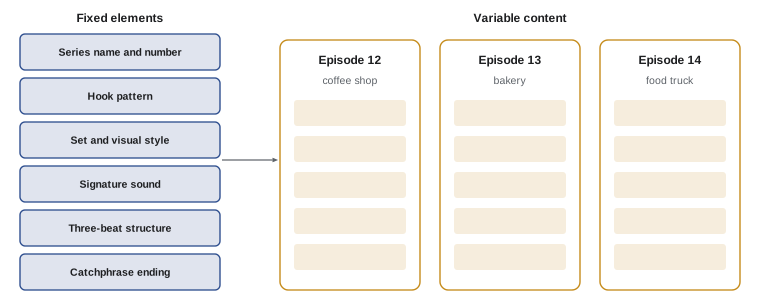
A strong recurring format has a fixed frame and variable content. The fixed elements might include a series name, a consistent opening or hook pattern, a recognizable visual style or set, a signature sound or music, a repeated structure, and a consistent ending or catchphrase. The variable elements are the subject of each episode: a new product, place, question, person or challenge. The format should be flexible enough to support many episodes; a test is to list at least twenty possible episodes before launching. Examples of recurring short-form formats include:
- Rating or ranking: "rating every... in my city", "tier list of...".
- Testing: "I tried the viral... so you don't have to", "testing cheap versus expensive...".
- Question and answer: "ask a nurse", "you asked, I answered".
- Daily or routine: "what I eat in a day as...", "day in the life of...".
- Challenges: "cooking with only $10", "one-minute sketches".
- Educational: "one word a day in Portuguese", "history in 60 seconds".
- Street or interview: asking strangers or experts the same question, with consent.
Naming and branding a series
A series name helps viewers recognize, remember and search for episodes. Good series names are short, descriptive and distinctive, such as a clear phrase that also works as hook text ("Cheap eats in Montreal, part 14"). Numbering episodes signals that there are more to watch and encourages viewers to explore earlier ones. Visual branding, such as a consistent cover design, font, color, opening shot, intro sound or graphic, makes episodes recognizable in the feed and on the profile grid, where a row of matching covers looks professional and invites browsing. Avoid long intros or animated title sequences, which waste the hook window; branding should be built into the hook rather than added before it.
Episodic and serialized content
Episodic series contain self-contained episodes: each video stands alone, and viewers can watch them in any order. Most short-form series are episodic, because most viewers encounter a single episode in the feed without having seen others. Serialized content tells a continuing story across episodes, such as a renovation project, a fitness journey, a business launch or a fictional story, which builds strong loyalty among regular viewers but requires each episode to orient new viewers quickly, for example with a one-line recap at the start. Hybrid approaches, with self-contained episodes that also contribute to a longer arc, combine the strengths of both.
Multi-part videos
Splitting a long story or tutorial into parts, such as "part 1" and "part 2", can build anticipation and drive viewers to the profile. Done well, each part delivers a satisfying segment and ends at a genuine point of tension. Done badly, it frustrates viewers with arbitrary cuts, slow drip-feeding of information, or parts that never arrive. Practical tips include publishing subsequent parts soon, ideally within hours or a day while interest is high; linking parts through playlists, series features, pinned comments or the caption; giving each part a quick recap and its own hook; and finishing the series. Viewers remember creators who leave stories unfinished.
Worked problem
Planning a series
A creator who works as a mechanic wants to launch a short-form series. They have three ideas: random car tips, "is this repair worth it?" where they assess viewers' repair quotes, and a serialized restoration of an old car. Which should they choose, and how should they structure it?
Show solution
- Random tips lack a fixed frame, so they are better as occasional standalone videos.
- "Is this repair worth it?" has a clear, repeatable structure: a viewer's quote, the creator's assessment, a verdict. It draws on audience submissions for endless episodes and builds trust.
- The restoration is a strong serialized series for loyal viewers but needs recaps for new viewers and a long commitment.
- Launch "Is this repair worth it?" as the signature episodic series, numbered, with a consistent set, opening line and verdict graphic.
- Run the restoration as a secondary weekly serialized series, with a five-second recap at the start of each episode.
Answer: Make "Is this repair worth it?" the main episodic series with a fixed structure and verdict, and run the restoration as a secondary serialized series with recaps.
Content pillars and the content mix
Content pillars are the three to five themes an account consistently covers (CRE-110 Lesson 6). In short form, pillars often map onto series and formats: a cooking creator might have pillars for quick recipes, kitchen tips and food stories, each with one or two recurring formats. Planning a content mix across pillars balances the account: some videos aim to reach new viewers, such as trend adaptations and broad tips; some build depth with existing followers, such as serialized content and community replies; some show personality, such as behind-the-scenes clips; and some support business goals, such as product or service content. A weekly or monthly calendar showing the mix helps avoid over-reliance on one type.
| Content purpose | Example formats | Share of mix (example) |
|---|---|---|
| Reach new viewers | Trend adaptations, broad tips, hooks with wide appeal | About 40 % |
| Deepen loyalty | Signature series, serialized stories, replies | About 35 % |
| Show personality | Behind the scenes, day in the life, opinions | About 15 % |
| Support business | Products, services, sponsored content | About 10 % |
Scheduling and consistency
Consistency in short form means publishing regularly enough that audiences and recommendation systems see a steady stream of content, and keeping series on a predictable rhythm, such as "new episode every Tuesday and Friday". Exact posting frequency matters less than sustainability: a schedule that can be maintained for months beats an intense burst followed by silence. Batch production (Lesson 12) and a buffer of finished videos protect the schedule against illness and busy periods. Posting time can matter for audiences concentrated in particular time zones, but platform analytics usually show it matters less than content quality; experiment, and check when your audience is active (CRE-202).
Evolving or retiring formats
Formats age. Signs of fatigue include declining views relative to the account's other content, falling completion rates, comments noting repetition, and the creator's own boredom. Options include evolving the format, such as adding a new segment, changing the location, inviting guests or raising the stakes; running a limited season and then pausing; spinning off a new series from a popular episode; or retiring the format respectfully, perhaps with a final episode. Successful creators continually test new formats alongside existing ones, so that a replacement is ready when a signature series declines.
Playlists and series features
Platforms offer tools to organize series: playlists on YouTube and TikTok, series or collections features on some platforms, pinned videos on profiles, highlight collections in Instagram stories, and links between parts. Organizing episodes into playlists makes it easy for viewers who discover one episode to watch more, which increases total views and session time. Some platforms also offer paid series or subscription features, where creators sell access to exclusive series; these require a strong existing audience and clear value (CRE-310 covers monetization).
Series and brand partnerships
Recurring series are attractive to brands because they offer predictable audiences, consistent quality and a natural place for integration. A brand might sponsor a single episode of a series, a whole season, or a segment within each episode. Sponsorships work best when the product fits the series naturally, such as a cookware brand sponsoring a cooking series, and when the creator keeps creative control so that episodes remain true to the format. Clear disclosure remains essential for each sponsored episode (Lesson 11).
Seasonal and event series
Some series are tied to seasons, holidays or events: an advent-calendar series in December, a back-to-school series in late August, a summer travel series, or daily coverage of a festival or sports event. Seasonal series create anticipation and urgency, give audiences a reason to return daily, and often align with brand campaigns. Planning them weeks in advance, with episodes filmed before the season begins, reduces pressure during busy periods.
Community-driven series
Series built on audience participation, such as answering viewer questions, reviewing viewer submissions, featuring followers' projects, or letting the audience vote on the next episode, deepen engagement and supply endless ideas. They require clear rules about what can be submitted, consent from people whose content or stories are featured, and moderation to keep the community positive. Crediting participants, and thanking them, encourages others to join.
Measuring series performance
Series should be evaluated as a whole, not only episode by episode. Useful measures include average views and retention per episode compared with the account's other content, how many viewers watch multiple episodes, follower growth during the series, comments that reference the series, and playlist views. Some episodes will underperform; what matters is whether the series as a whole builds an audience and serves the creator's goals. Comparing series against each other helps decide which to expand, evolve or retire.
Launching a new series
A new series benefits from a clear launch. Some creators announce it in a short teaser or in stories, explaining the format and when episodes will appear; others publish several episodes in quick succession so that new viewers can binge them and the recommendation system has several examples of the format to learn from. Pinning the first episode or a series trailer to the profile helps newcomers start at the beginning. Watching results closely for the first five to ten episodes shows whether the format resonates; it often takes several episodes for a series to find its audience, so judge it on the pattern rather than the first post. Ask viewers for episode suggestions early to build participation and a supply of ideas.
Format libraries
Over time, creators accumulate a library of formats they know how to make: each with a template, an example episode, notes on what works, typical performance and ideas for future episodes. A format library makes planning easy, because each week's schedule can draw on proven formats while leaving room for experiments. It also helps when working with editors and collaborators, who can study the examples to understand the expected style.
Series and accessibility
Consistent series also support accessibility: predictable structure, consistent caption styles and familiar visual cues help viewers with cognitive or attention differences follow content more easily, and regular viewers learn where to look for key information. Designing accessibility into a series template, rather than adding it episode by episode, makes it a default rather than an afterthought.
A well-designed series, maintained with care, can become the foundation of a creator's identity, audience and business for years.
Common mistakes
MistakeLaunching a format with only a few possible episodes.
InsteadList at least twenty episode ideas first.
MistakeLong animated intros for each episode.
InsteadBuild branding into the hook.
MistakeSerialized episodes that confuse new viewers.
InsteadOpen each episode with a quick recap.
MistakeLeaving multi-part stories unfinished.
InsteadPublish parts promptly and finish the series.
MistakeIgnoring format fatigue.
InsteadEvolve, pause or retire formats and test new ones.
Summary and key terms
- Series build recognition, anticipation, habit and efficient production.
- Formats combine fixed elements with variable content.
- Names, numbering and consistent covers brand a series.
- Episodic series stand alone; serialized ones need recaps.
- Multi-part videos need genuine cliffhangers and prompt follow-ups.
- Pillars and a planned mix balance reach, loyalty, personality and business.
- Keep sustainable schedules and evolve formats as they age.
- Series
- A set of related videos under one identity.
- Recurring format
- Template with fixed elements and variable content.
- Episodic
- Self-contained episodes.
- Serialized
- Continuing story across episodes.
- Recap
- Brief summary of earlier episodes.
- Content pillar
- Core theme an account covers.
- Content mix
- Balance of content types and purposes.
- Buffer
- Stock of finished videos ready to post.
- Format fatigue
- Declining interest in a repeated format.
- Playlist
- Organized collection of videos.
Practice problems
Work each problem on paper first, then reveal the answer to check.
Name three reasons series work.
Show answer
Recognition, anticipation, faster production, clearer audience signals.
What are the two parts of a recurring format?
Show answer
Fixed frame and variable content.
How many episode ideas should you list before launching?
Show answer
At least twenty.
Why number episodes?
Show answer
Signals more to watch and aids browsing.
What is the difference between episodic and serialized?
Show answer
Standalone episodes versus a continuing story.
How should multi-part videos end?
Show answer
At genuine points of tension, with prompt follow-ups.
Name four purposes in a content mix.
Show answer
Reach, loyalty, personality, business.
What matters more than exact posting frequency?
Show answer
Sustainability.
Name two signs of format fatigue.
Show answer
Falling views or completion, repetition comments, creator boredom.
Why organize episodes into playlists?
Show answer
Viewers easily watch more episodes.
Lesson quiz · 5 questions
Score 60% or more to complete this lesson.
Create a free account to save your progress, take quizzes and earn a certificate.