
CRE-210 · Lesson 3 of 12 · 25 min
Hooks in the first seconds
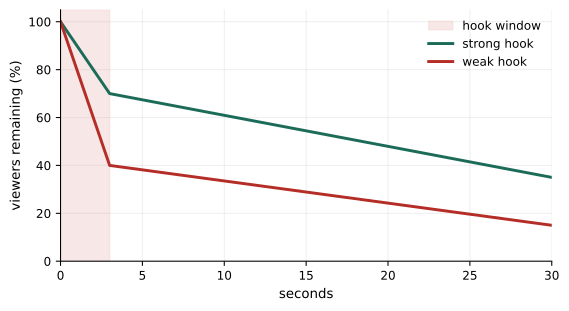
In short-form video, the hook is where most videos succeed or fail. Retention graphs for short videos often show a steep drop in the first two or three seconds, as viewers decide whether to stay, followed by a gentler decline. Improving the hook changes that first drop and therefore everything that follows: a video that keeps 70 % of viewers past the third second has far more chance of being recommended than one that keeps 40 %. CRE-120 introduced hook writing for scripts; this lesson focuses on hooks as complete audiovisual moments. It covers the three layers of a hook, visual hooks, verbal hooks, text hooks, common hook patterns, matching the hook to the payoff, testing hooks, and the ethics of hooks that promise more than the video delivers.
Why the first seconds matter
When a video appears in a feed, the viewer has made no commitment. They see the first frame, hear the first sound, and perhaps read the first line of text, all within about a second. If nothing signals that this video is worth their time, they swipe. Because recommendation systems use early retention and completion as signals of satisfaction (CRE-201), a weak hook not only loses those viewers but also reduces how widely the video is shown. A strong hook does three things almost instantly: it captures attention, signals what the video is about and who it is for, and creates a reason to keep watching, usually curiosity, a promise of value, emotion or entertainment.
The three layers of a hook
A short-form hook works on three layers at once, and the strongest hooks align all three:
- Visual: what the viewer sees in the first frame and first second, such as movement, an intriguing image, a face showing emotion, or the result of the process.
- Audio: what the viewer hears, such as the first spoken words, a striking sound or the start of a recognizable track.
- Text: the on-screen words that state or reinforce the promise, readable even with the sound off.
For example, a home renovation video might open with a dramatic before-and-after split screen (visual), the creator saying "we did this for under $2,000" (audio) and on-screen text "$2,000 kitchen makeover" (text). Each layer catches different viewers: some notice the image, some listen, some read. When the layers contradict each other or compete, the hook becomes confusing.
Visual hooks
Visual hooks are particularly powerful because the first frame is seen before anything else, even before sound starts. Effective visual hooks include:
- Starting with motion: something already happening, rather than a static frame or the creator walking into shot.
- Showing the result first: the finished dish, the transformed room, the completed trick, then showing how.
- An unusual image or perspective: an extreme close-up, an unexpected location, a surprising object.
- A face with clear emotion, looking at the camera, which draws attention instinctively.
- Visual tension: something about to happen, such as a glass on the edge of a table or a person about to jump.
- A pattern interrupt: an image that breaks the visual rhythm of the feed, such as unusual framing, color or a sudden zoom.
Avoid opening with logos, title cards, slow pans or the creator settling into frame. The cover frame, the still image chosen to represent the video on the profile grid, is also part of the visual identity but is separate from the opening frame in the feed.
Verbal hooks
The first sentence spoken should be short, specific and compelling, usually under three seconds when spoken. Patterns that work include:
- A direct promise: "Here's how to fold a fitted sheet in 20 seconds."
- A bold or surprising statement: "You've been washing your face wrong," used only if true and supported.
- A question that creates curiosity: "Why do planes fly at 35,000 feet?"
- A relatable statement: "If you always forget to drink water, this is for you."
- A story opening in the middle of action: "I was ten minutes into the interview when the fire alarm went off."
- A challenge or stakes: "I have $50 to feed a family of four for a week."
Start speaking immediately, without greetings such as "hi everyone" or preambles such as "so today I wanted to talk about". Speak with energy and clarity, and trim any breath or pause before the first word in editing.
Text hooks
On-screen text in the first second supports viewers watching without sound and reinforces the promise for everyone. Hook text should be short, ideally under about eight words, large, high contrast and placed within the safe zone (CRE-130 Lesson 3). It can repeat the spoken hook, complement it with a different angle, or provide context the visual does not. Text hooks that name the audience ("for new parents"), state a specific benefit ("save 2 hours a week"), or create a curiosity gap ("the mistake I made for 10 years") are effective. Avoid long sentences, small fonts and text that appears after the first second, by which time many viewers have decided.
| Hook pattern | Example | Works because |
|---|---|---|
| Result first | Finished cake, then "how I made this in one bowl" | Shows the payoff and promises the process |
| Specific promise | "Fix a squeaky door in 30 seconds" | Clear value and time commitment |
| Curiosity gap | "Nobody tells you this about renting" | Creates a question to be answered |
| Relatable situation | "POV: your code works and you don't know why" | Viewers recognize themselves |
| Stakes or challenge | "$20 to cook for six people" | Creates tension and anticipation |
| Contrarian (honest) | "Stop stretching before you run, here's why" | Challenges assumptions with evidence |
Matching the hook to the payoff
A hook is a promise, and the video must keep it. If the hook promises a result, the video must show it; if it poses a question, the video must answer it; if it promises a laugh, the payoff must be funny. Hooks that overpromise produce a sharp drop in retention once viewers realize the video will not deliver, along with negative comments and reduced trust. Viewers who feel misled may also mark content as "not interested", sending negative signals to the platform. The best hooks are specific about what the video delivers and then deliver more than expected, which encourages rewatches, shares and follows.
Worked problem
Rewriting a weak opening
A creator's video about organizing a small closet opens with them saying "Hey guys, so today I wanted to show you how I organize my closet because a lot of you have asked," while standing in front of a closed closet door. Retention drops to 35 % by second three. How could the hook be improved?
Show solution
- Visual: open on the finished, organized closet with the door swinging open, or a split screen of before and after.
- Audio: start immediately with "This closet is 90 centimeters wide and fits my whole wardrobe."
- Text: "Tiny closet, whole wardrobe" in large type within the safe zone.
- Cut straight to the first step by second three, removing the greeting entirely.
- Make sure the final shot returns to the organized closet, delivering on the promise and looping.
Answer: Open on the result with a specific spoken claim and short text, remove the greeting, and reach the first step within three seconds.
Testing and improving hooks
Hooks improve with deliberate practice and testing. Write several hook options for each video, at least three, and choose the strongest, or film two versions of the opening. Watch your retention graphs (CRE-202) to see how many viewers remain at three and five seconds, and compare videos with different hook styles. Some platforms allow trial or test posts, and creators sometimes repost a video with a new hook to compare. Keep a swipe file of hooks from other videos that stopped your own scroll, noting why. Over time, patterns emerge that suit your niche and audience. Be wary of copying hook phrases that have become clichés, such as overused "wait for it" or "you won't believe", which many viewers now ignore.
Ethical hooks
Because hooks are designed to capture attention, they can easily become manipulative. Misleading hooks include false claims, exaggerated health or financial promises, fake urgency, staged danger, and thumbnails or opening frames that misrepresent the content. These practices may breach platform policies on deceptive content, consumer protection laws when products are involved (Lesson 11), and audiences' trust. Hooks about health, money, safety and news carry particular responsibility: a hook such as "this cures anxiety" is not only misleading but potentially harmful. A good rule is that every hook should be one you would be comfortable defending as accurate to a skeptical viewer who watched the whole video.
Hooks for different genres
Hook conventions differ between genres. Comedy hooks often drop viewers straight into a recognizable situation ("When your manager says we're like a family"), relying on relatability and the promise of a laugh. Educational hooks lead with a surprising fact, a common mistake or a clear benefit. Lifestyle and aesthetic content often relies on a strong visual first frame with minimal text. Storytime hooks open with the most dramatic line of the story. Product and review hooks lead with a verdict or a striking result ("I returned this after one day"). Studying the best hooks in your genre and adapting their patterns, rather than copying their words, helps you meet viewers' expectations while standing out.
The first frame
Because the first frame appears before any motion or sound, some creators treat it as a still image that must work on its own, like a thumbnail. A strong first frame is uncluttered, shows a clear subject, includes readable text if text is used, and suggests movement or change about to happen. It should not be a blurry transitional frame, a black frame, or the creator reaching for the record button. In editing, check the very first frame of the export, and trim a few frames if needed so that the video begins on a strong image.
Hooks and the caption
In the feed, the written caption and sometimes the first line of it appear alongside the video. A caption that complements the hook, adding context or a question rather than repeating the on-screen text, gives viewers another reason to stay. For search, captions with clear keywords help videos appear for relevant queries (CRE-201). Avoid captions that spoil the payoff, such as revealing the result of a test or the punchline of a joke, which removes the reason to watch to the end.
Building a hook library
Over time, creators who track their hooks learn which patterns work for their audience. A hook library, a document or spreadsheet listing each video's hook text, spoken line, first-frame description, hook retention and notes, reveals patterns: perhaps result-first hooks consistently outperform questions, or hooks that name the audience work particularly well. Periodically reviewing the library and retiring patterns that have become stale keeps hooks fresh. Sharing notes with collaborators or editors helps everyone work toward the same standard.
Hooks and thumbnails for profile browsing
Viewers who visit your profile see a grid of covers rather than the opening seconds of each video. Covers with a short title, a clear image and consistent styling help them choose what to watch next. A video whose hook works in the feed but whose cover is a blurry mid-action frame may get few views from profile visitors. Choosing covers deliberately, often a frame from the payoff or a designed title card for series, extends the work of the hook to the profile.
Practicing hooks
Hook writing improves with deliberate practice. One exercise is to take ten recent videos in your niche, yours or others', and write three alternative hooks for each, then judge which would have stopped you scrolling. Another is to say each hook aloud and time it, cutting anything that takes longer than three seconds.
Common mistakes
MistakeOpening with greetings or introductions.
InsteadStart with the hook immediately.
MistakeVisual, audio and text hooks saying different things.
InsteadAlign all three layers.
MistakeLong hook text that appears late.
InsteadUse under about eight words in the first second.
MistakeHooks that overpromise.
InsteadPromise specifically and deliver more.
MistakeUsing clichéd hook phrases.
InsteadWrite specific, original hooks and test them.
Summary and key terms
- The first two to three seconds decide whether most viewers stay.
- Strong hooks capture attention, signal the topic and create a reason to watch.
- Hooks work on visual, audio and text layers that should align.
- Visual hooks start with motion, results, unusual images or emotion.
- Verbal hooks are short, specific and start immediately.
- Text hooks are short, large and appear in the first second.
- Hooks are promises: match them to the payoff and keep them honest.
- Hook window
- The first few seconds when viewers decide to stay.
- Visual hook
- Opening image or motion that captures attention.
- Verbal hook
- First spoken line.
- Text hook
- Opening on-screen words.
- Pattern interrupt
- Element that breaks the expected rhythm.
- Curiosity gap
- An unanswered question that motivates watching.
- Cover frame
- Still image representing a video on the profile.
- Swipe file
- Collection of examples for reference.
- Clickbait
- Misleading content designed to attract attention.
- Early retention
- Share of viewers remaining in the first seconds.
Practice problems
Work each problem on paper first, then reveal the answer to check.
What three things does a strong hook do?
Show answer
Captures attention, signals the topic, gives a reason to watch.
Name the three layers of a hook.
Show answer
Visual, audio, text.
Give two visual hook techniques.
Show answer
Start with motion, show the result first, emotion, unusual image.
Why avoid greetings?
Show answer
They waste the hook window.
Maximum suggested hook text length?
Show answer
About eight words.
What happens when hooks overpromise?
Show answer
Retention drops, negative feedback and lost trust.
How many hook options should you write?
Show answer
At least three.
What retention points show hook strength?
Show answer
Three and five seconds.
Give an example of a misleading hook.
Show answer
False health claims or fake urgency.
What rule keeps hooks ethical?
Show answer
Be able to defend the hook as accurate.
Lesson quiz · 5 questions
Score 60% or more to complete this lesson.
Create a free account to save your progress, take quizzes and earn a certificate.