
CRE-210 · Lesson 11 of 12 · 25 min
Analytics, iteration and sponsored short-form
Short-form creators publish often and receive feedback fast: within hours, a video's views, retention and engagement show how audiences responded. Used well, this feedback turns every video into an experiment that improves the next. Short form is also a major format for brand partnerships, and sponsored short videos bring their own creative challenges and legal obligations. CRE-202 covers analytics in depth; this lesson applies analytics specifically to improving short videos and then covers sponsored short-form content. It covers the short-form metrics that matter most, diagnosing videos, iterating and testing, avoiding misleading conclusions, working with brands on short-form content, integrating sponsors naturally, disclosure obligations in Canada and the United States, and measuring sponsored performance.
Short-form metrics that matter
Short-form analytics dashboards show many numbers. For improving the craft, a few are most useful:
- Views or plays, and how they grow over time: a slow start followed by growth suggests the video found an audience gradually.
- Average watch time and average percentage viewed: how much of the video a typical viewer watched.
- Retention curve: the percentage of viewers remaining at each second (Lesson 6).
- Hook retention, sometimes shown as the share of viewers who stayed past the first few seconds, or "viewed versus swiped away" on some platforms.
- Rewatches and completion: whether viewers watched to the end and replayed.
- Shares and saves: strong signals that viewers found the video valuable enough to send or keep (CRE-201).
- Comments: both quantity and content, which reveal what resonated.
- Follows from the video: whether it converted viewers into followers.
- Traffic sources: whether views came from the recommendation feed, followers, search, the profile or sound pages.
Metric names and definitions differ between platforms and change over time, so read each platform's help documentation for exact definitions.
Diagnosing a video
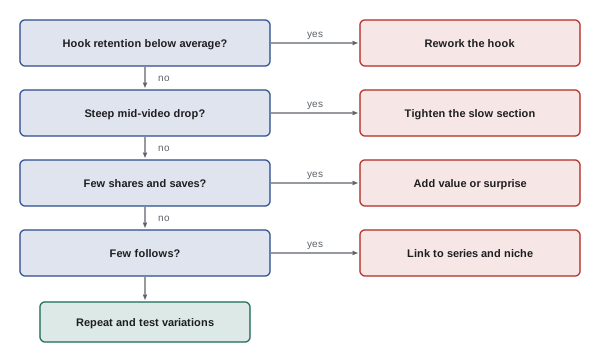
A systematic diagnosis compares a video's metrics with the account's typical results and identifies where it succeeded or struggled:
- Low hook retention suggests the first seconds did not stop viewers: revisit the visual, verbal and text hooks (Lesson 3).
- Good hook retention but a steep mid-video drop suggests a slow or confusing section: check the retention curve against the timeline.
- High retention but few shares suggests the video was watchable but not valuable or surprising enough to send.
- Many views but few follows suggests the video attracted interest but did not show why viewers should want more, or was off-niche.
- Low views despite good retention among those who saw it may reflect limited initial distribution, timing or topic, rather than quality; a repost or variation may do better.
Iterating and testing
Iteration means making deliberate changes based on what you learn and observing the results. Change one major variable at a time where possible, so that you can attribute differences: try a new hook style on several videos while keeping other elements similar, or compare a 20-second and a 40-second version of a format. Some platforms offer built-in testing: YouTube allows testing different titles and thumbnails for longer videos, and Instagram has offered trial reels shown first to non-followers (CRE-201). Keep an experiment log recording what you changed, what you expected and what happened. Look for patterns across many videos rather than drawing conclusions from one, because individual short videos vary widely in performance for reasons unrelated to their content.
Worked problem
Testing hook styles
A creator posts educational science shorts. They want to know whether opening with a question ("Why is the sky blue?") or a surprising statement ("The sky isn't actually blue") holds viewers better. How should they test it?
Show solution
- Choose ten upcoming videos of similar topic, length and editing style.
- Alternate the hook style: five with questions, five with surprising statements, randomly ordered.
- Record hook retention at three seconds, average percentage viewed and shares for each.
- Compare averages: for example, questions 62 % hook retention, statements 71 %.
- Treat the result as a working hypothesis and confirm it with another round before changing the approach entirely.
Answer: Alternate the two hook styles across ten similar videos, compare hook retention and shares, and confirm any difference with a second round.
Avoiding misleading conclusions
Short-form data is noisy. A single viral video can make a format look brilliant, and a single flop can make a good idea look weak. Common pitfalls include drawing conclusions from one or two videos; comparing videos posted at very different times or under different platform conditions; focusing on views alone rather than retention, shares and follows; chasing metrics that do not serve your goals, such as views that do not convert into a loyal audience; and assuming correlation is causation, for instance that a particular hashtag caused a video to perform. Median results over many videos give a more reliable picture than averages dominated by outliers. Combine data with qualitative feedback from comments and messages, and with your own judgment about quality and fit.
Working with brands on short-form content
Brands invest heavily in short-form creator partnerships because creators reach engaged audiences in an authentic voice. A typical partnership involves a brief from the brand describing goals, key messages, deliverables, timelines and restrictions; a creative concept from the creator; approval of a script or draft; production; review; and posting, sometimes with usage rights allowing the brand to run the video as an advertisement. Successful partnerships respect the creator's style and audience: briefs that force scripted, ad-like content often perform poorly, while those that let creators integrate the product into their usual formats perform better. Agree on deliverables, revisions, usage rights, exclusivity, payment and timelines in a written contract (CRE-330).
Integrating sponsors naturally
Sponsored short videos must still earn attention, which means they must be good videos first. Techniques that work include integrating the product into a recurring format, such as a "testing" series or a recipe that genuinely uses it; showing the product solving a real problem; telling a personal story about using it; demonstrating results honestly; and keeping the hook focused on viewer value rather than the brand name. Avoid long, scripted product lists, unrealistic claims and forced enthusiasm, which audiences recognize immediately. Honest opinions, including limitations, build credibility; creators should only promote products they have actually used and would recommend.
| Approach | Example | Why it works |
|---|---|---|
| Fit into a series | A sponsored episode of "tested so you don't have to" | Familiar format, honest testing |
| Problem and solution | A cleaning product on a real stain | Shows genuine value |
| Personal story | How an app helped plan a trip | Authentic and relatable |
| Tutorial | A recipe using a sponsor's ingredient | Useful content first |
| Behind the scenes | Using sponsored gear on a real shoot | Credible context |
Disclosure obligations
When a creator receives payment, free products, discounts, commissions or any other material benefit for featuring a brand, viewers must be told clearly. Disclosure should be in the video itself, through spoken words and on-screen text near the start, as well as in the caption, and platform branded-content or paid-partnership labels should be used where available. Disclosures hidden in a long list of hashtags, placed only at the end of the caption, or shown too briefly to read do not meet the standard.
In the United States, the Federal Trade Commission's Endorsement Guides, updated in 2023, require clear and conspicuous disclosure of material connections between endorsers and brands, and the FTC's rule on fake reviews and testimonials, in effect since October 2024, allows civil penalties for certain deceptive endorsement practices. The FTC advises disclosures that are hard to miss, in the video itself for video content, using plain words such as "ad" or "sponsored", and warns that platform tools alone may not be sufficient. Advertising to children is also subject to rules such as COPPA and industry self-regulation through the Children's Advertising Review Unit.
In both countries, brands and creators can be held responsible for misleading sponsored content, and claims made in sponsored videos must be truthful and substantiated. CRE-320 covers advertising law for creators in detail.
Measuring sponsored performance
Brands evaluate sponsored short-form content using metrics such as reach, views, engagement rate, watch time, link clicks, discount code redemptions, sales attributed through affiliate links, and brand lift studies where available. Creators should agree in advance which metrics will be reported, provide screenshots or platform insights reports after posting, and be honest about results. Comparing a sponsored video's retention with the creator's usual content shows whether the integration held attention; a sharp drop at the moment the product appears suggests the integration needs to be more natural next time. Long-term partnerships, in which a brand appears repeatedly in a creator's content, often perform better than one-off posts because audiences come to see the product as part of the creator's life.
Benchmarks and context
Creators often want to know whether their numbers are "good". Benchmarks vary widely by platform, niche, account size, video length and format, and published averages from third-party studies are rough guides at best. The most useful benchmark is your own account: compare each video with your recent median for the same format and length. A video with twice your median views and above-average hook retention is a success worth learning from, regardless of how it compares with other accounts. Over months, tracking your own medians shows whether your craft is improving.
Qualitative feedback
Numbers show what happened; comments, messages and conversations help explain why. Read comments for patterns: repeated questions suggest confusion or demand for more detail; requests for part two show strong interest; complaints about audio, text or pace point to craft problems; and shares accompanied by tags show who the video resonated with. Occasionally asking viewers directly, through polls or questions, what they want to see more of provides valuable input. Treat individual negative comments with perspective, focusing on patterns rather than single opinions.
Rates for sponsored short-form content
Creators are often unsure how to price sponsored short videos. Rates depend on audience size and engagement, niche, deliverables, usage rights, exclusivity, production complexity and timelines. Usage rights, allowing a brand to run the video as an advertisement, and exclusivity, preventing the creator from working with competitors, should command additional fees. Many creators develop a rate card and media kit showing audience demographics, typical performance and past partnerships (CRE-202). Industry surveys give rough ranges, but each negotiation is different; never accept terms that require misleading content or undisclosed promotion.
Affiliate links and commissions
Affiliate programs pay creators a commission when viewers buy through their links or codes. Short-form platforms increasingly support product tags and in-app shopping, making affiliate content easier to create. Affiliate relationships are material connections and must be disclosed in the same way as sponsorships, because viewers deserve to know that the creator earns money from their purchases. Recommending only products you genuinely use and believe in protects the trust that makes affiliate income possible.
Platform tools for creators
Most platforms offer creator dashboards with analytics, inspiration and education, such as TikTok's creator tools, Instagram's professional dashboard and YouTube Studio. These tools show not only metrics but also suggestions, trending topics in your niche and policy information such as account status, which reveals whether any content has been restricted (CRE-201). Checking them regularly, alongside your own experiment log, helps you understand how the platform sees your account. Features and names change frequently, so follow official creator blogs and help centers for updates rather than relying on rumors.
Responding to underperforming sponsored posts
Sometimes sponsored videos underperform. Rather than hiding results, discuss them openly with the brand, explain what you learned, and propose adjustments for future content, such as a more natural integration, a different format or timing. Honest reporting builds long-term relationships and trust with brands, who understand that individual short videos vary in performance.
Analytics and sponsorship both reward the same habits: honesty, patience, careful testing and a focus on what genuinely serves viewers over time.
Disclosure rules apply equally to small creators and large ones: the obligation depends on the connection with the brand, not on audience size.
Common mistakes
MistakeJudging videos by views alone.
InsteadDiagnose with hook retention, curves, shares and follows.
MistakeChanging many variables at once.
InsteadTest one major change across several videos.
MistakeDrawing conclusions from one viral video.
InsteadLook for patterns across many videos.
MistakeScripted, ad-like sponsored content.
InsteadIntegrate sponsors into genuine formats.
MistakeHiding disclosures in hashtags or captions only.
InsteadDisclose clearly in the video and caption.
Summary and key terms
- Hook retention, curves, completion, shares, saves and follows guide improvement.
- Diagnose videos by comparing metrics with the account's typical results.
- Iterate deliberately, changing one variable and logging experiments.
- Short-form data is noisy; use patterns, medians and qualitative feedback.
- Brand partnerships work best when creators keep their style and audience in mind.
- Integrate sponsors naturally and honestly.
- Disclose material connections clearly under Canadian and US rules.
- Hook retention
- Share of viewers who stay past the first seconds.
- Average percentage viewed
- Average share of a video watched.
- Traffic source
- Where views come from.
- Experiment log
- Record of changes, expectations and results.
- Median
- Middle value, less affected by outliers.
- Brief
- Brand document describing campaign requirements.
- Usage rights
- Permission for a brand to reuse content.
- Material connection
- Relationship that could affect an endorsement.
- Paid partnership label
- Platform tool identifying sponsored content.
- Brand lift
- Measured change in brand awareness or perception.
Practice problems
Work each problem on paper first, then reveal the answer to check.
Name four short-form metrics.
Show answer
Watch time, retention, hook retention, shares, saves, follows.
What does low hook retention suggest?
Show answer
The first seconds failed to stop viewers.
What do high retention but few shares suggest?
Show answer
Watchable but not valuable or surprising enough.
Why change one variable at a time?
Show answer
To attribute differences.
Why use medians?
Show answer
Outliers distort averages.
What does a brand brief include?
Show answer
Goals, messages, deliverables, timelines, restrictions.
Name two ways to integrate sponsors.
Show answer
Series fit, problem-solution, personal story, tutorial.
Where should disclosure appear?
Show answer
In the video near the start and in the caption.
Which body issues influencer disclosure guidelines in your country?
Show answer
Ad Standards and the Competition Bureau (Canada) or the FTC (US).
What does a drop when the product appears suggest?
Show answer
The integration needs to be more natural.
Lesson quiz · 5 questions
Score 60% or more to complete this lesson.
Create a free account to save your progress, take quizzes and earn a certificate.