
CON-430 · Lesson 9 of 12 · 27 min
Sustainable site practices and construction emissions
Most of a building's environmental footprint is fixed in design, but the construction site itself has impacts the contractor directly controls: soil eroded into streams, sediment washed into storm sewers, dust and noise affecting neighbors, diesel exhaust affecting workers and the community, damaged trees, and the greenhouse gas emissions of equipment, temporary heat and power. These impacts are regulated, they are visible to the public and the owner, and several are prerequisites in green building rating systems. This lesson covers erosion and sediment control, stormwater, dust, noise, idling and other nuisance controls, and then measuring and reducing a contractor's own emissions using the Scope 1, 2 and 3 framework introduced in Lesson 2. HSE-251 covers spill response and waste regulations, which are not repeated here.
Erosion and sediment control
When vegetation and topsoil are removed, rain and wind can erode exposed soil quickly. Sediment washed off a site clogs storm sewers, smothers fish habitat, carries nutrients and pollutants into waterways and can bring heavy fines. Erosion control prevents soil from moving in the first place, for example by limiting the area disturbed, phasing work, and covering bare soil with mulch, blankets or temporary seeding. Sediment control captures soil that does move before it leaves the site, using silt fences, sediment traps and basins, check dams, inlet protection and filter socks. Erosion control is usually cheaper and more reliable than sediment control, so good plans emphasize it.
In the United States, the Clean Water Act requires construction sites that disturb one acre or more (or are part of a larger common plan of development) to obtain a National Pollutant Discharge Elimination System (NPDES) stormwater permit. Most states issue their own construction general permits; in the remaining areas, EPA's Construction General Permit applies. Permit holders must prepare a stormwater pollution prevention plan (SWPPP) describing erosion and sediment controls, pollution prevention measures and inspection schedules, inspect regularly and after storms, keep records and stabilize the site at completion. Many cities add their own grading and erosion control ordinances.
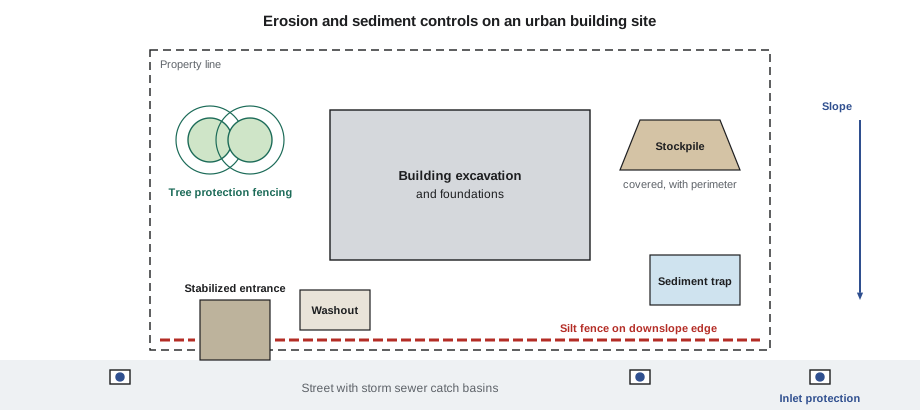
| Control | Purpose | Common failures |
|---|---|---|
| Stabilized construction entrance | Removes mud from vehicle tires before they reach the street | Gravel clogged with mud and not replaced; trucks bypass it |
| Silt fence | Slows sheet flow and traps sediment along downslope edges | Not trenched in, undermined, overtopped or used across channels |
| Inlet protection | Keeps sediment out of storm sewer catch basins | Clogged filters causing street flooding; removed and not replaced |
| Stockpile cover and perimeter | Prevents stockpiled soil from washing or blowing away | Tarps not secured; stockpiles placed near drains |
| Sediment trap or basin | Lets sediment settle from runoff before discharge | Not cleaned out; undersized for the drainage area |
| Concrete washout | Contains high-pH washwater from concrete trucks and tools | Overflowing, leaking or missing, so washwater reaches drains |
| Dewatering treatment | Treats pumped groundwater before discharge | Discharge without a permit or above sediment limits |
Most failures are maintenance failures. Controls installed at mobilization are often damaged by equipment, filled with sediment or removed for access and not replaced. A good practice is to assign a competent person to inspect weekly and after every significant rainfall, keep a log with photos, and fix problems within a set time. Rating system prerequisites for construction pollution prevention generally require exactly this: a plan, implementation and records.
Stormwater and low impact development
Permanent stormwater management is mainly a design matter, but builders install it and protect it during construction. Low impact development (LID) manages rainfall close to where it falls, using bioretention cells and rain gardens, permeable paving, green roofs, infiltration trenches and rainwater harvesting, rather than piping it away quickly. LID features are vulnerable during construction: sediment can clog bioretention soils and permeable paving before the building is even occupied, and heavy equipment can compact areas meant to infiltrate. Builders should fence off infiltration areas, install LID features late in the job after upstream areas are stabilized, and keep construction runoff away from them. CON-111 (lesson 9) covered green and blue roofs.
Dust, noise, light and idling
Construction affects neighbors through dust, noise, vibration, light and traffic, and complaints can lead to stop-work orders, fines and strained relationships with the owner and the community. Dust is controlled by watering haul roads and stockpiles, covering loads, wheel washing, limiting vehicle speeds, using water or vacuum attachments on saws and grinders, and stopping dusty work in high winds; silica dust is also a serious worker health hazard regulated under occupational health and safety rules. Noise is controlled by respecting municipal noise bylaw hours, choosing quieter equipment, siting generators and compressors away from neighbors, using acoustic barriers and planning noisy work for less sensitive times. Light from site lighting should be directed downward and shielded.
Idling diesel and gasoline engines waste fuel, add emissions and expose workers and neighbors to exhaust. Many municipalities and some provinces and states limit idling to a few minutes, with exceptions for equipment that needs to run to work, and many owners and contractors set stricter site rules. Practical measures include idling limits in site orientation, auto-shutdown features on newer equipment, warm shelters for workers in winter so that trucks are not left running, and monitoring fuel use per machine.
Construction greenhouse gas emissions
A contractor's own emissions come mainly from diesel in excavators, loaders, cranes, generators and trucks; gasoline in pickups; propane, diesel or natural gas for temporary heat; and grid electricity for temporary power, lighting, hoists and electric tower cranes. In Canada, temporary heat during winter construction is often the largest source after equipment. Lesson 3 included an estimate of these emissions in module A5. Under the Greenhouse Gas Protocol, a contractor's fuel use is its Scope 1, its purchased electricity is Scope 2, and its purchased materials, subcontractor activities, waste hauling and employee commuting are Scope 3.
| Scope | Contractor emission sources | Typical reduction measures |
|---|---|---|
| Scope 1 | Diesel equipment and generators, gasoline vehicles, propane or diesel temporary heat | Electric or hybrid equipment, idling limits, right-sized equipment, renewable diesel, enclosure and insulation to reduce heat |
| Scope 2 | Grid electricity for temporary power, hoists, cranes and site offices | Early permanent power connection, efficient site offices, renewable electricity purchases |
| Scope 3 | Purchased materials, subcontractors, waste hauling, deliveries, commuting | Low-carbon procurement, waste reduction, consolidated deliveries, carpooling and transit |
# Marlowe Builders' Scope 1 and 2 emissions on Cedar Row from monthly site logs (illustrative)
import random
random.seed(9)
months = 18
winter = {4, 5, 6, 7, 8, 16, 17}             # months needing temporary heat
factors = {'diesel': 10.21, 'gasoline': 8.78, 'propane': 5.72}  # kg CO2 per gallon (EPA factors)
grid = 916 * 0.4536 / 1000                    # kg CO2e per kWh, RFCW subregion (eGRID2023)
log = {'diesel': 0, 'gasoline': 0, 'propane': 0, 'kwh': 0}
for m in range(months):
    heavy = 1.8 if m < 5 else 0.7             # excavation and structure use more equipment
    log['diesel'] += random.gauss(370 * heavy, 40)
    log['gasoline'] += random.gauss(119, 13)
    log['propane'] += random.gauss(950, 105) if m in winter else 0
    log['kwh'] += random.gauss(9000, 1000)
s1 = {k: log[k] * f / 1000 for k, f in factors.items()}
s2 = log['kwh'] * grid / 1000
for k, v in s1.items():
    print(f"Scope 1 {k:9s} {log[k]:8,.0f} gal {v:6.1f} t CO2e")
print(f"Scope 2 electricity {log['kwh']:8,.0f} kWh {s2:5.1f} t CO2e")
total = sum(s1.values()) + s2
print(f"Scope 1 + 2 total: {total:.0f} t CO2e; at an internal price of $100/t: ${total * 100:,.0f}")Scope 1 diesel 6,703 gal 68.4 t CO2e Scope 1 gasoline 2,173 gal 19.1 t CO2e Scope 1 propane 6,157 gal 35.2 t CO2e Scope 2 electricity 160,414 kWh 66.7 t CO2e Scope 1 + 2 total: 189 t CO2e; at an internal price of $100/t: $18,938
Marlowe Builders' Scope 1 and 2 emissions on Cedar Row come to about 189 metric tons. Diesel equipment is a little over a third of the total, propane temporary heat almost a fifth and grid electricity, on an Ohio Valley grid, about a third. Compared with the roughly 2,600 metric tons in the materials Marlowe buys (its Scope 3), the site emissions are small, but they are entirely within the contractor's control, and at an internal carbon price of $100 per metric ton they would carry a notional cost of about $19,000.
An internal carbon price, a notional cost per metric ton used in decisions, helps make emissions visible alongside cost. ACCT-321 (lesson 10) shows how a carbon price can be built into performance measures, and BUS-230 (lesson 12) covers measuring Scope 3 emissions in supply chains. Contractors increasingly report their emissions to owners and lenders, set reduction targets and use the data in bids, and some public owners now ask for construction emissions plans.
Reducing construction emissions
Equipment emissions can be reduced by choosing the right size of machine, maintaining it well, limiting idling and, increasingly, using electric equipment. Battery-electric compact excavators, loaders, telehandlers, scissor lifts and aerial platforms are now commercially available, and electric tower cranes and hoists are common where grid power is available. Electric equipment is quieter and has no exhaust, which helps on urban sites and indoors, but it needs charging infrastructure and adequate temporary power, which must be planned early with the utility. Renewable diesel (hydrotreated vegetable oil) can be used in many existing diesel engines and reduces life cycle emissions substantially, although its tailpipe emissions are similar and its supply and price vary. Newer engines meeting the latest emission tiers reduce particulate matter and nitrogen oxides, which matters for health, but do not reduce carbon dioxide much.
Temporary power should come from the grid wherever possible. A diesel generator typically burns about 0.3 liters of fuel per kilowatt-hour, emitting about 0.8 kilograms of CO2e per kilowatt-hour, which is far more than most grids. Connecting temporary power early, using battery storage to cover peaks, and right-sizing generators when they are unavoidable all cut emissions and noise. Temporary heat can be reduced by enclosing and insulating the building envelope early, using insulated tarps and curing blankets, heating only the areas being worked, using electric heat where the grid is clean, and, with care and the manufacturer's and engineer's approval, using the permanent heating system with protection against dust.
Transport and deliveries can be reduced by consolidating deliveries, using local suppliers, planning just-in-time deliveries to avoid repeat trips, and, on large urban projects, using construction consolidation centers. Worker commuting can be reduced by encouraging carpooling and transit, which also eases parking on tight urban sites.
Tree protection and site ecology
Existing trees take decades to replace, provide shade and stormwater benefits and are often protected by municipal bylaws. Their roots extend well beyond the drip line, and most damage comes from soil compaction, grade changes and trenching in the root zone, not from direct contact. Tree protection zones should be fenced before any work starts, kept clear of stockpiles, parking and washout, and inspected regularly. Where work in the root zone is unavoidable, an arborist should advise on methods such as hand digging, air spading or boring. Topsoil can be stripped, stockpiled and reused for landscaping rather than exported and replaced, and invasive species should not be imported in fill or on equipment.
Worked problem
Grid power instead of generators on Cedar Row
For the first four months of the job, Marlowe Builders planned to run a diesel generator for temporary power, supplying about 9,000 kWh per month at about 0.08 gallons of diesel per kWh. The utility can provide a temporary connection for $18,000 that would replace the generator. Diesel costs $4.00 per gallon and grid electricity $0.14 per kWh. Compare carbon and cost for the four months, using 10.21 kg CO2 per gallon of diesel and the RFCW grid at about 0.42 kg CO2e per kWh.
Show solution
- Generator: 9,000 kWh × 4 months × 0.08 gal/kWh = 2,880 gallons of diesel.
- Generator carbon: 2,880 × 10.21 = 29,400 kg ≈ 29 t CO2e; fuel cost 2,880 × $4.00 = $11,520, plus generator rental.
- Grid: 36,000 kWh × 0.42 = 15,100 kg ≈ 15 t CO2e; energy cost 36,000 × $0.14 = $5,040, plus the $18,000 connection.
- Carbon saving: about 14 t CO2e; cost difference: $23,040 (grid) versus $11,520 plus rental (generator).
- If generator rental and refueling service are more than about $11,500 for the four months, the grid connection also costs less.
Answer: Even on a fossil-heavy grid, the early grid connection roughly halves temporary power emissions, and it reduces noise and exhaust for neighbors and workers. Whether it also saves money depends on generator rental and service costs; it needs to be requested from the utility months in advance.
Common mistakes
MistakeInstalling silt fence at mobilization and never inspecting it again.
InsteadInspect weekly and after rainfall, log findings and repair promptly.
MistakeRelying on sediment control while leaving large areas of soil bare.
InsteadLimit disturbance, phase work and stabilize exposed soil.
MistakeBuilding bioretention and permeable paving early and letting construction runoff reach them.
InsteadProtect LID areas and install them after upstream areas are stabilized.
MistakeRunning diesel generators for temporary power when the grid is available.
InsteadRequest an early temporary connection and right-size any generators.
MistakeIgnoring temporary heat in construction emissions estimates.
InsteadInclude it; in cold climates it can be a major source.
Summary and key terms
- Erosion control keeps soil in place; sediment control captures soil that moves. Erosion control is usually cheaper and more reliable.
- US sites disturbing one acre or more need an NPDES construction stormwater permit and a SWPPP.
- Most control failures are maintenance failures; inspect regularly and after rain.
- Low impact development features must be protected from sediment and compaction during construction.
- Dust, noise, light and idling controls protect neighbors, workers and the project's relationship with the community.
- A contractor's fuel is Scope 1, purchased electricity is Scope 2, and materials, subcontractors and commuting are Scope 3.
- Electric equipment, early grid connection, renewable diesel, idling limits and reduced temporary heat cut construction emissions.
- Tree protection zones must be fenced before work starts; most damage comes from compaction and grade changes.
- Erosion control
- Measures that prevent soil from being detached and moved by water or wind.
- Sediment control
- Measures that capture eroded soil before it leaves a site.
- Stabilized construction entrance
- A gravel pad at a site exit that removes mud from vehicle tires.
- Stormwater pollution prevention plan
- A US permit document describing erosion, sediment and pollution controls and inspections.
- Low impact development
- Stormwater management that controls rainfall close to where it falls using natural processes.
- Concrete washout
- A contained area where concrete trucks and tools are washed, keeping high-pH water out of drains.
- Internal carbon price
- A notional cost per metric ton of CO2e used in an organization's decisions.
- Renewable diesel
- A diesel substitute made from fats and vegetable oils that can be used in many diesel engines.
- Tree protection zone
- A fenced area around a tree's roots that must be kept free of construction activity.
Practice problems
Work each problem on paper first, then reveal the answer to check.
What is the difference between erosion control and sediment control?
Show answer
Erosion control keeps soil in place; sediment control captures it after it moves.
When does a US construction site need an NPDES stormwater permit?
Show answer
When it disturbs one acre or more, or is part of a larger plan.
Name three common erosion and sediment controls.
Show answer
For example, silt fence, inlet protection and a stabilized construction entrance.
Why do most controls fail?
Show answer
Lack of maintenance: they are damaged, clogged or removed and not replaced.
How should LID features be protected during construction?
Show answer
Fence them off, keep runoff and equipment away, and install them late.
Which scope are a contractor's diesel emissions?
Show answer
Scope 1.
What share of Cedar Row's site emissions comes from diesel equipment?
Show answer
A little over a third.
Why is a diesel generator worse than most grids for temporary power?
Show answer
It emits about 0.8 kg CO2e per kWh, more than most grids.
Name two ways to reduce temporary heat emissions.
Show answer
For example, early enclosure and insulation, heating only work areas, insulated tarps.
Where does most tree damage on construction sites come from?
Show answer
Compaction, grade changes and trenching in the root zone.
Lesson quiz · 5 questions
Score 60% or more to complete this lesson.
Create a free account to save your progress, take quizzes and earn a certificate.