
CON-430 · Lesson 1 of 12 · 30 min
Sustainability and the built environment
Buildings are the largest things most people ever make, use or pay for, and they last a long time. A mid-rise apartment building started this year will probably still be standing in 2090. The decisions made while it is designed and built fix most of its environmental footprint for that whole period: how much carbon was released to make its materials, how much energy it will need to stay warm, cool and lit, how healthy the air inside will be, how well it will cope with floods, heat and smoke, and what will happen to its materials when it is finally taken apart. Sustainable construction is the practice of making those decisions deliberately, with evidence, instead of by habit.
This course is written for builders: estimators, project managers, superintendents and construction managers who must deliver green buildings on real budgets and schedules. It assumes the building science from CON-111 (the envelope, materials and an introduction to embodied carbon) and the code framework from CON-140, and it refers to other courses instead of repeating them. CON-410 covers prefabrication and modular construction, CON-260 covers BIM and digital tools, BIOL-208 explains the ecology of climate change, BUS-310 covers corporate sustainability and ESG reporting, BUS-230 covers supply chain emissions, and ACCT-321 shows how a carbon price can be built into performance measures. Detailed mechanical design belongs to the architecture and engineering courses; here we look at systems as a builder must understand them.
Why the built environment matters
The Global Status Report for Buildings and Construction, published by the UN Environment Program and the Global Alliance for Buildings and Construction, is the standard annual reference for the sector. The 2025–2026 edition, published in May 2026, reports that buildings and construction account for about 37 % of global carbon dioxide emissions, nearly half of global material extraction and roughly 11 to 13 % of global economic output. It also notes that about half of the buildings expected to exist in 2050 have not yet been built or renovated, which means that decisions made in this decade will shape the sector's emissions for most of the century. The exact percentages change from edition to edition as methods and data improve, so always check the latest report before quoting a figure.
The 37 % figure combines two quite different things. Most of it comes from operating buildings: burning gas or oil for heat and hot water, and generating the electricity used for lighting, cooling, ventilation, appliances and equipment. The rest comes from making construction materials, especially cement, steel and aluminum, and from construction itself. Builders influence both. They influence operational emissions through the quality of the envelope, airtightness and commissioning, and they influence embodied emissions through material choices, procurement, waste and site energy.
What sustainability means for a building
The word sustainability is used loosely, and a builder needs a working definition. The most widely quoted comes from the 1987 Brundtland Commission report: development that meets the needs of the present without compromising the ability of future generations to meet their own needs. For buildings, that definition is usually broken into three linked dimensions, sometimes called the triple bottom line.
| Dimension | What it means for a building | Examples a builder controls or influences |
|---|---|---|
| Environmental | Carbon, energy, water, materials, waste, land and ecology | Low-carbon concrete mixes, airtightness, waste diversion, erosion control |
| Social | Health, safety, comfort, accessibility, community and equity | Low-emitting materials, construction air quality, local hiring, neighbor relations |
| Economic | First cost, operating cost, durability, asset value and risk | Life cycle costing, commissioning, quality control, resilient detailing |
The dimensions interact. A highly insulated envelope reduces energy cost and carbon but adds material and first cost; a large window area improves daylight and views but can increase heat loss and overheating; a mass timber structure can reduce upfront carbon but changes the fire strategy, moisture protection and insurance. Good sustainable construction is not about maximizing one indicator but about finding the combination that best meets the project's goals within its constraints, and being honest about the trade-offs.
Over the last decade, the focus of green building has shifted. Early green building programs rewarded a wide menu of features, such as bike racks, recycled content and efficient fixtures, with roughly equal weight. Today, carbon is the central metric for most owners, governments and rating systems, with health and resilience close behind. LEED v5, for example, now assigns half of its points to decarbonization. That shift matters for builders because carbon must be measured, which means quantities, product data and records that the contractor is often best placed to provide.
Whole-life carbon
Whole-life carbon is the total greenhouse gas emissions associated with a building over its life: the embodied carbon of making, transporting, installing, maintaining, replacing and eventually disposing of its materials, plus the operational carbon of running it. Lesson 3 explains the standard life cycle stages in detail. For now, two terms matter. Upfront carbon is the part of embodied carbon emitted before the building is occupied, during material production and construction. Operational carbon is emitted year after year while the building is in use, from on-site combustion and from the electricity it buys.
The balance between the two depends strongly on where the building is. On a clean, mostly hydroelectric or nuclear grid, an all-electric building's operational carbon is small and embodied carbon dominates its whole-life total. On a grid that still burns a lot of coal or gas, operational carbon remains large for decades. Upfront carbon also has a timing problem: it is released now, during this decade, when cutting emissions matters most, and nothing done later in the building's life can take it back.
# Whole-life carbon of Cedar Row over a 60-year study period (illustrative)
upfront_t = 2960          # embodied carbon A1-A5, t CO2e (from Lesson 3)
later_embodied_t = 620    # replacements and end of life (B4, C1-C4), t CO2e
energy_mwh = 680          # annual delivered energy, all-electric design, MWh
grids = {'Upstate New York-like grid': 110, 'Ohio Valley-like grid': 416, 'Missouri-like grid': 566}
years = 60
for name, g_per_kwh in grids.items():
    # assume the grid factor falls 2 % per year (compounded), a policy assumption
    op = sum(energy_mwh * 1000 * g_per_kwh * (0.98 ** y) / 1e6 for y in range(years))
    total = upfront_t + later_embodied_t + op
    print(f"{name:27s} operational {op:7,.0f} t  whole-life {total:7,.0f} t  "
f"embodied share {(upfront_t + later_embodied_t) / total:5.1%}")Upstate New York-like grid operational 2,627 t whole-life 6,207 t embodied share 57.7% Ohio Valley-like grid operational 9,935 t whole-life 13,515 t embodied share 26.5% Missouri-like grid operational 13,518 t whole-life 17,098 t embodied share 20.9%
The same all-electric building has an embodied share of a little over half of its whole-life carbon on an upstate New York-like grid, but only about a quarter on an Ohio Valley-like grid and about a fifth on a Missouri-like grid, even with the assumption that every grid gets 2 % cleaner each year. The lesson for builders is that both halves matter, but which half matters more is a local question. Where grids are clean, the biggest remaining lever is usually materials; where they still burn a lot of coal and gas, energy efficiency, on-site renewables and fuel choice still dominate.
Key terms that are often confused
Marketing language around green buildings is full of claims that sound similar but mean different things. A builder who signs a contract promising a net zero building needs to know which definition applies, because the cost and risk of each are very different.
| Term | Usual meaning | Watch for |
|---|---|---|
| Net zero energy | On-site renewables produce at least as much energy as the building uses over a year | Site or source energy basis; whether exported power counts |
| Net zero energy ready | Efficient enough that renewables could make it net zero, but they are not installed yet | Often a code tier or labeling program target |
| Zero carbon (operational) | Annual operational emissions are zero after counting clean energy and, in some programs, offsets | Whether offsets or certificates may be used, and their quality |
| Zero carbon (whole-life) | Operational and embodied carbon both accounted for and balanced | Very few buildings meet this today without offsets |
| Carbon neutral | Emissions balanced by offsets, often with no reduction requirement | Can mean little if reduction is not required |
| Low carbon | Reduced compared with a baseline | Always ask: compared with what? |
Two tools appear in many of these definitions. A renewable energy certificate represents the environmental attributes of one megawatt-hour of renewable electricity, and a carbon offset represents a reduction or removal of one metric ton of carbon dioxide equivalent somewhere else. Both are legitimate tools when they are high quality, but they have been criticized for weak additionality, double counting and impermanence, and the better programs now require real on-site reductions first and limit how offsets can be used. Builders should be careful about claims and avoid promising outcomes, such as net zero operation, that depend on how the owner runs the building.
The running example: Cedar Row
Throughout this course we follow one invented project. Cedar Row is an eight-story mixed-use building in Harrowgate, an invented city on the southern shore of Lake Erie in Ohio. It has 96 rental homes over about 6,500 square feet of ground-floor retail, with one level of underground parking. The gross floor area is about 116,000 square feet (10,800 square meters), of which about 90,400 square feet (8,400 square meters) is above grade and conditioned. The owner is Harrowgate Community Housing, a nonprofit; the architect is Fenwick Studio; and the construction manager is Marlowe Builders, brought on at schematic design under a construction manager at-risk contract. Every number in the example is illustrative.
The owner wants a building that is cheap to run, healthy for tenants, resilient to heat waves and basement flooding, and low in carbon. Its lenders and funders require third-party certification, and the city's energy benchmarking ordinance will apply once it is occupied. Two structural options are on the table: Option A, a conventional cast-in-place concrete flat plate, and Option B, a mass timber superstructure over a two-story concrete podium. In later lessons we calculate the embodied carbon of each option, model the energy use and operational carbon, choose a rating system pathway, plan waste and site practices, and assemble the whole strategy in the capstone.
Who controls what
Sustainability outcomes are shared among many parties, and responsibilities must be written into contracts and specifications. A common cause of disappointment on green projects is that each party assumes another is responsible for a target.
| Party | Main sustainability levers | Typical documents |
|---|---|---|
| Owner | Sets goals and budget, chooses delivery method and rating system, operates the building | Owner project requirements, funding conditions |
| Designers | Form, orientation, envelope, systems, structure, material specifications | Basis of design, drawings, specifications, energy model, LCA |
| Construction manager or general contractor | Constructability and cost advice, procurement, substitutions, site practices, quality, records | Sustainability plan, waste plan, submittals, credit documentation |
| Trades and suppliers | Product choice within the specification, installation quality, packaging | Product data, EPDs, test reports |
| Commissioning authority | Verifies that systems are designed, installed and working as intended | Commissioning plan, functional tests, reports |
| Operator and occupants | Settings, maintenance, behavior | Operations manual, training records |
The contractor's influence is larger than many people assume. Substitution requests can quietly undo a low-carbon specification: a supplier offers a cheaper insulation with a high global warming potential blowing agent, or a concrete mix with more cement to speed up stripping. Poor air barrier workmanship can double the air leakage the energy model assumed. A missing record can lose a rating system credit that was designed in. And on the positive side, early contractor involvement lets the team price alternatives honestly, find low-carbon products that local suppliers can actually provide, and plan the site to cut waste and emissions.
Costs, benefits and contested questions
Does building green cost more? The honest answer is that it depends on the target, the market and how early the goals are set. Studies of certified buildings have generally found modest cost premiums for mainstream certification levels, often 0 to 4 % of construction cost, with larger premiums for very ambitious targets such as Passive House or full net zero, and those premiums tend to fall as the market gains experience. Many measures save money over the building's life through lower energy, water and maintenance costs, and some studies find higher rents, occupancy and sale values for certified buildings, although separating the effect of certification from location and building quality is hard.
Other questions are genuinely contested and involve values as well as evidence. Should governments use carbon pricing, regulations or subsidies to drive building decarbonization? Supporters of carbon pricing argue that it is the most efficient tool because it lets each emitter find the cheapest reductions; critics argue that it is regressive, politically fragile and weak at overcoming split incentives between landlords and tenants. Canada removed its consumer fuel charge in April 2025 while keeping industrial carbon pricing, and the United States has no federal carbon price. Supporters of regulations, such as energy codes and building performance standards, argue that they deliver certain outcomes; critics point to compliance costs, effects on housing affordability and the burden on small owners. Subsidies are popular with recipients but cost public money and can reward projects that would have happened anyway. This course presents these debates fairly and leaves the policy conclusions to you; a builder's job is to deliver whatever the project and the law require, and to give clients accurate advice about costs and risks.
Habits of a sustainable builder
The rest of the course builds technical skills, but a few habits run through all of it.
- Ask for the targets in writing: carbon, energy, certification, health and resilience, with how each will be measured.
- Price alternatives, not just the base design, and include life cycle costs where the owner will pay them.
- Protect the specification during procurement and substitutions; a cheaper product is not equal if it misses a carbon or emissions limit.
- Keep records as you go: quantities, delivery tickets, product data, waste tickets, test results and photos.
- Treat quality as sustainability: an airtight, well-flashed, properly commissioned building performs better and lasts longer.
- Be careful with claims, and use the precise term for what the project will actually achieve.
Worked problem
Splitting whole-life carbon on Cedar Row
Using the whole-life results above, the owner asks whether Marlowe Builders should spend its value engineering effort on structure (embodied carbon) or on mechanical systems and the envelope (operational carbon). Assume a 60-year study period and an Ohio Valley-like grid.
Show solution
- Embodied carbon (upfront plus later): 2,960 + 620 = 3,580 t CO2e.
- Operational carbon over 60 years on the Ohio Valley-like grid: about 9,940 t CO2e for the all-electric design.
- Whole-life total: about 13,520 t CO2e, of which embodied carbon is only about 26 %.
- Upfront carbon alone (2,960 t) is still emitted before occupancy and cannot be reduced later.
- Each 10 % cut in energy use saves roughly 990 t over the study period, more than most single material changes.
Answer: On this grid, energy efficiency, on-site solar and clean power purchasing deserve the most attention, but upfront carbon should not be ignored: a 20 % cut would still save about 590 t CO2e, emitted now rather than spread over 60 years.
Common mistakes
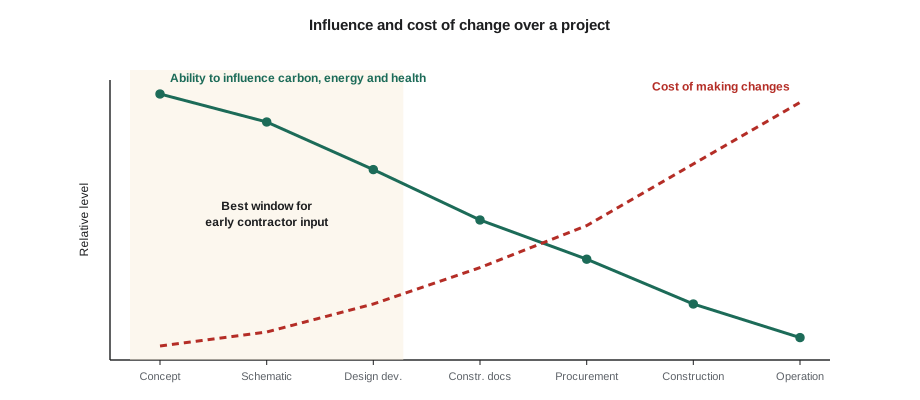
MistakeTreating sustainability as a list of features to add at the end of design.
InsteadSet measurable goals early, when the ability to influence outcomes is highest.
MistakeAssuming operational carbon always dominates whole-life carbon.
InsteadCheck the local grid; on clean grids embodied carbon often dominates.
MistakePromising a net zero building without defining the term.
InsteadWrite down the definition, boundary and who controls each part of the outcome.
MistakeApproving substitutions on price alone.
InsteadCheck carbon, emissions and performance data before accepting an equal.
MistakeQuoting an old figure for the sector's share of emissions.
InsteadCheck the latest Global Status Report and cite its year.
Summary and key terms
- Buildings and construction account for about 37 % of global CO2 emissions and nearly half of material extraction, according to the 2025–2026 Global Status Report.
- Sustainability has environmental, social and economic dimensions that interact and require trade-offs.
- Carbon has become the central metric of green building, with health and resilience close behind.
- Whole-life carbon combines embodied carbon (materials and construction) and operational carbon (energy use).
- Upfront carbon is emitted before occupancy and cannot be reduced later.
- The balance between embodied and operational carbon depends strongly on the local electricity grid.
- Terms such as net zero, zero carbon and carbon neutral have different meanings that must be defined in contracts.
- Builders influence outcomes through pricing, procurement, substitutions, workmanship, site practices and records.
- Policy tools such as carbon pricing, regulation and subsidies are contested; builders deliver what the project and law require.
- Sustainable construction
- Planning, building and operating buildings to meet present needs while reducing environmental harm and protecting future generations.
- Triple bottom line
- Assessment of performance on environmental, social and economic dimensions together.
- Whole-life carbon
- All greenhouse gas emissions associated with a building over its life, embodied and operational.
- Embodied carbon
- Emissions from making, transporting, installing, maintaining, replacing and disposing of building materials.
- Upfront carbon
- The part of embodied carbon emitted before a building is occupied.
- Operational carbon
- Emissions from the energy used to operate a building.
- Net zero energy
- A building whose on-site renewable energy production equals or exceeds its annual energy use.
- Carbon offset
- A credit representing one metric ton of CO2 equivalent reduced or removed elsewhere.
- Renewable energy certificate
- A certificate representing the environmental attributes of one megawatt-hour of renewable electricity.
Practice problems
Work each problem on paper first, then reveal the answer to check.
What share of global CO2 emissions does the 2025–2026 Global Status Report attribute to buildings and construction?
Show answer
About 37 %.
Name the three dimensions of sustainability.
Show answer
Environmental, social and economic.
What is upfront carbon?
Show answer
Embodied carbon emitted before occupancy, during material production and construction.
Why does the local grid matter to whole-life carbon?
Show answer
It sets the carbon intensity of electricity, so it decides how large operational carbon is for an electric building.
What is the difference between net zero energy and net zero energy ready?
Show answer
Net zero energy has renewables installed that meet annual use; net zero energy ready is efficient enough but has not installed them.
Give two ways a contractor can undermine a low-carbon specification.
Show answer
For example, approving high-carbon substitutions or poor air barrier workmanship.
Why is the ability to influence outcomes highest early in a project?
Show answer
Few decisions are fixed, so changes are cheap; later, changes require redesign and rework.
On Cedar Row with an all-electric design, why does the embodied share differ so much between locations?
Show answer
Because grid carbon intensity sets the size of operational carbon.
What question should you ask about any low-carbon claim?
Show answer
Compared with what baseline?
Give one argument for and one against carbon pricing.
Show answer
For: efficient, lets emitters find the cheapest cuts. Against: regressive or politically fragile, weak on split incentives.
Lesson quiz · 5 questions
Score 60% or more to complete this lesson.
Create a free account to save your progress, take quizzes and earn a certificate.