
CON-430 · Lesson 6 of 12 · 25 min
Energy codes and building performance standards in the US
Energy codes set the minimum energy performance for new buildings and major renovations, and building performance standards increasingly set limits for existing buildings. Together they are the main regulatory driver of operational energy and carbon. CON-140 explained how the International Code Council's model codes are developed and adopted by states and cities; this lesson looks at the energy codes and standards themselves, the stretch codes some jurisdictions use to go further, and the benchmarking and performance rules that apply once a building is occupied. Codes change frequently and adoption varies by state and city, so treat the details here as a map dated 2026 and always check the edition in force where you build.
How energy codes work
Energy codes usually offer two or three compliance paths. A prescriptive path sets minimum values for each component, such as maximum U-values for walls, roofs and windows, minimum equipment efficiencies, lighting power limits and controls. A trade-off path lets a better component offset a weaker one within limits. A performance path compares an energy model of the proposed building with a model of a reference building that just meets the prescriptive requirements, and the proposed building must use no more energy (or emit no more, in codes with emissions metrics) than the reference. Performance paths give designers flexibility but depend on modeling skill and honest inputs, and most also have mandatory requirements, such as airtightness and controls, that apply whatever the path.
For builders, codes create two practical responsibilities. First, what is built must match what was approved: a substituted window, a missing thermal break or a different mechanical unit can make the building non-compliant even if it was compliant on paper. Second, more codes now require tests and documentation during construction, such as airtightness tests, commissioning reports and as-built energy model updates, which must be scheduled and paid for.
The model energy codes
The two main model energy codes in the United States are the International Energy Conservation Code (IECC), published by the International Code Council every three years, and ANSI/ASHRAE/IES Standard 90.1, which the IECC allows as an alternative for commercial buildings and which is the federal reference standard for commercial energy codes. The IECC has separate residential and commercial provisions; mid-rise apartment buildings of four stories or more fall under the commercial provisions and 90.1. The 2021 and 2024 IECC and 90.1-2022 are the most recent editions, and the 2024 IECC added requirements for additional efficiency credits, electric-ready and renewable-ready provisions, some of them in appendices that jurisdictions can choose to adopt.
State adoption is uneven. Some states adopt each new IECC edition promptly, others lag by one or more editions, some have no statewide code and leave adoption to local governments, and some, such as California with its Title 24 Part 6 standards and Washington and Oregon with their own state energy codes, write their own codes that often exceed the IECC. Federal law requires the Department of Energy to determine whether each new edition saves energy and requires states to certify that their commercial codes meet the latest 90.1 edition, but enforcement of that requirement is limited. Federal funding to help states adopt the latest codes was part of the 2022 Inflation Reduction Act, and its status has changed with later federal budget decisions, so check before relying on it.
Stretch codes and state standards
Many states and cities go beyond the base code. Stretch codes are optional, more stringent codes that local governments can adopt; Massachusetts, for example, has a stretch energy code and a municipal opt-in specialized code with net zero provisions. New York's state energy code and New York City's local energy code exceed the IECC, and Washington state's energy code is among the most stringent and favors heat pumps for space and water heating. Some cities tried to ban gas connections in new buildings; a 2023 federal appeals court decision against Berkeley's ban led many cities to shift to other approaches, such as all-electric preferences in energy codes or emissions limits, and the legal picture continues to evolve.
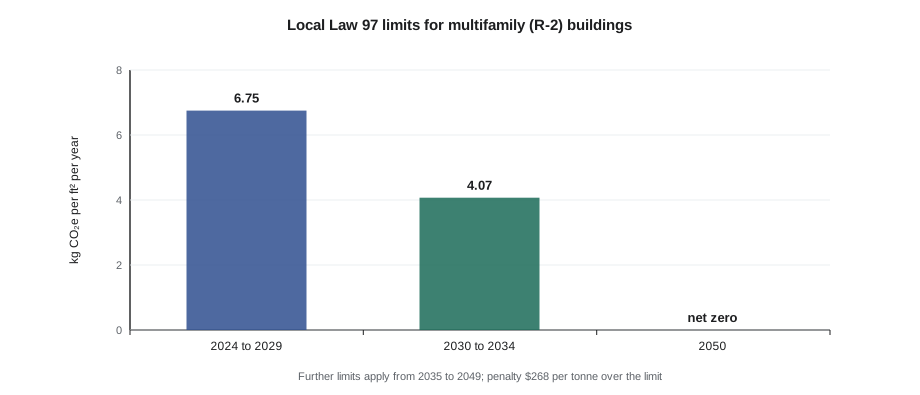
# Local Law 97-style emissions and penalties (coefficients and R-2 limits for 2024-2029 and 2030-2034)
ELEC, GAS = 0.000288962, 0.00005311     # t CO2e per kWh and per kBtu (2024-2029 coefficients)
LIMITS = {'2024-2029': 0.00675, '2030-2034': 0.00407}   # t CO2e per ft2 per year, multifamily (R-2)
PENALTY = 268                            # dollars per t CO2e over the limit
buildings = {   # name: (gross ft2, electricity kWh/yr, gas kBtu/yr)
    'Cedar Row, gas design':        (90400, 462000, 2237000),
    'Cedar Row, heat pump design':  (90400, 678000, 0),
    '1970s apartment building':     (120000, 1600000, 9500000),
}
for name, (ft2, kwh, kbtu) in buildings.items():
    e = kwh * ELEC + kbtu * GAS
    out = [f"{name:28s} {e:5.0f} t/yr"]
    for period, lim in LIMITS.items():
        over = max(0.0, e - lim * ft2)
        out.append(f"{period}: limit {lim * ft2:4.0f} t, penalty ${over * PENALTY:8,.0f}")
print(' | '.join(out))Cedar Row, gas design 252 t/yr | 2024-2029: limit 610 t, penalty $ 0 | 2030-2034: limit 368 t, penalty $ 0 Cedar Row, heat pump design 196 t/yr | 2024-2029: limit 610 t, penalty $ 0 | 2030-2034: limit 368 t, penalty $ 0 1970s apartment building 967 t/yr | 2024-2029: limit 810 t, penalty $ 42,045 | 2030-2034: limit 488 t, penalty $ 128,234
Both Cedar Row designs would comply easily with New York City's Local Law 97 limits for 2024–2029 and 2030–2034 if the building were in New York, because they are new and efficient. The 1970s building, by contrast, would pay about $42,000 a year in penalties during the first compliance period and about $128,000 a year in the second, which is why owners of older buildings are planning heat pump retrofits, envelope upgrades and controls improvements. For contractors, building performance standards are creating a large retrofit market in existing buildings.
Building performance standards
Building performance standards (BPS) set limits on energy use or emissions for existing buildings, usually large ones, with penalties for non-compliance. New York City's Local Law 97 covers most buildings over 25,000 square feet, sets emissions limits by occupancy type that tighten in 2030 and again toward net zero by 2050, and charges $268 for each metric ton of CO2e over the limit. Boston's BERDO 2.0, Washington state's Clean Buildings Performance Standard (based on energy use intensity targets, with the largest buildings due to comply from 2026), Denver's Energize Denver, and statewide standards in Colorado and Maryland follow similar principles. Most build on benchmarking ordinances that require annual reporting through ENERGY STAR Portfolio Manager. Legal challenges and amendments are common: an appeals court revived a preemption challenge to Local Law 97, but the law remained in full effect in 2026 while the litigation continued.
ENERGY STAR Portfolio Manager, the free tool most benchmarking laws rely on, faced proposed elimination in 2025. Congress funded ENERGY STAR for fiscal year 2026, and in March 2026 the Environmental Protection Agency and the Department of Energy agreed to make DOE the program's lead agency, with systems and partnerships moving over during 2026. Builders and owners should watch for changes to tools and scores, but benchmarking requirements in state and local law continue regardless.
Federal incentives and their end
For several years, two federal tax incentives shaped green building economics. Section 179D provided a deduction for energy-efficient commercial and large multifamily buildings, and Section 45L provided a credit to builders of energy-efficient homes, including multifamily units, both expanded by the Inflation Reduction Act in 2022. The One Big Beautiful Bill Act of 2025 ended them early: 179D is not available for property whose construction begins after June 30, 2026, and 45L is not available for homes acquired after June 30, 2026. Projects already under construction or completed before those dates may still qualify if they meet the requirements, including prevailing wage rules for the larger amounts. The federal Buy Clean program for low-carbon materials was also ended in 2025 (Lesson 12). For Cedar Row, which starts construction after mid-2026, neither incentive is available, so the business case must rest on operating savings, local incentives, utility programs and the owner's own goals.
Policy views differ sharply on these instruments. Supporters of stringent codes and performance standards argue that buildings last for decades, that efficiency is cheapest to build in at the start, and that markets underinvest because of split incentives between owners and tenants. Critics argue that each increment adds to construction and housing costs, that rules written for large cities may not suit small towns or cold rural regions, and that incentives and information may achieve similar results with less burden. Builders should be able to explain the costs and benefits of each option accurately to clients, whatever their own views.
What codes mean on site
Code compliance is increasingly verified by testing and documentation rather than drawings alone. A builder should expect to provide some or all of the following, and to plan time and money for them.
| Item | Purpose | Builder's role |
|---|---|---|
| Energy model and compliance report | Shows the design meets the chosen path and tier | Report substitutions that affect inputs; support as-built updates |
| Envelope submittals | Verify U-values, thermal breaks and air barrier products | Check effective, not nominal, values; hold substitutions to equal performance |
| Airtightness test | Confirms air leakage meets the required or modeled rate | Schedule early and final tests; fix leaks before finishes |
| Commissioning report | Verifies systems work as designed | Complete checklists, functional tests and deficiency corrections |
| Equipment schedules | Verify efficiency ratings and refrigerants | Confirm installed models match approved schedules |
| Benchmarking data | Annual reporting after occupancy | Provide meter information and documentation at handover |
Worked problem
Penalty exposure for an existing building
Marlowe Builders is asked to price a retrofit of the 1970s apartment building in the code above. The owner wants to avoid penalties in 2030–2034. The building emits about 967 t CO2e per year against a 2030 limit of about 488 t. A proposed package converts heating and hot water from gas to heat pumps, increasing electricity use by 1,100,000 kWh per year and eliminating gas use.
Show solution
- Current penalty in 2030–2034: (967 − 488) × $268 ≈ $128,000 per year.
- After retrofit, electricity: 1,600,000 + 1,100,000 = 2,700,000 kWh × 0.000288962 ≈ 780 t CO2e.
- Gas: zero, so total about 780 t, still about 292 t over the 2030 limit.
- Remaining penalty: 292 × $268 ≈ $78,000 per year; envelope and ventilation improvements are also needed.
- Note that the 2030–2034 electricity coefficient is expected to be lower than the 2024–2029 value used here, which would reduce the post-retrofit emissions.
Answer: Fuel switching alone is not enough; the owner needs a combined package of electrification, envelope, ventilation heat recovery and controls, phased to meet each compliance period. Builders who can price and sequence such packages in occupied buildings are in demand.
Common mistakes
MistakeAssuming the latest national or model code applies everywhere.
InsteadCheck the edition and amendments adopted where the project is located.
MistakeSubstituting envelope or mechanical products without checking the energy model.
InsteadConfirm substitutions keep the compliance path and tier valid.
MistakeTreating efficiency of heating equipment as a way to meet a demand intensity limit.
InsteadDemand intensity measures envelope and ventilation losses; improve those.
MistakeLeaving airtightness testing to the end of the project.
InsteadTest early, when leaks can still be fixed.
MistakeRelying on incentives without checking their current status.
InsteadVerify program rules and deadlines; many changed in 2025 and 2026.
Summary and key terms
- Energy codes offer prescriptive, trade-off and performance paths, with mandatory requirements in each.
- The IECC and ASHRAE 90.1 are the main model energy codes; mid-rise multifamily buildings follow the commercial provisions.
- State adoption varies widely; some states write their own codes, and stretch codes let cities go further.
- Building performance standards such as NYC Local Law 97 limit emissions or energy use in existing buildings, with penalties.
- Sections 179D and 45L ended for projects starting construction, or homes acquired, after June 30, 2026.
- Codes increasingly require testing and documentation during construction, which builders must plan and fund.
- Views on codes, standards and incentives differ; builders should explain costs and benefits accurately.
- Prescriptive path
- A code compliance path that sets minimum requirements for each component.
- Performance path
- A compliance path comparing an energy model of the proposed building with a reference building.
- Reference building
- A modeled version of the building that just meets the prescriptive requirements.
- Tiered energy code
- A code with several levels of performance that jurisdictions can adopt in steps.
- Stretch code
- An optional, more stringent code that a jurisdiction may adopt.
- Thermal energy demand intensity
- Annual heating energy needed per unit of floor area, regardless of the heating system.
- Building performance standard
- A regulation setting energy or emissions limits for existing buildings.
- Benchmarking
- Measuring and reporting a building's energy use and comparing it with similar buildings.
- Net zero energy ready
- A building efficient enough that on-site or nearby renewables could meet its annual energy use.
Practice problems
Work each problem on paper first, then reveal the answer to check.
Name the three common energy code compliance paths.
Show answer
Prescriptive, trade-off and performance.
Which energy standard is the federal reference for commercial codes?
Show answer
ASHRAE 90.1.
Which code provisions does a six-story apartment building usually follow?
Show answer
The commercial provisions of the IECC or ASHRAE 90.1.
What is a stretch code?
Show answer
An optional, more stringent code a jurisdiction can adopt.
What does Local Law 97 charge for emissions above the limit?
Show answer
$268 per metric ton of CO2e.
Which buildings does Local Law 97 mainly cover?
Show answer
Most buildings over 25,000 square feet.
When did 179D end for new projects?
Show answer
For property whose construction begins after June 30, 2026.
Why does fuel switching alone not bring the 1970s building under its 2030 limit?
Show answer
Electricity still has emissions; envelope and ventilation improvements are also needed.
Name two code-related tests or documents a builder supports.
Show answer
For example, airtightness tests and commissioning reports.
Give one argument against stringent building performance standards.
Show answer
They can impose high costs on owners, especially small owners and affordable housing.
Lesson quiz · 5 questions
Score 60% or more to complete this lesson.
Create a free account to save your progress, take quizzes and earn a certificate.