
CON-430 · Lesson 7 of 12 · 26 min
LEED, ENERGY STAR and US programs
Green building rating systems are voluntary frameworks that define what a green building is, award points or levels for meeting requirements, and verify the result through a third party. They matter to builders because owners, lenders, tenants and governments often require them, and because many credits depend directly on how a building is constructed and documented. A rating system can be a powerful organizing tool for a project team, or an expensive paperwork exercise that adds little; the difference usually lies in whether the system chosen matches the owner's real goals and whether the team plans for it from the start. This lesson surveys the main systems used in North America, explains how they differ, and focuses on the credits and documentation a contractor is responsible for.
Types of rating systems
Rating systems differ in what they assess, when they assess it and how. Some, such as LEED for new construction, assess the design and construction of a building and certify it around completion. Others assess actual operating performance, typically over 12 months, and must be renewed. Some focus on a single issue, such as carbon, energy or health, while others cover a broad range of topics. Some award points from a menu, so teams choose which credits to pursue; others set mandatory performance thresholds that every project must meet. Understanding these differences helps a team pick a system that supports its goals rather than distracting from them.
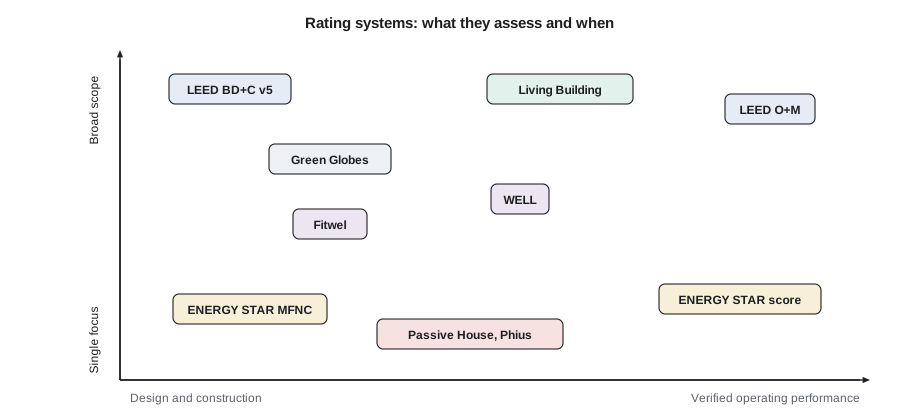
LEED v5
Leadership in Energy and Environmental Design (LEED) is the most widely used green building rating system in the world. It was created by the US Green Building Council (USGBC), with certification by Green Business Certification Inc. (GBCI). LEED has rating systems for building design and construction (BD+C), interior design and construction (ID+C), operations and maintenance (O+M), and neighborhoods and homes. USGBC members ratified LEED v5 in 2025, and certification under it is now available for new construction, interiors and operations. Under the transition schedule announced by USGBC, projects can still register under LEED v4 and v4.1 until June 30, 2027.
LEED v5 is organized around three impact areas: decarbonization, which accounts for half of the available points, ecological conservation and restoration (a quarter) and quality of life (a quarter). Compared with v4, it places much more weight on operational and embodied carbon, electrification and refrigerants, and it introduces prerequisites that require teams to assess climate resilience and the building's human impacts and to quantify embodied carbon and plan for operational decarbonization; check the current rating system for the exact list. The certification levels remain Certified (40 to 49 points), Silver (50 to 59), Gold (60 to 79) and Platinum (80 or more) out of 110 points, and USGBC has said Platinum projects in v5 must meet additional requirements, including a 20 % reduction in embodied carbon.
A LEED project registers early, builds a scorecard of targeted credits, documents each prerequisite and credit through an online platform, and submits for review, usually in two stages (design and construction). Reviewers may ask for clarification before awarding points. Because points are uncertain until the review is complete, experienced teams target more points than the level needs.
# Monte Carlo check of a LEED v5 scorecard for Cedar Row (illustrative credits and odds)
import random
random.seed(430)
# credit group: (points targeted, probability each point is earned)
card = {
    'Operational carbon and energy':      (14, 0.85),
    'Embodied carbon and materials':      (9, 0.70),
    'Refrigerants and electrification':   (5, 0.90),
    'Location, transport and site':       (12, 0.95),
    'Water efficiency':                   (5, 0.90),
    'Ecology, heat island and rainwater': (6, 0.75),
    'Indoor environmental quality':       (10, 0.80),
    'Resilience and quality of life':     (5, 0.70),
    'Integrative process and innovation': (5, 0.80),
}
target = sum(p for p, _ in card.values())
runs = 20000
totals = []
for _ in range(runs):
    totals.append(sum(sum(random.random() < pr for _ in range(n)) for n, pr in card.values()))
totals.sort()
expected = sum(n * pr for n, pr in card.values())
p_gold = sum(t >= 60 for t in totals) / runs
print(f"Points targeted: {target}; expected: {expected:.1f}")
print(f"5th to 95th percentile: {totals[int(0.05 * runs)]} to {totals[int(0.95 * runs)]}")
print(f"Probability of reaching Gold (60 points): {p_gold:.0%}")Points targeted: 71; expected: 58.6 5th to 95th percentile: 53 to 64 Probability of reaching Gold (60 points): 40%
Targeting 71 points sounds comfortable for Gold, which needs 60, but if each point has the probability shown of being earned, the expected score is only about 59 and the chance of reaching Gold is about 40 %. The simulation makes visible what experienced LEED consultants know: a buffer of 10 points may not be enough if many credits are uncertain. The team can either target more points or reduce uncertainty by locking in credits early, for example by confirming the energy model results and assigning clear owners for each credit.
ENERGY STAR
ENERGY STAR is a federal program that began at the Environmental Protection Agency in 1992 and covers appliances, equipment, homes and commercial buildings. For existing commercial and multifamily buildings, ENERGY STAR Portfolio Manager calculates a 1 to 100 score comparing a building's source energy use with similar buildings nationwide, adjusted for climate and use; buildings scoring 75 or higher, verified by a licensed professional, can earn ENERGY STAR certification for that year. For new construction, ENERGY STAR Multifamily New Construction and ENERGY STAR Certified Homes set efficiency, ventilation, insulation and quality requirements verified by raters, and the Department of Energy's Zero Energy Ready Home program builds on them. In March 2026, DOE became the lead agency for ENERGY STAR under an agreement with EPA, after Congress funded the program for fiscal year 2026; teams should watch for changes to tools and program requirements during the transition.
ENERGY STAR is unusual in that it focuses on energy, not on a broad menu of credits, and it is free to use. For builders, ENERGY STAR new construction programs mean inspections by a rater at key stages, such as before insulation is covered, and testing of air leakage and ventilation at completion; failing an inspection can delay drywall. For owners, a strong Portfolio Manager score supports benchmarking compliance and tenant marketing, and many building performance standards accept ENERGY STAR data.
Energy and carbon performance standards
Passive House is a performance standard focused on very low heating and cooling demand through superinsulation, high-performance windows, minimal thermal bridging, exceptional airtightness and heat recovery ventilation. The Passive House Institute's Classic criteria include a space heating demand of no more than 15 kWh/m²·yr (or a peak heating load of 10 W/m²), airtightness of no more than 0.6 ACH50 and a limit on renewable primary energy demand. In North America, the Phius standard, administered by Phius in the United States, sets climate-specific targets and is also used in Canada. Passive House buildings are certified on design and construction quality, with on-site verification of airtightness and ventilation; for builders, the airtightness target demands meticulous detailing and testing at several stages.
The Living Building Challenge, from the International Living Future Institute, is among the most demanding systems. It is organized into seven petals (place, water, energy, health and happiness, materials, equity and beauty) and requires 12 consecutive months of operating data before certification. Its materials petal includes a Red List of chemicals that projects must avoid, which affects product selection and documentation throughout construction.
Health and wellness systems
The WELL Building Standard, from the International WELL Building Institute, focuses on human health. WELL v2 is organized into concepts covering air, water, nourishment, light, movement, thermal comfort, sound, materials, mind and community, and it requires on-site performance testing of air and water quality, lighting and acoustics before certification. Fitwel, developed by the Center for Active Design with roots in US public health research, uses evidence-based strategies to promote health and is generally less costly to pursue. Both are often combined with an energy or carbon system, and both rely on construction practices such as indoor air quality management and low-emitting materials covered in Lesson 10.
Other programs
| Program | Scope | Notes |
|---|---|---|
| LEED O+M | Existing buildings, operating performance | Based on 12 months of data; recertified periodically |
| Green Globes | New and existing buildings | Green Building Initiative program; questionnaire-based with on-site assessment |
| DOE Zero Energy Ready Home | New homes and multifamily | Builds on ENERGY STAR with stricter efficiency and renewable readiness |
| National Green Building Standard | Residential and mixed-use | ICC 700 standard, certified through Home Innovation Research Labs |
| Fitwel and WELL | Health-focused | Often combined with LEED or ENERGY STAR |
| Envision | Infrastructure | For roads, bridges, water and other civil works |
Choosing a system
The right system depends on the owner's goals, funder or tenant requirements, budget and the building type. An owner focused on carbon might choose a carbon standard and add a health system for tenant appeal; an owner whose lender requires a recognized certification might choose LEED; an owner focused on low operating costs and comfort might choose Passive House. Some owners pursue two systems that share documentation. Systems should be chosen early, ideally at concept design, and written into the owner's project requirements and contracts, including who is responsible for each prerequisite and credit and who pays for certification fees, testing and consultant time.
Rating systems have critics as well as supporters. Supporters argue that they create a common language, drive market transformation, and give owners and tenants a credible, verified signal of quality. Critics argue that point-based systems can reward cheap credits over meaningful outcomes, that design-stage certification does not guarantee operating performance, and that documentation costs fall heavily on smaller projects. Newer versions, including LEED v5 and ZCB, respond by weighting carbon heavily and adding performance requirements.
The contractor's credits
Many rating system requirements are delivered or documented by the contractor. Losing them is one of the most common causes of a lower-than-planned certification, so they need clear responsibility, procedures and records from the start of construction.
| Requirement | What the contractor does | Typical records |
|---|---|---|
| Construction activity pollution prevention | Erosion and sediment control, dust control | Plan, inspection logs, photos |
| Construction waste management | Waste plan, source separation, diversion tracking | Hauler reports, tickets, diversion calculations |
| Construction indoor air quality management | Protect ducts and absorbent materials, control sources, flush-out or testing | Plan, photos, filter records, test reports |
| Low-emitting materials | Buy and install compliant products | Product data and emissions certificates |
| Embodied carbon and product disclosure | Collect EPDs and quantities for installed products | EPDs, delivery quantities, as-built LCA inputs |
| Refrigerant management | Install specified equipment and refrigerants, leak-test | Equipment schedules, charge records |
| Commissioning support | Checklists, functional testing, corrections, training | Commissioning reports and issues log |
A practical approach is a sustainability management plan that lists each requirement, the responsible person, the procedure, the records and the submission date, reviewed at regular site meetings. Subcontracts and purchase orders should include the specific requirements, such as low-emitting product certificates or EPDs, so that trades know they must provide them with submittals rather than at the end.
Worked problem
Building a scorecard buffer for Cedar Row
Harrowgate Community Housing needs LEED v5 Gold (60 points) for a funding program. The Monte Carlo check above shows a 40 % chance with 71 targeted points. The team identifies 8 additional points it could target with a 75 % chance each, and it believes better early documentation can raise the probability of the embodied carbon group from 70 % to 85 %.
Show solution
- Original expected score: about 58.6 points.
- Extra points: 8 × 0.75 = 6.0 expected points.
- Better documentation for the embodied carbon group: 9 × (0.85 − 0.70) = 1.35 expected points.
- New expected score: about 58.6 + 6.0 + 1.35 ≈ 66 points.
- Rerunning the simulation with these changes gives a chance of reaching 60 points of more than 95 %.
Answer: Adding points and reducing uncertainty together move Gold from a coin flip to a likely outcome. Marlowe Builders should confirm that the extra credits are affordable and assign an owner and record for each one in the sustainability management plan.
Common mistakes
MistakeChoosing a rating system late in design.
InsteadSelect it at concept design and write responsibilities into contracts.
MistakeTargeting exactly the number of points needed.
InsteadBuild a buffer and reduce uncertainty in key credits.
MistakeLeaving contractor documentation to the end of the project.
InsteadCollect records as work proceeds, with a responsible person for each credit.
MistakeAssuming design-stage certification guarantees operating performance.
InsteadUse commissioning, metering and, where suitable, performance-based certification.
MistakeLeaving rating system requirements out of subcontracts and purchase orders.
InsteadInclude specific product data and documentation requirements.
Summary and key terms
- Rating systems define, score and verify green buildings; they differ in scope, timing and method.
- LEED v5 puts half its points in decarbonization, adds new prerequisites and keeps Certified, Silver, Gold and Platinum levels out of 110 points.
- ENERGY STAR scores existing buildings from 1 to 100 and certifies new homes and multifamily buildings; DOE became its lead agency in 2026.
- Passive House sets strict heating demand and airtightness limits; the Living Building Challenge requires 12 months of performance data.
- WELL and Fitwel focus on health and depend on construction air quality and low-emitting materials.
- Choose a system early to match the owner's goals and write responsibilities into contracts.
- Contractors deliver key requirements such as pollution prevention, waste, construction air quality, product documentation and commissioning.
- Point uncertainty means teams should target a buffer and lock in credits early.
- Rating system
- A voluntary framework that defines, scores and verifies green building performance.
- Prerequisite
- A mandatory requirement in a rating system that earns no points but must be met.
- Credit
- An optional requirement in a rating system that earns points when met.
- LEED
- Leadership in Energy and Environmental Design, the USGBC rating system.
- Zero Carbon Building Standard
- The Canada Green Building Council's carbon-focused certification for design and performance.
- ENERGY STAR score
- A 1 to 100 rating comparing a building's energy use with similar buildings nationwide.
- Passive House
- A performance standard for very low heating and cooling demand and high airtightness.
- WELL Building Standard
- A rating system focused on the health and wellbeing of occupants.
- Sustainability management plan
- A contractor's plan assigning responsibility, procedures and records for each green building requirement.
Practice problems
Work each problem on paper first, then reveal the answer to check.
Name two ways rating systems differ.
Show answer
For example, design versus operations, single issue versus broad, menu versus mandatory thresholds.
What share of LEED v5 points is in decarbonization?
Show answer
About half.
How many points does LEED Gold require?
Show answer
60 to 79 points.
Why did the Cedar Row scorecard have only a 40 % chance of Gold with 71 points targeted?
Show answer
Many credits were uncertain, so the expected score was only about 59.
What does the Living Building Challenge require before certification?
Show answer
Twelve consecutive months of operating data.
What airtightness does Passive House Classic require?
Show answer
No more than 0.6 ACH50.
Name two health-focused rating systems.
Show answer
WELL and Fitwel.
Name three requirements typically delivered by the contractor.
Show answer
For example, construction pollution prevention, waste management and construction air quality management.
What should a sustainability management plan list?
Show answer
Each requirement, responsible person, procedure, records and submission date.
Give one criticism of point-based rating systems.
Show answer
They can reward cheap credits rather than meaningful outcomes.
Lesson quiz · 5 questions
Score 60% or more to complete this lesson.
Create a free account to save your progress, take quizzes and earn a certificate.