
COMP-101 · Lesson 3 of 12 · 22 min
Choosing a certification for your goals
▶ Video coming soon A video version of this lesson is on the way.
Marcus arrives at the third cert club session with a question he has been turning over all week. The library's board wants better reports on how the branches are used, and his manager has suggested he "get certified in something." He has three options in mind: Data+, which matches his work; Tech+, which a colleague recommended because it is short; and Security+, because he has read that it leads to higher salaries. "How do I choose," he asks, "without just picking the one with the best marketing?" Lorna says that is the right question, and that the answer is not a ranking of certifications but a method for matching one to a goal. This lesson is that method.
Start with the work, not the credential
The most common mistake in choosing a certification is starting from the list of certifications. A better starting point is a sentence about the work you want to be doing: the tasks, the tools and the problems. "I want to support staff and public computers across the branches without escalating every hardware problem" points toward A+. "I want to design and run the network for a new branch" points toward Network+ and later the infrastructure pathway. "I want to produce reliable reports the board can trust, and automate the monthly ones" points toward Data+. Once the sentence is written, choosing between credentials becomes a matter of reading their objectives and seeing which one describes that work most closely.
Write the goal as concretely as you can. "Get a better job" is too vague to help. "Move from the circulation desk to a technology support role within a year" is specific enough to compare against job postings and exam objectives. Noor's sentence, written on the first day of the cert club, was "fix things properly instead of guessing." Lorna asks her to sharpen it, and after some discussion it becomes "handle tier 1 and tier 2 tickets for branch computers, printers and accounts without escalating routine problems." That sentence reads almost like the summary of A+, which is a sign that it is a good goal.
Six factors to weigh
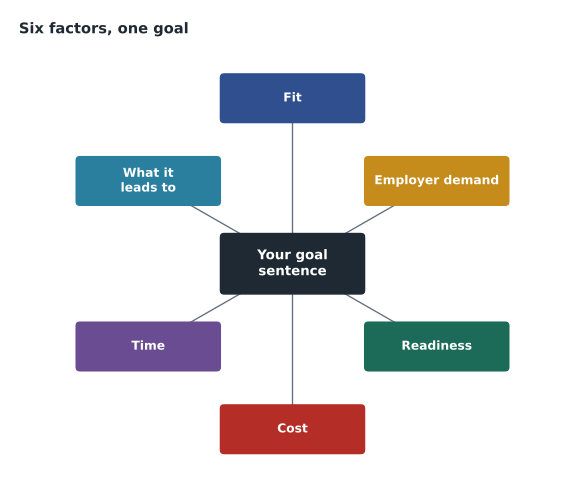
Once you have a goal, weigh each candidate certification against six factors. The first is fit: how closely the exam objectives match the work in your goal sentence. The second is employer demand: how often the credential appears in postings for the roles you want, in the places you want to work. The third is readiness: how much of the material you already know, which affects how long preparation will take. The fourth is cost: the exam fee, study materials, practice tests and the renewal cost over time. The fifth is time: how many weeks of study you can realistically fit around work and life. The sixth is what it leads to: whether it opens the next step on a pathway you care about.
No factor decides alone. A credential with high employer demand but poor fit will be hard to study for and less useful in your actual job. A credential with perfect fit but little employer recognition may still be the right choice if your current employer values it. Readiness and time interact: a credential that covers mostly new material may take months, which is fine if you have months and frustrating if you need a result by spring. Writing the factors down, and scoring each option against them, turns a vague feeling into a decision you can explain.
Researching employer demand
Employer demand is easier to measure than it sounds. Search job sites for the role you want in the city or region where you want to work, collect twenty or thirty postings, and count how often each certification appears and whether it is listed as required or preferred. The count does not need to be precise; you are looking for patterns. If A+ appears in most help desk postings near you and Tech+ appears in few, that tells you which credential local employers use as a screen. Government job sites are worth checking too, because public sector postings often state certification requirements explicitly.
Talk to people as well. Ask the IT staff where you work, or where you would like to work, which certifications they look for when they hire. Ask instructors at local colleges which credentials their graduates earn. Professional groups and online communities can help, but treat individual opinions as data points, not facts. Marcus does this exercise over a week and finds that data analyst postings in the Spokane area mention specific tools, such as SQL, spreadsheets and dashboard software, more often than any certification, and that Data+ appears in a minority of them as preferred. That is useful: it tells him the credential would help, but that demonstrable skills with the tools matter more.
Assessing your own readiness
Readiness is about how much of the exam you could pass today. The best way to estimate it is to read the exam objectives, described in lesson 4, and mark each objective as known, partly known or new. A quick practice test from a reputable source can confirm the estimate, as long as you remember that practice tests vary in quality and difficulty. If most objectives are already known, preparation may take a few weeks of review. If most are new, plan for months and consider a course with hands-on labs.
Recommended experience on the exam page is another guide. A+ Core 1, for example, lists 12 months of hands-on experience in an IT support role. If you have less, the exam is still open to you, but you will need to build that experience in a lab, as lesson 10 explains, or through work. Noor has four years of informal support at a branch and a month on the technology team, so she meets the spirit of the A+ recommendation for some topics and not others. Tech+ first gives her a structured review of the basics, which is why she chooses it.
Counting the full cost
The exam fee is the most visible cost but rarely the largest. Add study materials, practice tests, any course or lab subscription, and possibly travel to a test center. Add the cost of a retake, because even well-prepared candidates sometimes fail, and CompTIA's retake policy, covered in lesson 6, requires paying the full exam price each attempt. Then add renewal: most CompTIA certifications must be renewed every three years through continuing education, which can involve fees and study time, as lesson 11 explains. Exam prices vary by country and change from time to time, so check the CompTIA store for the price where you will test, and check whether your employer, school or a workforce program will pay.
Time is a cost too. A realistic study schedule for an entry-level exam might be a few hours a week for several weeks; for a harder exam with little prior knowledge, it can be months. Time spent studying is time not spent on something else, and a plan that assumes more hours than you have will fail quietly. Lesson 9 shows how to build a schedule that fits.
| Factor | Question to ask | Where to find the answer |
|---|---|---|
| Fit | Do the objectives describe the work in my goal? | The exam objectives document |
| Employer demand | Do postings for my target role ask for it? | Job sites, employers, instructors |
| Readiness | How much could I pass today? | Objectives self-check, a practice test |
| Cost | What will exam, study, retake and renewal cost? | CompTIA store, employer policy, lesson 11 |
| Time | How many weeks can I give it? | Your calendar, lesson 9 |
| What it leads to | Does it open a next step I want? | The pathway chart, lesson 2 |
A simple scoring matrix
A scoring matrix makes the comparison explicit. List the options in rows and the six factors in columns. Give each factor a weight that reflects how much it matters to you, so that a person with little time might weight time heavily while a person changing careers might weight employer demand most. Score each option from 1 to 5 on each factor, multiply by the weight, and add up the results. The highest total is not automatically the answer, but it shows which option your own priorities favor, and if your gut disagrees with the numbers, that is a sign to look again at the weights.
Marcus builds his matrix in a few lines of Python, which also gives him practice for the scripting that Data+ expects. He weights fit and employer demand most heavily, because his goal is about doing his current job better.
weights = {"fit": 3, "demand": 3, "readiness": 2, "cost": 1, "time": 2, "leads_to": 1}
scores = {
    "Data+":     {"fit": 5, "demand": 3, "readiness": 3, "cost": 3, "time": 3, "leads_to": 4},
    "Tech+":     {"fit": 2, "demand": 2, "readiness": 5, "cost": 4, "time": 5, "leads_to": 2},
    "Security+": {"fit": 1, "demand": 4, "readiness": 1, "cost": 3, "time": 1, "leads_to": 3},
}
totals = {name: sum(weights[f] * s[f] for f in weights) for name, s in scores.items()}
for name, total in sorted(totals.items(), key=lambda kv: -kv[1]):
print(f"{name:10} {total}")Data+ 43 Tech+ 38 Security+ 25
What this code does
It compares three certifications by scoring each on six factors, such as fit with your goals, job demand and cost, on a 1 to 5 scale. Each score is multiplied by how important that factor is and the results are added. The output ranks Data+ first, then Tech+, then Security+.
Data+ comes out on top for Marcus, with Tech+ second because it is quick and inexpensive, and Security+ last because it fits his work poorly and he has little of the background it assumes. The numbers are his own judgments, and someone else with different weights and scores would get a different answer. That is the point: the matrix does not choose for you, it shows you what you already believe in a form you can check.
When someone else chooses for you
Sometimes the choice is made for you. An employer may require a particular certification within a set time after hiring, a contract may name one, or a school program may build a credential into its curriculum. In those cases the six factors still help, but they change from "which certification?" to "how do I prepare for this one efficiently?" Readiness, time and cost become the main questions, and fit matters mostly as a reason to take the material seriously: if your employer requires Security+, it is because the work involves security, and the knowledge will be used.
It is also worth asking the employer what support comes with the requirement. Many organizations pay exam fees, provide study materials or allow study time during working hours, but only if you ask. Fairhaven's policy pays for a passed exam and one retake; another employer might pay up front, or only after a probation period. Knowing the policy before you book avoids surprises, and it can change the cost factor in your matrix completely.
Changing your mind
A decision made today can be revised. Interests change as you learn, jobs change, and certifications themselves change as versions are retired and new credentials appear. The goal sentence is the anchor: if the work you want changes, revisit the choice; if it has not, resist switching just because a different credential is in the news. Lorna's rule of thumb is to review each plan every six months, which is also roughly how often new versions and new credentials are announced, and to change course only when the goal itself has moved.
Worked problem
Choosing between two good options
Dez holds Network+ and Cloud+. His goal is "design and secure the network for the new Eastside branch, opening in 2028." He is choosing between Security+ and CloudNetX. Using the six factors, which should come first?
Show solution
- Fit: the goal includes securing the network, which Security+ covers directly; CloudNetX covers expert-level hybrid network design, which also fits.
- Readiness: Security+ recommends Network+ and two years of experience, which Dez has. CloudNetX is an expert-level exam aimed at people with many years of experience, which he does not yet fully have.
- Time and cost: Security+ is the shorter path; CloudNetX would take far more preparation.
- What it leads to: Security+ strengthens the base that expert-level design assumes, so it makes CloudNetX easier later.
Answer: Security+ first. It fits the goal, matches Dez's readiness and makes the expert credential more achievable later.
At the end of the session, each person writes a one-line decision with a reason. Noor's says "Tech+ first, because it is a quick structured review, then A+, because it matches the job." Marcus's says "Data+, because it matches my work, but build SQL and dashboard skills alongside it, because employers ask for those more." Neither decision is final, and Lorna tells them so. A plan is a draft that gets better as you learn more.
Common mistakes
MistakeChoosing a certification because it has the highest average salary.
InsteadSalary follows the job, and the job follows fit; choose what matches the work you want.
MistakeCounting only the exam fee.
InsteadInclude study materials, a possible retake, time and renewal.
MistakeAsking one person which certification to get.
InsteadCollect postings and several opinions, and look for patterns.
MistakeLetting the scoring matrix decide.
InsteadUse it to make your priorities visible, then judge.
Summary and key terms
- Start from a concrete sentence about the work you want to do.
- Weigh fit, employer demand, readiness, cost, time and what each option leads to.
- Measure employer demand from real postings and conversations in your area.
- Estimate readiness by checking the exam objectives and trying a practice test.
- Count the full cost: exam, study, retake and renewal.
- A weighted scoring matrix makes your priorities visible but does not decide for you.
- Goal sentence
- A concrete description of the work you want to be able to do.
- Employer demand
- How often employers ask for a credential in postings for a role.
- Readiness
- How much of an exam you could pass today.
- Scoring matrix
- A table that scores options against weighted factors.
- Weight
- A number expressing how much one factor matters relative to others.
Practice problems
Work each problem on paper first, then reveal the answer to check.
Rewrite the goal "get into IT" as a useful goal sentence.
Show answer
Example: "Work as a help desk technician supporting staff computers and accounts within a year."
Name the six factors.
Show answer
Fit, employer demand, readiness, cost, time and what it leads to.
Why count retake and renewal costs?
Show answer
Because retakes require paying full price and most certifications must be renewed every three years.
How can you measure employer demand cheaply?
Show answer
Collect twenty or thirty postings for the target role and count how often each certification appears.
In a matrix with weights fit 3 and time 2, an option scores fit 4 and time 5. What do those two factors contribute?
Show answer
3 times 4 plus 2 times 5, which is 22.
Why might Data+ alone be less persuasive than Data+ plus demonstrated SQL skills?
Show answer
Because many analyst postings ask for specific tools more often than for certifications.
Lesson quiz · 5 questions
Score 60% or more to complete this lesson.
Create a free account to save your progress, take quizzes and earn a certificate.