
COMP-101 · Lesson 1 of 12 · 23 min
The CompTIA certification family
▶ Video coming soon A video version of this lesson is on the way.
On the first Thursday in November, Lorna Fitzgerald books the small meeting room on the second floor of the central branch of Fairhaven Regional Library in Spokane, orders sandwiches, and writes one question on the whiteboard: what do you want to be able to do in two years that you cannot do today? Five people from Library Technology Services sit around the table. Noor Abbasi, who moved from the Northgate circulation desk to the technology team a month ago, writes "fix things properly instead of guessing." Dez Okafor-Laine, the network administrator, writes "design the new branch network without calling the vendor." Hana Petrovic writes "keep my CySA+ current and stop being the only person who reads the firewall logs." Lorna nods at each answer and then draws a long horizontal line under the question. "Most of what you wrote," she says, "lines up with a certification. Not because a certificate makes you good at anything, but because a good certification describes a job in enough detail that you can train for it. For the next few weeks we're going to learn how that system works, and by the end of the month each of you will have a written plan." That plan, built one lesson at a time, is what this course is about.
What a certification is, and what it is not
A professional certification is a credential issued by an organization that is not your employer or your school, confirming that you met a published standard on a particular date. In information technology, most certifications are earned by passing one or more proctored exams. A certification is different from a degree or diploma, which shows you completed a program of study over months or years, and from a certificate of completion, which shows only that you attended a course. It is also different from a license to practice: no government requires an IT technician to hold a CompTIA certification in the way a province or state requires an electrician to hold a license, although many employers and some government contracts do require specific certifications as a condition of hiring.
Certifications are useful because they are portable and comparable. A hiring manager in another city who has never heard of the library's IT team can still read "Network+" on a résumé and know roughly what the candidate was tested on, because the exam objectives are public. For the candidate, a certification gives structure: a list of topics, a target date and a clear finish line. What a certification cannot do is prove that you can perform under pressure on a real network with real users. Lorna is blunt about this with the cert club. "A certification gets you an interview," she says. "What you can explain in the interview gets you the job, and what you can do in the first six months keeps it."
Who CompTIA is
CompTIA, the Computing Technology Industry Association, is a non-profit trade association for the technology industry. It is best known for its vendor-neutral certifications, which means its exams test general skills and concepts rather than one company's products. A Cisco certification teaches you to configure Cisco equipment; a Microsoft certification teaches Microsoft services; a CompTIA certification teaches the ideas that apply whichever brand of switch, operating system or cloud provider an employer happens to use. That neutrality is why CompTIA certifications are common first credentials. Someone starting out often does not yet know which vendors their future employer will use, and the vendor-neutral foundation transfers to any of them.
CompTIA does not deliver its exams itself. Its exams are delivered through Pearson VUE, a testing company that runs test centers around the world and an online proctoring service called OnVUE. CompTIA writes and maintains the exams, sets the rules, issues the certifications and runs the continuing education program that keeps them current. Lesson 7 explains booking in detail, and lesson 8 covers the rules of the testing session.
The main certifications at a glance
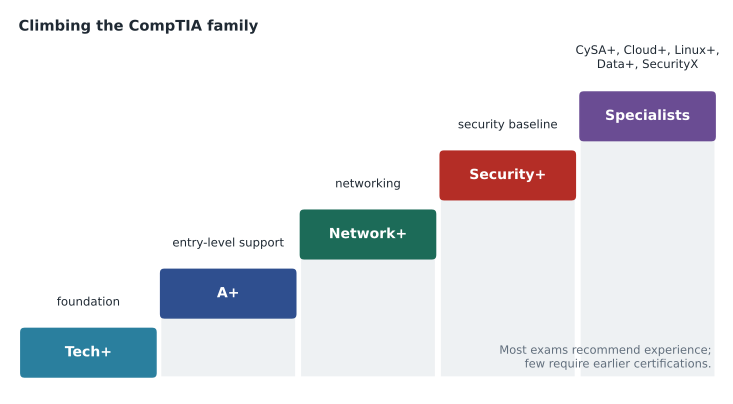
CompTIA offers dozens of credentials, but a small group accounts for most of what employers ask for. At the foundation is Tech+, the successor to the older IT Fundamentals (ITF+) credential. It covers computing basics, infrastructure, applications, software development concepts, data and security, and it is aimed at people exploring whether IT is for them, including high-school and college students. Tech+ is earned with exam FC0-U71. CompTIA's exam page says no prior experience is necessary, the exam has a maximum of 70 multiple-choice questions, lasts 60 minutes, and is passed with 650 on a scale of 900. COMP-110, COMP-111 and COMP-119 in this program prepare you for it.
Above Tech+ sit what CompTIA has long called the core certifications: A+, Network+ and Security+. A+ is the classic entry-level support credential and requires two exams, Core 1 and Core 2, which cover hardware, networking, operating systems, security and troubleshooting. Network+ covers designing, configuring and troubleshooting networks. Security+ is the baseline security credential and is widely used by employers and government agencies as a minimum for security-related roles. Each of these is earned with a single version of its exam at a time, and each version is retired and replaced roughly every three years as technology changes.
Beyond the core are certifications for specific kinds of work. Server+, Linux+ and Cloud+ cover infrastructure: running servers, Linux systems and cloud environments. CySA+ covers security analysis and monitoring, and PenTest+ covers authorized penetration testing. Data+ covers data analysis and DataSys+ covers database administration. Project+ covers IT project management. At the top are what CompTIA now calls Xpert-level certifications, such as SecurityX (formerly CASP+), CloudNetX and DataAI, which are designed for experienced professionals with many years in the field. CompTIA also offers shorter credentials it labels Essentials and Pro, covering topics such as AI, office software and soft skills, which sit outside the main ladder.
| Certification | Focus | Typical candidate |
|---|---|---|
| Tech+ | Computing basics, infrastructure, software, data, security | Students and career changers exploring IT |
| A+ | Hardware, operating systems, support and troubleshooting | Help desk and desktop support technicians |
| Network+ | Network design, configuration and troubleshooting | Junior network administrators and support staff |
| Security+ | Baseline security concepts and practices | Systems and security administrators |
| Linux+, Server+, Cloud+ | Running infrastructure | System administrators and cloud engineers |
| CySA+ | Security monitoring and analysis | Security operations analysts |
| Data+, DataSys+ | Data analysis and database administration | Analysts and database administrators |
| SecurityX, CloudNetX, DataAI | Expert-level design and leadership | Senior engineers and architects |
Why exams change: versions and retirement
Every CompTIA exam has a code, such as FC0-U71 for Tech+ or N10-009 for Network+, and every code belongs to a version. Network+ version 9, for example, is exam N10-009, which CompTIA says launched on June 20, 2024, with retirement usually about three years after launch. When a new version arrives, the old one stays available for a while, usually several months, and then retires. CompTIA's Security+ page, for instance, lists version 7 (SY0-701) as available today, with English retirement scheduled for June 11, 2027, and says version 8 is expected to launch on or around November 17, 2026. During an overlap you can usually choose either version, and both earn the same certification.
Versions matter for two reasons. First, study materials are written for a specific version, so a book for an old exam may leave out topics the new one tests and spend pages on topics it has dropped. Always check the exam code on the cover of a book or the description of a course against the version you plan to take. Second, if your test date is close to a retirement date, plan carefully: if you fail the old version just before it retires, your next attempt will have to be on the new one. Dez, who is thinking about Security+, has exactly this decision to make, and the cert club spends ten minutes on it before moving on.
How employers use certifications
Certifications show up in three places in hiring. The first is job postings, where they often appear as "required" or "preferred" qualifications. Human resources staff and applicant tracking systems may screen résumés for these keywords before a technical person ever reads them. The second is contracts and policies: some government and defense contracts require that technicians working on certain systems hold particular certifications. In the United States, the Department of Defense's cyber workforce framework has long listed CompTIA certifications such as Security+ among the credentials that can satisfy its requirements, which is one reason Security+ is so common. The third is internal progression: some organizations tie pay steps or promotions to certifications, and many pay for exams and training.
The library is an example of the third kind. Fairhaven pays the exam fee for any technology staff member who passes, and reimburses one retake. Lorna negotiated the policy two years ago by showing the board how much the library was spending on outside contractors for work its own staff could learn to do. That policy is one reason the cert club exists, and it is also why Lorna insists that every plan include a realistic date: the budget for the year depends on knowing roughly how many exams will be taken.
A family that keeps changing
The CompTIA family is not fixed. A+ has existed since the 1990s and has been revised many times, from an exam about desktop hardware and early versions of Windows to one that now includes cloud services, mobile devices and scripting. Tech+ replaced IT Fundamentals when CompTIA decided its foundation exam should include more about software development, data and security. CASP+ was renamed SecurityX when CompTIA introduced its Xpert label. New credentials appear as the industry changes, such as recent ones covering AI, operational technology and automation, and older ones are sometimes withdrawn altogether.
For a learner, the practical lesson is to trust the current CompTIA page for a certification over anything else, including this course. Books, videos, forum posts and even colleagues' memories go out of date. Lorna keeps a habit she recommends to everyone in the cert club: before booking any exam, open the official certification page, note the exam code, the number of questions, the length, the passing score and any retirement date, and write those facts at the top of your study plan with the date you checked them. If anything changes before your test date, you will notice, because you will be checking against your own note rather than against memory.
Noor tries it that afternoon for Tech+ and writes five lines in her notebook: FC0-U71, up to 70 questions, 60 minutes, 650 to pass on a scale of 900, no experience required. Underneath she adds the date she checked. It takes three minutes, and it is the first real step of her plan.
Worked problem
Matching people to the family
At the first session, Lorna asks the group to place each person's goal on the ladder. Noor wants to fix things properly; Dez wants to design networks; Hana wants to keep her analyst skills current; Marcus, the data analyst, wants to automate the library's circulation reports. Where does each goal point?
Show solution
- Noor is new to IT and has no certification yet. Tech+ gives her a broad foundation quickly, and A+ matches the support work she now does every day.
- Dez already holds Network+ and Cloud+. His design goal points toward Security+, because a network design has to be secure, and later toward expert-level networking work such as CloudNetX.
- Hana holds Security+ and CySA+. Her goal is mostly renewal, which lesson 11 covers, plus depth in the analysis work CySA+ describes.
- Marcus works with data, not infrastructure. Data+ matches his daily work more directly than any of the core three.
Answer: Noor: Tech+ then A+. Dez: Security+ next. Hana: renew CySA+. Marcus: Data+. The ladder is a map, not a single path.
By the end of the first session, the whiteboard is covered with arrows. Noor notices that nobody's arrow goes straight up the middle of the ladder. Each person enters at a different step and moves in a different direction, which is the point Lorna wanted to make. The next lesson looks at the pathways CompTIA uses to describe those directions.
Common mistakes
MistakeTreating a certification as proof that someone can do the job.
InsteadA certification shows that a standard was met on a date; experience and explanation show the rest.
MistakeBuying any study guide with the right certification name on it.
InsteadCheck the exam code and version, because material for a retired version may miss current topics.
MistakeAssuming every certification has to be taken in order.
InsteadMost CompTIA exams have recommended experience, not required prerequisites.
MistakeThinking vendor-neutral means less useful.
InsteadVendor-neutral knowledge transfers to whatever products an employer uses.
Summary and key terms
- A certification confirms that a published standard was met on a date, usually by passing a proctored exam.
- CompTIA is a non-profit trade association that offers vendor-neutral certifications, delivered through Pearson VUE.
- Tech+ (FC0-U71) is the foundation: a maximum of 70 questions in 60 minutes, passed with 650 on a scale of 900.
- A+, Network+ and Security+ are the core; Linux+, Server+, Cloud+, CySA+, Data+ and others specialize; Xpert certifications such as SecurityX sit at the top.
- Each exam has a code and a version, and versions are usually replaced about every three years.
- Employers use certifications in postings, contracts and internal progression.
- Certification
- A credential from an independent body confirming that a published standard was met.
- Vendor-neutral
- Testing general skills and concepts rather than one company's products.
- Exam code
- The identifier for one version of an exam, such as FC0-U71.
- Retirement
- The date after which an exam version can no longer be taken.
- Pearson VUE
- The testing company that delivers CompTIA exams at test centers and online.
- Xpert
- CompTIA's label for its expert-level certifications, such as SecurityX.
Practice problems
Work each problem on paper first, then reveal the answer to check.
What is the exam code for Tech+?
Show answer
FC0-U71.
How many exams does A+ require?
Show answer
Two: Core 1 and Core 2.
What does vendor-neutral mean?
Show answer
The exam tests general concepts that apply across products, not one company's equipment or services.
Why should you check the exam code on a study guide?
Show answer
Because material written for a retired version may leave out current topics.
Which certification did SecurityX replace?
Show answer
CASP+.
Name two ways employers use certifications.
Show answer
Any two of: screening in job postings, contract or policy requirements, internal pay or promotion steps.
Which company delivers CompTIA exams?
Show answer
Pearson VUE, at test centers or online through OnVUE.
Lesson quiz · 5 questions
Score 60% or more to complete this lesson.
Create a free account to save your progress, take quizzes and earn a certificate.