
COMP-101 · Lesson 12 of 12 · 22 min
Capstone: your personal certification roadmap
▶ Video coming soon A video version of this lesson is on the way.
The last cert club session of November is the one Lorna has been building toward. Each person brings a single page: their personal certification roadmap. The sandwiches are the same as on the first day, the whiteboard still has the faint outline of the question she wrote then, and the five pages laid on the table look nothing like the scribbled goals from four weeks ago. Noor's has a timeline, a checklist and a budget. Dez's has a decision with a reason. Marcus's has a sentence about tools that no certification covers. This final lesson walks through what a good roadmap contains, follows Noor's from start to finish, and ends with a template you can use for your own.
What a roadmap is for
A certification roadmap is a short written plan that connects a career goal to a sequence of credentials, with dates, resources and checkpoints. It is not a promise and not a contract. Its job is to turn the lessons of this course into decisions you have actually made: which certification, why, by when, with what preparation, at what cost, and how you will keep it. Writing those decisions down does two things. It exposes gaps, such as a date that the study hours cannot support. And it gives you something to review and revise, which is far easier than starting from nothing each time your situation changes.
A roadmap should fit on one page. Longer plans tend to be read once and then forgotten; a page can be pinned above a desk, carried to a meeting with a manager, or reviewed in five minutes on a Sunday evening. Detail lives elsewhere: in the objectives checklist from lesson 4, the study schedule from lesson 9 and the CE tracker from lesson 11. The roadmap links them together.
The parts of a roadmap
A complete roadmap has seven parts. The first is the goal sentence from lesson 3, describing the work you want to be doing. The second is the sequence of certifications that leads there, read from the pathways in lesson 2, with a one-line reason for each. The third is the current facts for the first certification: exam code, number of questions, length, passing score and any retirement date, taken from the official page and dated, as lesson 1 recommended. The fourth is the study plan in summary: total hours, weekly sessions and phases, from lesson 9. The fifth is the lab, from lesson 10. The sixth is the booking and exam-day plan, from lessons 7 and 8. The seventh is the long view: how each certification will be renewed, from lesson 11, and when the roadmap itself will be reviewed.
| Part | What it answers | From lesson |
|---|---|---|
| Goal sentence | What work do I want to do? | 3 |
| Sequence | Which certifications, in what order, and why? | 2 and 3 |
| Current facts | Code, questions, length, passing score, retirement, checked on a date | 1, 4, 6 |
| Study plan | How many hours, when, in what phases? | 4 and 9 |
| Lab | Where and how will I practice hands-on? | 10 |
| Booking and exam day | Center or online, ID, accommodations, date | 5, 7 and 8 |
| Long view | How will I renew, and when will I review this plan? | 11 |
Noor's roadmap
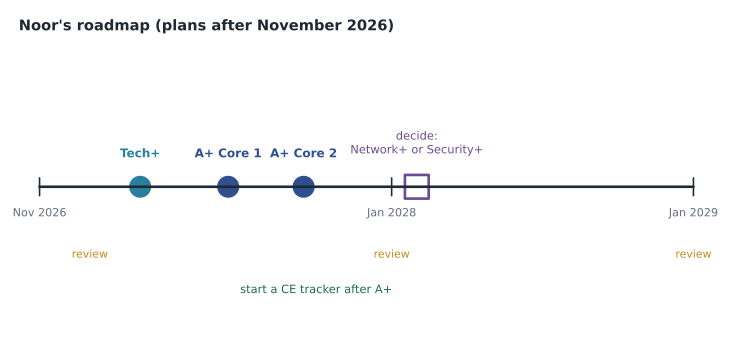
Noor's goal sentence, sharpened in lesson 3, reads: "Handle tier 1 and tier 2 tickets for branch computers, printers and accounts without escalating routine problems, within eighteen months." Her sequence has three steps. First, Tech+, because it is a quick, structured review of the broad basics and will show her where her gaps are. Second, A+ Core 1 and Core 2, because their objectives describe almost exactly the work in her goal and because A+ is the credential local employers ask for. Third, a later decision between Network+ and Security+, which she will make once she has a year of experience in Library Technology Services and knows which part of the work she enjoys most.
Her current facts for Tech+, checked on CompTIA's page in November 2026, are FC0-U71, a maximum of 70 multiple-choice questions, 60 minutes, and 650 on a scale of 900 to pass, with no prior experience required. Her study plan is 48 hours over about sixteen weeks, three hours a week plus the cert club, in four phases, with infrastructure getting the most time because it is both the heaviest domain and her weakest. Her lab is the borrowed desktop from Lorna's shelf and three virtual machines on her laptop, isolated from her household network. She plans to test online from her spare room in March 2027, booking in January once her practice scores are steady, and she has already confirmed that both her IDs match her registered name and expire after 2028.
For the long view, she notes that Tech+ under code FC0-U71 has no expiry, and that A+ will need 20 CEUs every three years, or will renew automatically if she later earns Network+ or Security+. She will review the roadmap at the end of every month in which she takes an exam, and every January. The library pays for passed exams and one retake, so her budget line is short: practice tests and a second-hand A+ book from the library sale, with the exam fees covered by Fairhaven under its policy.
Checking the roadmap with numbers
Before presenting, Noor checks that her dates hang together. If Tech+ is in March and each A+ exam needs about twelve weeks of preparation at her usual pace, with a two-week break after each exam, when would each exam fall? She asks the question in Python, using her own estimates.
from datetime import date, timedelta

steps = [
    ("Tech+ (FC0-U71)", date(2027, 3, 18)),
]
prep_weeks = {"A+ Core 1": 12, "A+ Core 2": 12}
gap_weeks = 2

last = steps[-1][1]
for exam, weeks in prep_weeks.items():
    last = last + timedelta(weeks=gap_weeks + weeks)
    steps.append((exam, last))

for exam, day in steps:
print(day.isoformat(), exam, "(planned)")2027-03-18 Tech+ (FC0-U71) (planned) 2027-06-24 A+ Core 1 (planned) 2027-09-30 A+ Core 2 (planned)
What this code does
It builds an exam schedule starting from a booked Tech+ date. For each later exam it adds a two-week gap plus the planned weeks of study to the previous date. The output lists the planned dates for A+ Core 1 and A+ Core 2.
The script puts A+ Core 1 in late June and Core 2 in late September 2027, well within her eighteen-month goal. That leaves room for slippage, a holiday and the possibility of a retake. She rounds the dates to months on her roadmap, because precise dates more than a few months away suggest a certainty she does not have.
The rest of the cert club
Dez's roadmap is a decision more than a timeline. His goal is to design and secure the Eastside branch network; his sequence is Security+ next, then expert-level network design later. His current facts note that Security+ version 7, SY0-701, retires in English on June 11, 2027, and that CompTIA expects version 8 to launch on or around November 17, 2026. He has decided to sit version 7 in February 2027, because his materials are written for it and his practice scores are steady, which leaves time for a retake before it retires.
Hana's roadmap is mostly about renewal: CySA+ through CEUs from her spring conference and her internal phishing course, which will renew Security+ as well, and a decision about SecurityX in 2028. Marcus's roadmap says Data+ in the summer of 2027, after the board's January reporting pilot, but its most important line is not a certification at all: "Build SQL and dashboard skills with real library data, and keep a portfolio of reports." Lorna says that line is the best thing anyone has written all month, because it recognizes that certifications are one part of a career, not the whole of it. Even Ava has a roadmap: Tech+ at a test center during her spring break, then the makerspace's Linux workshop.
Sharing the roadmap
A roadmap is more useful when someone else has seen it. Show it to your manager, who may be able to offer study time, exam fees, projects that build the right experience or a mentor. Show it to a colleague or friend who will ask how it is going. If you are a student, show it to an instructor or a career adviser, who may know of vouchers, school testing arrangements or local employers who hire graduates with particular credentials. Sharing the plan also invites correction: someone who has taken the exam you are planning, or who hires for the role in your goal sentence, may spot a problem you missed.
Noor takes her roadmap to her monthly check-in with Lorna, who is also her manager. Lorna makes two suggestions. The first is to add the Eastside planning afternoons with Dez to the lab section, because they are hands-on experience in exactly the area Noor rated weakest. The second is to move the A+ dates into the library's budget year, so that the exam fees are planned rather than surprises. Both changes take a minute to write and make the plan stronger.
The first week
The hardest part of any plan is the start, so finish your roadmap by deciding what you will do in the first week. Make it small and specific: download the objectives, rate the first domain, put three study sessions in your calendar, and check your IDs. These are tasks that take an hour or two in total, and completing them turns the roadmap from a document into something you are doing. Noor's first-week list has five items, and by the following Thursday all five are ticked.
From here, the courses that follow pick up where this one leaves off. COMP-110 and COMP-111 cover the Tech+ objectives in detail, and COMP-119 prepares you for the exam itself. If your roadmap points elsewhere, the courses for A+, Network+, Security+ and the other certifications in this program follow the same pattern: objectives, hands-on practice, review and readiness.
Worked problem
Reviewing a roadmap for gaps
Jun, the other makerspace volunteer, shows Lorna a draft roadmap: "Goal: get a job in IT. Plan: Tech+, A+, Network+, Security+, CySA+ and SecurityX by next summer." He is in his last year of high school. What would you change?
Show solution
- The goal is too vague; a sentence such as "work part-time on a help desk while I study at college" gives the roadmap something to aim at.
- Six certifications in under a year is unrealistic alongside school, and SecurityX is an expert-level credential designed for people with many years of experience.
- The current facts are missing: exam codes, lengths and passing scores, with the date checked.
- There is no study plan, lab, booking plan or review date, so there is no way to tell whether the plan is working.
Answer: Sharpen the goal, cut the sequence to Tech+ and then A+, add dated exam facts, a study plan and a lab, and set a review date. The rest can be planned later.
Jun rewrites his roadmap at the table. The new version has two certifications, a goal sentence about a part-time help desk job, and a review date in June. It is much less impressive at a glance and much more likely to happen.
Your roadmap
To build your own, work through the seven parts in order. Write your goal sentence and test it against two or three real job postings. Read the pathways and choose a sequence, with a one-line reason for each step. Look up the current facts for your first certification on CompTIA's site and write them down with today's date. Download the objectives, rate yourself, and estimate the hours. Fit the hours to your real week, in phases. Decide where you will practice, and how you will keep the lab safe. Choose a center or online testing and check your IDs. Write down how you will renew. Finally, put a review date at the bottom, and keep it.
The cert club ends with a photograph of five one-page roadmaps on the table, which Lorna pins to the noticeboard outside the Library Technology Services office. She tells the group that the most useful thing about the photograph will be looking at it again in a year, when some of the plans will have been followed, some revised and at least one abandoned for something better. That, she says, is what plans are for.
Common mistakes
MistakeWriting a roadmap with no goal sentence.
InsteadStart with the work you want to do; the certifications follow from it.
MistakeListing every certification you might ever want.
InsteadPlan the next one or two in detail and leave later steps as open decisions.
MistakeUsing exam facts remembered from a forum.
InsteadCopy them from CompTIA's current page, with the date you checked.
MistakeTreating planned dates as fixed.
InsteadTreat them as checkpoints and move them when the evidence says so.
MistakeNever looking at the roadmap again.
InsteadSet a review date and keep it.
Summary and key terms
- A roadmap is a one-page plan linking a goal to a sequence of certifications with dates and checkpoints.
- It has seven parts: goal, sequence, current facts, study plan, lab, booking and exam day, and the long view.
- Plan the next one or two certifications in detail; leave later steps as decisions.
- Check dates with simple arithmetic, and round long-range dates to months.
- Include skills and experience that no certification covers.
- Review and revise the roadmap on a schedule.
- Certification roadmap
- A one-page plan connecting a career goal to a sequence of credentials.
- Checkpoint
- A planned point at which progress is reviewed.
- Decision point
- A step in a roadmap deliberately left open until more is known.
- Current facts
- The official exam details, copied with the date they were checked.
- Review date
- A date set in advance for revising the roadmap.
Practice problems
Work each problem on paper first, then reveal the answer to check.
Name the seven parts of a roadmap.
Show answer
Goal sentence, sequence, current facts, study plan, lab, booking and exam day, long view.
Why should a roadmap fit on one page?
Show answer
So it is reviewed regularly rather than read once and forgotten.
Why does Dez plan to sit Security+ version 7 rather than wait for version 8?
Show answer
His materials are for version 7, his scores are steady, and the date leaves time for a retake before version 7 retires.
What is wrong with planning SecurityX in a first-year roadmap?
Show answer
It is an expert-level credential designed for people with many years of experience.
Why round long-range dates to months?
Show answer
Precise dates far ahead suggest a certainty you do not have.
What line in Marcus's roadmap does Lorna praise, and why?
Show answer
Building SQL and dashboard skills with a portfolio, because certifications are only one part of a career.
Lesson quiz · 5 questions
Score 60% or more to complete this lesson.
Create a free account to save your progress, take quizzes and earn a certificate.