
COMP-101 · Lesson 11 of 12 · 22 min
Renewal, continuing education and stacking
▶ Video coming soon A video version of this lesson is on the way.
Hana has a date circled in her calendar: her CySA+ expires in 2027. At the eleventh cert club session she logs in to her CompTIA account on the big screen to show the others what renewal looks like from the inside. There is a progress bar showing the continuing education units she has already uploaded, a list of the activities that earned them, and a countdown to the end of her renewal cycle. "Earning a certification takes a few months," she says. "Keeping it takes three years of small steps. If you plan for that from the start, it's easy. If you forget, it becomes a scramble." This lesson explains how CompTIA's continuing education program works, the ways to renew, what it costs, and how stackable certifications and higher-level exams fit in.
Why certifications expire
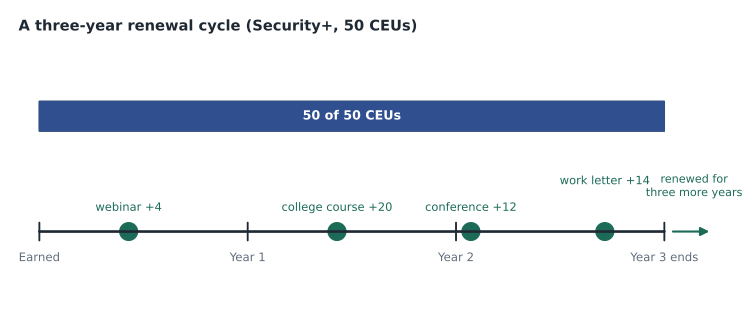
Technology changes quickly, and a certification that never expired would gradually describe skills nobody uses. CompTIA's answer is the continuing education program, usually shortened to CE. Most CompTIA certifications are valid for three years from the date you earn them. During that three-year renewal cycle, you keep the certification current by showing that you have kept learning, and at the end of the cycle it is renewed for another three years. If you do nothing, it expires, and you would need to pass the current exam again to hold it.
Not every credential works the same way. Tech+ is a foundation credential, and CompTIA's Tech+ page lists two exam codes with different validity: FC0-U71, shown with no expiration, and FC0-U71-CE, shown as valid for five years. CompTIA's CE fee information says that Tech+ has no CE fee and that renewing it means passing the latest version of the exam. Older certifications are a special case too: some certifications earned many years ago were issued as lifetime credentials, and CompTIA's account system shows which kind you hold. If you are not sure whether a certification you hold requires CE, check your CompTIA account rather than guessing.
Continuing education units
The main way to renew is to earn continuing education units, or CEUs, and upload them to your CompTIA account. Each certification needs a set number of CEUs during its three-year cycle. CompTIA's CE pages list, for example, 20 CEUs for A+, 30 for Network+, 50 for Security+, 50 for Cloud+, 50 for Linux+, 30 for Server+, 60 for CySA+, 60 for PenTest+, 75 for SecurityX, 20 for Data+ and 30 for DataSys+. Higher-level certifications need more, because they cover more ground and their holders are expected to keep up with more.
CEUs come from many kinds of activity, as long as they relate to the certification's objectives. CompTIA's CE pages describe categories including training and higher education, such as courses, conferences, webinars and college classes; work experience in a relevant role; IT industry participation, such as teaching, writing, mentoring or speaking; and earning other qualifying certifications. Each category has its own rules about how many CEUs an activity is worth and what evidence you must keep, such as a certificate of completion or a letter from an employer, so read the rules for the category before you rely on it. CompTIA may audit submissions, so keep your evidence for every activity you claim.
Other ways to renew
There are faster routes than collecting CEUs one activity at a time. Earning a higher-level CompTIA certification renews the ones below it on the same path: for example, earning Security+ while you hold A+ and Network+ can renew those as well, and earning CySA+ can renew Security+. CompTIA's CE pages say that when you hold several certifications, you pay only for your highest-level one, and lower-level certifications renew automatically, unless the higher-level certification does not fully renew the lower one. Other qualifying industry certifications, including some vendor certifications, can also count toward renewal.
CompTIA also sells CertMaster CE, an online course for each certification designed to cover the changes since you earned it. Completing it renews the certification in one step. Finally, you can pass the latest version of the exam, which renews the certification for a new cycle. Which route is best depends on what you were going to do anyway: if you were planning to study for a higher certification, that is the most efficient path; if you attend conferences and training regularly through work, CEUs may come almost for free.
| Way to renew | How it works | Best for |
|---|---|---|
| Continuing education units | Upload qualifying activities with evidence | People who train, teach or attend events regularly |
| Higher-level CompTIA certification | Earning it renews lower ones on the path | People already planning their next step |
| Other qualifying certifications | Some vendor and industry credentials count | People adding vendor skills |
| CertMaster CE | Complete CompTIA's renewal course | People who want a single, structured step |
| Pass the latest exam version | Take the current exam again | People who prefer exams, and Tech+ holders |
What renewal costs
Renewing with CEUs involves a CE fee, which CompTIA says is paid once per three-year cycle rather than every year, by the certification's expiry date. Its fee page lists 75 dollars per cycle for A+, Data+, SecAI+ and AutoOps+, and 150 dollars per cycle for many others, including Network+, Security+, Server+, Linux+, Cloud+, CySA+, PenTest+, SecurityX, DataSys+ and Project+. There is no CE fee when you renew by earning a higher-level CompTIA certification or by completing CertMaster CE, although those routes have their own costs: the exam fee or the course price. Fees can change, so check CompTIA's current fee page before planning around them.
Employers often pay renewal costs, especially when the certification is required for the job. Fairhaven pays the CE fee for any certification that appears in a staff member's job description, which covers Hana's CySA+ and Dez's Network+. Ask your employer about renewal support at the same time as you ask about exam fees.
Tracking your cycle
Most lapsed certifications lapse through forgetting rather than choice. A simple tracker prevents that. Record each certification, the date it was earned, the expiry date, the CEUs required and the CEUs uploaded so far, and set a reminder at least six months before each expiry. Dez keeps his tracker in a few lines of Python, which also calculates how many CEUs he needs per remaining month.
from datetime import date

today = date(2026, 11, 12)
certs = [
    # name, expiry date, CEUs required, CEUs uploaded
    ("Network+", date(2027, 8, 31), 30, 18),
    ("Cloud+", date(2028, 3, 31), 50, 12),
]
for name, expires, needed, done in certs:
    months_left = (expires.year - today.year) * 12 + (expires.month - today.month)
    remaining = max(needed - done, 0)
    per_month = remaining / months_left if months_left > 0 else remaining
print(f"{name}: {remaining} CEUs left, {months_left} months, about {per_month:.1f} a month")Network+: 12 CEUs left, 9 months, about 1.3 a month Cloud+: 38 CEUs left, 16 months, about 2.4 a month
What this code does
It tracks continuing-education credits for two certifications. For each one it counts the months until expiry and the credits still needed, then divides to get a monthly pace. The output shows about 1.3 credits a month for Network+ and 2.4 a month for Cloud+.
Network+ needs 12 more CEUs in about nine months, a little over one a month, which a couple of webinars and a conference will cover. Cloud+ needs 38 more in about sixteen months. But Dez is planning Security+, and if he passes it, it may renew Network+ in one step, which is worth checking in CompTIA's rules before he spends time collecting CEUs for it.
Stackable certifications
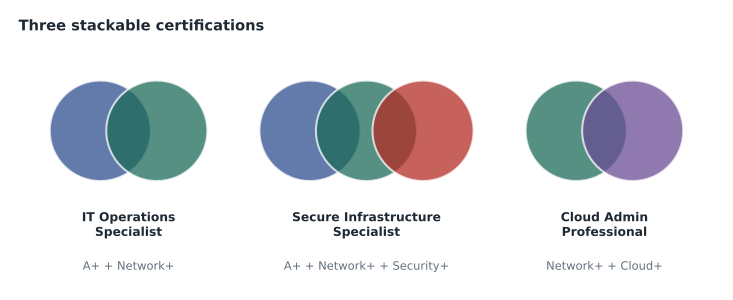
Stackable certifications, introduced in lesson 2, are awarded automatically when you hold a specific set of CompTIA certifications. CompTIA lists specialist, professional and expert stackables on two pathways. On the infrastructure pathway, A+ and Network+ earn IT Operations Specialist; A+ and Linux+ earn Systems Support Specialist; Network+ and Cloud+ earn Cloud Admin Professional; Network+ and Server+ earn Network Infrastructure Professional; and Network+ and Linux+ earn Linux Network Professional. On the cybersecurity pathway, A+, Network+ and Security+ earn Secure Infrastructure Specialist; Security+ and Cloud+ earn Secure Cloud Professional; Security+ and CySA+ earn Security Analytics Professional; and combinations with PenTest+ and SecurityX earn further professional and expert stackables.
A stackable depends on the certifications it is built on, so keeping those current keeps the stackable meaningful; CompTIA's stackables page explains how its dates are set. Stackables do not need a separate exam, and they are a useful way to show a combination of skills on a résumé or a professional networking profile. Dez discovers during the session that he already holds one he had never noticed: Network+ and Cloud+ together make him a CompTIA Cloud Admin Professional.
Uploading activities
CEUs are recorded in your CompTIA account, the same account that holds your certification record. For each activity, you enter what it was, when it happened and how many CEUs you are claiming, and you attach or keep the evidence the category requires. Some activities, such as CompTIA's own training and higher-level CompTIA certifications, are recorded automatically or with little effort; others, such as a college course or a conference, need you to upload proof. Upload activities as you complete them, not in a rush at the end of the cycle: the evidence is easier to find, and you can see your progress toward the target at any time.
Read the rules for each category before you rely on it. Activities must usually relate to the certification's objectives, must fall within the current renewal cycle, and may have limits on how many CEUs one kind of activity can provide. A course on spreadsheet formulas might count toward Data+ but not toward Security+, while a cloud security webinar might count toward both Security+ and Cloud+. When in doubt, check CompTIA's guidance for the category or ask CompTIA before you spend time on an activity you hope will count.
Renewal as part of a career plan
Renewal works best when it is built into the way you already learn. Many professionals attend training, read industry news, mentor junior colleagues and take on new kinds of work as a normal part of their jobs; much of that can count toward CE if it is recorded. Planning your next certification so that it renews the ones below it turns two goals into one. And deciding which certifications to keep is a legitimate choice: if your career has moved away from a certification's area, letting it lapse may be sensible, as long as you understand what you are giving up and whether any employer or contract requires it.
Lorna's own approach is to review all her certifications once a year, each January, with the tracker in front of her. She asks three questions about each: does my work still use it, does anyone require it, and what is the cheapest honest way to keep it? Her answers have changed over the years. She let one vendor certification lapse when the library stopped using that vendor's products, and she kept Linux+ long after she stopped administering servers daily, because she mentors the team members who do.
Worked problem
Choosing the cheapest renewal path
Hana holds Security+ and CySA+, both expiring in 2027. She attends a security conference every spring and teaches a short internal course on phishing each year. What is the most efficient way for her to keep both?
Show solution
- CySA+ is the higher-level certification, so renewing it can also renew Security+, and she pays the CE fee only for the highest-level certification.
- Her conference attendance and teaching are qualifying activities, so she can earn CEUs toward the 60 that CySA+ requires.
- She should keep evidence for each activity: conference certificates and records of the course she taught.
- If she later decides to pursue SecurityX, passing it would renew both without CE fees.
Answer: Renew CySA+ with CEUs from her conference and teaching, which renews Security+ too, paying one CE fee; consider SecurityX later as an alternative path.
Noor adds a line to her plan for after she passes Tech+ and A+: "Start a CE tracker the day I pass A+. Twenty CEUs in three years. Set a reminder six months before expiry." Lorna says that line will save her a stressful month in 2030.
Common mistakes
MistakeAssuming a certification lasts forever.
InsteadMost CompTIA certifications are valid for three years and must be renewed.
MistakeClaiming CEUs without keeping evidence.
InsteadKeep certificates and letters for every activity in case of audit.
MistakePaying CE fees for every certification you hold.
InsteadWith several certifications, you pay for the highest-level one; lower ones renew automatically when fully covered.
MistakeCollecting CEUs for a certification that a planned higher exam would renew anyway.
InsteadCheck whether your next certification will renew it.
MistakeRemembering expiry dates instead of tracking them.
InsteadKeep a tracker with reminders at least six months ahead.
Summary and key terms
- Most CompTIA certifications are valid for three years and renewed through the continuing education program.
- Each certification needs a set number of CEUs, such as 20 for A+, 30 for Network+ and 50 for Security+.
- CEUs come from training, work experience, industry participation and other certifications, with evidence kept.
- Higher-level CompTIA certifications, CertMaster CE and passing the latest exam are other ways to renew.
- CE fees are paid once per cycle, such as 75 or 150 dollars depending on the certification; none apply when renewing by a higher certification or CertMaster CE.
- Stackable certifications are earned automatically from sets of certifications that you hold.
- Continuing education (CE)
- CompTIA's program for keeping certifications current.
- CEU
- A continuing education unit, a measure of qualifying learning activity.
- Renewal cycle
- The three-year period in which a certification must be renewed.
- CertMaster CE
- CompTIA's course that renews a certification on completion.
- Stackable certification
- A credential awarded automatically for holding a set of certifications.
Practice problems
Work each problem on paper first, then reveal the answer to check.
How long is a CompTIA renewal cycle?
Show answer
Three years.
How many CEUs does Security+ need per cycle?
Show answer
50.
Name three categories of CE activity.
Show answer
Any three of: training and higher education, work experience, IT industry participation, other certifications.
What is the CE fee for A+ per cycle, according to CompTIA's fee page?
Show answer
75 dollars.
Which stackable do A+, Network+ and Security+ earn together?
Show answer
CompTIA Secure Infrastructure Specialist.
How is Tech+ renewed?
Show answer
By passing the latest version of the exam; there is no CE fee.
Lesson quiz · 5 questions
Score 60% or more to complete this lesson.
Create a free account to save your progress, take quizzes and earn a certificate.