
BIOL-350 · Lesson 3 of 12 · 33 min
Thermoregulation, torpor and hibernation
Temperature affects every physiological process. Enzyme reaction rates, membrane fluidity, the conduction velocity of nerves and the force of muscle contraction all change with temperature, typically with a Q₁₀ of 2 to 3, as we saw in lesson 2. Animals have evolved two broad solutions to this problem. Some accept that their body temperature will follow the environment and adjust their biochemistry; others generate heat internally and hold body temperature high and steady. Northern Canada and the United States, with summer highs above 30 °C and winter lows below −40 °C in many places, offer some of the most dramatic examples of both strategies, from wood frogs that freeze solid to ground squirrels that cool to below the freezing point of water.
Ectotherms and endotherms
The older terms cold-blooded and warm-blooded are misleading, since a desert lizard basking at noon may be warmer than a mammal. Physiologists instead classify animals by the source of their body heat. Ectotherms rely mainly on external heat sources, such as the sun and warm surfaces; endotherms rely mainly on heat produced by their own metabolism. A second axis describes how variable body temperature is: homeotherms keep a fairly constant body temperature, poikilotherms let it vary. Most mammals and birds are endothermic homeotherms; most fish, amphibians, reptiles and invertebrates are ectothermic poikilotherms. The interesting cases lie between, including hibernating mammals, which are endothermic but let their temperature fall for long periods, and regional endotherms such as tunas, lamnid sharks, some moths and bumblebees, which warm part of their bodies.
The heat balance
An animal's body temperature is stable when heat gained equals heat lost. Heat is produced by metabolism and exchanged with the environment by four physical routes: radiation, the exchange of infrared energy with surroundings; conduction, direct transfer to objects in contact; convection, transfer to moving air or water; and evaporation, the loss of latent heat as water evaporates from skin or respiratory surfaces. Each route can work in either direction except evaporation, which only cools. On a sunny day, radiation from the sun can deliver far more heat to a lizard than its own metabolism produces, which is why basking works.
Conductive and convective heat loss from an animal to its surroundings can be approximated by Newton's law of cooling: heat loss is proportional to the difference between body temperature and ambient temperature, multiplied by a thermal conductance C that includes the effects of surface area, insulation and air or water movement. Water conducts heat about 25 times faster than air and has a much higher heat capacity, so a fish's gills, which must exchange gases with large volumes of water, also act as efficient heat exchangers. This is the main reason almost all fish are ectotherms.
The thermoneutral zone
Plotting the resting metabolic rate of an endotherm against ambient temperature gives a characteristic curve, first analyzed by Per Scholander and colleagues in 1950 for Arctic and tropical mammals and birds. Over a range of moderate temperatures, the thermoneutral zone, metabolic rate is at its minimum, the basal rate, and the animal regulates heat loss by cheap means: changing posture, fluffing fur or feathers, and adjusting blood flow to the skin. Below the lower critical temperature, these adjustments are exhausted and the animal must raise its heat production to balance increasing heat loss; metabolic rate rises linearly as temperature falls, with a slope equal to the thermal conductance. Above the upper critical temperature, the animal must spend energy on evaporative cooling, by sweating, panting or gular fluttering, and metabolic rate rises again.
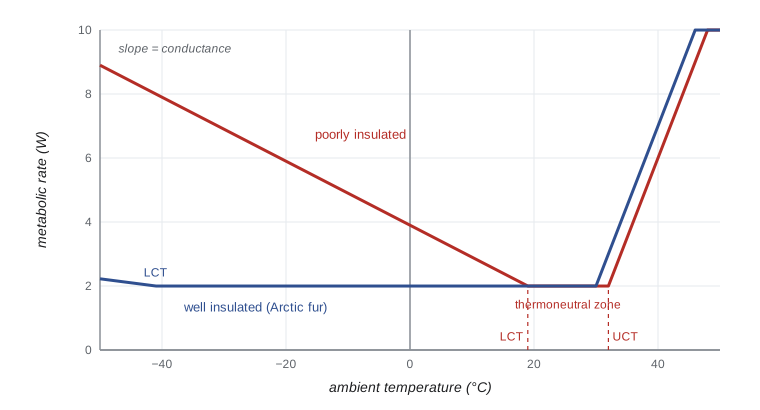
Scholander's work showed how insulation changes the curve. Arctic foxes, with thick winter fur, have a lower critical temperature around −40 °C or below, so they can rest in most Arctic winter weather without raising their metabolic rate at all. Tropical mammals, with thin coats, have lower critical temperatures of 20 to 30 °C and must raise metabolic rate steeply when it is only mildly cool. The line below the lower critical temperature, if extended, reaches zero metabolism at a temperature equal to body temperature, because at that temperature no heat would be lost. Its slope is the conductance, and an animal can reduce it by fluffing fur, curling up or huddling with others.
# Scholander model: below the lower critical temperature (LCT),
# metabolic rate M = C (Tb - Ta). Above it, M stays at BMR.
Tb = 39.0
animals = {   # name: (BMR in W, conductance in W per degC) -- illustrative values
    "weasel-sized mammal (0.1 kg)":     (0.55, 0.030),
    "arctic fox, winter fur (4 kg)":    (8.0, 0.10),
    "tropical mammal, thin coat (4 kg)": (8.0, 0.45),
}
print("animal                              LCT (degC)   M at -30 degC   x BMR")
for name, (bmr, C) in animals.items():
    lct = Tb - bmr / C
    m30 = max(bmr, C * (Tb - (-30.0)))
print(f"{name:35s} {lct:8.1f} {m30:7.2f} W {m30 / bmr:5.1f}")animal LCT (degC) M at -30 degC x BMR weasel-sized mammal (0.1 kg) 20.7 2.07 W 3.8 arctic fox, winter fur (4 kg) -41.0 8.00 W 1.0 tropical mammal, thin coat (4 kg) 21.2 31.05 W 3.9
The well-insulated fox has a lower critical temperature of about −41 °C and needs no extra heat at −30 °C. The thinly furred animal of the same size would need about four times its basal rate. The small mammal is the most revealing. Even with good fur for its size it has a lower critical temperature near 21 °C, because a small body has a large surface relative to its volume and cannot carry thick insulation without becoming unable to move. At −30 °C it would need nearly four times its basal metabolic rate just to stay warm. This is why small northern mammals such as voles, shrews and weasels spend winter in the subnivean space under the snow, where temperatures stay near 0 °C even when the air above is far colder.
Producing heat
When heat must be produced, endotherms use two main mechanisms. Shivering thermogenesis uses rapid, unsynchronized contractions of skeletal muscle that produce heat rather than movement; it can raise metabolic rate four- to fivefold. Non-shivering thermogenesis occurs mainly in brown adipose tissue in mammals. Brown fat cells contain many mitochondria with uncoupling protein 1 (UCP1), which lets protons leak back across the inner mitochondrial membrane without making ATP, so the energy of the proton gradient is released as heat. Brown fat is abundant in newborn mammals, in small mammals acclimated to cold and in hibernators, where it rewarms the body at arousal. Adult humans retain small depots of brown fat, mostly around the neck and collarbones, that can be activated by cold exposure.
Birds lack brown fat and UCP1 but produce heat by shivering and possibly by mechanisms in muscle involving calcium cycling. Black-capped chickadees, which weigh only about 11 g, survive northern winters by shivering almost constantly through long nights, allowing their body temperature to fall several degrees in regulated nocturnal hypothermia to save energy, and eating fat-rich seeds and insects by day. Chickadees store thousands of seeds in autumn and remember where they hid them, and the hippocampus of chickadees from harsher northern climates is larger than that of southern populations.
Conserving heat
Insulation by fur, feathers and fat is the first line of defense against cold. Many northern mammals and birds grow a thicker coat in winter. Marine mammals rely mainly on blubber, since fur loses its insulating air layer when compressed under water; sea otters, which lack blubber, have the densest fur of any mammal and must groom constantly to keep air trapped in it. Body shape also matters. Bergmann's rule describes the tendency for endotherms in colder climates to be larger, which reduces their surface-to-volume ratio; Allen's rule describes the tendency for cold-climate animals to have shorter extremities. The ears of the Arctic hare are short; those of the black-tailed jackrabbit of the hot southwestern deserts are long and serve as radiators. Both rules have exceptions, and their mechanisms are debated, but they are widely supported within many groups.
Countercurrent heat exchange is one of the most elegant solutions in physiology. In the legs of wading birds, the flippers of whales and seals and the feet of Arctic foxes, arteries carrying warm blood outward run closely alongside veins returning cold blood from the extremity. Heat passes from artery to vein along the whole length of contact, so arterial blood is already cool when it reaches the foot, and venous blood is rewarmed before it reaches the body core. The extremity runs cold, and little heat is lost. A gull standing on ice may have foot temperatures near 0 °C while its core stays near 40 °C. The same principle, used in reverse, lets tunas and lamnid sharks keep their swimming muscles warm, and it appears again in gills and kidneys in lessons 9 and 11.
Cooling
Evaporation is the only way an animal can lose heat when the environment is hotter than its body. Evaporating a gram of water removes about 2.4 kJ of heat. Humans and horses sweat; dogs, many birds and small mammals pant, moving air over moist respiratory surfaces; birds also flutter the throat, a behavior called gular fluttering; kangaroos and some rodents spread saliva on their fur. Panting at the resonant frequency of the respiratory system reduces the work of breathing, and many panting animals avoid respiratory alkalosis by moving air mainly through dead space. Evaporative cooling costs water, a serious problem for desert animals. Camels and some antelopes reduce it by allowing their body temperature to rise during the day, storing heat, and losing it by conduction and radiation during the cool night. A dehydrated camel's body temperature may vary by 6 °C or more between night and day.
Living with body temperature that varies
Ectotherms regulate body temperature too, mostly through behavior. A garter snake emerging from its den in spring basks in the sun until it reaches its preferred temperature of around 28 to 32 °C, then shuttles between sun and shade to stay there. Desert lizards orient their bodies perpendicular to the sun's rays early in the day and parallel to them at noon. Large ectotherms such as leatherback turtles, which feed in waters near Nova Scotia and Newfoundland in summer, keep their core temperature well above that of the cold sea through their large size, insulating fat and countercurrent exchangers in their flippers, a pattern sometimes called gigantothermy.
Ectotherms also adjust their physiology to temperature over days to weeks. In thermal acclimation, the enzymes, membranes and mitochondria of fish and other ectotherms change composition so that performance at the new temperature partly recovers. Cold-acclimated fish have more mitochondria in their muscles and more unsaturated fatty acids in their membranes, which keeps the membranes fluid in the cold, a process called homeoviscous adaptation. Over evolutionary time, enzymes of Antarctic fish have become more flexible and work well at −1.9 °C, the temperature of the Southern Ocean, but they are easily denatured at temperatures most fish would consider mild.
Surviving freezing
Ice formation in tissues is lethal to most cells: ice crystals rupture membranes, and as water freezes, solutes are concentrated in the remaining liquid, shrinking cells by osmosis. Animals in cold environments either avoid freezing or tolerate it. Freeze-avoiding animals lower the freezing point of their body fluids or prevent ice from growing. Antifreeze proteins, found in polar fish, overwintering insects and some plants, bind to small ice crystals and stop them from growing. They evolved independently several times: the antifreeze glycoproteins of Antarctic notothenioid fish and those of Arctic cod are almost identical but arose from different genes, a striking case of convergent evolution. Winter flounder off the coast of Newfoundland and New England produce antifreeze proteins in winter under seasonal hormonal control. Some insects supercool, keeping their body fluids liquid well below the melting point by removing ice-nucleating agents and accumulating glycerol.
A few animals survive the freezing of much of their body water. The wood frog, Lithobates sylvaticus, ranges north beyond the Arctic Circle in Alaska and the Yukon and overwinters in leaf litter, where it can freeze solid. As ice begins to form on its skin, the frog's liver converts glycogen to glucose, which floods the blood and cells to concentrations far above normal and acts as a cryoprotectant. Ice forms only outside cells, in the body cavity and under the skin; heartbeat and breathing stop. Up to about two thirds of the frog's body water may freeze. When it thaws, the heart restarts and the frog resumes normal life within hours. Alaskan wood frogs, which experience colder and longer winters, tolerate lower temperatures and longer freezing than those from southern Ontario or Ohio, partly because they accumulate urea as well as glucose.
Torpor and hibernation
For small endotherms, maintaining a high body temperature through a northern winter, when food is scarce, would be extremely costly. Many escape the cost by abandoning endothermy temporarily. In daily torpor, used by hummingbirds, some bats, deer mice and many small marsupials, body temperature and metabolic rate fall for part of each day, usually at night or during the inactive period, and the animal rewarms each day. In hibernation, or multi-day torpor, bouts of deep torpor lasting days to weeks are separated by brief periodic arousals. Hibernators include ground squirrels, marmots including the woodchuck, chipmunks, jumping mice and many bats. Torpor is a regulated state: the set point for body temperature is lowered, not abandoned, and a torpid animal will increase heat production if body temperature falls below its new set point.
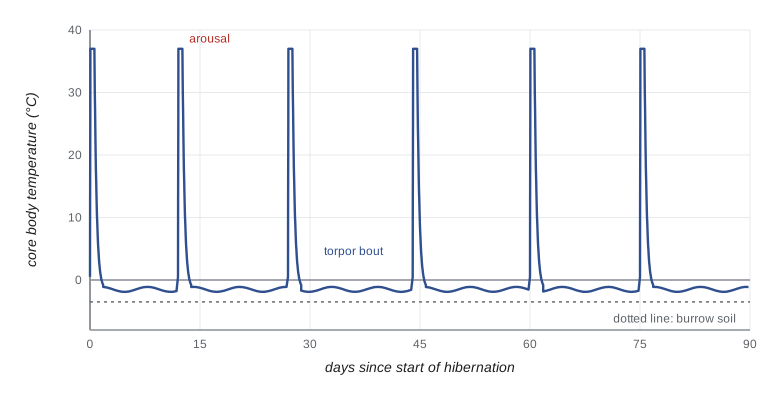
The arctic ground squirrel, Urocitellus parryii, holds the record among mammals. Brian Barnes reported in 1989 that ground squirrels hibernating in Alaska let their core temperature fall to about −2.9 °C without freezing, by supercooling their body fluids. During torpor metabolic rate falls to as little as 1 to 2 percent of the basal rate; heart rate falls from around 300 beats per minute to a handful. Every one to three weeks the squirrel rewarms itself to near 37 °C for less than a day, using brown fat and shivering, before re-entering torpor. Most of the energy used during hibernation is spent on these arousals, and why they occur is still not fully understood; hypotheses include the need to restore immune function, clear metabolic wastes or allow sleep.
Black bears and grizzly bears hibernate differently. Their body temperature falls only a few degrees, to around 30 to 35 °C, yet their metabolic rate falls to about a quarter of the basal rate. Øivind Tøien and colleagues showed in 2011 that bears in Alaska suppressed their metabolism far more than the small fall in temperature would predict from Q₁₀ alone, so active metabolic suppression must be involved. Bears do not eat, drink, urinate or defecate for up to five to seven months; they recycle urea nitrogen into protein, lose little muscle or bone, and females give birth and nurse cubs during this time. These abilities interest medical researchers studying muscle wasting, osteoporosis and kidney disease.
import math

# Energy saved by torpor in a 25 g deer mouse during a 12 h night at Ta = 5 degC.
# Heat loss follows Newton's law; metabolism adjusts to hold body temperature.
C = 0.012           # thermal conductance, W per degC (illustrative)
Ta, Tb_normal = 5.0, 37.0
BMR = 0.21          # W, basal rate for 25 g (illustrative)

def night_energy(Tb_torpor, hours_torpor, q10=2.5):
    normal = max(BMR, C * (Tb_normal - Ta)) * (12 - hours_torpor) * 3600
    # in torpor, metabolism is the larger of heat loss and a Q10-depressed BMR
    depressed = BMR * q10 ** ((Tb_torpor - Tb_normal) / 10)
    torpor = max(depressed, C * (Tb_torpor - Ta)) * hours_torpor * 3600
    # rewarming: heat to raise 25 g of tissue (3.5 J per g per degC), assuming
    # 70% of the heat produced stays in the body during rewarming
    arousal = 0.0 if hours_torpor == 0 else 25 * 3.5 * (Tb_normal - Tb_torpor) / 0.7
    return normal + torpor + arousal   # joules

base = night_energy(37.0, 0)
for tb in (25.0, 15.0, 10.0):
    e = night_energy(tb, 10)
    print(f"torpor at {tb:4.1f} degC for 10 h: {e/1000:5.1f} kJ  (saving {100*(1-e/base):4.1f} %)")
print(f"normothermic all night: {base/1000:5.1f} kJ")torpor at 25.0 degC for 10 h: 12.9 kJ (saving 22.2 %) torpor at 15.0 degC for 10 h: 9.8 kJ (saving 40.7 %) torpor at 10.0 degC for 10 h: 8.3 kJ (saving 50.0 %) normothermic all night: 16.6 kJ
Even in this crude model, ten hours of torpor with body temperature falling to 10 °C roughly halves the night's energy budget, after paying the cost of rewarming, while a shallow torpor at 25 °C saves only about a fifth. Real deer mice in the laboratory use torpor when food is restricted and nights are cold, and savings of this order have been measured. The model also shows why torpor at very low body temperatures is mainly a strategy of small animals: a small body cools and rewarms quickly, whereas a bear would need many hours and a large amount of fuel to rewarm from near freezing.
Worked problem
How much fat does a hibernating ground squirrel need?
A 700 g ground squirrel hibernates for 210 days. Suppose its average metabolic rate during torpor is 2 percent of a BMR of 2.3 W, and that 16 arousals each cost the equivalent of 12 hours at three times BMR. Fat yields 39 kJ per gram. How much fat must it store?
Show solution
- Torpor: 0.02 × 2.3 W = 0.046 W for about 202 days (210 days minus 8 days spent in arousals) = 0.046 × 202 × 86,400 ≈ 803 kJ.
- Arousals: 16 × 12 h × 3 × 2.3 W = 16 × 43,200 s × 6.9 W ≈ 4,769 kJ.
- Total ≈ 5,570 kJ, of which about 86 percent is spent on arousals.
- Fat needed ≈ 5,570 / 39 ≈ 143 g, about 20 percent of body mass.
Answer: About 140 g of fat. The estimate is rough, but the point is robust: arousals, not torpor itself, dominate the energy cost of hibernation, and ground squirrels typically fatten by a third or more before winter.
Common mistakes
MistakeEquating ectotherm with cold-blooded.
InsteadEctotherms gain heat mainly from outside, but many maintain high body temperatures by behavior; a basking lizard can be warmer than a mammal.
MistakeSaying an animal in torpor has stopped regulating its temperature.
InsteadTorpor lowers the set point; torpid animals still defend a minimum body temperature.
MistakeAssuming the wood frog freezes inside its cells.
InsteadIce forms only in extracellular spaces; cells are protected by glucose and urea and shrink without freezing.
MistakeThinking larger fur always solves cold for small mammals.
InsteadSmall animals cannot carry thick enough insulation; they rely on shelter, huddling, torpor and high heat production.
MistakeTreating bear hibernation as identical to ground squirrel hibernation.
InsteadBears show modest cooling with strong metabolic suppression; ground squirrels cool to near or below 0 °C.
MistakeDescribing countercurrent exchange as heat being destroyed.
InsteadHeat is transferred from outgoing arterial to returning venous blood and retained in the core.
Summary and key terms
- Ectotherms rely mainly on external heat, endotherms on metabolic heat; homeotherm and poikilotherm describe how variable body temperature is.
- Body temperature is stable when metabolic heat plus heat gained equals heat lost by radiation, conduction, convection and evaporation.
- Below the lower critical temperature, metabolic rate rises in proportion to the gradient between body and air; insulation lowers the slope.
- Heat is produced by shivering and by UCP1-mediated non-shivering thermogenesis in brown fat; it is conserved by insulation, body shape and countercurrent exchange.
- Evaporation is the only route of heat loss when air is hotter than the body, and it costs water.
- Freeze avoidance uses antifreeze proteins and supercooling; freeze tolerance, as in the wood frog, uses cryoprotectants and extracellular ice.
- Daily torpor and hibernation lower the set point and save energy; arousals dominate the cost of hibernation.
- ectotherm
- An animal whose body heat comes mainly from external sources.
- endotherm
- An animal whose body heat comes mainly from its own metabolism.
- thermal conductance
- The rate of heat loss per degree of difference between body and ambient temperature.
- thermoneutral zone
- The range of ambient temperatures over which an endotherm's metabolic rate is at its minimum.
- lower critical temperature
- The ambient temperature below which an endotherm must raise heat production.
- brown adipose tissue
- Fat tissue rich in mitochondria with UCP1, specialized for non-shivering heat production.
- countercurrent heat exchange
- Heat transfer between adjacent vessels carrying blood in opposite directions, reducing heat loss.
- homeoviscous adaptation
- Adjustment of membrane lipid composition to keep membrane fluidity constant at different temperatures.
- antifreeze protein
- A protein that binds ice crystals and prevents their growth, lowering the freezing point of body fluids.
- freeze tolerance
- The ability to survive ice formation in the body, usually only in extracellular spaces.
- torpor
- A regulated reduction in body temperature and metabolic rate.
- hibernation
- Seasonal multi-day torpor interrupted by periodic arousals.
Practice problems
Work each problem on paper first, then reveal the answer to check.
Name the four routes of heat exchange and say which can only remove heat.
Show answer
Radiation, conduction, convection and evaporation; evaporation only removes heat.
An endotherm has a BMR of 6 W, body temperature 38 °C and conductance 0.2 W per °C. What is its lower critical temperature?
Show answer
38 − 6/0.2 = 8 °C.
Why are almost all fish ectotherms?
Show answer
Water conducts heat away rapidly and gills, which must contact large volumes of water, act as heat exchangers.
How does UCP1 produce heat?
Show answer
It lets protons leak across the inner mitochondrial membrane, so the energy of the gradient is released as heat rather than used to make ATP.
Explain how countercurrent exchange keeps a gull's core warm while it stands on ice.
Show answer
Warm arterial blood passing to the foot gives up heat to cold venous blood returning, so little heat reaches the foot and the returning blood is rewarmed.
What do Bergmann's and Allen's rules state?
Show answer
Endotherms in colder climates tend to be larger (Bergmann) and to have shorter extremities (Allen).
How does the wood frog protect its cells during freezing?
Show answer
Its liver releases large amounts of glucose (and urea), which act as cryoprotectants; ice forms only outside cells.
Why do hibernating ground squirrels spend most of their winter energy on arousals?
Show answer
Rewarming from near 0 °C to 37 °C and staying warm for hours costs far more than the very low metabolism of torpor.
What evidence shows that bears actively suppress metabolism in hibernation?
Show answer
Metabolic rate falls to about 25 percent of BMR with only a few degrees of cooling, far more than Q₁₀ effects alone predict.
How does a camel reduce water loss in the heat?
Show answer
It lets body temperature rise by day, storing heat, and loses it at night, reducing the need for evaporative cooling.
Lesson quiz · 5 questions
Score 60% or more to complete this lesson.
Create a free account to save your progress, take quizzes and earn a certificate.