
BIOL-350 · Lesson 1 of 12 · 32 min
Homeostasis and control systems
An animal is an open system. Energy and matter flow through it all the time: food and oxygen come in, heat, carbon dioxide and wastes go out. The world outside changes from hour to hour and season to season. A trout in a mountain stream meets water that swings between near freezing and 20 °C. A snowshoe hare in a northern winter loses heat to air at −30 °C. A kangaroo rat in the desert may go its whole life without drinking. Yet in each of these animals, many internal variables stay remarkably steady. Animal physiology is largely the study of how they manage it, and of the price they pay for doing so.
This course is a comparative and environmental physiology course. BIOL-214 described how individual cells move ions across membranes, generate a membrane potential and use actin and myosin to move. BIOL-108 surveyed the diversity of animals, and BIOL-208 looked at how organisms fit into their physical environment. Here we ask how whole animals, from insects and squid to fish, birds and mammals, regulate their internal environment, move, sense the world and cope with extreme conditions. Human examples appear where they help, but the human body is only one solution among many, and clinical detail is left to the health sciences courses such as MED-111 to MED-113. Each lesson pairs the biology with the quantitative tools physiologists use, from scaling equations and the Nernst equation to models of oxygen binding and countercurrent exchange.
The internal environment
In the 1850s and 1860s the French physiologist Claude Bernard argued that the cells of a complex animal do not live in the outside world at all. They live in the fluid that bathes them, the milieu intérieur, and the stability of that fluid is the condition for a free and independent life. In the 1920s the American physiologist Walter Cannon gave the idea a name, homeostasis, and described the coordinated mechanisms that keep body temperature, blood glucose, blood pressure and the composition of body fluids within narrow limits. Cannon chose homeo, meaning similar, rather than homo, meaning same, on purpose: regulated variables are not fixed, they fluctuate within a range.
In most animals the body water is divided into compartments. Intracellular fluid, inside cells, makes up roughly two thirds of body water in a mammal. Extracellular fluid makes up the rest and is further divided into interstitial fluid, which bathes the cells, and plasma, the fluid part of blood. Each compartment has a characteristic composition. Intracellular fluid is rich in potassium and organic anions; extracellular fluid is rich in sodium and chloride. These differences are not accidents. They are maintained by ion pumps at a large energetic cost, and they underlie electrical signaling, the regulation of cell volume and the movement of water, topics that recur throughout the course.
| Compartment | Share of body water (mammal) | Main cation | Main anions | Controlled by |
|---|---|---|---|---|
| Intracellular fluid | About two thirds | K⁺ (about 140 mM) | Proteins, organic phosphates | Na⁺/K⁺-ATPase and channels in each cell membrane |
| Interstitial fluid | About one quarter | Na⁺ (about 145 mM) | Cl⁻, HCO₃⁻ | Capillary exchange (Starling forces) |
| Plasma | About one twelfth | Na⁺ (about 145 mM) | Cl⁻, HCO₃⁻, plasma proteins | Kidneys, gut, gills or skin |
Regulators and conformers
Animals differ greatly in how much they regulate. A regulator holds an internal variable steady despite changes in the environment; a conformer lets the internal variable follow the environment. Most marine invertebrates are osmoconformers: the osmotic concentration of their body fluids matches that of sea water. A blue mussel moved into brackish water lets its blood become more dilute. A shore crab, by contrast, keeps its blood more concentrated than dilute sea water, using active ion uptake across its gills. Temperature shows the same contrast. A bass in a lake has a body temperature within a degree or so of the water around it; a beaver swimming in the same lake keeps its core near 37 °C.
Regulation and conformity are properties of a particular variable, not of a whole animal. A goldfish conforms in body temperature but regulates its blood osmolarity. A desert lizard conforms in body temperature overnight but regulates it by basking and shade-seeking during the day. Neither strategy is better in general. Regulation buys independence from the environment at an energetic cost; conformity is cheap but means the animal's cells must tolerate a wider range of conditions. Many conformers have enzymes and membranes that work over a broad range of temperatures or ionic strengths, a theme we return to in lessons 3 and 12.
The anatomy of a control system
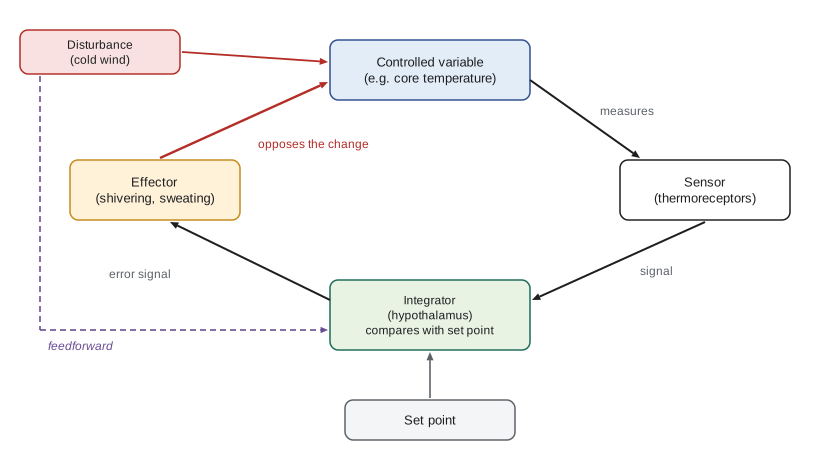
Engineers and physiologists describe regulation with the same vocabulary. A controlled variable, such as core temperature or blood pressure, is measured by sensors, also called receptors. The sensors send information to an integrating center, which compares the measured value with a reference value, the set point, and computes an error signal. The integrating center then drives effectors, such as muscles, glands or ion pumps, which change the controlled variable. In a home heating system the thermometer in the thermostat is the sensor, the thermostat is the integrating center and the furnace is the effector. In a mammal, warm-sensitive and cold-sensitive neurons in the skin and in the preoptic area of the hypothalamus are the sensors, the hypothalamus is the integrating center, and shivering muscles, brown fat, skin blood vessels and sweat glands are the effectors.
In negative feedback, the response opposes the disturbance. If core temperature rises above the set point, the error signal drives effectors that lower it; if temperature falls, effectors raise it. Negative feedback is the core mechanism of homeostasis because it is self-correcting. It is not perfect. A purely proportional controller, whose effort is proportional to the size of the error, leaves a residual offset when a disturbance is sustained, because some error is needed to keep the effector running. Physiological controllers often combine proportional action with other components, such as integral action that accumulates error over time and removes the offset, or rate-sensitive action that responds to how fast a variable is changing.
Two properties describe how good a controller is. Gain is the ratio of the correction achieved to the error that remains. If an outside disturbance would shift a variable by 10 units in the absence of control, and with control the variable shifts by only 1 unit, the controller has corrected 9 units and left 1, so its gain is 9. The higher the gain, the smaller the residual error. Response time describes how quickly the correction happens. High gain and fast response can conflict: a controller that reacts strongly to a signal that arrives late tends to overshoot, and the variable oscillates. Delays are common in physiology, because signals take time to travel and effectors such as blood vessels and hormones take time to act.
The simulation below compares an uncontrolled body, a proportional controller and a proportional-integral controller. The model is deliberately simple: a variable x relaxes toward the value set by the environment, a disturbance appears at time 20, and the controller adds a correction. It is a teaching model, not a model of any particular animal, but it shows the main features of feedback control.
# A teaching model of feedback control (arbitrary units)
# dx/dt = -(x - env)/tau + u ; disturbance raises env by 10 units at t = 20
set_point, tau, dt = 0.0, 5.0, 0.01

def simulate(kp, ki):
    x, integral, t, trace = 0.0, 0.0, 0.0, {}
    while t <= 80.0001:
        env = 10.0 if t >= 20 else 0.0
        error = set_point - x
        integral += error * dt
        u = kp * error + ki * integral
        x += (-(x - env) / tau + u) * dt
        for mark in (19, 30, 50, 80):
            if abs(t - mark) < dt / 2:
                trace[mark] = x
        t += dt
    return trace

for name, kp, ki in (("no control", 0.0, 0.0),
                     ("proportional, kp = 1.8", 1.8, 0.0),
                     ("prop. + integral", 1.8, 0.3)):
    tr = simulate(kp, ki)
    print(f"{name:24s}" + "".join(f"  t={m:>2}: {tr[m]:5.2f}" for m in (19, 30, 50, 80)))

gain = (10.0 - simulate(1.8, 0.0)[80]) / simulate(1.8, 0.0)[80]
print(f"gain of the proportional controller: {gain:.1f}")no control t=19: 0.00 t=30: 8.65 t=50: 9.98 t=80: 10.00 proportional, kp = 1.8 t=19: 0.00 t=30: 1.00 t=50: 1.00 t=80: 1.00 prop. + integral t=19: 0.00 t=30: 0.23 t=50: 0.01 t=80: 0.00 gain of the proportional controller: 9.0
Without control, the variable climbs to the full 10 units imposed by the disturbance. The proportional controller holds it near 1 unit: it removes about 90 percent of the disturbance, which corresponds to a gain of 9, but a residual error remains as long as the disturbance lasts. Adding integral action drives the residual error back toward zero within a few tens of time units, because the accumulated error keeps raising the correction until none remains. Integral action is not free: if the gains are set too high, the integrated error makes the variable overshoot and oscillate. Human thermoregulation behaves in some ways like a high-gain proportional controller: when people exercise in the heat, core temperature rises a little and then stabilizes at a new, slightly higher level, which is exactly what a proportional controller predicts.
Feedforward and anticipation
Feedback can act only after a variable has already changed. Many physiological systems also use feedforward control, in which a disturbance is detected, or predicted, before it alters the controlled variable. Cold receptors in the skin trigger shivering and vasoconstriction before core temperature falls. Heart rate and ventilation rise at the start of exercise, within seconds, before blood oxygen or carbon dioxide levels have changed, because the brain's motor commands send parallel signals to cardiovascular and respiratory centers. The sight and smell of food trigger insulin release and gastric secretion, the cephalic phase of digestion, before any nutrients are absorbed. Feedforward control reduces the error a feedback loop must correct, but it relies on prediction, and it can be wrong.
Positive feedback
In positive feedback, a change in a variable triggers responses that amplify the change. Positive feedback is not homeostatic, but it is useful when a process must run quickly to completion. The rising phase of the action potential is a positive feedback loop: depolarization opens voltage-gated sodium channels, sodium entry depolarizes the membrane further, and more channels open, as we will see in lesson 4. Blood clotting, the surge of luteinizing hormone before ovulation and the uterine contractions of birth in mammals, driven by oxytocin release that further stimulates contractions, are other examples. Each positive feedback loop must be ended by something outside the loop: sodium channel inactivation, the depletion of a substrate or the delivery of the young.
Set points that move
The set point of a control system is not always fixed. Body temperature in mammals follows a daily rhythm, a degree or so lower during sleep in humans, and much lower in animals that use daily torpor. During fever, pyrogens such as prostaglandin E₂ act on the hypothalamus to raise the thermoregulatory set point. The fevered animal shivers and seeks warmth at a normal body temperature, because by the standard of its new set point it is too cold. Fever is not confined to mammals. Desert iguanas, goldfish and even crayfish infected with bacteria choose warmer places in a thermal gradient, a behavioral fever, and in several experiments infected lizards prevented from doing so were more likely to die. The ability to raise the set point appears to be ancient and adaptive.
Seasonal changes in set points are common in northern animals. Many mammals and birds shift their body mass, fat stores, metabolic rate and the timing of reproduction with the season, under the control of photoperiod and hormones such as melatonin and thyroid hormones (lesson 7). Hibernating ground squirrels regulate their body temperature even during torpor, but at a set point only a few degrees above freezing (lesson 3).
Allostasis and the cost of regulation
The concept of allostasis, introduced by Peter Sterling and Joseph Eyer in 1988 and developed by Bruce McEwen, emphasizes that regulation often involves predictive, coordinated changes across many systems rather than the defense of single fixed values. Blood pressure rises when a person stands up, before any fall is sensed; glucocorticoid levels rise in anticipation of waking. Allostasis makes the cost of regulation explicit. Repeated or chronic activation of stress systems, called allostatic load, can damage tissues over time. Whether allostasis is a genuinely new idea or a useful extension of homeostasis that includes feedforward control and moving set points is debated among physiologists, but the emphasis on prediction and cost is valuable.
Every regulated variable has an energetic price. The sodium pump alone accounts for perhaps 20 to 40 percent of the resting metabolic rate of a mammal, much of it in the brain and kidneys. Keeping a body warm in the cold costs food. Keeping blood dilute in sea water costs ion transport. Animals therefore face trade-offs: an animal that regulates tightly can be active across a wide range of conditions but must find more food. Comparative physiology is in large part the study of how different animals have struck these trade-offs.
Levels of explanation and the comparative method
Physiologists ask two kinds of question. Proximate questions ask how a mechanism works: which channels, which hormones, which neural circuits. Ultimate questions ask why the mechanism exists: what selective pressures shaped it and what it does for the animal's survival and reproduction. A complete answer usually needs both. Why do emperor penguins huddle? Proximately, huddling reduces the surface exposed to wind and cold; ultimately, males fasting through the Antarctic winter while incubating an egg would otherwise exhaust their fat reserves.
In 1929 the Danish physiologist August Krogh wrote that for many problems there will be some animal of choice, on which it can be most conveniently studied. The Krogh principle has guided comparative physiology ever since: the squid giant axon for the action potential, frog muscle for excitation–contraction coupling, the toad bladder for epithelial transport, the electric ray for the acetylcholine receptor. Comparative physiologists also use the comparative method itself, looking for patterns across species, such as the scaling of metabolic rate with body mass (lesson 2), or convergent solutions to the same problem, such as antifreeze proteins in polar fish (lesson 3). Because related species share traits by descent, modern comparative analyses use phylogenetically informed statistics, as described in BIOL-321.
Worked problem
Diagnosing a control system from data
An experimenter warms a resting rabbit with a heat lamp. Without any thermoregulatory response, the lamp would raise core temperature by an estimated 2.0 °C. In the experiment, core temperature rises by 0.25 °C and then stabilizes while ear blood flow increases tenfold. What is the gain of the thermoregulatory system, and what does the stable but raised temperature tell you about the kind of controller involved?
Show solution
- The disturbance alone would have produced an open-loop change of 2.0 °C.
- With regulation the closed-loop change is 0.25 °C, so the correction is 2.0 − 0.25 = 1.75 °C.
- Gain = correction / remaining error = 1.75 / 0.25 = 7.
- A sustained, stable error of 0.25 °C during a sustained disturbance is what a proportional controller produces: the effector (ear vasodilation) needs a continuing error signal to keep running.
- The rabbit uses its large ears as heat exchangers, so the effector here is cutaneous vasodilation, a cheap response compared with panting.
Answer: The gain is 7. The small, persistent rise in temperature during the disturbance is the signature of proportional control; an integral component would eventually return temperature to the original value.
Reading physiological data
Physiological data come with built-in variability. Individuals differ in size, age, sex, acclimation history and time of day. Most physiological rates scale with body mass (lesson 2) and depend on temperature (lesson 3), so a fair comparison between two species, or two treatments, has to account for both. Acclimation, the reversible change in physiology that follows prolonged exposure to a new condition in the laboratory, and acclimatization, the equivalent change in the wild, can shift tolerances substantially: a goldfish kept at 30 °C tolerates temperatures several degrees higher than one kept at 10 °C. Adaptation, by contrast, refers to genetic change over generations. Distinguishing the three requires careful experimental design, typically by raising animals from different populations under common conditions, a common-garden experiment.
Throughout the course, invented or approximate data sets are labeled as such. The equations are standard, and the code examples are designed to show how a physiologist reasons rather than to reproduce particular published results. Where a number comes from a published study, the study is identified and the value is given as approximate.
Common mistakes
MistakeTreating homeostasis as the holding of variables at exactly fixed values.
InsteadRegulated variables fluctuate within a range around a set point, and set points themselves can change with time of day, season or infection.
MistakeCalling an animal a regulator or a conformer as a whole.
InsteadRegulation is a property of a particular variable; a goldfish conforms in body temperature but regulates its blood osmolarity.
MistakeAssuming that negative feedback eliminates error completely.
InsteadA proportional controller leaves a residual error during a sustained disturbance; its size depends on the gain.
MistakeDescribing fever as a failure of thermoregulation.
InsteadIn fever the set point is raised and the animal actively regulates around the new value; behavioral fever occurs even in ectotherms.
MistakeUsing positive feedback as a synonym for a beneficial response.
InsteadPositive feedback amplifies a change; it is useful for all-or-none events but must be terminated by something outside the loop.
MistakeConfusing acclimation with adaptation.
InsteadAcclimation is a reversible change within an individual's lifetime; adaptation is genetic change across generations.
Summary and key terms
- Cells of complex animals live in an internal environment of extracellular fluid whose composition, temperature and volume are regulated.
- Regulators hold internal variables steady; conformers let them follow the environment. Regulation costs energy but buys independence.
- A control system has sensors, an integrating center with a set point, and effectors; negative feedback opposes disturbances.
- Gain measures how much of a disturbance is corrected; proportional controllers leave a residual error that integral action can remove.
- Feedforward control anticipates disturbances; positive feedback amplifies changes for events that must run to completion.
- Set points move with daily and seasonal rhythms and during fever; allostasis stresses prediction and the cost of regulation.
- Comparative physiology combines proximate and ultimate explanations and uses the Krogh principle to choose suitable study animals.
- homeostasis
- The maintenance of internal variables within a range compatible with life, despite external change.
- milieu intérieur
- Claude Bernard's term for the internal fluid environment that bathes the cells.
- regulator
- An animal that keeps a particular internal variable steady despite environmental change.
- conformer
- An animal whose internal variable follows that of the environment.
- set point
- The reference value around which a controlled variable is regulated.
- negative feedback
- A control arrangement in which the response opposes the initial change.
- positive feedback
- A control arrangement in which the response amplifies the initial change.
- feedforward control
- Control that responds to a disturbance before it changes the controlled variable.
- gain
- The ratio of the correction achieved by a control system to the error that remains.
- allostasis
- Achieving stability through anticipatory change in many systems, with an associated cost called allostatic load.
- acclimation
- A reversible physiological change in response to a single altered condition in the laboratory.
- Krogh principle
- The idea that for many problems there is an animal on which the problem can be most conveniently studied.
Practice problems
Work each problem on paper first, then reveal the answer to check.
Name the three main fluid compartments of a mammal and the dominant cation in intracellular and extracellular fluid.
Show answer
Intracellular fluid (K⁺), interstitial fluid and plasma (both Na⁺).
Without regulation a disturbance would change blood pressure by 30 mmHg; with regulation it changes by 5 mmHg. What is the gain?
Show answer
Correction 25, remaining error 5, so the gain is 25/5 = 5.
Why does a proportional controller leave a residual error during a sustained disturbance?
Show answer
Its effector output is proportional to the error, so some error must persist to keep the effector working against the disturbance.
Give one example of feedforward control in exercise.
Show answer
Heart rate and ventilation rise at the start of exercise through central command, before blood gases change.
Give two examples of positive feedback and say what terminates each.
Show answer
The rising phase of the action potential (terminated by sodium channel inactivation) and oxytocin-driven contractions in birth (terminated by delivery).
What is behavioral fever, and in which animals has it been shown?
Show answer
Selection of warmer temperatures during infection; shown in lizards, fish and crayfish, among others.
Is a mussel an osmoregulator or an osmoconformer, and what does that imply for its cells?
Show answer
An osmoconformer; its cells must tolerate changes in extracellular osmolarity, regulating their own volume.
Distinguish acclimation, acclimatization and adaptation.
Show answer
Acclimation: reversible change to one factor in the lab; acclimatization: reversible change to natural conditions; adaptation: genetic change over generations.
State the Krogh principle and give an example.
Show answer
For many problems there is an animal of choice on which they are best studied; for example, the squid giant axon for the action potential.
Why might an animal accept the cost of tight regulation?
Show answer
Regulation lets it remain active and its cells function optimally across a wider range of external conditions.
Lesson quiz · 5 questions
Score 60% or more to complete this lesson.
Create a free account to save your progress, take quizzes and earn a certificate.